
So, you're ready to jump in and start your own SEO business. Smart move. But before you get lost in the weeds of keyword research and backlink strategies, let's get the foundation right. Getting this part wrong is a classic rookie mistake.
Too many aspiring agency owners obsess over the technical side of SEO but completely ignore the business fundamentals. The result? They end up as overworked freelancers, not CEOs. The real key to scaling is building a solid operational framework from the very beginning.
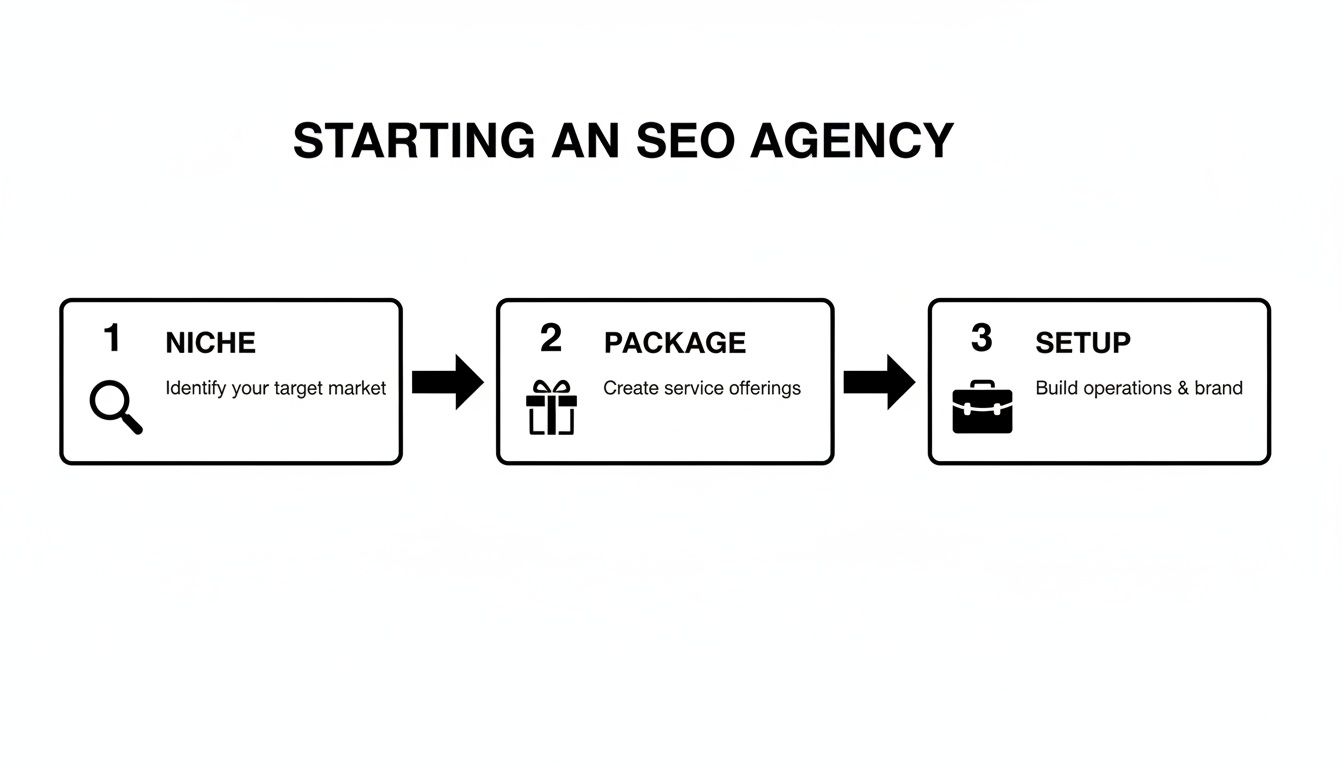
This simple roadmap—Niche, Package, Setup—is your guide. It keeps things from getting overwhelming and makes sure you nail the business side of things before you even think about chasing down your first client.
Find Your Niche (And Stick to It)
Your first big move is to stop being a generalist. Seriously. Offering "SEO services" to anyone with a website is a race to the bottom. Instead, you need to become a specialist. Pick a specific market and own it. This could be B2B SaaS, local plumbers, or Shopify e-commerce stores.
Why? Because specializing lets you build deep expertise, create repeatable processes, and—most importantly—charge what you're worth. When you're the go-to expert for a specific industry, your marketing becomes magnetic. You're not just another SEO provider; you're the solution to their specific problems.
Think about these points when you're hunting for your niche:
- Lean on Your Experience: What do you already know? If you’ve spent years in real estate, start there. Your insider knowledge is a massive advantage.
- Check for Demand: Are businesses in this space already paying for marketing? A quick Google search for "[your niche] + SEO agency" will tell you if there's money being spent.
- Follow the Money: Look for industries where a single customer is worth a lot. Law firms, medical practices, and high-ticket B2B services are goldmines because the return on their SEO investment is crystal clear.
I can't stress this enough: The fastest way to build authority and command higher retainers is to become the absolute best at serving a very specific type of client. Don't try to be everything to everyone.
Thinking about which industries have the best potential for a high return on investment? This table breaks down some of the most lucrative options to help you decide where to focus your efforts.
Choosing Your Niche Potential ROI By Industry
| Industry Niche | Average ROI from SEO | Typical Breakeven Timeline |
|---|---|---|
| Legal (e.g., Personal Injury) | 400% - 800% | 6-12 months |
| Healthcare & Medical | 350% - 700% | 8-14 months |
| Home Services (HVAC, Plumbing) | 300% - 600% | 4-9 months |
| B2B SaaS | 250% - 550% | 9-18 months |
| E-commerce (High-Ticket Items) | 200% - 500% | 6-12 months |
As you can see, niches with high customer lifetime values often produce the most impressive returns, making them easier to sell and retain as clients.
Productize Your Services
Once you know who you’re serving, you can figure out what you’re selling. The goal here is to stop writing custom proposals for every single lead. It's a massive time-sink. Instead, create tiered service packages that are easy for potential clients to understand and buy.
Here are a few classic packages that just plain work:
- The Foot-in-the-Door Audit: A one-time, comprehensive SEO audit. You'll analyze their technical SEO, on-page content, and backlink profile. It's the perfect low-risk offer to start a relationship.
- The Local SEO Power-Up: Built for brick-and-mortar businesses. This package would focus heavily on optimizing their Google Business Profile, building local citations, and targeting location-based keywords.
- The All-Inclusive Monthly Retainer: This is your core offering. It’s an ongoing, full-service package covering everything from content and link building to technical monitoring and monthly reporting.
Make It Official
Alright, you've got your niche and your packages. Now it's time to make this thing real. Setting up your business properly from the start protects you legally and makes you look like a pro.
This means picking a business name, registering as an LLC or sole proprietorship, opening a dedicated business bank account, and getting some basic accounting software. Don't skip this. The global market for SEO services is set to hit an insane $106.15 billion by 2030. A proper business structure is your ticket to getting a piece of that pie.
For a deeper dive into the nuts and bolts of setting everything up, this Starting an SEO Agency: A Founder's Playbook is an excellent resource. And as you build, remember that incorporating technology can give you a real edge; learn more about the benefits of AI-driven SEO strategies to get ahead of the curve from day one.
How to Price and Package Your SEO Services
Pricing is one of those make-or-break decisions when you're starting an SEO business. Nail it, and you're on the path to a profitable, scalable agency. Get it wrong, and you'll find yourself on a fast track to burnout, drowning in low-margin work. The real key is to shift your mindset. Stop thinking like a freelancer trading hours for dollars. Start positioning your services as a high-return investment for your clients.
Your packages should tell a story. They need to guide a potential client from where they are now—frustrated and invisible online—to where they want to be: with more visibility, better leads, and measurable growth. You're not just selling "keyword research" or "link building." You're selling results.

Choosing Your Core Pricing Model
Before you can build out your packages, you need to decide how you'll charge. Hourly rates might seem simple, but they often punish you for being efficient and create unpredictable bills for your clients. For an agency model, two structures really stand out for their scalability and client-friendliness.
- Project-Based Fees: This is perfect for one-off, clearly defined services. Think a technical SEO audit, a website migration project, or an initial local SEO setup. You charge a flat fee for a specific list of deliverables, which gives the client cost certainty and protects your own margins.
- Monthly Retainers: This is the holy grail for agency stability. A monthly retainer is an ongoing partnership where you handle all aspects of a client's SEO strategy for a fixed monthly fee. It creates predictable, recurring revenue for you and allows you to execute a long-term strategy for the client. Honestly, this is the goal for most sustainable SEO businesses.
A hybrid approach often works best. Kick things off with project-based fees for foundational work, like an audit. Once you've proven your value, it's a much easier conversation to transition that happy client into a higher-value monthly retainer.
Building Tiered Service Packages
Creating tiered packages is a classic, powerful sales strategy for a reason. It lets you meet clients where they are, catering to different budgets and needs while naturally showing them a clear path to upgrade. The classic three-tier structure works wonders.
Here’s a real-world example for a local service business:
- Starter Package ($750/month): This focuses on the absolute essentials. Think Google Business Profile optimization, local citation management, and on-page SEO for their core service pages.
- Growth Package ($1,500/month): Includes everything in Starter, but adds monthly content creation (like two blog posts), some foundational link building, and performance reporting.
- Premium Package ($3,000+/month): This is the all-in solution. It adds advanced link acquisition, a higher volume of content, conversion rate optimization, and deeper strategic consulting.
This structure anchors your value and subtly makes the mid-tier "Growth" package feel like the most sensible and popular choice.
Defining Your Scope of Work
Scope creep is the silent killer of profitability. It starts with a client asking for "just one more thing," and before you know it, you're doing twice the work for the same pay. The only antidote is a crystal-clear Scope of Work (SOW) document that you include in every single proposal and contract.
Your SOW needs to meticulously detail every deliverable. If your package includes "monthly content," define that. Does it mean "two 1,500-word blog posts"? Does it include topic ideation and uploading to their CMS? Be just as explicit about what is not included, like graphic design for the blog posts or social media promotion.
This isn't about being difficult; it's about setting professional boundaries and clear expectations from day one. A well-defined scope protects both you and the client, ensuring there are no nasty surprises and the project stays on track and, most importantly, on budget. If you're looking for inspiration on how to bundle services, checking out how other platforms structure their AI-powered content platform pricing plans can give you some great ideas for your own tiered offerings.
Your Essential Toolkit for SEO Workflows
Trying to start an SEO business without the right tools is like trying to build a house with just a hammer. Sure, you might get a wall up, but it’s going to be slow, painful, and probably not very stable. In the agency world, profitability is a direct result of efficiency, and efficiency comes from a smart tech stack and repeatable workflows.
Getting this right from day one is what keeps you from drowning in manual tasks as you start to grow. Instead of reinventing the wheel for every new client, you’ll have a streamlined system that delivers consistent, high-quality results. This is the stuff that turns a freelancer into a real agency owner.

This setup isn't just about tools; it’s your command center for managing every campaign and proving your value to clients.
Building Your Core SEO Tech Stack
Look, your tech stack doesn’t need to be ridiculously expensive or complicated, especially when you're just starting out. The goal is to cover the absolute essentials: research, auditing, tracking, and reporting. You can start lean and then invest more as the clients and revenue start rolling in.
Here are the non-negotiable categories you need to cover:
- All-in-One SEO Platforms: These are the Swiss Army knives of our industry. Tools like Ahrefs and Semrush are the standard for a reason—they handle keyword research, competitor analysis, backlink tracking, and site audits all in one dashboard. They carry a monthly subscription, usually starting around $99-$129/month, but the hours they save you make them a worthwhile investment from the jump.
- Technical SEO Crawler: To really dig into the weeds of a technical audit, you need a dedicated crawler. Screaming Frog is the go-to desktop tool for this. The free version crawls up to 500 URLs, which is often plenty for smaller client sites. It’ll spot broken links, redirect chains, and other nasty technical issues that the all-in-one platforms might skim over.
- Rank Tracking: While your main platform will have rank tracking, a dedicated tool often provides more accurate, localized data. Something like SE Ranking or AccuRanker gives you the granular detail you need to monitor keyword positions across different cities and devices. This is crucial for showing clients tangible progress.
- Client Reporting: Manually building reports every month is a soul-crushing time suck. Get familiar with Looker Studio (what used to be Google Data Studio). You can pipe in data from Google Analytics and Search Console to create professional, automated dashboards that update in real-time. Set it and forget it.
The single biggest mistake I see new agency owners make is trying to piece everything together with free tools. Sure, Google Keyword Planner is fine for brainstorming, but investing in one solid all-in-one platform gives you the data integrity you need to actually win and keep clients.
Choosing the right tool can feel overwhelming. To help you sort through the options, check out our detailed guide on what to look for in SEO tools. It breaks down what really matters.
From Tools to Repeatable Workflows
Having the best tools is only half the battle. The real magic happens when you build them into standardized, repeatable workflows. This is the secret to scaling your agency without your quality of work taking a nosedive.
Think of these workflows as your agency's internal playbook. They ensure every single client gets the same high level of service, every single time.
Here are the first three workflows you need to lock down:
- Standardized Client Onboarding: Create a simple checklist for every new client. It should cover everything from getting access to their Google Analytics and Search Console to conducting the kickoff call and setting up their project in your tools. A smooth, professional onboarding process makes a fantastic first impression.
- Streamlined Content Production: Map out your entire content process, from A to Z. This workflow should cover keyword research, content briefing, writing, editing, on-page optimization, and hitting "publish." Using a simple project management tool like Trello or Asana can help you visualize the pipeline and keep things moving.
- Monthly Reporting Template: Never create a report from scratch. Build a master template in Looker Studio that highlights the KPIs clients actually care about: organic traffic, keyword improvements, and most importantly, leads or conversions. This not only saves you hours but also ensures your results are presented consistently and professionally month after month.
A Practical Guide to Winning Your First Clients
Alright, you’ve got the technical skills and the perfect service packages. That’s a great start, but it doesn't pay the bills. The real test begins when you have to land those first few clients—the ones who will take a chance on you and believe in your ability to deliver results. This is the moment you shift from being an SEO practitioner to a true business owner.
Client acquisition can feel like a huge, intimidating mountain to climb, but it doesn't have to be. The key is to be strategic, persistent, and laser-focused on showing your value long before an invoice is ever sent. Forget about casting a wide, generic net. Your early efforts need to be surgical and personal.
The good news? You're selling something people desperately need. SEO leads convert at a stunning 14.6%—that's nearly nine times higher than traditional outbound leads. This single stat is why so many marketers swear by SEO as their top channel for ROI. Keep that in your back pocket; it's a powerful piece of proof for your sales conversations.
Kickstart Your Client Acquisition
When your portfolio is empty, you need tactics that build both experience and credibility, fast. Don't waste your time chasing Fortune 500 companies. Instead, focus on methods that deliver quick wins and create the case studies you'll use to land bigger clients down the road.
One of the best ways to get immediate, paid experience is by subcontracting or "white-labeling" your services for larger, more established marketing agencies. These agencies are often swamped and are more than happy to outsource specific tasks like link building or technical audits. This gets you paid, gives you a priceless look inside a successful agency's operations, and provides work you can add to your portfolio (just make sure you get permission).
Another fantastic starting point is your own network. Think about friends, family, or former colleagues who own or work at small businesses. Reach out and offer them a heavily discounted—or even free—initial SEO audit to get your foot in the door. It's a low-risk way for them to see your expertise in action and for you to build a compelling case for a paid monthly retainer.
You can also check out leading freelancing platforms where countless businesses are actively looking for SEO help.
Mastering Proactive Outreach
When you're new, waiting for leads to find you isn't a strategy. You have to be proactive, and LinkedIn is an absolute goldmine for this. But please, don't just spam connection requests. The goal is to build genuine relationships.
Here’s a simple, effective way to approach LinkedIn:
- Pinpoint Your Ideal Client: Use Sales Navigator or advanced search to find decision-makers (like Marketing Managers or Founders) in your target niche.
- Engage Authentically: Before sending a request, spend a week or two engaging with their content. Leave thoughtful comments on their posts. Show you're paying attention.
- Send a Personalized Request: When you connect, mention a recent post or a shared interest. Make the message about them, not you.
- Offer Value, No Strings Attached: Once connected, resist the urge to pitch. Instead, offer a quick, helpful insight. A simple message like, "Hey [Name], I noticed your site loads a bit slow on mobile, which could be impacting your rankings. Have you tried compressing your images?" can open the door to a real conversation.
The goal of outreach isn't to make a sale on the first touch. It's to start a conversation by proving your expertise and showing you genuinely want to help their business.
Crafting a Proposal That Closes
Once you've nurtured a conversation into a real opportunity, your proposal becomes the single most important document you create. A weak proposal is just a list of services and prices. A winning proposal tells a story. It diagnoses the client's specific problem, presents your service as the clear solution, and outlines the tangible business results they can expect.
Think of your proposal as a strategic document, not just a quote. Structure it to build confidence and make saying "yes" an easy decision.
- The Diagnosis: Start by summarizing their challenges and goals using their own words. This immediately shows you were listening.
- The Solution: Directly map your proposed services to their problems. Don't just list "Keyword Research." Explain how that research will help them attract more qualified buyers.
- The Investment: Frame your pricing as an investment, not a cost. Show the potential return and, if possible, compare it to their current customer acquisition costs.
- The Proof: This is where your early subcontracting or pro-bono work pays off. Include a mini-case study or some data that backs up your proposed strategy.
Turning a simple proposal into a strategic blueprint is a game-changer. It positions you as an indispensable partner from day one. You can find some great frameworks for this kind of solution-first thinking in these content marketing strategy examples.
Mastering Client Management and Reporting
Landing clients is the spark, but keeping them happy is the fuel that will actually grow your business. The journey from a signed proposal to a long-term, profitable partnership comes down to one thing: your ability to manage expectations, communicate clearly, and prove your value, month after month.
This isn't just about sending a PDF with some graphs. It's about building real trust and making yourself an indispensable part of their growth.

That whole process kicks off with an amazing onboarding experience. If you rush it or seem disorganized, you plant seeds of doubt right away. A structured, professional start, on the other hand, shows them they made the right choice. Your goal is to make them feel secure, understood, and genuinely excited for what's to come.
Setting The Stage With A Flawless Onboarding
A smooth onboarding is your first real chance to show off the organized, professional agency they just hired. It's about more than just getting logins; it's about getting perfectly aligned on goals and setting a collaborative tone from day one.
A rock-solid onboarding process always includes these three things:
- A Welcome Packet: Send over a clean, branded document that outlines the next steps, introduces their main point of contact, and links to any resources they'll need. Simple, but effective.
- An Intake Questionnaire: Get detailed. Ask about their business, ideal customers, top competitors, and what they’ve tried in the past. This gives you critical strategic info and, just as importantly, makes the client feel heard.
- A Structured Kickoff Call: This is the big one. Have a set agenda ready to go. You'll want to review their goals, lock in how and when you'll communicate, and walk them through your initial 90-day roadmap.
Your kickoff call is not another sales pitch. It’s your first strategic working session. Use it to reaffirm their decision to hire you by showing them you have a clear, actionable plan to get results.
Reporting That Resonates With Business Owners
Generic SEO reports filled with jargon are a one-way ticket to a canceled contract. Clients don't care about "domain authority" or keyword fluctuations on their own. They're paying you for business outcomes. Your reports have to connect the dots between your SEO activities and their bottom line.
The trick is to shift the focus from what you did to what it means for their business. Don't just show a graph of rising organic traffic. Explain that this represents more potential customers discovering their brand. After all, organic search is a beast, driving a massive 46.98% of all website traffic and making it the top channel for digital discovery.
To build reports that actually prove your worth, you need to tie everything back to tangible business results. Here's how to frame your reporting around what clients really care about.
Key Performance Indicators To Report To Clients
When you're building out your client reports, it's easy to get lost in the weeds of SEO data. The table below is designed to help you move beyond vanity metrics and focus on the KPIs that directly demonstrate business impact. This is how you show a client you're not just an expense, but an investment.
| Metric Category | Primary KPIs | Why It Matters To The Client |
|---|---|---|
| Visibility & Traffic | Organic Traffic Growth, Top 10 Keyword Rankings | "This shows how many more potential customers are finding your business through search." |
| Engagement | Bounce Rate, Average Session Duration, Pages per Session | "This tells us that the new visitors are high-quality and genuinely interested in what you offer." |
| Conversion & Revenue | Goal Completions (e.g., form fills, calls), Conversion Rate, Assisted Conversions | "This is the most important part—it's the number of new leads and sales our work generated this month." |
The bottom line is that you absolutely must have conversion tracking set up correctly in Google Analytics from the moment you start. Track everything from contact form submissions to phone calls.
When you can confidently report that your SEO work generated 25 new qualified leads last month, your value becomes crystal clear. It's hard to argue with results like that.
Getting this right requires good systems. For agencies building out their reporting stack, our guide on the best SEO reporting tools for agencies can help you pick a platform that handles the data-crunching so you can focus on delivering strategic insights. This kind of proactive, results-focused communication is what turns you from a vendor into a true strategic partner.
Got Questions About Starting an SEO Business?
Jumping into the world of SEO entrepreneurship is a huge step, and it’s totally normal to feel a mix of excitement and a whole lot of uncertainty. You’ve probably got a dozen questions running through your mind as you start to map things out.
Let's cut through the noise. Here are some of the most common questions I hear from people just starting out, with straight-up, no-fluff answers to get you moving.
What’s the Real Cost to Start an SEO Business?
Honestly, you can get an SEO business off the ground for less than you might think. Your biggest upfront costs are usually business registration (this can be anywhere from $100-$500 depending on your state and how you structure it), a decent website (plan on $200-$1,000 if you build it yourself with a premium theme), and your core SEO tools.
You can definitely start with the free stuff from Google, like Google Analytics and Search Console. From there, your main software expense will be an all-in-one platform. A starter plan for a tool like Ahrefs or Semrush will set you back about $99-$129 per month.
If you're smart about it, you can realistically launch for well under $1,000. The most significant investment at the start? Your own time. Be prepared to pour hours into learning, networking, and just plain doing the work.
Do I Really Need to Be an Expert in Everything SEO?
Absolutely not. In fact, trying to be a jack-of-all-trades is one of the fastest ways to fail. It’s a classic rookie mistake that waters down your marketing and forces you to compete on price because you can't compete on expertise.
The smarter play is to specialize. Pick one area and become the go-to person for it. This makes it so much easier to build a reputation and attract the right clients.
Think about specializing in a niche like one of these:
- Technical SEO for E-commerce: Focus on the nuts and bolts—site speed, structured data, and crawlability—for online stores.
- Local SEO for Service Businesses: Become a master of Google Business Profile, local citations, and geo-targeting for businesses like plumbers, dentists, or law firms.
- Link Building for SaaS Companies: Help software startups get noticed by building high-authority backlinks that drive visibility and trial sign-ups.
Specializing makes your marketing infinitely easier. It instantly positions you as an authority and lets you charge premium rates for your focused expertise. You can always team up with other freelancers later to offer more services as you grow.
How Long Until I Land My First Paying Client?
This is the million-dollar question, isn't it? The timeline can be anywhere from a few weeks to a few months. It really boils down to your existing network and how hard you hustle. Just building a website and waiting for the leads to roll in is a recipe for disappointment. You have to be proactive.
Here's a proven shortcut: offer a low-cost or even free SEO audit to a business owner you already know. It gets your foot in the door, lets you show off your skills without any high-stakes pressure, and gives you a killer case study. Once you deliver real value, it's a natural transition to pitch them on a monthly retainer.
Also, don't sleep on platforms like LinkedIn. Get active, share valuable insights in your niche, and build relationships before you ever ask for the sale. It works.
What Legal Paperwork Do I Actually Need?
If you only get one document sorted, make it your client service agreement. This contract is your single most important piece of legal protection, and it sets the professional tone for every project you take on. Don't treat it as an afterthought.
Your contract needs to be crystal clear on a few key points to protect both you and your client:
- Scope of Work: Spell out exactly what services you’re providing. Just as crucial, list what’s not included to avoid scope creep.
- Payment Terms: Clearly state your fees, when you expect to be paid (e.g., on the first of the month), and what happens if a payment is late.
- Term and Termination: Define how long the agreement lasts and the specific conditions under which either you or the client can end the contract.
For clients sharing sensitive business info, you might also want a Non-Disclosure Agreement (NDA). Whatever you do, I strongly recommend having a lawyer look over your contract template before you bring on that first client. It's a small investment for massive peace of mind.
Ready to turn targeted keywords into compounding organic traffic without the manual busywork? IndexPilot is an AI-powered SEO content platform that automates the entire workflow, from keyword discovery to publishing on your CMS. Let our trainable AI Agents handle the research, writing, and optimization so you can scale your content and grow your business. Learn how IndexPilot can transform your SEO into a reliable growth engine.