
An SEO article generator is a sophisticated AI tool designed to handle the entire content creation workflow, from digging up keywords to spitting out a complete first draft. The whole point is to create articles that are not just readable for people but are also perfectly structured to rank well on search engines like Google, which saves content teams an incredible amount of time.
What Is an SEO Article Generator?
Think of it like having a brilliant research assistant who works 24/7. That's pretty much what an SEO article generator does. This tool isn't just a simple writing bot; it's a strategic partner that can instantly size up search trends, pinpoint valuable keywords, and then assemble a solid draft for your blog or website. It's really more of a content strategist powered by artificial intelligence.
These platforms are built from the ground up to understand what makes online content successful. They sift through massive amounts of data to get a handle on search intent—the "why" behind what someone types into a search bar—and then produce articles that satisfy both Google's algorithms and a reader's curiosity.
How the Technology Works
At its heart, an SEO article generator uses advanced algorithms and natural language processing (NLP) to transform a single prompt into a fully-fledged article. The magic happens in a few distinct stages:
- SERP Analysis: First, the tool scans the top-ranking pages for your target keyword. It's essentially reverse-engineering what's already working.
- Keyword Integration: Next, it identifies the most important primary and secondary keywords and weaves them naturally throughout the text.
- Outline Creation: Based on its analysis, it builds a logical structure with headings (H2s, H3s) that organize the information in a way that’s easy to follow.
- Content Generation: Finally, it gets down to writing, filling out the outline paragraph by paragraph to create the full piece.
This infographic gives you a quick visual of how a generator tackles content creation, from that initial analysis to the final draft.
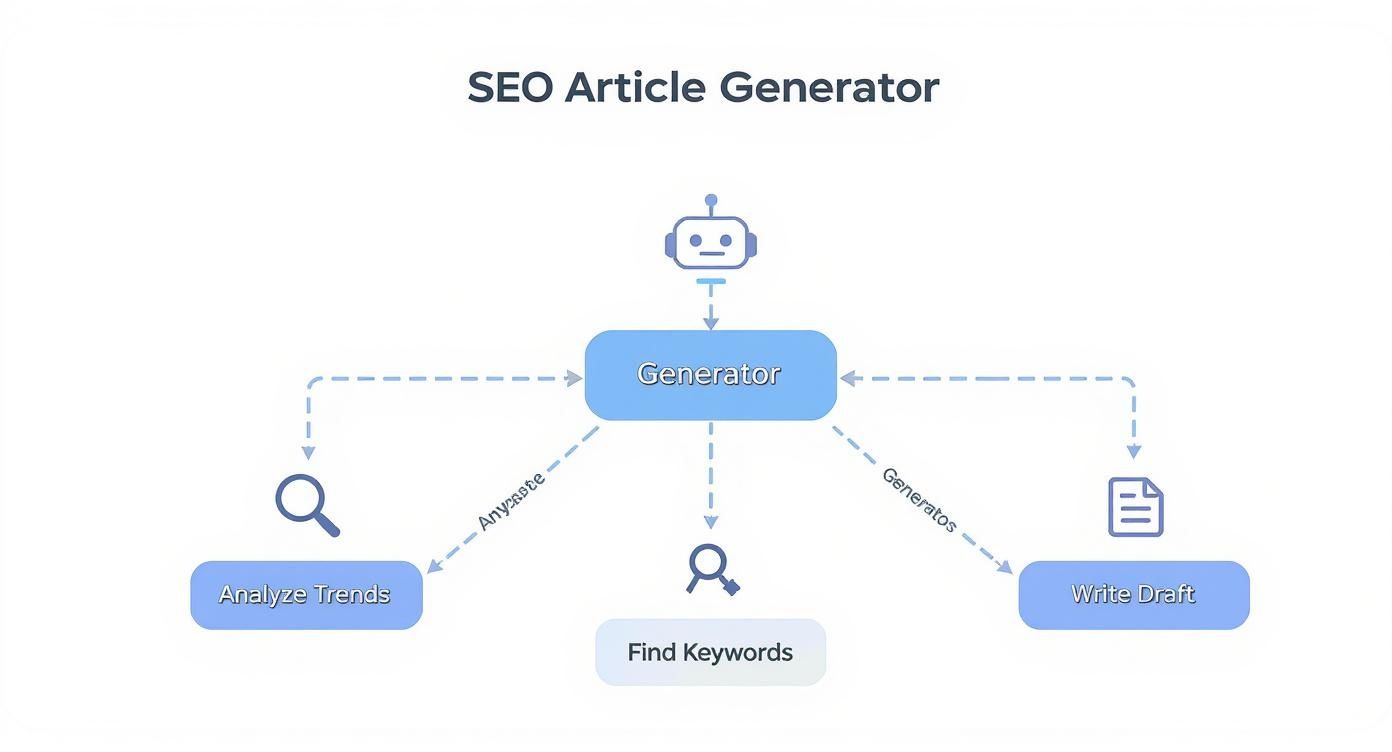
As you can see, the process is systematic: analyze what's working, find the right words, and then build the content around that framework.
To give you a clearer picture, here’s a quick breakdown of what these tools are really doing under the hood.
Key Functions of an SEO Article Generator at a Glance
| Function | Description | Primary SEO Benefit |
|---|---|---|
| Keyword Research & Analysis | Scans SERPs to identify primary, secondary, and LSI keywords that top-ranking content uses. | Ensures content is relevant and targets terms with proven search demand. |
| SERP-Based Outlining | Creates a structured outline with H2s and H3s based on the common patterns of top-performing articles. | Builds a comprehensive structure that search engines and readers find easy to follow. |
| Natural Language Generation | Writes human-like paragraphs, sentences, and sections based on the optimized outline and keywords. | Produces readable, engaging content that keeps users on the page longer. |
| Internal & External Linking | Suggests relevant internal links to other pages on your site and credible external sources. | Improves site architecture, distributes link equity, and builds topical authority. |
| On-Page SEO Optimization | Automatically generates meta titles, descriptions, and alt text, and ensures proper keyword density. | Covers essential on-page ranking factors without manual effort. |
This table shows how each function directly contributes to a stronger SEO foundation, moving beyond just writing to active optimization.
The AI Revolution in SEO
The rise of the SEO article generator is just one piece of a much larger puzzle. AI is completely reshaping the SEO world, and it's happening fast. By 2025, it’s predicted that 71.5% of users will turn to generative AI tools for information, and AI-driven features are already influencing about 30% of Google search queries.
This huge shift is fueling the AI SEO software market, which is expected to jump from $1.99 billion in 2024 to nearly $5 billion by 2033. The companies embracing these tools are reaping the rewards, reporting up to 25% higher revenue over five years compared to those who don't.
The goal isn't to replace human writers but to augment their capabilities. A skilled marketer armed with a top-tier AI generator can produce high-quality, optimized content at a scale that was previously unimaginable.
In this new environment, it’s also crucial to get familiar with concepts like Generative Engine Optimization (GEO), which is all about making your content pop up in AI-powered search results. By understanding these ideas, you can turn these tools into powerful collaborators in your content strategy. To see which platforms are leading the charge, check out our guide on the https://www.indexpilot.ai/blog/top-ai-article-generators.
The Strategic Benefits for Your Content Workflow
Bringing an SEO article generator into your content process is about more than just speeding things up; it’s a strategic move that can directly fuel business growth. These tools take on the heavy lifting—the research, the structuring, the first draft—and in doing so, they free up your team. Suddenly, your people have more time to focus on high-level strategy, creative direction, and actually connecting with your audience. It completely changes the economics of content marketing.
Think about it. What if you could turn content creation from a multi-day marathon into a focused sprint that takes just a few hours? That’s the most immediate payoff. The old way of doing things—keyword research, competitor analysis, outlining, drafting, and initial SEO tweaks—is a massive time sink. An SEO article generator crushes that timeline.
Instead of spending hours digging through search results to piece together an outline, the tool delivers one in minutes. Instead of staring at a blank page, you start with a comprehensive, optimized draft. This efficiency is a game-changer. A single content creator can now produce the output of a small team, leveling the playing field for businesses of all sizes.

Achieve Unmatched SEO Precision
In SEO, precision is everything, and this is where a generator really shines. It’s like having an SEO expert baked right into your writing software. The tool embeds optimization best practices from the very start, making sure every article is built on a solid foundation designed to rank.
This isn’t magic; it’s just smart automation handling several key tasks:
- Data-Driven Outlines: The generator analyzes what’s already ranking at the top of Google to build outlines that cover topics thoroughly and nail search intent.
- Strategic Keyword Integration: It doesn’t just stuff your main keyword in. It finds and naturally weaves in critical secondary and LSI (Latent Semantic Indexing) keywords that search engines expect to see.
- Optimized Structure: Articles are automatically formatted with the right heading tags (H2s, H3s), which is crucial for helping search engines understand your content's hierarchy.
This built-in precision gets rid of the guesswork and avoids the common mistakes that prevent content from ranking. Instead of trying to optimize an article after it’s written, the article is born optimized. This drastically increases its chances of performing well right out of the gate. The benefits of AI content tools go far beyond just speed; they provide a reliable framework for quality and performance.
Unlock Scalable Content Production
For a lot of businesses, especially startups and small teams, content marketing goals often run headfirst into the wall of limited resources. You might know you need to publish multiple articles a week to compete, but that’s often impossible to do manually. An SEO article generator completely shatters that barrier.
By automating the most labor-intensive parts of content creation, you can scale your output without scaling your headcount. This makes it possible for a solo entrepreneur to execute a content strategy that was once reserved for companies with large marketing departments.
Scalability means you can consistently publish high-quality content, building topical authority in your niche faster than you ever thought possible. Whether you're trying to populate a brand-new blog, target hundreds of long-tail keywords, or support a product launch with a flood of informational articles, a generator gives you the engine to make it all happen. This ability to produce great content at scale is a massive competitive advantage, letting you capture more organic traffic and stake your claim as a leader in your market.
Essential Features of a Powerful Generator
Not all SEO article generators are built the same. Far from it. Some are little more than glorified text spinners that churn out generic content, while the best ones act like a true content partner. If you want real results, you need to know the mission-critical features that separate a high-performance tool from a digital paperweight.
Think of it like choosing a car. A scooter might get you around the block, but you wouldn't take it on a cross-country road trip. For that, you need a powerful engine, GPS, and cruise control. The same logic applies here; the right features are essential for getting your content where it needs to go.
Real-Time SERP Analysis
A top-tier generator doesn't just guess what Google wants to see—it knows. It does this through real-time SERP (Search Engine Results Page) analysis. Before it even thinks about writing, the tool dissects the top-ranking articles for your keyword.
This process is like having a scout report back from behind enemy lines. The AI identifies common themes, subtopics, question formats, and even the average word count of the content that's already winning. This data-first approach means the article it generates is engineered to meet both search engine and user expectations right from the start.
By analyzing what already works, the generator builds a content brief that is reverse-engineered for success. It’s not about copying competitors but about understanding the winning formula and then creating something even better.
Honestly, this feature is non-negotiable. Without it, you're just generating text in a vacuum and hoping it sticks. With SERP analysis, every article is strategically crafted to compete for a top spot.
Integrated Keyword Research And Optimization
A powerful generator goes way beyond just plugging in your main keyword a few times. It should have integrated keyword research capabilities to identify and map out a whole cluster of related terms, including LSI (Latent Semantic Indexing) keywords and long-tail variations.
The real magic is in how it uses this information. The best tools don't just sprinkle these terms in randomly. They intelligently weave them into the article, making sure they appear naturally in headings, subheadings, and paragraphs to build topical authority. This is how you show search engines you're an expert on the subject.
Effective keyword optimization should cover:
- Semantic Clustering: Grouping related keywords to make sure you cover the topic from all angles.
- Natural Integration: Placing keywords where they make sense to a human reader, not just an algorithm. No awkward "keyword stuffing."
- Density Monitoring: Keeping an eye on keyword density so it feels natural to both readers and search engines.
To help you tell the difference between a basic tool and a more sophisticated one, here's a quick comparison of what to look for.
Feature Comparison Essential vs Advanced SEO Generators
This table breaks down the must-have features versus the nice-to-have functionalities you'll find in different SEO article generators.
| Feature Category | Essential Functionality (Must-Have) | Advanced Functionality (Nice-to-Have) |
|---|---|---|
| Keyword Research | Identifies primary and secondary keywords. | Discovers semantic clusters and long-tail opportunities. |
| SERP Analysis | Analyzes top 10 results for word count and headings. | Analyzes top 20+ results for topics, questions, and entities. |
| Content Generation | Creates a basic article based on a keyword. | Builds a detailed, data-driven outline before writing. |
| Optimization | Checks for primary keyword density. | Optimizes for topical authority with natural LSI keyword integration. |
| Brand Voice | Offers generic tone settings (e.g., "professional"). | Learns and replicates your unique brand voice from writing samples. |
| Quality Checks | Includes basic grammar and spelling checks. | Provides plagiarism detection and readability scoring. |
While the essential features give you a starting point, the advanced functionalities are what truly save time and produce content that can dominate the search results.
Brand Voice and Tone Customization
Generic, robotic-sounding content is a huge turn-off for readers. That’s why brand voice customization is a must-have for any serious content marketer. A good generator lets you define your brand’s unique personality.
You should be able to set parameters for tone, like "professional," "witty," "casual," or "academic." The more advanced platforms even let you upload samples of your own writing, which the AI then analyzes to learn and mimic your specific style, vocabulary, and sentence structure.
This ensures all your content is consistent, helping you build a brand that people recognize and trust. It’s the difference between a one-size-fits-all t-shirt and a tailored suit—one clearly makes a much better impression.
Built-In Quality Assurance Checks
Finally, an elite generator should also act as your first line of defense in the editing process. Hitting "publish" on raw AI content without a review is a massive risk, which is why built-in quality checks are so important.
Look for tools that offer:
- Plagiarism Checker: Scans the text against billions of web pages to make sure it's original.
- Readability Score: Analyzes the content using metrics like the Flesch-Kincaid scale to ensure it’s easy for your audience to digest.
- Grammar and Spelling Correction: Catches and fixes common writing mistakes automatically.
These features save a ton of time during editing and add a crucial layer of protection for your brand's reputation. Knowing what to look for in SEO tools is key, and these quality checks should be at the very top of your list. They help ensure the content you create is not just optimized, but also polished and credible.
Creating Your First SEO Article Step by Step
Alright, let's move from theory to action. This is where you see just how powerful an SEO article generator can be. But don't mistake this for a "set it and forget it" button. It's more of a partnership—the AI does the heavy lifting while you steer the ship with your strategy and expertise.
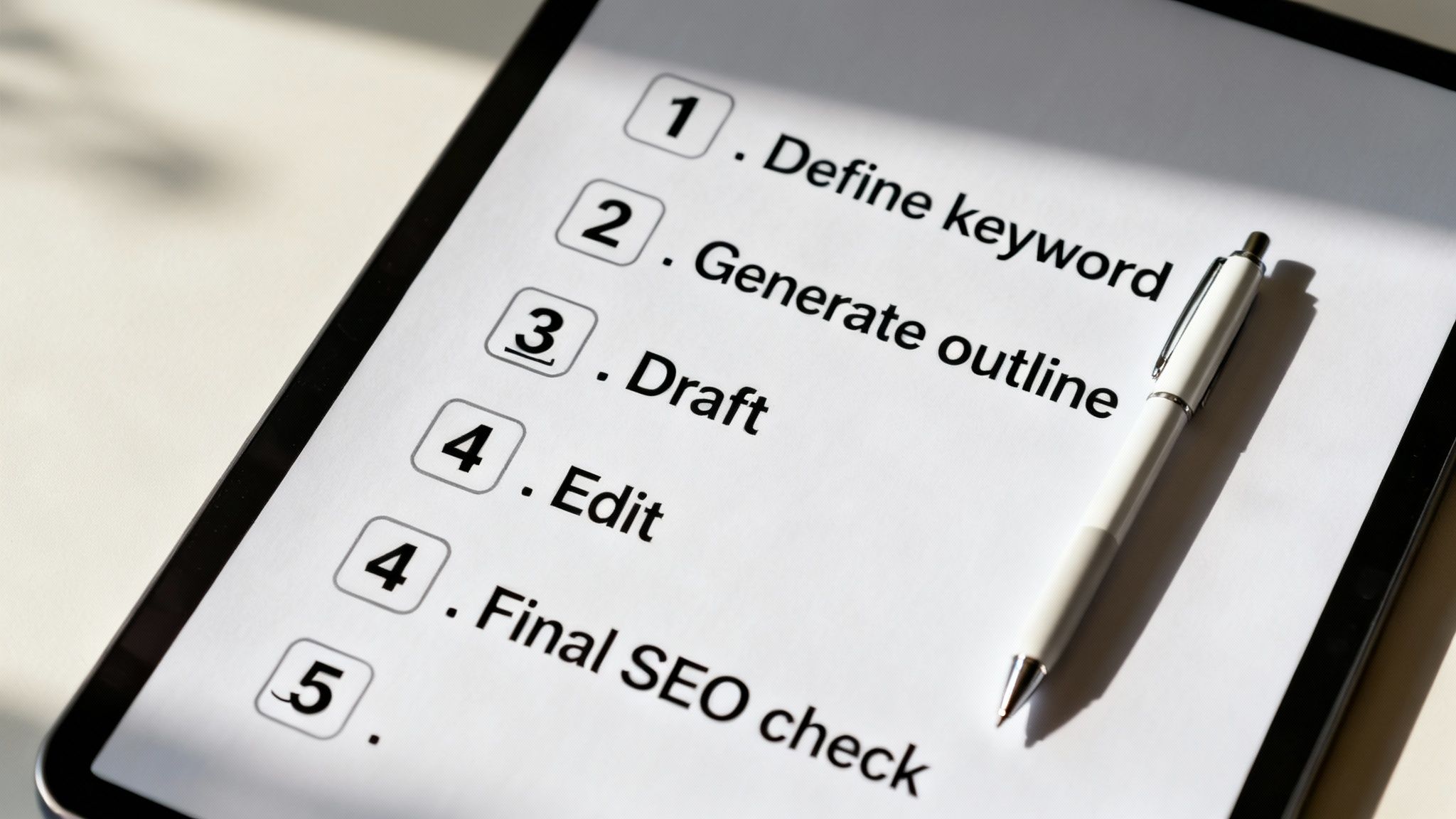
Let's walk through creating your first article together, breaking it down into simple, actionable steps.

Think of the image above as the foundation. A good generator automates all those little pieces of the SEO puzzle to get you started on the right foot.
Step 1: Define Your Keyword and Audience
Every great piece of content starts with a clear purpose. Before you even touch the generator, you need to nail down two things: the primary keyword you want to rank for and the exact person you're writing for.
Your keyword is your compass. A broad term like "coffee" is a recipe for getting lost. Instead, a specific, long-tail keyword like "best coffee beans for cold brew" gives the AI a crystal-clear destination. This focus is what brings in the right kind of traffic.
Just as important is your audience. Are you talking to total beginners who need the basics spelled out? Or are you writing for seasoned pros looking for advanced tips? Knowing this from the start helps you shape the AI’s tone and the depth of the content, making sure the final piece actually connects with your readers.
Step 2: Generate a Strategic Outline
Got your keyword? Great. Now it's time to let the SEO article generator do its thing. Plug in your keyword and let the tool run its SERP analysis. In just a few minutes, it will spit out a detailed outline based on what's already winning on Google's front page.
This outline is your strategic blueprint. It usually includes:
- An optimized H1 title designed to grab attention and clicks.
- A logical flow of H2s and H3s that covers the topic from all angles.
- Key talking points under each heading to guide the content.
Now, look this outline over. Does it make sense? Did it miss anything crucial? This is your first real opportunity to inject your human expertise—adding, removing, or rearranging sections to build an even stronger framework before a single paragraph is written.
The outline is the most crucial stage of collaboration with the AI. A well-structured outline, refined by human insight, all but guarantees a high-quality first draft that aligns perfectly with search intent.
Step 3: Produce the Initial Draft
Once you're happy with the outline, give the generator the green light to write the full article. The AI will take that blueprint and flesh out every section. It’ll naturally weave in your main keyword and related terms, pull in relevant facts from its SERP analysis, and stick to the structure you approved.
This first draft is your raw material. It’s a solid, SEO-friendly base to build on, saving you from that terrifying blank page. You're already about 80% of the way there.
Step 4: Apply the Vital Human Touch
This is the step that separates a good AI article from a great one. The AI gives you the skeleton and the muscle, but you provide the heart and soul. Your editing should zero in on a few key areas:
- Fact-Checking: AI can pull old data or get things mixed up. Double-check every statistic and claim.
- Injecting Expertise: Add your own unique stories, insights, or brand-specific examples. This is how you build real authority.
- Refining Brand Voice: Tweak the wording until it sounds exactly like you.
- Improving Flow: Read it out loud. You'll quickly catch any clunky sentences or awkward phrasing.
This human touch is absolutely non-negotiable if you want to create content that genuinely stands out. For a deeper dive into making your content shine, check out our guide on how to write a blog post for SEO.
Step 5: Final On-Page SEO Checks
Before you hit "publish," do one last on-page SEO sweep. Most generators get the basics right, but a final check is always a good idea. Make sure your meta title and description are compelling, your internal links are placed strategically, and every image has descriptive alt text.
Getting these on-page details right is more important than ever. The global SEO market is expected to hit a staggering USD 127.3 billion by 2030, and on-page SEO services make up a huge 42.3% of that revenue in 2024. These final checks are what give you that competitive edge.
If you're just starting out or want to get a feel for this workflow without any commitment, there are plenty of platforms offering free content creation tools to experiment with.
Common Mistakes to Avoid With AI Content
An SEO article generator can be an incredible asset, but treating it like a magic "publish" button is the fastest way to create mediocre, forgettable content. If you want sustainable success, you need to sidestep the common pitfalls that can sink your SEO efforts and even damage your brand’s credibility.
Let's walk through the most frequent mistakes people make and how you can build a smarter, more effective workflow.
The single biggest mistake is blindly trusting the AI's output. Publishing a raw, unedited draft is a recipe for disaster. These tools are powerful, but they aren’t infallible. They can easily misinterpret context, pull outdated information, or produce text that just sounds... off. Robotic.
Think of the first draft from your SEO article generator as a perfectly formed block of high-quality clay. It has potential, but it still needs a skilled artist—that’s you—to add the fine details, texture, and unique character that will turn it into a masterpiece.
Forgetting Your Brand Voice
Another critical error is forgetting about your brand's unique voice and tone. If your brand is known for being witty and informal, publishing a dry, academic article from an AI will feel completely out of place to your audience. Consistency is everything when it comes to building a recognizable and trusted brand.
A great generator will let you customize the tone, but the final polish is always on you. Take the time to tweak the phrasing, inject your brand’s personality, and make sure the content genuinely sounds like it came from a real person on your team.
- What Not to Do: Just accept the default "professional" tone for every article. This leads to generic content that fails to stand out or build any real connection with readers.
- Best Practice: Actively edit the draft to align with your specific brand voice. Whether it's humorous, authoritative, or empathetic, make sure it’s consistent with all your other communications.
Ignoring Google's E-E-A-T Framework
In the world of SEO, Google's E-E-A-T (Experience, Expertise, Authoritativeness, Trustworthiness) framework is the law of the land. It’s how the search engine decides if your content is credible and actually helpful. Publishing unverified AI content directly contradicts these principles.
An AI can't fake firsthand experience. Your job is to infuse the AI-generated draft with genuine insights, personal anecdotes, and unique perspectives that only a human expert can provide. For building authority, this is non-negotiable.
To make sure your content aligns with E-E-A-T, you absolutely must:
- Fact-Check Everything: Verify every single statistic, claim, and piece of data.
- Add Your Expertise: Weave in unique examples, case studies, or personal stories.
- Cite Reputable Sources: Link out to authoritative studies and expert opinions to back up your points.
This human oversight is what transforms a generic article into a trustworthy resource that both users and search engines will value. For a deeper dive, our guide to SEO copywriting best practices offers more insights on creating authoritative content.
Publishing Content Without a Final Review
Ultimately, all these mistakes boil down to one central problem: skipping the final human review. This is where you catch awkward phrasing, fix factual inaccuracies, and add that crucial human touch that forges a real connection with your audience.
Remember, the SEO battlefield is more competitive than ever. In 2025, an estimated 68% of all online experiences will start with a search engine, and organic results account for a staggering 94% of all clicks.
With Google dominating the market, creating high-quality, trustworthy content is the only way to earn those top rankings and capture valuable traffic. The rise of generative AI and Google's focus on E-E-A-T are seen as top SEO disruptors, making human oversight even more critical. Your final review is what ensures your content is actually ready to compete.
Frequently Asked Questions
Even after seeing what an SEO article generator can do, it's totally normal to have a few questions. This tech is moving fast, and it’s smart to get ahead of the common concerns. Let's clear the air and give you some direct, practical answers.
We'll tackle the big ones: originality, what Google thinks, and where human expertise still fits in. The goal is to give you the confidence to start using these tools in your content strategy.
Is AI-Generated Content Considered Plagiarism?
This is a big one, and the answer is a hard no—as long as you're using a quality tool. Modern SEO article generators aren't just glorified "spinners" that rehash old content. They use sophisticated language models to build completely new sentences from the ground up, based on the massive amounts of data they've learned from.
Think of it like this: a student reads a dozen books and articles for a research paper, then writes an original essay synthesizing all that information. The AI does something very similar, creating a unique piece of work from its "reading."
That said, it’s always a good idea to run the final piece through a built-in plagiarism checker. It’s a simple step that adds a final layer of protection for your site's reputation and ensures you're putting something truly original out there.
Will Google Penalize Me For Using an SEO Article Generator?
Google has been pretty clear on this: they reward high-quality content, no matter how it’s made. Their main concern is whether your content is helpful, reliable, and gives the user a good experience. What they are against is using automation to pump out low-quality, spammy articles just to game the system.
So, could you get penalized? Yes, if you use a generator to create generic, unedited nonsense. But if you use it as a starting point to craft well-researched, insightful articles that you then polish with your own expertise, you're playing right by their rules.
The bottom line is to focus on the final product. Google cares about quality and helpfulness. As long as your AI-assisted content hits the E-E-A-T (Experience, Expertise, Authoritativeness, Trustworthiness) marks, you're in the clear.
Ultimately, the responsibility for quality always lands on your shoulders as the publisher.
Can an AI Truly Understand Search Intent?
Yes, and frankly, this is where these tools really shine. A good SEO article generator doesn't just look at keywords; it analyzes the top-ranking pages for that query to figure out the search intent behind it. In other words, what is the user really looking for?
The AI typically sorts intent into a few main buckets:
- Informational: The user wants to learn something (e.g., "how to make cold brew coffee").
- Navigational: They're trying to get to a specific site (e.g., "IndexPilot login").
- Transactional: They're ready to buy something (e.g., "buy whole bean espresso").
- Commercial Investigation: They're in research mode, comparing options before a purchase (e.g., "best burr grinder 2024").
By reverse-engineering the content that's already winning, the AI gets a data-backed blueprint for what users want to see. This approach is often more on-point than human intuition alone because it's based on what's already proven to work.
How Much Human Editing Is Really Needed?
A fair amount. One of the biggest mistakes people make is treating these tools like a "one-and-done" button. The AI can get you 80-90% of the way there with an amazing, optimized first draft, but that last 10-20% is where you work your magic.
Your editing pass should always cover these bases:
- Fact-Checking: AI can get things wrong or pull outdated stats. Double-check every claim, number, and fact.
- Adding Brand Voice: Tweak the tone and phrasing so it sounds like you, not a robot. This is crucial for building a connection with your readers.
- Injecting Personal Experience: This is your secret weapon. Weave in your own stories, unique examples, or case studies that only you can provide. This is pure E-E-A-T gold.
- Polishing the Flow: Read the article out loud. You'll instantly catch any clunky sentences or awkward phrasing that needs smoothing out.
Think of the AI as your co-writer. It does the heavy lifting on structure and research, but you provide the soul and credibility that builds a loyal audience.
Ready to see how an SEO article generator can transform your content workflow? With IndexPilot, you can automate the entire process from keyword research to publishing, all while maintaining complete control over quality and brand voice. Our trainable AI Agents learn your style to create content that’s not just optimized for search engines, but also for your audience.