Picture this: A potential customer opens ChatGPT and asks, "What's the best marketing analytics platform for small businesses?" Within seconds, they receive a detailed answer recommending three specific tools. Your competitor is mentioned. You're not.
This scenario is playing out millions of times every day across ChatGPT, Claude, Perplexity, and other AI search engines. While you're meticulously tracking your Google rankings and website traffic, an entirely new discovery channel is shaping buying decisions—and you have no idea whether your brand is part of the conversation.
The shift is already here. Users increasingly bypass traditional search engines and go straight to AI models for recommendations, comparisons, and advice. These conversational interfaces don't just return links—they synthesize information and deliver confident answers. If your brand isn't mentioned in those answers, you're invisible to a growing segment of your target audience. Monitoring AI search engine mentions has evolved from a nice-to-have into a competitive necessity for marketers and founders who want to maintain visibility in this new landscape.
The Rise of AI-Powered Discovery (And Why Traditional Analytics Miss It)
AI search engines operate on fundamentally different principles than the Google you've spent years optimizing for. When someone asks ChatGPT or Claude a question, these models don't simply retrieve and rank web pages. Instead, they synthesize information from their training data and, increasingly, from real-time web retrieval to generate coherent, conversational answers.
This synthesis process is where brand visibility gets created—or lost. The AI model evaluates which sources are most authoritative, relevant, and trustworthy for a given query, then weaves that information into a natural-sounding response. Your brand might be recommended as the top solution, mentioned alongside competitors, or completely absent from the answer.
Here's the problem: your current analytics stack has no visibility into this process.
Google Analytics tracks when someone clicks through to your website. SEO tools monitor your search rankings and backlink profile. Social listening platforms catch mentions on Twitter and Reddit. But none of these tools can tell you what happens when an AI model generates an answer about your industry, your product category, or your specific use case.
The visibility gap is real and significant. Consider that ChatGPT alone processes billions of queries monthly. Perplexity has become the go-to research tool for professionals seeking quick, synthesized answers. Claude is increasingly used for business analysis and decision-making. Across all these platforms, conversations about your market are happening constantly—and you're flying blind. Understanding how AI search engines work is the first step toward closing this gap.
Traditional SEO focused on ranking for keywords. You could track your position, monitor competitors, and measure progress. AI-powered discovery is more nuanced. The same query asked three different ways might generate three different sets of brand mentions. The context matters. The phrasing matters. And unlike a static search results page, AI-generated answers can vary significantly even for identical queries.
This creates a new category of brand visibility that exists entirely outside your current measurement framework. You might have excellent traditional SEO performance while being completely absent from AI-generated recommendations. Or you might be frequently mentioned by AI models without realizing it, missing opportunities to amplify what's working.
What AI Search Engine Mention Monitoring Actually Tracks
Effective AI mention monitoring goes far beyond simple brand name tracking. It's a multi-dimensional view of how AI models perceive, position, and recommend your brand across different contexts and platforms.
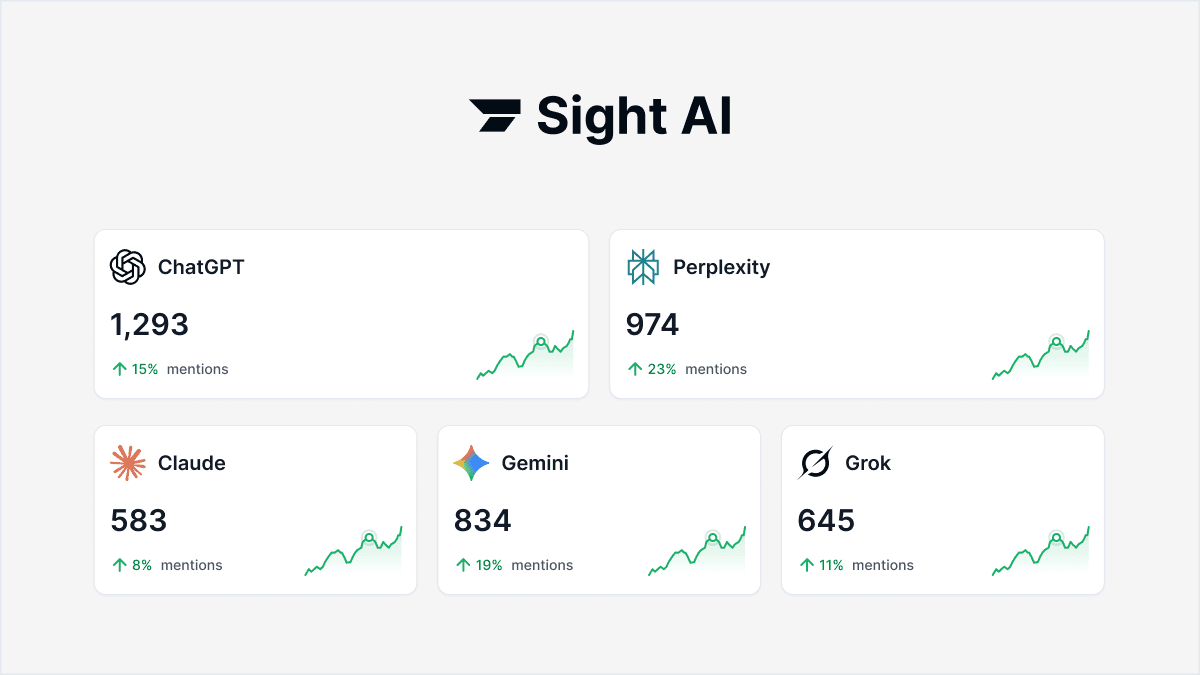
Platform Coverage: Comprehensive monitoring tracks your brand across the major AI search platforms—ChatGPT, Claude, Perplexity, Google's Gemini, and Microsoft Copilot. Each platform has different training data, retrieval mechanisms, and user bases. What works on ChatGPT might not translate to Perplexity, and vice versa. Using dedicated AI mentions monitoring software helps you track all these platforms systematically.
Mention Frequency: How often does your brand appear in AI-generated responses? This baseline metric helps you understand your current visibility level. Are you mentioned once a week or hundreds of times daily? The frequency tells you whether you're a recognized authority in your space or still building AI visibility.
Sentiment Analysis: Not all mentions are created equal. AI models might mention your brand in positive contexts ("leading solution for X"), neutral contexts (factual comparisons), or even negative contexts (limitations or criticisms). Understanding sentiment helps you gauge not just visibility but reputation within AI-generated content.
Prompt Tracking: This is where monitoring gets strategically valuable. What specific questions trigger mentions of your brand? When someone asks about "project management tools for remote teams," do you appear? What about "budget-friendly CRM options" or "enterprise analytics platforms"? Knowing which prompts generate mentions reveals your positioning in the AI landscape.
Competitive Positioning: AI models often mention multiple brands when answering questions. Are you listed first, third, or not at all? How do AI platforms compare you to competitors? This competitive context shows where you stand in the AI-powered discovery hierarchy. Tracking brand mentions in AI search results reveals exactly how you stack up against competitors.
Context and Framing: Beyond simple mentions, monitoring should capture how your brand is described and positioned. Are you characterized as the affordable option, the enterprise solution, the user-friendly choice? The framing AI models use shapes how potential customers perceive your brand before they ever visit your website.
Setting Up Your AI Visibility Monitoring System
Building an effective monitoring system starts with strategic platform selection. While you could theoretically track every AI platform, focus creates more actionable insights than scattered coverage.
Platform Prioritization: Identify which AI platforms your target audience actually uses. B2B decision-makers increasingly rely on Claude for business analysis. Researchers and professionals favor Perplexity for its cited sources. Consumers often default to ChatGPT for product recommendations. Your monitoring should concentrate on the platforms where your potential customers are asking questions.
For most businesses, a core monitoring set includes ChatGPT, Claude, and Perplexity. These three platforms represent different user behaviors and content synthesis approaches. Learning how to monitor Perplexity mentions specifically can give you insights into how research-focused users discover your brand. As your monitoring matures, you can expand to Gemini, Copilot, and emerging platforms.
Establishing Baselines: Before you can improve AI visibility, you need to know where you stand today. Run a baseline assessment across your chosen platforms. Test 20-30 relevant prompts that potential customers might ask—questions about your product category, common problems you solve, and comparison queries that include your competitors.
Document current mention frequency for each prompt. Note whether mentions are positive, neutral, or negative. Record which competitors appear alongside your brand and how you're positioned relative to them. This baseline becomes your benchmark for measuring progress.
Creating Your Monitoring Cadence: AI models update their training data and retrieval mechanisms over time. Your monitoring needs to capture these changes without drowning you in noise. A weekly monitoring cadence works well for most businesses—frequent enough to spot trends, but not so constant that you're chasing random variations.
Structure your weekly monitoring around three prompt categories. First, track your core prompts—the 5-10 most important questions where you want consistent visibility. Second, rotate through broader industry prompts to understand your overall market positioning. Third, test new prompts based on content you've recently published or market changes you've observed.
Building Your Prompt Library: Effective monitoring requires a well-designed prompt library. Think like your potential customers. What questions would they ask before discovering your brand? What problems are they trying to solve? What comparisons are they making?
Your prompt library should include direct questions ("What's the best tool for X?"), problem-focused queries ("How do I solve Y?"), and comparison prompts ("X vs Y vs Z"). Include variations in phrasing—AI models can respond differently to "top tools for project management" versus "best project management software" versus "which project management platform should I choose."
Turning Mention Data Into Content Opportunities
Raw mention data becomes valuable when you transform it into content strategy. The patterns in your monitoring reveal exactly where to focus your content efforts for maximum AI visibility impact.
Identifying High-Value Gaps: Review your monitoring data and look for prompts where competitors get mentioned but you don't. These gaps represent immediate opportunities. If "best email marketing platforms for e-commerce" consistently mentions three competitors but not your brand, that's a signal. You need content that establishes your authority in that specific context.
The gap analysis works in reverse too. Find prompts where you get mentioned and double down. If AI models already recognize you as an authority on "marketing automation for SaaS," create more comprehensive content in that area. Strengthen your position where you're already visible.
Content Gap Analysis: Compare the topics where you get AI mentions against your existing content library. Often you'll find misalignment. You might have excellent content about your product features but lack the educational, problem-solving content that AI models prefer to cite.
AI platforms tend to reference comprehensive guides, authoritative definitions, and content that thoroughly addresses user questions. If your content library is heavy on product marketing but light on educational resources, that explains low AI visibility. Use your mention data to identify which educational topics would have the highest impact. Understanding how AI search engines rank content helps you create resources that get cited more frequently.
Prompt-Driven Content Planning: Traditional content planning often starts with keyword research. AI visibility monitoring adds a new dimension—prompt research. What questions are people actually asking AI models? What phrasing do they use? What context do they provide?
Create content that directly addresses the prompts you're tracking. If monitoring reveals that people ask "how to choose between X and Y," create a comprehensive comparison guide. If they ask "what's the difference between A and B," publish an authoritative explainer. This prompt-driven approach ensures your content aligns with how people actually seek information.
Understanding Citation Patterns: Pay attention to which of your existing pages get cited by AI models when they do mention your brand. These citation patterns reveal what type of content AI platforms consider authoritative. You might discover that your in-depth tutorial gets cited frequently while your product overview doesn't. That insight should shape your content strategy going forward.
Improving Your AI Search Visibility Based on Monitoring Insights
Monitoring reveals opportunities. Improvement requires deliberate action based on those insights. The connection between what you learn from AI mention tracking and what you publish determines whether your visibility grows over time.
Creating Citation-Worthy Content: AI models preferentially cite certain content characteristics. Comprehensive coverage of a topic performs better than surface-level overviews. Structured information that's easy to parse and synthesize gets referenced more often than rambling narratives. Unique insights, original research, and authoritative definitions all increase citation likelihood.
When you identify a content gap from your monitoring, don't create just another blog post. Create the definitive resource on that topic. Make it comprehensive enough that an AI model looking to synthesize information about that subject would naturally pull from your content. Following proven AI search engine optimization techniques ensures your content gets discovered and cited.
Building Topical Authority: AI visibility compounds over time as you build topical authority. If you publish one excellent guide about project management, you might get occasional mentions. If you publish ten comprehensive resources covering different aspects of project management, AI models increasingly recognize you as an authority in that space.
Use your monitoring data to identify your authority clusters—topics where you already have some AI visibility. Then systematically expand your content coverage within those clusters. Each new piece reinforces your authority and increases the likelihood of mentions across related prompts.
Optimizing for GEO (Generative Engine Optimization): Just as SEO evolved as a discipline for optimizing traditional search visibility, GEO is emerging as the practice of optimizing for AI-generated responses. The principles differ from traditional SEO in important ways.
GEO prioritizes comprehensive, authoritative content over keyword density. It values clear structure and information hierarchy that AI models can easily parse. It emphasizes answering questions thoroughly rather than optimizing for specific search terms. Apply these principles to content you create based on monitoring insights. A comprehensive guide on how to optimize for AI search engines can help you implement these strategies effectively.
Connecting Monitoring to Publishing Workflows: The most effective approach integrates AI visibility monitoring directly into your content creation and publishing workflow. When you identify a high-value content gap, create the content to fill it. When you publish that content, ensure it gets indexed quickly so AI models can discover and potentially cite it.
Tools that combine AI visibility tracking with content generation and automated indexing create a closed loop. You discover opportunities through monitoring, create optimized content to address those opportunities, and ensure that content gets discovered as quickly as possible. This integration accelerates your path from insight to improved visibility.
Your AI Mention Monitoring Action Plan
Week 1 - Establish Your Baseline: Select 3-5 AI platforms to monitor based on where your audience seeks information. Create your initial prompt library with 20-30 questions potential customers might ask. Run your baseline assessment and document current mention frequency, sentiment, and competitive positioning.
Week 2 - Identify Quick Wins: Analyze your baseline data to find high-value gaps—prompts where competitors get mentioned but you don't, especially for topics where you already have relevant content. These represent opportunities to improve visibility without creating new content from scratch. Use an AI mentions monitoring service to automate this discovery process.
Week 3 - Create Your Content Roadmap: Based on your gap analysis, prioritize 5-10 content pieces that would have the highest impact on AI visibility. Focus on comprehensive guides and authoritative resources for topics where you want consistent mentions.
Ongoing - Monitor and Optimize: Implement weekly monitoring of your core prompts. Track mention frequency, sentiment trends, and competitive positioning over time. As you publish new content, monitor whether it improves visibility for related prompts. Adjust your content strategy based on what the data reveals. Implementing AI search visibility monitoring as an ongoing practice ensures you catch changes before competitors do.
Key Metrics Dashboard: Track these metrics weekly: total mention count across platforms, sentiment distribution (positive/neutral/negative), competitive positioning changes, and prompt coverage (percentage of your target prompts where you get mentioned). Monthly, review trends in these metrics to gauge whether your AI visibility is improving.
Integration Checklist: Connect AI monitoring with your existing marketing stack. Use monitoring insights to inform content planning. Ensure new content gets indexed quickly through automated indexing tools. Create feedback loops where publishing success reinforces what you learn from monitoring data.
The New Reality of Brand Discovery
AI search engines have fundamentally changed how people discover solutions, evaluate options, and make decisions. This isn't a future trend—it's happening now, at scale, across millions of daily interactions.
The marketers and founders who recognize this shift early gain a significant advantage. While competitors remain focused exclusively on traditional SEO, you can build AI visibility that captures attention in this new discovery channel. The gap between those monitoring AI mentions and those flying blind will only widen as AI-powered search continues to grow.
Monitoring AI search engine mentions isn't about abandoning traditional SEO or website analytics. It's about expanding your visibility measurement to match how people actually seek information today. You need both. You need to know your Google rankings and your AI mention frequency. You need to track website traffic and understand how AI models position your brand.
The good news? You don't need to manually query dozens of AI platforms daily or build complex tracking systems from scratch. The infrastructure for AI visibility monitoring now exists. The question is whether you'll adopt it before your competitors do.
Stop guessing how AI models like ChatGPT and Claude talk about your brand—get visibility into every mention, track content opportunities, and automate your path to organic traffic growth. Start tracking your AI visibility today and see exactly where your brand appears across top AI platforms.