
A winning keyword strategy isn't about chasing the highest volume keywords anymore. It's about building genuine topical authority. This means moving through a full cycle: discovering what your audience actually needs, mapping their intent, clustering keywords into smart groups, and then constantly measuring what works to get better.
That shift—from just hunting for keywords to truly owning a topic—is the secret sauce behind modern SEO success.
Moving Beyond Keywords to Build Topical Authority
Forget the old playbook of stuffing a page with one keyword and calling it a day. Today's search engines are incredibly sophisticated. They understand context, synonyms, and the nuanced relationships between different ideas.
Because of this, a successful keyword strategy is all about covering a topic so thoroughly that you satisfy a user’s entire journey—from their first curious question to their final decision.
You have to start thinking like a publisher, not just an SEO. The goal is to build an entire ecosystem of content that answers every possible question a user might have about your niche. Do that, and you establish your site as the go-to resource. That's the kind of authority Google loves to reward with higher rankings and a steady stream of organic traffic.
The Four Pillars of a Modern Strategy
A solid keyword strategy is built on four core pillars. They work together in a continuous loop, with each stage feeding insights into the next. It becomes a self-improving system that can adapt to whatever the market or your users throw at you.
Here's a breakdown of the core components that make up a successful, modern keyword strategy and what each one aims to achieve.
Pillars of a Modern SEO Keyword Strategy
| Pillar | Primary Goal | Key Activity |
|---|---|---|
| Discovery & Analysis | Understand audience needs and find content gaps. | Competitor analysis, customer feedback, forum mining. |
| Intent Mapping & Clustering | Organize raw keywords into a logical content structure. | Grouping terms by user intent (e.g., informational, transactional). |
| Content Planning & Execution | Turn keyword clusters into a published content plan. | Creating a content calendar and producing high-quality assets. |
| Measurement & Iteration | Continuously improve performance based on real data. | Tracking rankings, traffic, conversions, and refining the strategy. |
Each pillar is essential for creating a system that not only ranks but also delivers real business value over the long haul.
The flowchart below gives you a nice visual of how this cyclical process works.

You can see how each step logically flows into the next, creating a continuous loop of improvement and refinement. If you want to take this a step further and scale your content creation to build out massive topic coverage, it's worth exploring more advanced techniques like programmatic SEO strategies.
Ultimately, adopting this strategic mindset is a core part of the modern content strategies for growth teams that are driving real, measurable business results today.
Key Takeaway: A successful keyword strategy is not a one-time project but an ongoing process. It's about building a content machine that consistently addresses user needs, establishing your brand as a trusted authority and capturing compounding organic traffic.
Uncover Keywords Your Competitors Are Ignoring
If you want a keyword strategy that actually moves the needle, you have to dig deeper than the obvious terms everyone in your space is fighting over. The real gold is found just beneath the surface, hiding in the specific questions and unique phrasing your customers use every single day.
This is where you find the high-intent keywords—the ones that drive conversions, not just vanity traffic.
The best place to start is by tapping into the data you already have. Your sales and support teams are on the front lines, hearing the exact problems, goals, and language your customers use. Their inboxes and call logs are an absolute goldmine for keyword ideas.
Think about it. A customer probably isn't searching for "project management software." They're more likely to ask your support team something like, "how can I track task dependencies for a remote team?" That question isn't just a support ticket; it's a long-tail keyword packed with purchase intent.
Run a Strategic Keyword Gap Analysis
A keyword gap analysis is easily one of the most powerful plays in the SEO game. It’s a straightforward way to see exactly which keywords your competitors are ranking for that you aren't. This process instantly hands you a list of proven, traffic-driving terms you can target to start stealing market share.
Most major SEO tools, like Ahrefs, make this easy. Just plug in your domain next to two or three of your biggest competitors, and the tool will spit out a report showing where you overlap and—more importantly—where the gaps are.
Here’s what that report typically looks like, highlighting keywords competitors rank for while your site is nowhere to be found.
This isn't just about finding more keywords. It's about spotting strategic weaknesses in your competitors' armor that you can exploit. Look for keywords where they're stuck on page two or have thin, low-quality content. Those are your low-hanging fruit.
Pro Tip: Don't limit your analysis to direct competitors. Check out adjacent competitors or influential blogs in your niche. They often target top-of-funnel informational keywords your direct rivals ignore, opening up brand new avenues for traffic.
Mine the SERPs for Hidden Gems
Google itself is a treasure trove of keyword ideas that scream user interest. Two features are especially useful for this kind of reconnaissance.
- People Also Ask (PAA): These little dropdown boxes show you the related questions people are asking about your topic. Every single one is a potential long-tail keyword or a subheading for your next article.
- Related Searches: Scroll to the bottom of the page, and Google will literally show you other queries people use. These are often fantastic semantic variations that can help you build out more comprehensive, authoritative content.
For example, a search for "content marketing ROI" might bring up PAA questions like "how do you measure content marketing success?" or "what are content marketing KPIs?" These are perfect topics to build a content cluster around your main keyword, allowing you to capture a much wider net of related searches. As you start targeting these new terms, our guide on tracking your organic search keywords can help you monitor what's working.
Go All-In on Long-Tail Keywords
It's absolutely essential to focus on these longer, more specific phrases. Long-tail keywords now account for a staggering 70% of all search traffic. Why? Because people are getting more conversational with their searches.
Sure, these terms have lower search volume individually, but together, they represent the bulk of search demand. More importantly, they carry much higher commercial intent. Someone searching for "best running shoes for flat feet" is a lot closer to buying than someone just typing "running shoes."
You don't need a huge budget to get started, either. There are plenty of the best free keyword research tools that can give you valuable insights.
By combining sharp competitor analysis with intel from your customers and the SERPs, you can build a massive, highly-targeted keyword list that will fuel your entire SEO machine and drive real results.
2. Keyword Research and Intent Mapping
Okay, you've done your homework and have a massive list of potential keywords. That's a great start, but a long, disorganized list is just raw data. It’s like having a pile of bricks without a blueprint—the potential is there, but you can't build anything yet.
The real magic happens when you start organizing these terms around how people actually search. This means digging into the "why" behind the query and mapping each keyword to a specific user intent.

Understanding user intent is all about getting inside your audience's head. What are they trying to do? Are they just looking for an answer, trying to find a specific website, comparing products, or are they ready to pull out their credit card?
When you classify your keywords this way, you can build a content plan that meets people exactly where they are. This isn't just a "nice-to-have"; it's a foundational piece of an effective keyword strategy SEO because it ensures you create the right type of content for every single search.
The Four Flavors of Search Intent
Every keyword you target will fall into one of four main intent categories. The easiest way to figure this out? Just Google the term. The Search Engine Results Page (SERP) is your cheat sheet; Google's top results are a direct signal of what it thinks users want to see.
Informational Intent: The user wants to learn something. These are your classic "what is," "how to," or "why" questions. The SERPs will be packed with blog posts, in-depth guides, and videos.
Navigational Intent: The user is just trying to get to a specific website or page. Think searches like "IndexPilot login" or "YouTube." These are almost always branded searches.
Commercial Intent: The user is in the research phase, kicking the tires before a potential purchase. They're comparing options and looking for the "best" solution. Searches will often include modifiers like "best," "review," "vs," or "alternative."
Transactional Intent: The user is ready to buy, right now. These searches include terms like "buy," "price," "discount," or specific product SKUs. SERPs for these queries will be dominated by product pages, pricing pages, and e-commerce category pages.
Mapping your keywords correctly prevents one of the most common—and costly—mistakes I see: creating a beautiful, long-form blog post for a keyword that has clear transactional intent. If Google is ranking product pages for that term, your guide will struggle to get any traction, no matter how well-written it is.
Key Insight: Don't fight the SERP. If Google consistently shows a specific type of content (like listicles or product pages) for a keyword, that's your blueprint. Trying to rank a different format is an uphill battle that just wastes time and money.
To help you get started, here's a simple framework for mapping intent to the right content format.
Keyword Intent Mapping Framework
This table breaks down how to classify your keywords based on what the user is trying to accomplish and match that goal with the most effective type of content.
| Intent Type | User Goal | Content Format Example |
|---|---|---|
| Informational | Learn, find an answer, solve a problem. | Blog posts, how-to guides, tutorials, infographics, checklists. |
| Navigational | Go to a specific website or page. | Homepage, login page, about us page, contact page. |
| Commercial | Research, compare options, find the best solution. | Comparison articles, "best of" listicles, product reviews, case studies. |
| Transactional | Make a purchase, sign up, get a quote. | Product pages, pricing pages, demo request forms, service pages. |
Using a simple table like this can help your team stay aligned and ensure that every piece of content you create is perfectly suited to the audience you're trying to reach.
How to Group Keywords into Topic Clusters
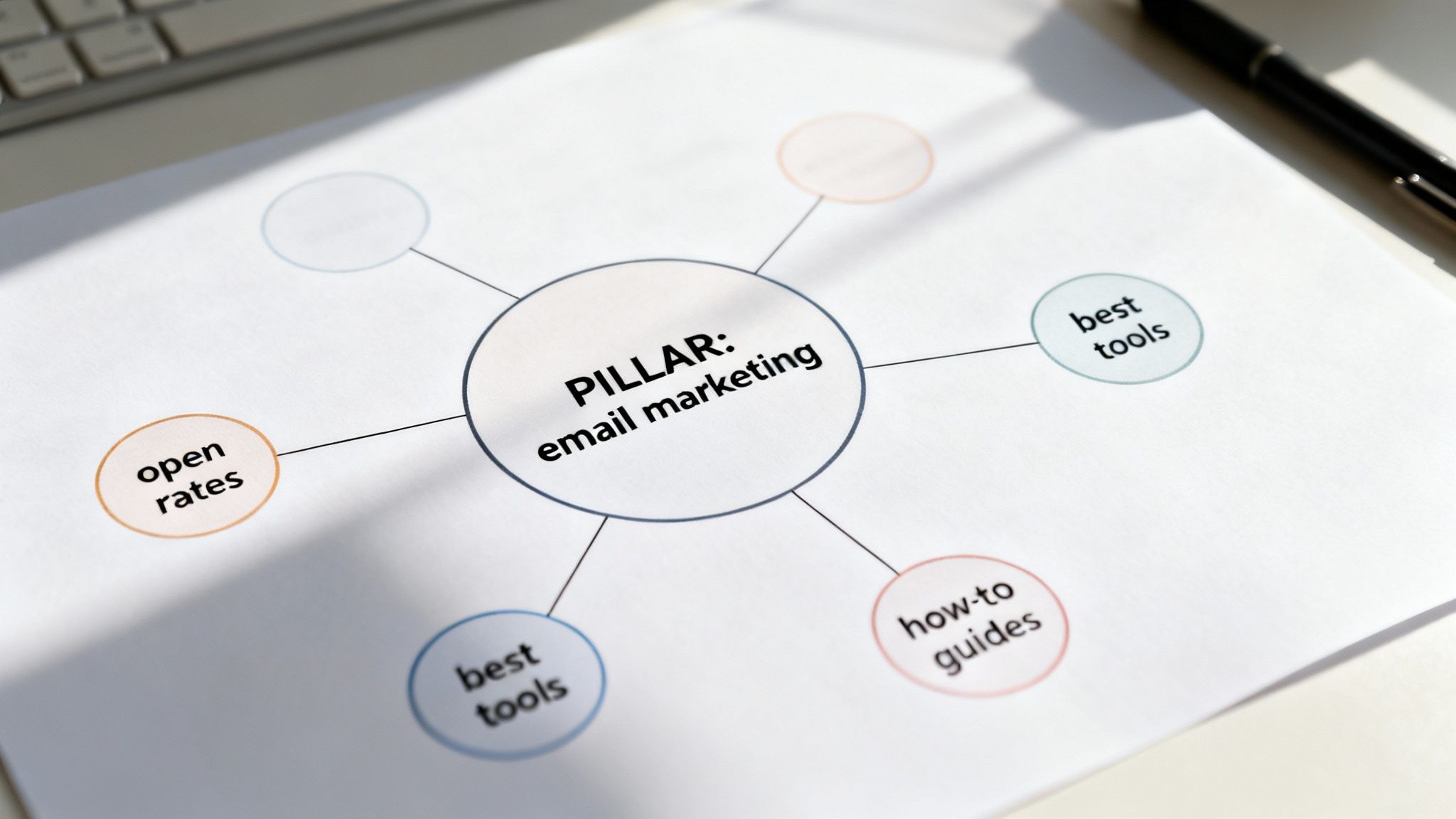
Once you’ve mapped your keywords to their intent, the next step is to organize them into topic clusters. This is where your strategy really starts to take shape. The model is simple: you create one central "pillar" page on a broad topic and then support it with several in-depth "cluster" pages that cover specific subtopics.
This structure does wonders for your SEO. It signals to search engines that you have deep expertise on a subject, making you a trusted authority.
Let's walk through a real-world example using the pillar topic "email marketing software."
Pillar Page Keyword:
- email marketing software (Informational/Commercial)
This pillar page would be your ultimate, comprehensive guide. It covers everything a user needs to know at a high level and acts as the central hub that all related, more specific content links back to.
Cluster Page Keywords: From there, we branch out and identify more specific, long-tail keywords. These become our cluster pages, with each one targeting a very distinct user need.
- best free email marketing tools (Commercial)
- how to improve email open rates (Informational)
- Mailchimp vs Constant Contact (Commercial)
- email marketing automation examples (Informational)
- email marketing software pricing (Transactional)
Each of these cluster pages is a detailed article focused squarely on its target keyword. And here's the crucial part: every single cluster page links back up to the main pillar page. This internal linking strategy is essential. It funnels authority to your most important page and helps Google understand the topical relationship between all your content.
This organized approach is lightyears more effective than just publishing a series of disconnected blog posts. It’s also helpful to understand the nuances of how search engines treat different phrasing and variations of these terms. Learning about how keywords match type works in paid search can offer valuable insights for your organic strategy, too.
By structuring your content this way, you create a powerful, interconnected web of information that comprehensively covers a topic. This builds topical authority, improves the user experience by guiding visitors to related content, and strengthens the entire foundation of your keyword strategy SEO.
Right, you've done the heavy lifting and organized your keywords into neat, strategic clusters. This is where the magic really starts to happen. It's time to take that blueprint and turn it into a living, breathing content plan that will guide your entire keyword strategy SEO. We're officially moving from research to production.
Each cluster you've built is more than just a list of terms; it's a topic you're aiming to own. The goal here isn't just to fill slots on a calendar. It's to build a cohesive content ecosystem, piece by piece, that establishes your topical authority and guides your audience through their journey.
Prioritizing Your Content Pipeline
Let's be real: you can't create everything at once. That’s why ruthless prioritization is your best friend. A smart content plan is all about balancing the quick wins with the long-term strategic plays. I've found a simple scoring system that weighs three key factors is the best way to decide what to tackle first.
This framework strips away the guesswork and channels your limited resources where they'll make the biggest impact.
- Search Potential: This is a blend of raw monthly search volume and the realistic traffic potential. Sure, high-volume keywords look great on paper, but you should also look at the traffic the current top-ranking pages get for the whole cluster.
- Business Value: How directly does this topic connect to what you sell? A lower-volume keyword with high purchase intent can be infinitely more valuable than a broad, top-of-funnel term that just attracts eyeballs.
- Ability to Win: Time for an honest assessment. How tough is this keyword, and who's currently sitting on page one? Focus on topics where you have a legitimate shot at ranking within a reasonable timeframe.
By scoring each cluster against these criteria, you get a data-informed production schedule. The topics that score high across the board? Those are your sweet spots. Start there.
Building a Data-Informed Content Calendar
Your content calendar should be more than a simple schedule. It's your team's single source of truth for execution, ensuring every piece of content has a home and a clear purpose.
A solid calendar maps each keyword cluster to a specific content asset and includes all the key details needed to guide production from start to finish.
| Cluster (Pillar/Topic) | Target Keyword | Content Title (Draft) | Format | Status |
|---|---|---|---|---|
| Email Marketing Software | best email marketing tools | The 9 Best Email Marketing Tools (We Tested Them) | Listicle | Briefing |
| Email Marketing Software | how to write a newsletter | How to Write a Newsletter That People Actually Read | Guide | Writing |
| Email Marketing Software | email marketing analytics | 12 Email Marketing KPIs You Should Be Tracking | Blog Post | Published |
This kind of structure keeps everyone aligned and makes it easy to track progress from the initial idea all the way to publication.
Don't underestimate how critical this planning is. Recent data shows that 72% of marketers believe relevant content creation is their most effective SEO tactic. And with 84% of organizations now having a content marketing strategy, a well-organized plan is what separates you from the noise. You can discover more insights about SEO effectiveness to see just how much a structured approach pays off.
Pro Tip: Your calendar isn't just for new content. Schedule regular "content refreshes" for your existing articles. Updating a post with new data, fresh examples, or better insights can often give you a much faster SEO boost than creating something from scratch.
From Plan to Production with AI-Powered Briefs
Once a topic makes it onto the calendar, the next step is building a detailed content brief for your writers. This used to be a huge time-sink, but now it’s a perfect place to bring in AI to speed things up and bake SEO best practices in from the very beginning.
Tools like IndexPilot are built for this. They can analyze the top-ranking content for your target keyword and generate a comprehensive, data-informed outline in minutes. This brief often includes:
- Optimal Structure: A breakdown of recommended H2 and H3 headings based on what’s already winning.
- Key Questions to Answer: Insights pulled directly from Google's "People Also Ask" sections to ensure your content is thorough.
- Semantic Keywords: A list of related terms and entities to include for building topical depth.
- Word Count & Readability Targets: Clear benchmarks based on the competitive landscape.
Giving your writers this level of detail means they aren't just creating content; they're creating content that's engineered to rank. It's the final, crucial bridge between your keyword strategy and the published article, setting every single piece up for success.
Executing Flawless On-Page SEO and Internal Linking
You’ve got your keyword clusters and a solid content plan. That’s the strategic blueprint. Now it’s time to roll up our sleeves and get tactical, making sure every single piece of content is perfectly tuned to rank.
This is where meticulous on-page SEO and a smart internal linking structure come into play. Together, they form the technical glue holding your entire keyword strategy SEO together.
Think of on-page SEO as the final polish before you ship. It’s how you signal to search engines that your content is the most relevant, clear, and authoritative answer out there. This goes way beyond just sprinkling in some keywords; it's about creating a perfectly structured, contextually rich experience for both people and search engine crawlers.
This isn’t about keyword stuffing. It's about clarity. A well-optimized page is just plain easy for Google to understand, and that understanding translates directly into better performance.
Mastering Your On-Page SEO Checklist
To execute flawlessly time and time again, you need a repeatable checklist for every article. This keeps your quality consistent and ensures no critical elements slip through the cracks. The basics might seem obvious, but the real difference is in the details.
Here are the absolute non-negotiables to optimize for your primary and secondary keywords on every post:
- Title Tag: This is your single most important on-page element. Your primary keyword should be as close to the beginning as possible, followed by a hook that makes people want to click.
- Meta Description: While not a direct ranking factor, a great meta description sells the click in the SERPs. Include your primary keyword and a clear benefit that answers the user's question: "Why should I click your result?"
- H1 Heading: Your H1 is the main headline on the page. It needs to align closely with your title tag and state the page's topic clearly, weaving in your primary keyword naturally.
- Image Alt Text: Don't skip this. Every image needs descriptive alt text. It’s a prime opportunity to include your primary or secondary keywords where it makes sense, which boosts both accessibility and contextual relevance for search engines.
Beyond these core four, you'll want to weave your primary and secondary keywords into your introduction, your subheadings (H2s, H3s), and throughout the body copy. The key is to make it feel completely natural and helpful, not forced.
Building Context with Semantic SEO
Just repeating your target keyword over and over is a strategy from a decade ago. Modern search engines are far more sophisticated; they focus on understanding the topic as a whole. This is where semantic SEO and related entities become your secret weapon.
An "entity" is just a specific person, place, or concept that Google understands. By including relevant entities and semantically related terms in your content, you build a stronger contextual web around your main topic, showing Google you're an expert.
For example, an article targeting "keyword strategy seo" shouldn't just repeat that phrase. It should also naturally include related terms and entities like search intent, topic clusters, SERP analysis, Google Search Console, Ahrefs, and long-tail keywords.
This approach proves to Google that your content is comprehensive and covers the topic in-depth, not just scratching the surface. It’s what separates a thin, forgettable article from an authoritative resource.
Architecting a Powerful Internal Linking Structure
Internal linking is easily one of the most underutilized—and most powerful—tools in an SEO's arsenal. Your topic cluster model gives you the perfect blueprint for creating a logical and powerful internal link structure that can seriously accelerate rankings.
The strategy is simple but incredibly effective:
- Link from Cluster Pages to the Pillar Page: Every single cluster page (your specific, long-tail articles) must link back up to its corresponding pillar page (the broad, foundational guide). This is non-negotiable.
- Use Descriptive Anchor Text: The clickable text of your internal link needs to be descriptive. Use variations of the target page's primary keyword to give search engines strong context. Ditch generic anchor text like "click here" for good.
- Link Between Relevant Cluster Pages: Don't hesitate to link between related cluster pages within the same topic hub. This strengthens the topical relationship between them and makes it easier for users to navigate your site.
This structure funnels authority from all your detailed cluster pages up to your main pillar page, signaling its importance to Google. At the same time, it distributes "link equity" across your site, helping new content get discovered and indexed faster. As you scale, you can even explore more advanced methods like building a system for automated internal links to maintain this structure without all the manual work.
By combining meticulous on-page optimization with a strategic internal linking plan, you ensure every piece of content you create has the best possible chance to rank, drive traffic, and build your overall topical authority.
Measuring and Refining Your Keyword Strategy
Hitting "publish" on a new piece of content feels great, but it’s really just the starting line. A truly effective keyword strategy SEO isn't a "set it and forget it" task. It's a living system that needs constant attention. What works today might be old news tomorrow, and the only way to keep winning is to let the data lead the way.
This final part of the process is all about closing the loop. We’re going to get into tracking performance, figuring out what the numbers actually mean, and using those insights to make your strategy smarter and more effective over time.

Pinpointing Your Key Performance Indicators
You can't improve what you don't measure. It’s easy to get lost in a sea of vanity metrics, so the trick is to focus on the handful of KPIs that actually tell you if your keyword strategy is working. Your go-to sources for this will be Google Search Console and Google Analytics.
These are the core metrics you should have your eyes on:
- Keyword Rankings: This is your most direct feedback. Are you climbing the SERPs for your target terms? Tracking this tells you if your on-page SEO and internal linking are hitting the mark.
- Organic Traffic: Higher rankings should mean more visitors. Keep an eye on overall organic traffic, but also zoom in on individual pages to see which new articles are pulling their weight.
- Click-Through Rate (CTR): You'll find this gem in Google Search Console. It shows how well your page stands out on the results page. A high ranking with a low CTR is a huge red flag that your title or description isn't compelling.
- Conversions and Goal Completions: This is where the rubber meets the road. Is your content driving demo requests, email sign-ups, or sales? You have to tie your SEO efforts back to actual business results.
Make sure the metrics you track are tied to your bigger business goals. For a more detailed approach, our guide on how to track keyword rankings lays out a complete framework for getting this set up.
Interpreting the Data and Taking Action
Collecting data is the easy part. The real magic happens when you figure out what to do with it. Your metrics tell a story, and your job is to listen and react.
Here are a few common situations you'll run into and what to do about them:
| Scenario | What It Means | Recommended Action |
|---|---|---|
| High Rankings, Low CTR | People see you, but your title tag and meta description aren't grabbing their attention. | Time to A/B test. Write more benefit-driven, curiosity-inducing titles and metas to earn that click. |
| High Traffic, Low Conversions | You're getting an audience, but the content isn't convincing them to take the next step. | Take a hard look at the on-page experience. Is the call-to-action buried? Does the content really match search intent? |
| Rankings Stuck on Page Two | The content is solid, but it just doesn't have the authority to crack the top 10. | This page needs more love. Funnel more high-quality internal links to it and hunt for external backlink opportunities. |
| Ranking for the Wrong Keywords | The page is getting traffic for terms that aren't relevant, which usually leads to a high bounce rate. | Go back and re-optimize. Sharpen the focus of the content to better align with its primary keyword and user intent. |
This isn't just about reporting; it's about turning data into a game plan for continuous improvement.
Key Takeaway: Don't just look at the data—interrogate it. Always ask "why" behind the numbers. Why did CTR tank this month? Why did conversions on that one page suddenly spike? The answers are how you build a smarter keyword strategy.
Knowing When to Refresh vs Create New Content
As your content library grows, you'll constantly face a big question: update an old post or write a new one? Making the right call here is key to using your time and resources effectively.
Go for a content refresh when:
- An article's rankings are slowly slipping over time.
- The information, stats, or examples are getting stale.
- A competitor just one-upped you with a more comprehensive piece.
- The page gets decent traffic but you know it could do better.
Create something new when:
- You’re targeting a completely new keyword cluster or subtopic.
- The search intent for a topic has totally changed, demanding a different format (e.g., a video instead of a blog post).
- You don't have any existing content that could be logically expanded to cover the new keyword.
A simple content refresh can often give you a massive SEO boost for a fraction of the effort of starting from scratch. While Google's algorithm has over 200 factors, fresh, relevant content is a huge signal. With the top organic result getting around 27.6% of all clicks, keeping your best content in top shape is one of the smartest moves you can make.