Organic search traffic represents one of the most valuable assets a business can build. Unlike paid advertising that stops the moment you pause spending, organic traffic compounds over time. Every piece of optimized content becomes a persistent sales channel, working around the clock to attract visitors actively searching for solutions you provide.
Yet despite publishing content regularly, many marketers watch their traffic flatline. They're caught in a cycle of creating without strategy, optimizing without direction, and measuring without clarity.
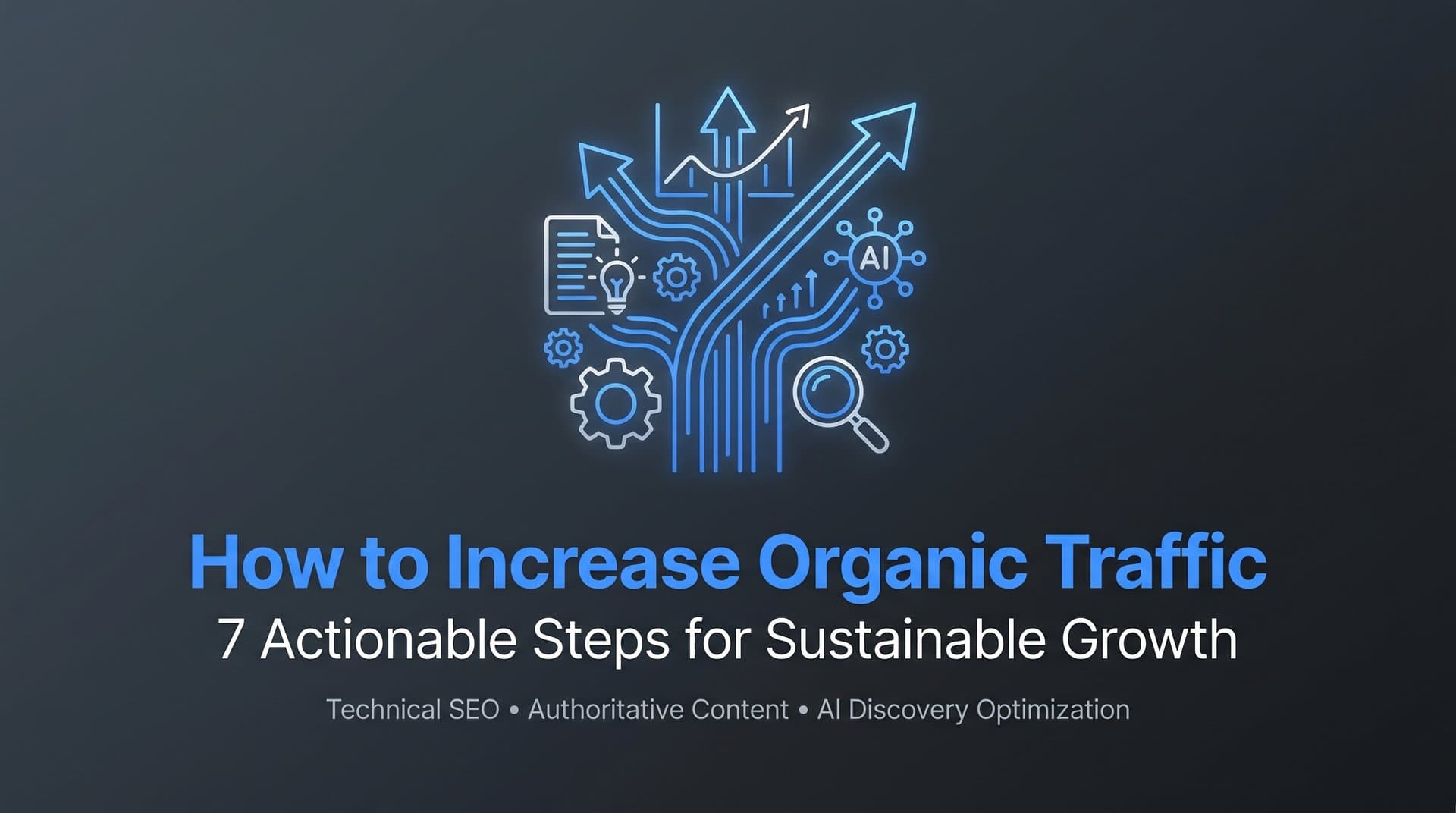
The difference between stagnant and growing organic traffic isn't effort—it's framework. This guide presents a systematic seven-step approach to increase organic search traffic sustainably. You'll learn to audit your current performance, identify high-impact opportunities, optimize strategically, and expand into emerging channels like AI search platforms.
Each step builds on the previous one, creating compound effects that accelerate over time. Whether you're starting from zero or breaking through a plateau, this framework provides your roadmap.
Step 1: Audit Your Current Search Performance and Identify Gaps
You can't improve what you don't measure. The first step toward increasing organic search traffic is understanding exactly where you stand today.
Start by verifying your Google Search Console setup. This free tool from Google shows how your site appears in search results, which queries trigger your pages, and where technical issues might be blocking your visibility. If you haven't claimed your property yet, do it now—historical data only appears after you've connected the tool.
Inside Search Console, navigate to the Performance report. Export your last 90 days of data, focusing on queries where you rank between positions 5-20. These represent your quickest wins. Pages ranking on the second page of Google already have some authority and relevance—they just need optimization to break into the top positions where most clicks happen.
Document Your Baseline Metrics: Record your current impressions, clicks, click-through rate, and average position for each important page. These numbers become your benchmark for measuring improvement. Understanding what organic traffic looks like in Google Analytics helps you correlate Search Console data with actual site behavior.
Next, analyze which content types currently drive the most traffic. Are your how-to guides outperforming product pages? Do listicles attract more visitors than case studies? Understanding what already works helps you double down on successful formats.
Finally, identify content gaps where competitors rank but you don't. Use your Search Console data to find queries related to your business where you have zero visibility. These gaps represent untapped opportunities—topics your audience is actively searching for that you haven't addressed yet.
The success indicator for this step is simple: you have a spreadsheet documenting your baseline metrics, your quick-win opportunities ranked by potential impact, and a list of content gaps to address. This audit becomes the foundation for everything that follows.
Step 2: Build a Keyword Strategy Around Search Intent
Not all keywords deserve equal attention. A keyword strategy without search intent is like a map without a destination—you might be moving, but you're not necessarily going anywhere useful.
Search intent describes what users actually want when they type a query. Someone searching "what is content marketing" has informational intent—they want to learn. Someone searching "content marketing software pricing" has commercial intent—they're evaluating options. Understanding what search intent means in SEO determines which keywords drive business results versus which just inflate vanity metrics.
Categorize Your Keywords by Intent: Sort your target keywords into four buckets. Informational queries attract top-of-funnel traffic and build awareness. Navigational queries come from people looking for specific brands or resources. Commercial queries indicate research and comparison—these visitors are closer to decisions. Transactional queries signal immediate purchase intent.
Prioritize keywords that balance low competition with high relevance to your business goals. A keyword with 100,000 monthly searches means nothing if it attracts the wrong audience or if you'll never rank for it. Mastering keyword research for organic SEO helps you identify terms where you can realistically reach the first page within 3-6 months based on your current domain authority.
Create topic clusters that establish topical authority. Instead of isolated articles on random subjects, build content ecosystems. A pillar page covers a broad topic comprehensively, while cluster content dives deep into specific subtopics, all linking back to the pillar. This structure signals to search engines that you're an authority on the entire topic, not just individual keywords.
Balance head terms with long-tail opportunities. Head terms like "SEO" have massive search volume but fierce competition. Long-tail variations like "SEO strategies for B2B SaaS companies" have lower volume but higher intent and less competition. Your strategy needs both—head terms for authority, long-tail for conversion.
Verify your success by ensuring your keyword map covers all stages of the buyer journey. If you only target bottom-funnel keywords, you miss the opportunity to build awareness. If you only create top-funnel content, you attract traffic that never converts. Complete coverage means you're visible wherever your audience searches, regardless of their stage.
Step 3: Optimize Existing Content for Higher Rankings
Creating new content gets attention, but optimizing existing pages often delivers faster results. You've already invested in these pages—they're indexed, they have some authority, and they're ranking for something. Strategic optimization can unlock their full potential.
Start by updating outdated information. Content from two years ago might rank decently, but outdated statistics, deprecated tools, or old examples undermine credibility. Search engines favor fresh, current content. Go through your top 20 pages and update anything that references old data or outdated practices.
Improve Title Tags and Meta Descriptions: These elements don't directly impact rankings, but they dramatically affect click-through rates. A page ranking fifth with a compelling title and description can attract more clicks than a page ranking third with generic copy. Write titles that include your target keyword naturally while promising clear value. Keep them under 60 characters to avoid truncation in search results.
Add strategic internal links to and from high-authority pages. Your homepage and most-linked pages have accumulated authority over time. When they link to other pages, they pass some of that authority along. Identify your strongest pages and add contextual links to pages you want to boost. Simultaneously, link back to these authority pages from newer content to create a web of relevance signals.
Enhance content depth by addressing related questions. Check the "People Also Ask" boxes that appear in search results for your target keywords. These represent real questions users have about your topic. Incorporate answers to these questions naturally within your content, expanding its comprehensiveness without bloating it unnecessarily.
Monitor your rankings for optimized pages weekly. Improvements typically appear within 4-6 weeks, though competitive terms may take longer. If a page doesn't improve after optimization, that's data—it tells you the page might need more substantial changes, more authoritative backlinks, or that the keyword might be too competitive for your current domain strength. For detailed tactics, explore proven methods to improve organic search ranking.
Step 4: Create New Content Targeting Identified Opportunities
With your existing content optimized, turn attention to the gaps you identified in Step 1. New content targeting these opportunities expands your visibility into searches where you're currently invisible.
Develop detailed content briefs before writing. A brief should include your target keyword, search intent, competing pages that currently rank, unique angles or data you'll include, and the key questions you'll answer. This upfront planning prevents generic content that duplicates what already ranks without adding new value.
Structure Content for Scannability: Most readers scan before they read deeply. Use clear heading hierarchies that let someone understand your main points by reading H2 and H3 tags alone. Break up long paragraphs into 2-4 sentence blocks. Use bold text to highlight key concepts within paragraphs, creating visual anchors that guide the eye.
Include original insights, data, or perspectives that differentiate your content from competitors. Generic advice regurgitated from the top ten results won't outrank those results. What unique experience, data, or methodology can you contribute? Original research, case studies, or proprietary frameworks give search engines and readers reasons to choose your content over alternatives.
Optimize specifically for featured snippets and People Also Ask boxes. These prominent positions can dramatically increase visibility even if you don't rank first organically. Format answers concisely—featured snippets typically pull 40-60 word excerpts. Use definition formats for "what is" queries, numbered lists for process questions, and tables for comparison queries.
Track how quickly new content gets indexed and where it ranks initially. Most pages should appear in search results within days if you have proper sitemap automation. Initial rankings might be low, but they establish a baseline. Understanding how blogging grows organic traffic helps you set realistic expectations for content that doesn't get indexed within two weeks—signaling technical issues that need immediate attention.
Step 5: Strengthen Technical SEO and Site Performance
Even brilliant content fails if technical issues prevent search engines from crawling, indexing, or ranking it properly. Technical SEO creates the foundation that makes all other optimization efforts possible.
Start with Core Web Vitals—Google's metrics for page experience. Largest Contentful Paint measures loading performance and should occur within 2.5 seconds. First Input Delay measures interactivity and should be under 100 milliseconds. Cumulative Layout Shift measures visual stability and should stay below 0.1. Use Google's PageSpeed Insights tool to identify specific issues slowing your pages.
Fix Crawl Errors and Broken Links: Search Console's Coverage report shows pages Google can't access or index. Address these systematically. Broken links frustrate users and waste crawl budget—the time search engines allocate to crawling your site. Use tools to scan for 404 errors and either fix the links or implement proper 301 redirects.
Implement schema markup to help search engines understand your content structure. Schema is structured data that explicitly tells search engines what your content represents—whether it's an article, a product, a recipe, or an event. Proper schema markup can trigger rich results like star ratings, price information, or FAQ accordions directly in search results, increasing visibility and click-through rates.
Ensure mobile-first optimization across all pages. Google predominantly uses the mobile version of content for indexing and ranking. If your mobile experience is broken or limited compared to desktop, your rankings suffer. Test every important page on actual mobile devices, not just browser emulators, to catch issues that affect real users.
Accelerate indexing with sitemap automation and IndexNow protocols. Instead of waiting for search engines to discover your new content, proactively notify them. Understanding the differences between IndexNow and Google Search Console helps you choose the right approach. Automated sitemap updates ensure your XML sitemap reflects your current content immediately, dramatically reducing the time between publication and indexing.
Step 6: Build Authority Through Strategic Link Acquisition
Backlinks remain one of the strongest ranking signals. They represent votes of confidence from other sites—signals that your content is valuable enough to reference and recommend.
The most sustainable link acquisition strategy is creating genuinely linkable assets. Original research naturally attracts links because other content creators need data to support their arguments. Free tools solve problems for users and get referenced repeatedly. Comprehensive guides become go-to resources that others cite as authoritative sources.
Pursue Relevant Industry Mentions: Identify publications, blogs, and resources in your industry that accept contributions or cover topics related to your expertise. Quality matters more than quantity—one link from an authoritative industry publication carries more weight than dozens from low-quality directories. Focus on relationships, not transactions. Contribute genuine value, and links follow naturally.
Reclaim unlinked brand mentions across the web. Many sites mention your brand, products, or team members without linking to you. Use monitoring tools to find these mentions, then reach out with a simple request to turn the mention into a link. This works because the hard part—getting mentioned—already happened. You're just asking for proper attribution.
Monitor your backlink profile and disavow toxic links. Not all links help—some can actually harm your rankings. Links from spam sites, link farms, or obviously manipulative sources send negative signals. Regularly audit your backlinks and use Google's disavow tool to tell search engines to ignore problematic links you can't remove.
Track the growth of referring domains from quality sources. A steady increase in diverse, relevant backlinks indicates healthy link acquisition. Sudden spikes might signal unnatural link building that could trigger penalties. Aim for consistent, gradual growth from sites with genuine topical relevance to your business.
Step 7: Expand Visibility Across AI Search Platforms
Search behavior is evolving. Users increasingly turn to AI assistants like ChatGPT, Claude, and Perplexity for answers instead of traditional search engines. These platforms represent a new frontier for organic visibility—one where many brands have zero presence simply because they haven't optimized for it yet.
AI models surface information differently than traditional search engines. They synthesize answers from multiple sources, often citing specific brands or resources when providing recommendations. Understanding how these models comprehend and reference content creates opportunities to generate organic traffic from AI search platforms.
Optimize Content Structure for AI Comprehension: AI models excel at processing clearly structured information. Use descriptive headings that explicitly state what each section covers. Define terms clearly when first introducing them. Structure lists and processes in logical sequences. Following proven AI search optimization strategies makes it easier for AI to understand and extract information from your content, increasing the likelihood of becoming a source for AI-generated answers.
Monitor where and how AI platforms mention your brand. Just as you track traditional search rankings, tracking AI visibility shows you which topics trigger brand mentions, what sentiment those mentions carry, and where opportunities exist to increase presence. This visibility data reveals content gaps—topics where AI assistants frequently respond but never mention your brand.
Create content that answers questions AI assistants commonly receive. AI platforms handle millions of queries daily across every topic imaginable. By creating comprehensive, authoritative content that addresses these questions better than existing sources, you increase the likelihood of being cited when users ask related questions. If you're struggling with visibility, learn why your content might not be ranking in AI search results.
The success metric for AI visibility is straightforward: increased brand mentions across AI platforms when users ask questions related to your expertise. This emerging channel won't replace traditional search, but it represents significant opportunity for brands that optimize for it early while competition remains relatively low.
Putting It All Together
Sustainable organic search traffic growth comes from systematic execution across these seven interconnected steps. Each builds on the previous, creating compound effects that accelerate over time.
Start with your audit to establish baseline metrics and identify opportunities. Build a keyword strategy rooted in search intent, ensuring you target terms that actually drive business results. Optimize your existing content before creating new pages—quick wins from optimization fund the longer-term investment in new content creation.
Layer in technical improvements that ensure search engines can properly crawl, index, and rank your content. Build authority through strategic link acquisition, focusing on quality over quantity. And don't ignore the emerging opportunity of AI search visibility—early movers in this space are establishing presence while competition remains manageable.
Your Implementation Checklist: Baseline metrics documented in Search Console. Keyword map complete with intent categorization. Top 10 existing pages optimized for target keywords. Content calendar active with new pages targeting identified gaps. Critical technical issues resolved and Core Web Vitals improved. Link building strategy implemented with monthly outreach targets. AI visibility monitoring established across major platforms.
Track progress monthly, not daily. Organic SEO rewards patience and consistency over quick fixes. Most optimizations take 4-8 weeks to show measurable impact. Some competitive keywords might take 6-12 months to crack the first page. The key is maintaining momentum—consistent optimization, regular content creation, ongoing technical improvements.
Remember that organic traffic compounds. A page ranking today continues attracting visitors next month, next quarter, next year. Every optimized page becomes a persistent asset. Every piece of content targeting the right intent creates a new entry point for your ideal audience. Every technical improvement lifts all your pages simultaneously.
The marketers who win at organic search aren't necessarily the ones with the biggest budgets or the largest teams. They're the ones who execute systematically, measure rigorously, and iterate continuously. This framework gives you the roadmap—execution determines your results.
Stop guessing how AI models like ChatGPT and Claude talk about your brand—get visibility into every mention, track content opportunities, and automate your path to organic traffic growth. Start tracking your AI visibility today and see exactly where your brand appears across top AI platforms.