Your competitor just got recommended by ChatGPT to a potential customer asking about solutions in your category. Your brand? Not mentioned. Not even considered.
This isn't a hypothetical scenario. Right now, thousands of people are asking AI assistants like ChatGPT for product recommendations, service comparisons, and buying advice. These conversations are happening without your knowledge, and if your brand isn't part of them, you're losing market share to competitors who are.
The shift is already underway. AI-powered search is replacing traditional Google queries for product research, and the recommendations these AI models provide carry enormous trust weight with users. When ChatGPT suggests three project management tools and yours isn't one of them, that's not just a missed opportunity—it's a competitive disadvantage you can't see or measure with traditional analytics.
Here's what makes this particularly challenging: you can track your Google rankings, monitor social media mentions, and analyze website traffic. But how do you know if ChatGPT is recommending your brand? How do you discover when competitors are being suggested instead of you? How do you identify the specific contexts where your brand should appear but doesn't?
Most brands are operating completely blind in this new landscape. They have zero visibility into their AI mention patterns, no understanding of how AI models discuss their products, and no systematic way to improve their positioning in AI-powered recommendations.
This guide changes that. You're about to build a complete monitoring system that reveals exactly how ChatGPT discusses your brand, identifies gaps where competitors are winning, and provides the intelligence you need to optimize your AI visibility strategically.
We'll walk through this in four focused steps: building your monitoring framework, executing strategic manual testing, implementing scalable automation, and optimizing based on the intelligence you gather. By the end, you'll have a systematic approach that most of your competitors lack—giving you first-mover advantage in AI-powered search.
Let's start by building the foundation that makes effective monitoring possible.
Step 1: Build Your Brand Mention Detection Framework
Before you can monitor effectively, you need to know exactly what you're tracking. Most brands jump straight to tools and automation, then wonder why they're missing critical mentions or drowning in irrelevant data.
The problem? They never mapped their complete brand universe.
Your brand exists in AI training data under dozens of variations—your company name, product names, executive names, proprietary methodologies, even common misspellings. If you're only monitoring your official brand name, you're operating with massive blind spots.
Mapping Your Complete Brand Universe
Start by creating a master tracking list that captures every way your brand might appear in ChatGPT responses. This isn't about vanity—it's about comprehensive intelligence.
Company Name Variations: Include your full legal name, common abbreviations, and frequent misspellings. If you're "TechCorp Solutions," track "TechCorp," "Tech Corp," "Techcorp," and even "TekCorp" if that's a common error.
Product and Service Names: List every product, service, and feature name—including discontinued offerings that might still appear in AI training data. Your legacy product from 2019 might still be getting mentioned.
Executive and Thought Leadership Terms: Add founder names, executive names, and any proprietary methodologies or frameworks your company is known for. If your CEO is a recognized industry voice, their name is a tracking term.
Category and Industry Terms: Include the specific terminology your brand is associated with. Not just "project management software," but "agile project management," "remote team collaboration," or whatever niche you own.
Your goal is a master list of 15-25 monitoring terms. While this manual mapping is essential for comprehensive coverage, ai brand visibility tracking tools can automate the detection of brand name variations, product mentions, and associated terminology across all major AI models.
Creating Your Monitoring Query Strategy
Different query types reveal different mention patterns. A direct "best [category] tools" query shows different competitive dynamics than a "how to solve [problem]" query.
You need a query strategy that mirrors how real customers actually ask questions.
Direct Recommendation Queries: These are straightforward "best X for Y" questions. Test queries like "best project management tools for remote teams" or "top CRM software for small businesses." These reveal when you're being recommended versus competitors.
Comparison Queries: Create queries that pit you against competitors: "X vs Y vs Z comparison" or "alternatives to [competitor name]." These show how ChatGPT positions your brand relative to others.
Problem-Solving Queries: Frame queries around specific customer pain points: "how to improve team collaboration across time zones" or "reducing customer churn in SaaS." These reveal whether your brand appears as a solution to specific problems.
Industry Trend Queries: Test broader queries about your industry's future: "future of remote work tools" or "emerging trends in marketing automation." These show whether you're positioned as an industry leader or follower.
Develop 8-10 core query templates that cover different stages of the customer journey. A SaaS company might test early-stage awareness queries ("what is customer success software"), mid-stage consideration queries ("best customer success platforms for B2B"), and late-stage decision queries ("Gainsight vs ChurnZero vs Totango").
The key is variety. If you only test direct recommendation queries, you'll miss the problem-solving contexts where your brand should appear but doesn't. If you only test your category, you'll miss adjacent opportunities where competitors are capturing mindshare.
Document each query template with the strategic insight it's designed to reveal. "Best [category] for [use case]" queries reveal competitive positioning. "How to [solve problem]" queries reveal solution association. "Future of [industry]" queries reveal thought leadership positioning.
This query strategy becomes the foundation for both manual testing and automated monitoring. You're not just tracking mentions—you're mapping the complete landscape of how AI models discuss your brand across every relevant context.
Step 2: Execute Strategic Manual Testing
Now that you know what to track and how to query for it, it's time to see exactly how ChatGPT currently discusses your brand. Manual testing might seem tedious, but it reveals nuanced patterns that automated tools often miss.
This isn't about checking a few queries and moving on. Strategic manual testing means systematically exploring how ChatGPT responds across different contexts, use cases, and competitive scenarios. The intelligence you gather here informs everything that follows.
Designing Effective Test Prompts
The quality of your insights depends entirely on the quality of your prompts. Generic queries produce generic insights. Strategic prompts reveal actionable patterns.
Use Customer Language, Not Marketing Speak: Real customers don't ask "What's the leading enterprise-grade customer relationship management solution?" They ask "What CRM should I use for my sales team?" Test with the actual language your customers use.
Test Both Direct and Indirect Scenarios: Direct queries mention your brand explicitly: "Is [YourBrand] good for [use case]?" Indirect queries don't: "What's the best tool for [use case]?" Both reveal different positioning dynamics.
Include Competitor Comparison Prompts: Test head-to-head comparisons with your top three competitors. How does ChatGPT position you relative to them? What strengths and weaknesses does it highlight?
Vary Specificity Levels: Test broad industry queries ("best marketing automation tools"), mid-level category queries ("best email marketing platforms for e-commerce"), and highly specific use case queries ("best abandoned cart email tool for Shopify stores").
A cybersecurity company discovered through systematic testing that ChatGPT consistently recommended them for enterprise security solutions but never mentioned them for small business needs—even though they had SMB products. This revealed a positioning gap that manual testing exposed but automated tools might have missed without proper context.
Develop 12-15 test prompts that mirror real customer questions across different awareness stages, use cases, and competitive contexts. Document each prompt with the hypothesis you're testing: "This prompt should reveal whether we're associated with [specific use case]" or "This comparison should show how we're positioned against [competitor]."
Analyzing Response Patterns and Context
Mention frequency tells you almost nothing. What matters is the context surrounding your mentions—how you're positioned, what triggers your brand to appear, and what's said about you when you do appear.
Document Mention Positioning: Are you mentioned first as a top recommendation, or buried as an alternative? Are you the primary suggestion or a "you might also consider" afterthought? Position matters more than presence.
Track Sentiment and Positioning Language: What specific language does ChatGPT use to describe your brand? "Industry-leading," "cost-effective alternative," "best for beginners," or "enterprise-focused"? This language reveals how AI models have learned to position your brand.
Note What Triggers Your Brand Mentions: Which specific query elements cause your brand to appear? Is it certain use cases, company sizes, industries, or problem types? Understanding triggers helps you optimize for the contexts that matter most.
Identify Competitive Gaps: Pay special attention to queries where competitors appear but you don't. These gaps represent immediate optimization opportunities—contexts where you should be visible but aren't.
A marketing automation platform discovered through response analysis that ChatGPT consistently mentioned them positively but always included caveats about pricing being "on the higher end." This wasn't just a mention—it was a perception issue that needed addressing through content that demonstrated ROI and value justification.
Create a systematic documentation process for each test. Record the exact prompt, the full response, whether your brand was mentioned, positioning relative to competitors, sentiment indicators, and any notable patterns. This structured approach transforms random testing into actionable intelligence.
These testing insights become the foundation for developing a comprehensive ai content strategy that improves your brand's visibility and positioning in AI recommendations based on real data rather than assumptions.
Step 3: Implement Scalable Monitoring Systems
Manual testing reveals patterns, but you can't manually test ChatGPT every day. You need systematic monitoring that provides ongoing intelligence without consuming all your time.
The goal isn't just automation—it's building a monitoring system that balances comprehensive coverage with actionable insights. Too narrow and you miss critical mentions. Too broad and you drown in noise.
Choosing Your Monitoring Approach
Different monitoring methods serve different strategic purposes and resource constraints. Your choice depends on your technical capabilities, budget, and how critical AI visibility is to your business.
API-Based Monitoring: If you have development resources, you can build custom monitoring using OpenAI's API. This provides maximum control and customization but requires ongoing technical maintenance and API costs.
Third-Party Monitoring Platforms: Specialized ai monitoring tools provide comprehensive tracking across multiple AI models with built-in analytics and reporting. This approach offers the most complete coverage with minimal technical overhead.
Hybrid Manual-Automated Approaches: Some teams combine weekly automated monitoring with monthly deep-dive manual testing. This balances efficiency with nuanced insight gathering.
Resource Investment Considerations: A mid-size B2B company compared weekly manual checks versus daily automated monitoring. The automated approach caught a competitor's sudden surge in mentions within 48 hours, allowing them to investigate and respond quickly. The manual approach would have missed this shift entirely until the monthly review.
Select your monitoring frequency based on competitive landscape intensity. Highly competitive markets with frequent product launches and positioning shifts need daily monitoring. Stable markets with slower change cycles can use weekly monitoring effectively.
Configuring Actionable Alert Systems
Raw monitoring data isn't useful. You need alert systems that filter signal from noise and prompt action when it matters.
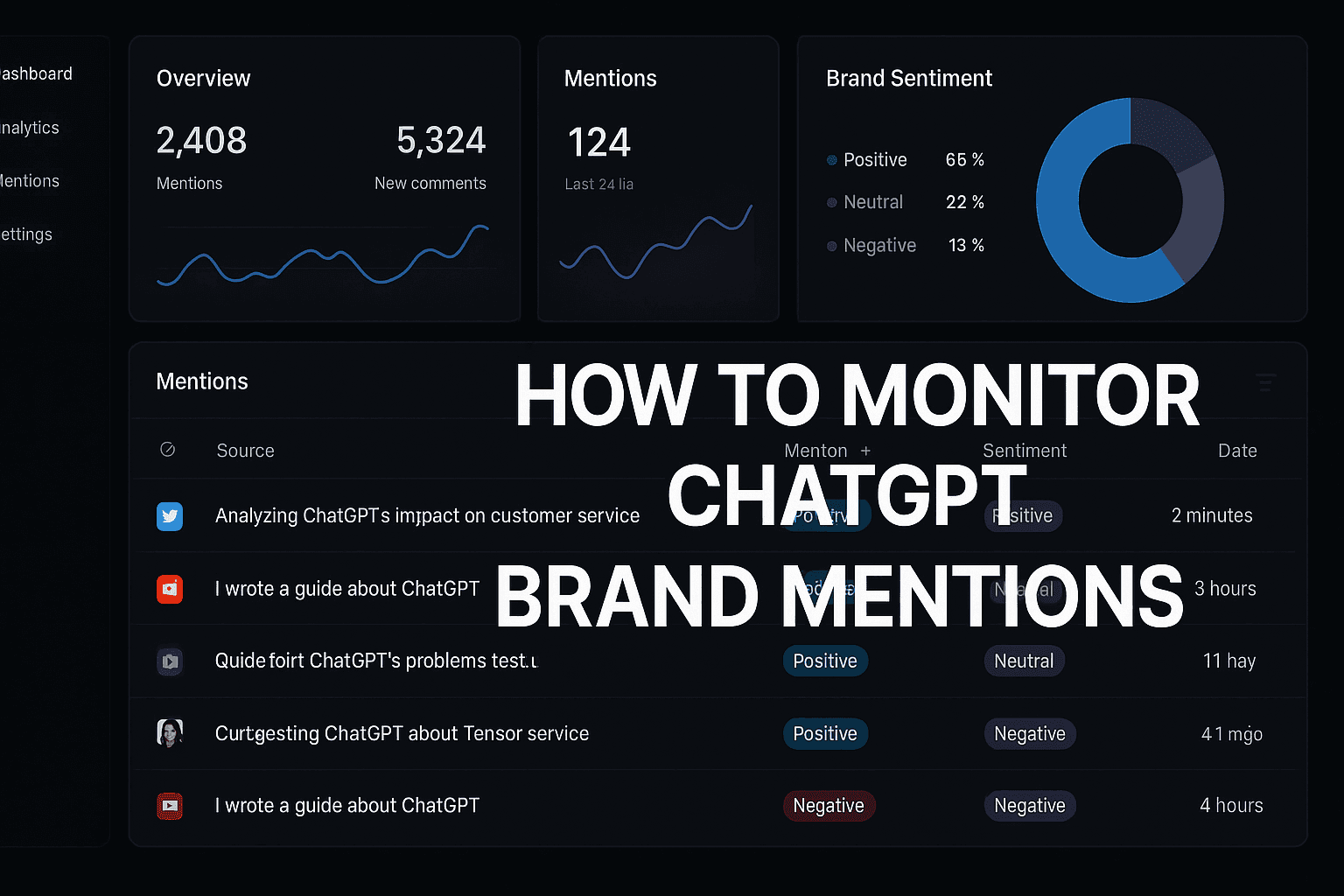
Implement Mention Quality Scoring: Not all mentions are equal. Configure your system to categorize mentions as positive (recommended as top choice), neutral (mentioned as option), negative (mentioned with caveats), or contextual (mentioned in specific scenarios). This scoring helps you prioritize response efforts.
Set Up Competitor Intelligence Alerts: Configure alerts that trigger when competitors suddenly appear in contexts where they previously didn't, or when their mention frequency spikes. These shifts often indicate new content campaigns or positioning changes you need to understand.
Establish Threshold Triggers: Set alerts for significant changes rather than every minor fluctuation. A 20% increase in negative sentiment mentions over a week warrants investigation. A single negative mention doesn't.
Create Trend Dashboards: Build reporting that highlights patterns over time rather than point-in-time snapshots. Is your mention frequency increasing or decreasing? Is sentiment improving? Are you gaining ground in specific use cases?
Advanced teams integrate monitoring insights with their broader ai content marketing strategy to ensure content production aligns with visibility gaps discovered through systematic monitoring.
Step 4: Optimize Based on Monitoring Intelligence
Monitoring without optimization is just expensive data collection. The real value comes from translating insights into strategic actions that improve your AI visibility.
This step transforms your monitoring system from a passive tracking tool into an active competitive advantage. You're not just watching what happens—you're systematically improving your positioning based on what you discover.
Identifying High-Impact Optimization Opportunities
Not all visibility gaps are equally important. Strategic optimization means focusing resources on the opportunities that drive the most business value.
Prioritize High-Intent Query Gaps: If ChatGPT recommends competitors for bottom-funnel queries like "best [category] for [specific use case]" but you're absent, that's a high-priority gap. These queries indicate purchase intent.
Target Competitive Displacement Opportunities: Identify contexts where you're mentioned but positioned below competitors. These are easier wins than creating visibility from scratch—you just need to improve relative positioning.
Address Negative Sentiment Patterns: If monitoring reveals consistent negative framing ("expensive," "complex," "steep learning curve"), prioritize content that directly addresses these perception issues with evidence and context.
Expand into Adjacent Categories: Look for related query types where competitors appear but you don't. If you're a project management tool mentioned for "team collaboration" but absent from "remote work software" queries, that's an expansion opportunity.
A B2B software company discovered through monitoring that they were consistently recommended for enterprise use cases but never for mid-market scenarios, despite having mid-market products. They created targeted content addressing mid-market needs, and within three months, began appearing in those query contexts.
Create a prioritized optimization roadmap based on business impact, competitive intensity, and resource requirements. Focus on the 3-5 highest-value opportunities rather than trying to address every gap simultaneously.
Implementing Content-Based Visibility Improvements
AI models learn from publicly available content. Strategic content creation is your primary lever for improving how ChatGPT discusses your brand.
Create Use Case-Specific Content: If monitoring reveals you're absent from specific use case queries, create comprehensive content addressing those scenarios. Detailed case studies, implementation guides, and solution-specific pages help AI models associate your brand with those contexts.
Develop Comparison and Alternative Content: If competitors dominate comparison queries, create authoritative comparison content that positions your solution fairly alongside alternatives. This content helps AI models understand your competitive positioning.
Publish Thought Leadership on Emerging Topics: If you want to be mentioned in future-focused queries, publish forward-looking content on industry trends, emerging challenges, and innovative approaches. This establishes thought leadership positioning in AI training data.
Optimize Existing High-Authority Pages: Enhance your most authoritative pages (homepage, product pages, about page) with clear positioning statements, use case descriptions, and competitive differentiators. These pages carry significant weight in how AI models understand your brand.
Teams using ai blog automation can scale content production to address multiple visibility gaps simultaneously, creating the comprehensive content footprint needed to improve AI model understanding across diverse query contexts.
Measuring Optimization Impact
Effective optimization requires systematic measurement of what's working and what isn't. Your monitoring system should track improvement over time, not just current state.
Track Mention Frequency Changes: Are you appearing more often in target query categories after optimization efforts? Measure week-over-week and month-over-month trends to identify improvement patterns.
Monitor Position Improvements: Are you moving from third-mentioned to first-mentioned in competitive queries? Position changes indicate improving competitive strength in AI recommendations.
Measure Sentiment Shifts: Is the language ChatGPT uses to describe your brand becoming more positive? Are previous negative caveats disappearing? Sentiment improvement indicates successful perception management.
Analyze New Context Appearances: Are you appearing in query contexts where you were previously absent? New context visibility indicates successful category expansion or use case association.
A SaaS company tracked their optimization efforts over six months and discovered that content addressing specific use cases improved mention frequency by 40% in those contexts, while generic brand content had minimal impact. This insight helped them focus resources on high-impact content types.
Establish a regular review cadence—monthly for most brands, weekly for highly competitive markets—to assess optimization impact and adjust strategy based on what's driving results.
Your Competitive Advantage in AI-Powered Search
You now have something most of your competitors don't: a systematic approach to understanding and improving your brand's visibility in AI-powered conversations.
This isn't just about tracking mentions. You've built a complete intelligence system—from your monitoring framework that captures every brand variation, through strategic manual testing that reveals positioning patterns, to automated monitoring that provides ongoing competitive insights, and finally to optimization strategies that turn data into action.
The brands winning in AI search aren't guessing. They're monitoring systematically, analyzing strategically, and optimizing continuously. That's exactly what you can do now.
Start with your framework this week. Map your brand universe, develop your query templates, and run your first manual tests. By week two, implement your monitoring automation and configure your alert systems. By week three, you'll have your first optimization cycle complete based on real intelligence.
The competitive advantage goes to the brands that move first. While your competitors remain blind to their AI visibility, you'll be systematically improving your positioning in the conversations that matter most—the ones happening right now between potential customers and AI assistants.
Ready to automate this entire monitoring process? Start tracking your AI visibility today with comprehensive ChatGPT brand mention tracking, daily monitoring across multiple AI models, automated sentiment analysis, and optimization recommendations that turn insights into action.