You're launching a startup with ambitious growth targets, a lean team of two marketers, and a content calendar that demands three blog posts per week. By Wednesday afternoon, you're already behind schedule, scrambling to research keywords, draft outlines, and coordinate with freelancers who may or may not deliver on time. Sound familiar?
This is the content paradox every startup faces: organic traffic and brand authority require consistent, high-quality content, but producing it manually consumes resources you simply don't have. Traditional content marketing approaches designed for enterprise teams with specialized roles don't translate to startup realities.
The solution isn't working harder or hiring faster. It's building automated systems that maintain publishing velocity without proportionally increasing headcount. Automated content marketing leverages AI workflows and intelligent automation to help resource-constrained teams compete with established players in both traditional search and emerging AI-powered discovery platforms.
The following seven strategies focus on practical implementation with measurable outcomes. Each addresses a specific bottleneck in the content production and distribution process, allowing your small team to operate with the efficiency of a much larger operation.
1. Build an AI-Powered Content Production Pipeline
The Challenge It Solves
Manual content creation creates an impossible bottleneck for startup teams. A single blog post can consume 4-6 hours when you factor in research, outlining, writing, editing, and optimization. Multiply that by your weekly publishing goals, and you've consumed your entire marketing bandwidth before addressing distribution, promotion, or strategic work.
The traditional solution of hiring more writers or engaging freelancers introduces new problems: onboarding time, quality inconsistency, and escalating costs that scale linearly with output. You need a system that breaks this linear relationship between content volume and resource investment.
The Strategy Explained
Modern AI content systems use multiple specialized agents working in sequence, each handling a distinct phase of production. Think of it like an assembly line where different stations handle research, outline generation, writing, fact-checking, and SEO optimization.
The key difference from simple AI writing tools is the multi-agent approach. A research agent analyzes top-ranking content and identifies gaps. A strategy agent determines the optimal structure and angle. A writing agent produces the draft. An optimization agent handles keyword placement and readability. This division of labor produces content that addresses both search intent and AI platform requirements.
Tools like Sight AI's Content Writer implement this multi-agent architecture with 13+ specialized agents that handle everything from keyword research to final optimization. The system operates in Autopilot Mode, requiring minimal human intervention beyond initial brief approval and final review.
Implementation Steps
1. Identify your highest-value content types (typically guides, listicles, and explainers for startups) and document your quality standards, brand voice, and structural preferences.
2. Set up your AI content pipeline with clear agent responsibilities—research agents gather competitive intelligence, outline agents structure the piece, writing agents produce drafts, and optimization agents handle technical SEO requirements.
3. Create a review workflow where your team focuses exclusively on strategic edits and brand alignment rather than starting from scratch, reducing review time to 15-30 minutes per piece instead of hours of writing.
Pro Tips
Start with content types that have clear formulas and structures, like comparison posts or feature listicles. These benefit most from automation because the framework is consistent. Save more creative, brand-defining pieces for human-led creation until your AI pipeline proves reliable. Build a content brief template that captures your requirements once, then reuse it across similar content types.
2. Automate Keyword Research and Content Gap Analysis
The Challenge It Solves
Manual keyword research is a time sink that never ends. You spend hours in spreadsheets, cross-referencing search volumes, analyzing competition, and identifying opportunities—only to repeat the process next month as search trends shift. By the time you've prioritized your targets and briefed content, the competitive landscape has already changed.
Worse, manual research creates blind spots. You naturally gravitate toward obvious keywords while missing emerging opportunities or long-tail variations that competitors haven't targeted yet. Your content calendar reflects what you thought to research, not necessarily what your audience is actually searching for.
The Strategy Explained
Automated keyword research systems continuously monitor search trends, competitor content, and ranking opportunities without manual intervention. These tools analyze your existing content library, identify gaps where competitors rank but you don't, and generate prioritized content briefs automatically.
The automation extends beyond simple keyword lists. Modern systems analyze search intent, cluster related keywords into topic groups, and recommend content types that match user expectations. They also track how AI platforms like ChatGPT and Perplexity respond to queries in your space, revealing optimization opportunities that traditional SEO tools miss entirely.
This continuous monitoring means your content strategy adapts in real-time rather than waiting for quarterly planning cycles. When a competitor publishes new content or search trends shift, your system flags the opportunity automatically.
Implementation Steps
1. Connect your keyword research tool to your existing content library and competitor domains, allowing the system to establish baseline performance and identify immediate gaps in your coverage.
2. Configure automated content brief generation that includes target keywords, search intent analysis, competitor content analysis, and recommended structure—eliminating the manual research phase entirely.
3. Set up weekly digest reports that surface your highest-priority opportunities based on search volume, competition level, and relevance to your product, keeping your content calendar aligned with actual demand.
Pro Tips
Focus on long-tail keyword clusters rather than individual high-volume terms. These clusters often represent topic areas where you can dominate multiple related searches with comprehensive content. Use question-based keywords as content starting points—they naturally align with both traditional search intent and AI platform responses. Monitor seasonal trends six weeks ahead to prepare content before demand peaks.
3. Implement Automated Publishing and Indexing Workflows
The Challenge It Solves
Publishing bottlenecks kill momentum even when content production runs smoothly. Your team finishes a great article, then it sits in a Google Doc for days waiting for someone to format it in WordPress, add images, configure SEO fields, and schedule publication. Meanwhile, the topic relevance decays and competitors publish similar content first.
After publication, there's another wait: search engines need to discover, crawl, and index your new content before it can rank. This discovery lag can take days or weeks, during which your content generates zero organic traffic despite being live on your site.
The Strategy Explained
Automated publishing workflows connect your content creation system directly to your CMS, eliminating manual transfer steps. Once content passes your review checkpoint, it flows automatically into your website with proper formatting, meta tags, and structural elements already configured.
The second automation layer handles search engine discovery through IndexNow protocol implementation. This protocol allows your site to notify search engines immediately when new content publishes or existing content updates, dramatically reducing the time between publication and indexing.
Together, these automations compress the publication-to-traffic timeline from weeks to days. Your content reaches search results while it's still timely and relevant, maximizing its competitive advantage.
Implementation Steps
1. Set up direct CMS integration between your content production system and your website platform, mapping content fields to CMS fields so articles publish with proper structure, meta descriptions, and schema markup automatically.
2. Implement IndexNow integration that pings search engines immediately when content publishes or updates, ensuring your sitemap stays current and search engines discover changes within hours instead of waiting for scheduled crawls.
3. Configure automated quality checks that verify proper formatting, working links, and image optimization before publication, catching technical issues that would otherwise require manual review and republishing.
Pro Tips
Schedule publications during peak crawl times for your site, typically when your existing high-traffic pages get the most search engine attention. Use automated sitemap updates alongside IndexNow for redundancy—some search engines prioritize one discovery method over the other. Set up post-publication monitoring that alerts you if indexing doesn't occur within 48 hours, indicating potential technical issues.
4. Create Content Repurposing Automation Systems
The Challenge It Solves
You invest significant resources creating a comprehensive blog post, publish it once, and move on to the next piece. The content sits on your blog generating organic traffic, but it never reaches the audiences active on social platforms, email newsletters, or video channels. You're leaving reach and engagement on the table because manual repurposing feels like creating entirely new content.
When teams do attempt repurposing, it's inconsistent and time-consuming. Someone manually extracts key points, rewrites them for Twitter, reformats for LinkedIn, and maybe creates an email summary. This manual process is so labor-intensive that most content only gets repurposed once, if at all.
The Strategy Explained
Content repurposing automation transforms a single piece of source content into multiple formats and platform-specific versions without proportional effort increases. The system analyzes your blog post, identifies key insights and quotable moments, and generates tailored versions for each distribution channel.
A blog post about automated marketing becomes a Twitter thread highlighting the seven key strategies, a LinkedIn article expanding on implementation challenges, an email newsletter with actionable takeaways, and a video script walking through the most visual concepts. Each version maintains your brand voice while adapting structure and tone to platform expectations.
The multiplication effect is substantial. One hour of content creation becomes ten hours of distributed reach across channels where your audience already spends time. You're not creating more content—you're maximizing the value of content you've already produced.
Implementation Steps
1. Build repurposing templates for each distribution channel that define structure, tone adjustments, and format requirements, ensuring consistency while allowing platform-specific optimization.
2. Set up automated workflows triggered by blog publication that generate social media posts, email newsletter sections, and video scripts from the source content, using AI to extract key points and adapt messaging for each platform.
3. Create a review and scheduling queue where your team can quickly approve repurposed content and set distribution timing, maintaining quality control without starting from scratch for each platform.
Pro Tips
Prioritize repurposing your highest-performing content first—pieces that already generate traffic and engagement will amplify better across channels. Create platform-specific hooks that reference current trends or conversations, making repurposed content feel native rather than recycled. Use visual content extraction to identify diagrams, screenshots, or data visualizations that work particularly well on visual platforms like LinkedIn and Instagram.
5. Set Up AI Visibility Monitoring for Brand Mentions
The Challenge It Solves
Traditional SEO tracking tells you where you rank in Google, but it's blind to an increasingly important channel: AI-powered search platforms. When potential customers ask ChatGPT, Claude, or Perplexity for product recommendations or industry advice, you have no visibility into whether your brand appears in those responses or what context surrounds those mentions.
This blind spot is particularly dangerous for startups competing against established brands. AI platforms often reference well-known names by default, leaving newer companies invisible even when they offer superior solutions. Without tracking these mentions, you can't identify opportunities to improve your AI visibility or understand how AI models describe your brand when they do mention it.
The Strategy Explained
AI visibility monitoring tracks how AI platforms respond to queries relevant to your business, identifying when your brand appears, what context surrounds those mentions, and how sentiment compares to competitors. This creates a new layer of competitive intelligence that traditional SEO tools don't capture.
The monitoring extends beyond simple brand mentions. It tracks which prompts trigger your brand's appearance, what attributes AI models associate with your product, and where competitors appear instead of you. This data reveals content gaps and positioning opportunities that directly influence AI platform recommendations.
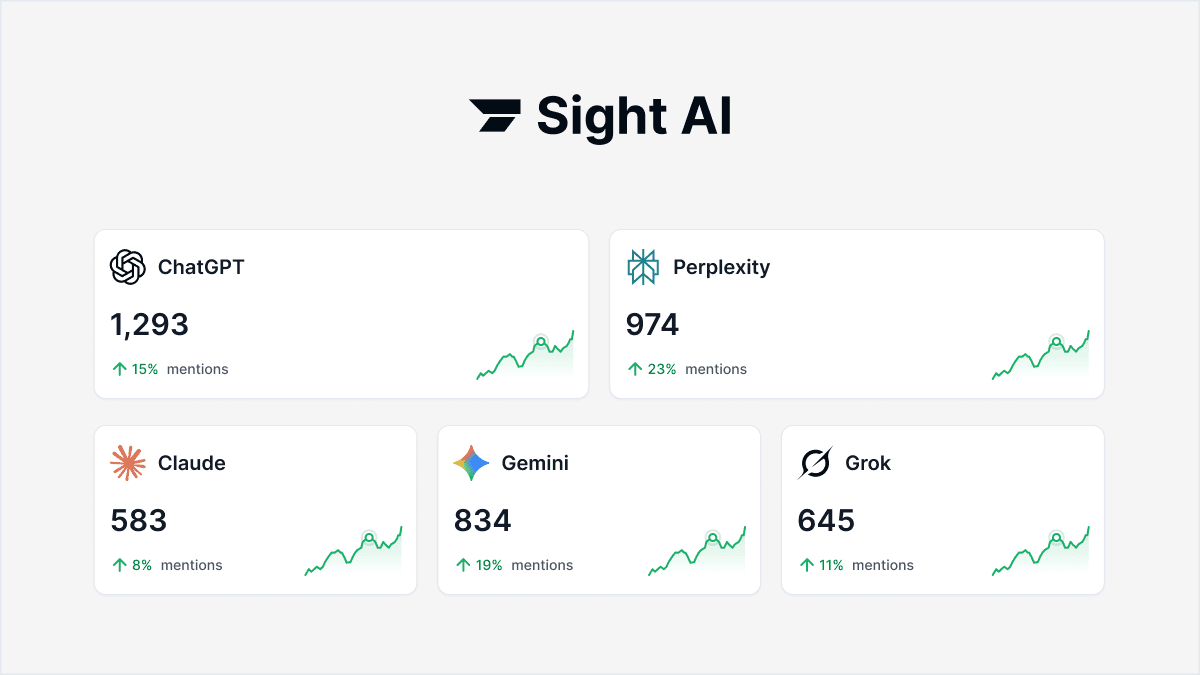
Tools like Sight AI's visibility tracking monitor brand mentions across ChatGPT, Claude, Perplexity, and other AI platforms, providing an AI Visibility Score with sentiment analysis and prompt tracking. This quantifies your presence in AI-powered search and helps you optimize content to improve those mentions.
Implementation Steps
1. Define your core tracking queries—the questions and prompts potential customers use when researching solutions in your category, including product comparisons, feature searches, and problem-solution queries.
2. Set up continuous monitoring across major AI platforms that logs response variations, tracks mention frequency, and analyzes sentiment to establish your baseline AI visibility and identify immediate improvement opportunities.
3. Create alert workflows that notify your team when significant changes occur in AI mentions, such as new competitor appearances, negative sentiment shifts, or emerging query patterns where you're currently invisible.
Pro Tips
Test variations of the same query to understand how AI platforms respond to different phrasings—this reveals optimization opportunities for your content. Monitor competitor mentions to identify their strengths in AI visibility, then create content that addresses those same use cases with your unique angle. Use mention context analysis to understand what attributes AI models associate with your brand, ensuring your content reinforces desired positioning.
6. Automate Content Performance Tracking and Optimization
The Challenge It Solves
Content performance analysis falls into the "important but not urgent" category, which means it rarely happens consistently. Your team publishes new pieces, checks initial traffic, then moves on to the next deadline. Meanwhile, older content gradually declines in rankings, accumulates outdated information, and misses opportunities for improvement that could restore or boost performance.
When teams do analyze performance, it's a manual slog through Google Analytics and Search Console, trying to identify patterns and prioritize fixes. By the time you've compiled the data and decided what to update, the opportunity cost of that analysis time feels questionable. You need a system that surfaces actionable insights automatically.
The Strategy Explained
Automated performance tracking monitors your content library continuously, identifying pieces that are declining in rankings, missing featured snippet opportunities, or showing engagement problems. The system doesn't just report problems—it prioritizes them based on traffic potential and generates specific optimization recommendations.
The automation extends to triggering refresh workflows. When a high-value piece drops in rankings, the system can automatically generate an updated outline incorporating new information, competitive insights, and search intent changes. Your team reviews and approves rather than starting the optimization process from scratch.
This creates a self-improving content library where high-potential pieces get attention automatically rather than relying on someone to remember to check them. Your best content stays fresh and competitive without manual monitoring.
Implementation Steps
1. Configure automated dashboards that track key metrics for each published piece—rankings, traffic trends, engagement signals, and conversion performance—with alerts triggered when metrics cross defined thresholds indicating action needed.
2. Set up prioritization algorithms that score optimization opportunities based on current traffic, ranking position, and improvement potential, ensuring your team focuses on updates that will drive the most impact.
3. Build refresh workflows that generate updated content briefs for declining pieces, incorporating new competitive intelligence, search intent changes, and content gaps that have emerged since original publication.
Pro Tips
Focus refresh efforts on content ranking positions 4-10 for target keywords—these pieces are close to page-one visibility and often need only modest improvements to jump significantly. Monitor featured snippet opportunities where your content ranks well but doesn't own the snippet, then restructure to better match snippet formats. Set seasonal review triggers for time-sensitive content, ensuring it stays current before demand peaks rather than after.
7. Develop Automated Internal Linking and Content Clustering
The Challenge It Solves
As your content library grows beyond 50-100 pieces, maintaining internal link health becomes impossible to manage manually. You publish new content without systematically linking it to related existing pieces. Older content doesn't get updated with links to newer pieces. Your site architecture gradually becomes a collection of isolated articles rather than a cohesive topical authority structure.
This fragmentation hurts both SEO performance and user experience. Search engines can't efficiently discover and understand the relationships between your content pieces. Users who land on one article don't naturally flow to related pieces that would keep them engaged longer. You're leaving significant SEO value on the table simply because manual internal linking doesn't scale.
The Strategy Explained
Automated internal linking systems analyze your content library to identify topical relationships, then suggest or implement links that build content clusters around your key themes. The system understands which pieces support others, which serve as pillar content, and where strategic links would strengthen topical authority signals.
The automation works bidirectionally. When you publish new content, the system identifies existing pieces that should link to it and generates suggested anchor text. It also updates older pieces with links to new content, ensuring your library stays interconnected without manual tracking of every potential connection.
This creates a self-organizing content architecture that strengthens as your library grows. Each new piece automatically integrates into your topical clusters, reinforcing your authority in key areas rather than existing in isolation.
Implementation Steps
1. Audit your existing content to identify topical clusters and pillar content opportunities, mapping how pieces relate to each other and where strategic internal links would strengthen those relationships.
2. Implement automated link suggestion systems that analyze new content during the publication workflow, recommending internal links to related pieces with appropriate anchor text that maintains natural readability.
3. Set up retroactive linking workflows that periodically review older content and suggest updates to link to newer pieces, ensuring your entire library stays interconnected as it grows rather than only linking forward in time.
Pro Tips
Prioritize links from high-authority pages to newer content you want to boost—this passes link equity more effectively than linking from low-traffic pages. Use descriptive anchor text that includes target keywords naturally rather than generic "click here" phrases. Limit internal links to 3-5 per article to maintain link value and avoid overwhelming readers, focusing on the most relevant and valuable connections.
Putting It All Together
Implementing automated content marketing doesn't require overhauling your entire operation in one sprint. Start with the strategy that addresses your biggest bottleneck. For most startups, that's content production—the pipeline that determines everything downstream.
Once your AI-powered content pipeline runs smoothly and you're publishing consistently, layer in publishing automation to eliminate the gap between creation and live content. From there, add performance tracking so you know what's working and what needs attention. Each automation builds on the previous one, creating compounding efficiency gains.
The startups that succeed with content marketing in 2026 aren't necessarily producing more content than their competitors. They're producing smarter content with systems that scale without proportional resource increases. While competitors hire their third content writer, you're building infrastructure that maintains quality and velocity with the same lean team.
Focus on building systems that compound over time. Your automated content pipeline improves as it learns your brand voice and audience preferences. Your internal linking structure strengthens with each new piece. Your AI visibility grows as you consistently publish optimized content. These aren't one-time projects—they're infrastructure investments that pay dividends for years.
The competitive advantage goes to startups that recognize this shift early. Traditional content marketing favored companies with deep resources to hire large teams. Automated content marketing favors companies with systems thinking and willingness to embrace AI-powered workflows. Your team size matters less than your operational efficiency.
Stop guessing how AI models like ChatGPT and Claude talk about your brand—get visibility into every mention, track content opportunities, and automate your path to organic traffic growth. Start tracking your AI visibility today and see exactly where your brand appears across top AI platforms.