Growing your organic search traffic isn't about chasing algorithms or finding a magic bullet. It’s a deliberate process that blends technical precision, genuinely helpful content, and building real authority in your space.
Think of it this way: you need to make it incredibly easy for search engines to find and understand your site, while also creating content that people actually want to find.
Your Blueprint For Meaningful Organic Growth
So, you want to know how to improve your organic search traffic? Let's move past the fluffy theory and get into the practical, actionable advice that actually works. Sustainable growth isn’t about a single trick; it's about building a solid foundation across a few crucial areas.
This journey starts with appreciating why organic search is worth the effort in the first place. In a world of fleeting social media trends and ever-increasing ad costs, organic search is the most reliable engine for long-term, sustainable growth. If you're serious about this, it's worth exploring the different proven strategies for organic search traffic growth that top professionals use.
The Core Pillars of Organic Success
Your entire strategy should rest on four interconnected pillars. If one is weak, it can bring the others crumbling down. That's why a holistic approach is the only one that delivers consistent, lasting results.
- Technical Integrity: This is the bedrock. If Google can't efficiently crawl, index, and understand your website, even the most brilliant content will be lost in the digital abyss.
- Audience-First Content: This is about creating material that directly answers the questions and solves the problems your target audience is searching for. Our detailed guide on how blogging grows organic traffic dives deep into this process.
- Earned Authority: It's not enough to say you're an expert; you have to prove it. This means building credibility through high-quality backlinks and establishing your site as a trusted resource.
- User Experience (UX): Once people land on your site, their experience is everything. Page speed, mobile-friendliness, and simple navigation all signal quality to search engines and encourage visitors to stick around.
Don't underestimate the sheer impact of this channel. Even as we head into 2025, organic search is still the king, driving an estimated 53% of all website traffic. This stat alone shows why SEO is so vital. It's also interesting to note that long-tail keywords—those longer, more specific search queries—now make up a whopping 69% of all searches.
A winning SEO strategy isn't just about ranking for a few popular keywords. It's about becoming the definitive answer for the questions your audience is asking, which is how you build lasting trust and attract highly qualified traffic.
To give you a clear framework right from the start, let's break down these pillars into a simple table. This will help you see each focus area, its main goal, and the key metrics you'll need to watch. Think of this as your high-level dashboard for tracking progress on your journey toward higher organic traffic.
Key Focus Areas for Organic Traffic Growth
| Focus Area | Primary Goal | Key Metrics to Track |
|---|---|---|
| Technical SEO | Ensure search engines can easily crawl, index, and render your site content. | Crawl Errors, Index Coverage, Site Speed, Mobile Usability |
| Content Strategy | Create valuable, relevant content that answers user intent and targets keywords. | Keyword Rankings, Organic Traffic, Time on Page, Bounce Rate |
| Link Building | Build authority and credibility through high-quality backlinks from reputable sites. | Number of Referring Domains, Backlink Quality, Domain Authority |
| User Experience (UX) | Provide a seamless and engaging experience that keeps users on your site. | Core Web Vitals, Session Duration, Click-Through Rate (CTR) |
With this structure in mind, you have a clear roadmap for what to prioritize. Each of these areas is a discipline in itself, but by working on them together, you create a powerful synergy that drives real, measurable growth.
Building a Rock-Solid Technical SEO Foundation
Before a single word of your content ever gets read, search engines like Google are busy doing a crucial backstage check. They have to crawl your site to find all your pages, index them to figure out what they're about, and render them to see what a human visitor sees.
If this technical process hits a snag, even the most brilliant content can get lost in the digital void. It's the silent killer of many SEO campaigns.
Think of your website like a library. A clean, logical site architecture is the shelving system that makes it a breeze for search engine crawlers (the librarians) to find every single book (your pages). But a confusing structure? That's like piling books in random corners, leaving them buried and effectively invisible to anyone looking for them.
All your other SEO efforts—content, authority, user experience—are built on top of this technical base.
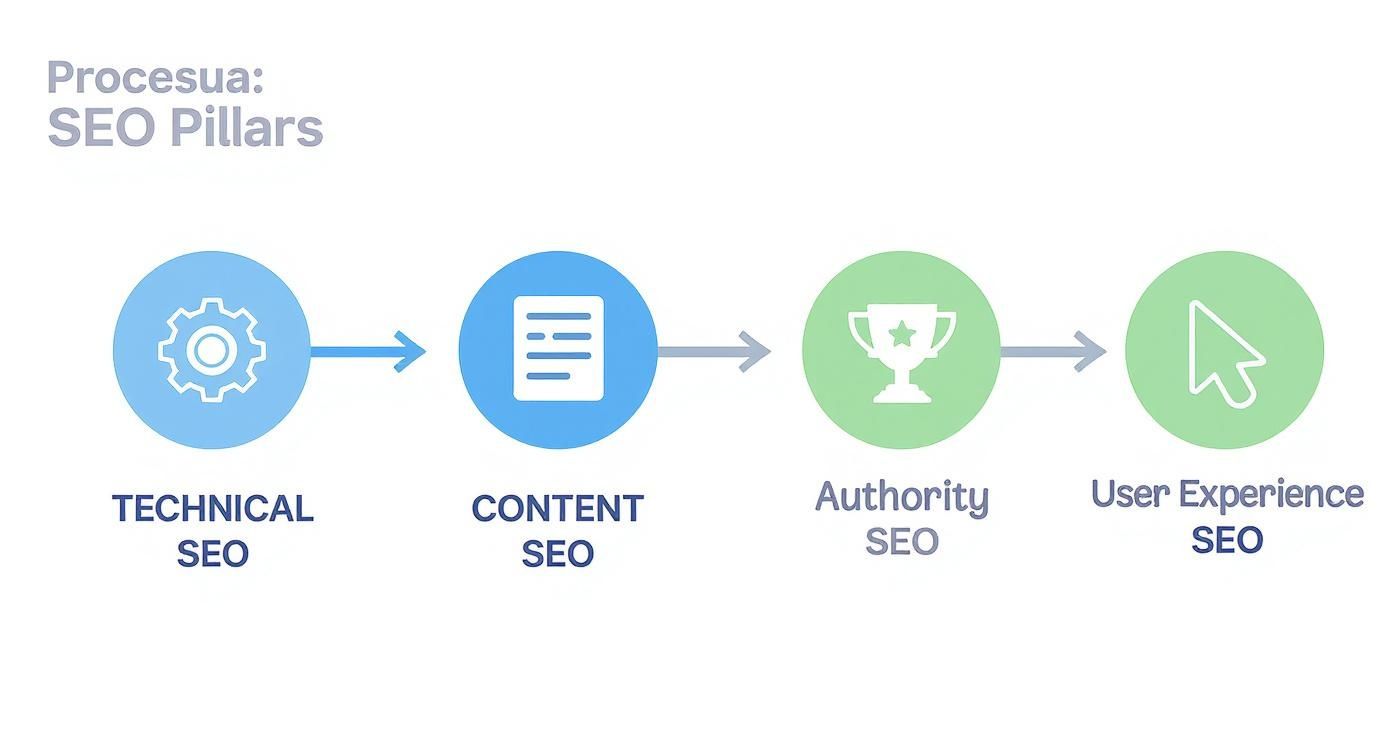
As you can see, if that technical starting point is shaky, everything else you do will have a much weaker impact.
Conducting Your Own Mini-Technical Audit
You don't need a huge budget to start sniffing out the technical gremlins holding back your organic traffic. In fact, one of the most powerful tools out there is completely free: Google Search Console.
Think of Search Console as your direct line to Google. It’s where Google tells you exactly what it thinks of your site, flagging the critical issues that demand your attention. This isn't guesswork; it's data straight from the source.
Your first stop should be the Index Coverage report. This is your report card on how well Google is getting your pages into its index. Keep an eye out for trends in errors, excluded pages, and valid pages. A sudden spike in errors is a massive red flag that could point to a serious crawling problem.
From there, zoom in on these key areas:
- Crawl Errors: This is where you find pages Google's bots just couldn't access. Usually, these are "404 Not Found" errors, which are dead ends for both users and search engines.
- Mobile Usability: Google indexes the web from a mobile point of view (mobile-first indexing), so this is non-negotiable. The report will pinpoint pages with problems like text that's too small or buttons that are too close together.
- Core Web Vitals: This report grades your site on user experience, specifically loading speed, interactivity, and visual stability. A poor score here can directly hurt your rankings.
Addressing Common Technical Pitfalls
Once you've run an initial check, it's time to dig into a few of the more nuanced issues that often get missed but can wreak havoc on your organic performance.
One of the biggest culprits is duplicate content. This often happens by accident. For example, if your site is accessible with and without the "www" at the beginning, search engines see two identical versions of every single page.
The fix is a simple snippet of code called a canonical tag. This tag points search engines to the "master" version of a page, consolidating all your ranking power into a single URL.
Another game-changer is structured data, also known as Schema markup. This is basically a vocabulary you add to your site's code to tell search engines exactly what your content is about. You can mark up a recipe with ingredients and cook times, or an article with its author and publication date.
By implementing structured data, you're helping Google understand your page's context. This makes your site eligible for eye-catching "rich snippets" in the search results—things like star ratings, FAQs, or event details—which can seriously boost your click-through rate.
To get a comprehensive look at your site’s health and find more technical opportunities, it's worth using specialized SEO score checker tools. They can often provide a more detailed view than Search Console alone. And if you're ready to go deeper, our complete guide to technical SEO breaks down these concepts even further.
Nailing your technical foundation ensures every piece of content you create and every link you build has the best possible chance to succeed.
Crafting Content That Captures Search Intent
A flawless technical setup is just the starting line. To really see your organic search traffic climb, you need to create content that doesn't just check a keyword box, but deeply satisfies the reason a user is searching in the first place. This is the whole game: capturing search intent.

It’s so easy to get fixated on keywords with big search volumes, but that's a common trap. The real magic happens when you understand what someone is trying to accomplish. Are they trying to learn something? Compare products? Or are they ready to pull out their credit card? Nailing this is what separates a page that ranks from a page that actually grows your business.
Beyond Keywords to Uncovering User Intent
The first step is a mental shift. Stop asking "what are people typing?" and start asking "what problem are they trying to solve?" This reframes everything and is absolutely crucial for creating content that connects. When a user feels like you get them, they stick around, engage more, and start to see you as the authority in your space.
Just think about the difference between someone searching for "best running shoes" versus "Brooks Adrenaline GTS 23 review." The first person is in discovery mode, probably looking for a big comparison article. The second is way further down the funnel, looking for one last piece of validation before they buy. Your content has to serve these completely different needs.
A good way to start mapping this out is by bucketing your keywords into the main types of search intent:
- Informational: The user wants to learn. Think "what is content marketing?" These are perfect for in-depth blog posts and guides.
- Navigational: They're just trying to get to a specific site, like "IndexPilot login." You don't usually target these.
- Commercial Investigation: The user is weighing their options. A search like "IndexPilot vs Jasper" is a prime example. This is your cue for comparison pages or deep-dive feature breakdowns.
- Transactional: They're ready to act. "Buy SEO software" is a clear signal that belongs on a product or pricing page.
Aligning your content format with the user's intent isn't just a good idea—it's a non-negotiable part of modern SEO. Trying to rank a product page for an informational keyword is like trying to fit a square peg in a round hole. It just won't work because it completely misses what the searcher actually needs.
Building Topic Clusters for Deeper Authority
Once you've got a handle on intent, you can level up from writing one-off articles to building topic clusters. This strategy is a game-changer. It works by creating a central, comprehensive "pillar" page on a broad topic, which then links out to several "cluster" pages that dive deeper into specific subtopics.
For example, your pillar page could be "The Ultimate Guide to SEO." Your cluster content would then be individual, detailed articles on things like "Technical SEO Basics," "How to Do Keyword Research," and "Beginner's Link Building Strategies." This structure proves to search engines that you have serious expertise on the entire subject, not just a few isolated pieces.
This web of interconnected content does two things brilliantly: it keeps users clicking around your site longer, and it funnels authority from all those cluster pages back to your main pillar page. This gives your pillar a massive boost for those high-value, competitive terms.
The On-Page Optimization Checklist That Matters
On-page SEO is so much more than just sprinkling keywords around. It's about structuring your content so it’s crystal clear for both your readers and the search engine crawlers. A well-optimized page simply delivers a better experience, and Google rewards that with better rankings.
Here’s a practical checklist to run through for every piece of content you publish:
- Craft a Compelling H1 Title: Your H1 needs to be unique, include your primary keyword, and create a strong hook that pulls the reader in immediately.
- Optimize Your Meta Description: Think of this as your 155-character ad in the search results. Make it an active, persuasive pitch that clearly states the page's value and makes people want to click.
- Use Strategic Internal Links: Link out to other relevant articles on your site, using descriptive anchor text. This is huge for distributing page authority and guiding users toward more of your great content.
- Optimize Images: Always compress your images for fast load times and use descriptive alt text that includes relevant keywords. This makes your content accessible and helps your images show up in Google Image search.
These elements aren't just separate tasks; they work together to create a seamless user journey. For a much deeper dive, our guide on how to optimize content for SEO has advanced techniques you can put to use right away. Mastering these fundamentals is how you build content that doesn’t just get seen—it gets results.
Earning Authority and Building Quality Links
A rock-solid technical setup and amazing content get you in the game, but building authority is how you start winning. Think of high-quality backlinks as votes of confidence from other established websites. Each link from a reputable source tells Google, "Hey, this content is trustworthy and valuable," which is one of the most powerful signals you can send to improve your organic search traffic.

The old days of buying links or spamming comment sections are long gone—and frankly, they can get your site penalized. Today, link building is about earning genuine endorsements through quality and strategic outreach. It's less about quantity and all about the relevance and authority of the sites linking back to you.
Trust me, one great link from a respected industry publication is worth more than a hundred low-quality links from irrelevant blogs.
Creating Link-Worthy Assets
The most sustainable way to earn backlinks is to create something so valuable that other people want to link to it. This means moving beyond standard blog posts and developing "link-worthy assets." These are the substantial pieces of content that become go-to resources in your industry.
To become a backlink magnet, you should consider creating assets like these:
- Original Research or Data Studies: Run a survey, analyze industry data, and publish your findings. Journalists and bloggers are always hungry for original data, and they will almost always link back to the source.
- Free Tools and Calculators: A simple but genuinely useful tool—like a mortgage calculator for a real estate site or a headline analyzer for a marketing blog—can attract links for years on end.
- Definitive Guides: Your goal here is to create the single best, most comprehensive resource on a specific topic. If your guide is truly the ultimate source of information, it will naturally become the page people reference.
These assets require more upfront effort, no doubt. But their long-term payoff in organic traffic is immense. They form the foundation of many successful outreach campaigns and are a core component of well-executed content marketing strategy examples.
Mastering Strategic Outreach
Once you have a fantastic asset, it’s time to let the right people know it exists. Strategic outreach is the art of connecting with journalists, editors, and site owners who are likely to find your content valuable for their own audience. This isn't about begging for links; it's about building relationships and offering genuine value.
Your outreach process needs to be targeted and personal. First, identify websites that have already written about similar topics or linked to related content. Tools like Ahrefs or Semrush can help you pinpoint these opportunities. Then, craft a concise, compelling email that gets straight to the point.
The biggest mistake I see is people sending a generic, templated email to hundreds of contacts. The best outreach is highly personalized. Mention a recent article they wrote, explain why your resource would be a great fit for their audience, and make it incredibly easy for them to see its value.
The Overlooked Power of Internal Linking
While earning external backlinks is crucial, don't forget about the power you hold on your own site. Internal linking—the practice of linking from one page on your website to another—is a seriously underrated tactic for boosting organic traffic.
Proper internal linking helps in three key ways:
- It Distributes Authority: When you get a powerful backlink to one of your pages, you can pass some of that "link equity" to other important pages on your site through internal links.
- It Establishes Topical Authority: By creating a web of interconnected articles around a core topic, you signal deep expertise to search engines.
- It Guides Users and Crawlers: It helps visitors discover more of your content and allows search engine bots to find and index all your pages more efficiently.
Think of it like this: every new blog post is an opportunity to strengthen the authority of your most important "money" pages—like your product pages or cornerstone guides—by linking back to them with descriptive anchor text. This simple habit helps channel your website's authority exactly where you want it to go.
Using Data to Optimize and Earn More Clicks
Hitting that number one spot on Google feels amazing. But here’s the tough truth: a top ranking is useless if nobody clicks on it. Getting to the top is just the first half of the battle; the real work begins when you have data showing how people actually interact with your site in the search results.
This is where you shift from just creating content to actively refining its performance on the SERP. The whole game becomes about maximizing your click-through rate (CTR). You want every impression you earn to have the best possible chance of turning into a real visitor.
Finding Your Hidden Opportunities in Google Search Console
Your best friend for this task is, without a doubt, Google Search Console (GSC). It gives you a direct, unfiltered look at how your pages perform in the wild, revealing insights you can't get anywhere else.
What you're hunting for are pages with a high average ranking position but a surprisingly low CTR. These are your golden opportunities. A high ranking tells you Google already sees your page as relevant and authoritative for the query. The low CTR, however, screams that your title tag and meta description just aren't cutting it—they aren't compelling enough to earn that click.
Think of these pages as a leaky faucet in your traffic pipeline. The water is flowing (you're getting impressions), but you're losing a huge amount before it ever reaches its destination. Fixing that leak is often one of the quickest ways to see a real jump in traffic.
Once you’ve found these underperformers, it’s time to start experimenting. For a closer look at what to track, our guide on how to measure SEO success dives deep into the key metrics.
Rewriting Titles and Metas to Win the Click
Your title tag is your headline, and your meta description is your ad copy. They have to stand out in a sea of competitors. The first step is to simply search for your target keyword and analyze what’s already on page one. What kind of language are they using? Can you spot an angle they're missing?
Try A/B testing some of these proven ideas for your titles:
- Add Numbers: "10 Ways to..." almost always grabs more attention than "How to..."
- Use Brackets or Parentheses: Adding a little flair like
[New Data]or(2025 Guide)can really make your title pop. - Ask a Question: A title like "Are You Making These SEO Mistakes?" creates instant intrigue and makes the searcher want to know the answer.
- Emphasize a Benefit: Don't just state the topic; highlight what the user will get out of it.
Your meta description needs to back up the title's promise. It should summarize the core value of the page and include a subtle call to action. Simple words like "discover," "learn," and "find out" gently nudge people to click.
This obsession with CTR is non-negotiable because 75% of users never scroll past the first page of search results. Competition is fierce, and data from Semrush shows the first organic result alone often pulls a CTR of around 22.4%. Grabbing even a tiny piece of that can make a massive difference. Better yet, aiming for SERP features like featured snippets can be a game-changer—they can achieve a whopping CTR of 42.9%, letting you leapfrog everyone else.
Common Questions About Organic Traffic
Jumping into SEO always sparks a few questions. We get it. Here are some of the most common ones we hear from marketers and founders trying to get a handle on their organic search traffic, along with some straight-up answers to help you shape your strategy.
How Long Does It Take to See SEO Results?
This is the big one, isn't it? Let's be real: SEO is a long game, not a lottery ticket.
While you might see small bumps from quick technical fixes in a few weeks, the kind of meaningful organic traffic growth that comes from solid content and link-building efforts usually takes 4 to 12 months to really show up.
A lot depends on where you're starting from. Things like your website's current authority, how crowded your industry is, and how consistently you're actually doing the work all play a huge role. The aim isn't a one-time spike; it's about building steady, compounding momentum that pays off for years.
Should I Create New Content or Update Old Content?
The best answer? Both. A healthy SEO strategy needs a mix of creating new stuff and polishing what you already have.
Publishing new content is your ticket to targeting fresh keywords, answering different user questions, and becoming a known authority on new topics. It’s how you expand your reach.
But don't sleep on your existing content—updating it is often the fastest way to get a win. When you refresh an old blog post, you're building on the authority and backlinks it already has, which can give it a much quicker boost in the SERPs. A good rule of thumb is to publish new articles consistently while setting aside time for regular audits to update your best-performing posts.
A lot of seasoned SEO pros live by the 80/20 rule for content: spend 20% of your time creating brand new articles and the other 80% promoting and updating your existing library. This makes sure your hard-earned assets are always pulling their weight.
Is Link Building Still Important for SEO?
Without a doubt. High-quality backlinks from relevant, authoritative sites are still one of Google's top-ranking signals.
Think of them as votes of confidence from other trusted players in your space. They tell Google that your content is credible, valuable, and worth showing to more people.
Of course, modern link building has nothing to do with the old-school spammy tactics. Today, it’s all about earning those links naturally by creating exceptional content, doing smart digital PR, and building real relationships in your industry. A strong backlink profile isn't just a nice-to-have; it's a massive competitive advantage that can seriously move the needle on your organic traffic.
Ready to stop the manual grind and put your organic growth on autopilot? IndexPilot uses trainable AI Agents to handle your entire SEO content workflow, from keyword strategy and writing to optimization and publishing. Transform your SEO into a reliable growth engine today.