Building a content calendar is all about turning a chaotic brainstorm into a structured, actionable plan. It’s the process of deciding what you'll publish, where it will go, and when it will go live. This blueprint is your secret weapon for creating consistent, goal-driven marketing that actually works.
Why a Content Calendar Is Your Secret Weapon

Let's be real—marketing without a plan is just stressful. You're constantly scrambling, reacting to the day instead of executing a vision. A content calendar is so much more than a spreadsheet with dates; it's the strategic framework that transforms abstract goals into a powerful marketing engine.
This is the tool that top marketing teams lean on. It ensures every single piece of content, whether it's a deep-dive blog post or a quick social media update, aligns perfectly with the bigger business goals. This structure is what keeps your brand voice and message consistent across every platform you're on.
Building a System for Success
A solid calendar does more than just organize your posts. It’s the key to seamless team collaboration, clearly laying out roles, deadlines, and the entire production workflow. That clarity alone cuts out the last-minute panic and makes sure everyone knows exactly what they need to do and when.
Think of it as the central hub for your entire content operation. It helps you:
- Visualize your strategy: You can see the whole plan at a glance, making it easy to spot gaps or jump on new opportunities.
- Improve consistency: A regular publishing schedule builds trust with your audience and gives search engines a reason to pay attention.
- Save time and reduce stress: The daily "what should I post?" dilemma vanishes, freeing up your mental space for more creative work.
There's a reason this strategic approach is so widely adopted. In fact, 47% of B2B marketers say that having a documented content strategy is a game-changer for their success. It all comes back to having a structured tool like a content calendar at the core of your efforts.
A content calendar isn't just for scheduling. It's about being intentional. Every entry should have a purpose, a target audience, and a clear call-to-action that moves your business forward.
Ultimately, this isn't just about getting organized—it's about building a sustainable system that delivers results you can actually measure. It frees you from the constant pressure of the content hamster wheel, so you can focus on growth.
To see what this kind of planning looks like in the real world, check out these powerful content marketing strategy examples.
Building Your Calendar's Strategic Foundation
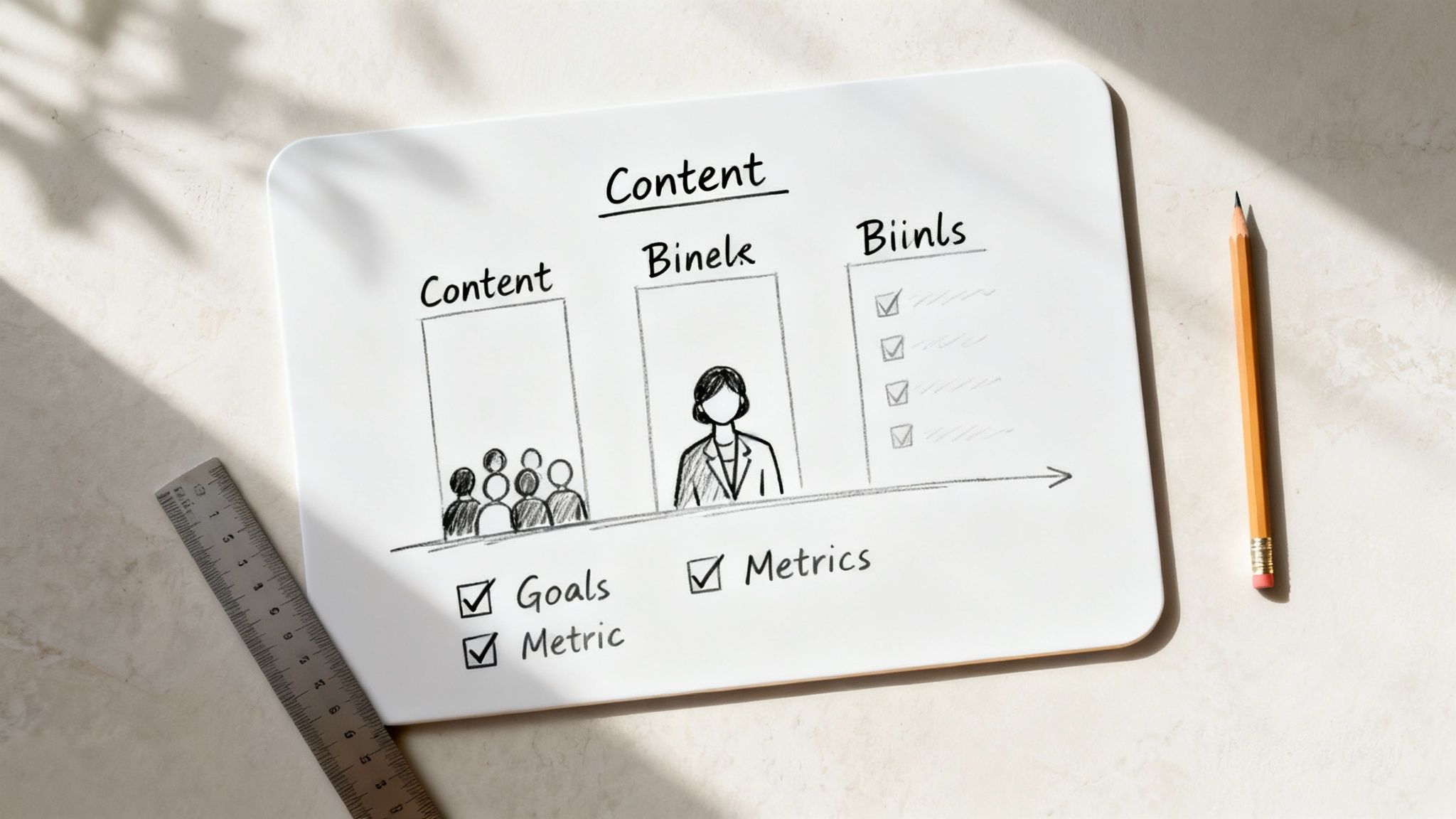
Let's be honest: a content calendar without a strategy is just a glorified to-do list. You can schedule posts all day long, but if they aren't tied to a real business goal, you're just filling empty space. An effective calendar starts long before you open a spreadsheet or a Trello board.
It all begins with anchoring every single piece of content to a clear objective. What are you actually trying to accomplish? Are you chasing brand awareness, generating leads, or something else entirely? Your answer dictates the kind of content you'll create and the metrics you'll obsess over.
For example, a startup trying to get its name out there will lean heavily on top-of-funnel content—think educational blog posts and shareable social media videos. On the flip side, a more established company looking to drive sales will schedule more product-focused webinars, case studies, and comparison guides. This deliberate alignment is what turns your content efforts into a true growth engine.
Define Your Content Pillars
With your goals locked in, it's time to establish your content pillars. These are the 3-5 core themes or topics your brand will own. Think of them as the foundational columns supporting your entire content strategy, ensuring everything you publish feels cohesive and reinforces your expertise.
For a B2B SaaS company like ours, the pillars might look something like this:
- SEO Automation: Covering everything about scaling content creation with AI.
- Content Marketing Strategy: Dishing out practical guides and real-world examples for marketers.
- Organic Growth Tactics: Sharing actionable advice on driving traffic and leads.
These pillars become your filter. If a new idea doesn't fit neatly under one of them, it's probably a distraction. This simple framework makes brainstorming infinitely more efficient and keeps you focused on what your audience actually cares about.
Defining your content pillars is the single best way to maintain brand consistency. It guarantees that every article, post, and video reinforces your expertise and speaks directly to your target audience's needs.
Understand Your Audience Deeply
You can have the best goals and the most organized pillars, but if you don't really know your audience, it's all for nothing. Go beyond the basic demographics. You need to get into their heads. What are their biggest pain points? What challenges keep them up at night? What questions are they typing into Google at 2 AM?
Use customer surveys, social listening, and your own analytics to dig up these insights. You might discover your audience prefers short, tactical video guides over long-form articles, which is a game-changer for your content planning. Building this strategic foundation has become so crucial that the global calendar market, which includes marketing planning tools, is projected to hit $43.40 billion by 2025. This growth just underscores how much businesses are banking on structured planning to connect with their audience.
Once you have your goals, pillars, and audience insights locked down, your calendar starts to look less like a schedule and more like a strategic roadmap. Now, you're ready to fill it with targeted ideas that have a real purpose. If you need a jumpstart, check out our guide on where to find blog content ideas.
Choosing the Right Tools for Your Team
Your content calendar is only as good as the platform you build it on. The right tool can take your strategy from a static document and turn it into a dynamic, collaborative workspace where things actually get done. But with a sea of options out there, picking one can feel like a job in itself.
The good news? You don't need a super complex or pricey solution right out of the gate. Honestly, the best tool is the one your team will actually use, day in and day out. For solo creators or tiny teams, a simple Google Sheets spreadsheet is often the perfect place to start. It’s free, flexible, and you can access it from anywhere.
But as your team grows and you start publishing more frequently, you'll feel the limitations of a spreadsheet. That's when project management tools like Asana or Trello become game-changers. They give you a much more visual and automated way to manage your workflow, turning calendar items into real tasks with owners, deadlines, and dependencies.
From Simple Spreadsheets to Powerful Platforms
Knowing when to upgrade is a huge part of building a content calendar that can grow with you. If you're constantly sending manual "just checking in" emails or digging through your inbox to find asset approvals, that's a pretty clear sign you've outgrown your basic setup.
This move toward more capable software is a massive industry trend. The market for marketing calendar software is expected to explode from USD 426.6 million in 2025 to a staggering USD 1,157.9 million by 2035. This isn't just about fancy features; it's driven by a real need for automation and a single source of truth for campaigns, which makes the whole content process run smoother.
Your content calendar tool should reduce friction, not create it. If your team finds the platform confusing or clunky, they won't use it, and your carefully crafted strategy will just collect digital dust.
To help you navigate the options, here's a quick look at some popular tools and what they're best for.
Content Calendar Tool Comparison
| Tool | Best For | Key Features | Pricing Model |
|---|---|---|---|
| Google Sheets | Solo creators & small teams | • Free & accessible • Highly customizable • Easy collaboration |
Free |
| Trello | Visual workflow management | • Kanban boards • Card-based tasks • Power-Ups for integrations |
Freemium |
| Asana | Project & task management | • Multiple views (list, board, calendar) • Automation rules • Detailed task dependencies |
Freemium |
| CoSchedule | Marketing teams | • All-in-one marketing calendar • Social media scheduling • Project & asset management |
Paid plans |
Each of these has its own strengths. The key is to match the tool's capabilities to your team's specific workflow and pain points.
Must-Have Fields for Your Calendar Template
No matter which tool you land on, your calendar needs a solid structure to be your team's command center. A great template gives everyone clarity at a glance, answering the most important questions without them having to ask.
Here's an example of what a well-structured calendar can look like in a tool like Asana.
See how easy it is to understand the entire workflow? Key details like the publish date, owner, and status are right there.
To be truly effective, your template should have these core components:
- Publish Date: The exact day and time the content goes live. No ambiguity.
- Content Title/Topic: A clear, working headline for the piece.
- Content Owner: The one person responsible for getting this piece over the finish line.
- Status: The current stage in your workflow (e.g., Ideation, Drafting, In Review, Scheduled).
- Content Type: The format, like a blog post, video, case study, or social media update.
- Distribution Channels: Where you'll promote the content (e.g., LinkedIn, Twitter, Email Newsletter).
These fields are the non-negotiable foundation of a functional calendar. Down the road, you can add more advanced columns for things like target keywords, associated campaigns, or performance metrics. Start with a strong foundation that brings order to the chaos.
And of course, as you fill out that shiny new calendar, make sure your team is equipped with the best content creation tools for marketers to actually bring all those brilliant ideas to life.
An empty template is just a list of good intentions. This is where the rubber meets the road—where your strategy and tools come together to build a living, breathing content engine. It's time to start plugging in high-impact ideas and designing a repeatable workflow that keeps your marketing consistent and effective.
Filling out your calendar isn't about randomly slotting in topics. It’s about planning a balanced mix of content for the next quarter. I like to think of it as creating a well-rounded meal plan; you need variety—from in-depth blog posts and case studies to quick social media updates and engaging videos—to satisfy different audience appetites and hit your marketing goals. To make it all work, you'll need a solid organic social media marketing playbook to drive real growth.
Brainstorming With Purpose
First things first, start by mapping your core content pillars to specific formats. If one of your pillars is "SEO Automation," your calendar might feature a comprehensive "how-to" guide, a short video explaining a key concept, and a customer success story for social proof. This intentional approach makes sure every single piece of content has a job to do.
Here are a few brainstorming methods I've seen work wonders:
- Customer Question Mining: Go treasure hunting in your support tickets, sales call notes, and social media comments. What are people constantly asking? Every one of those questions is a potential piece of content.
- Competitor Analysis: See what your competitors are up to. Pinpoint their top-performing content and look for gaps you can fill or topics you can cover from a unique angle they missed.
- Team Ideation Sessions: Get everyone in a room (virtual or otherwise) for structured brainstorming meetings. Encourage people from sales, support, and product to chip in ideas based on their direct customer interactions.
The best content ideas often come from the friction points your customers experience every day. Your calendar should be a direct response to their needs, not just a reflection of what you want to talk about.
Once you have a healthy backlog of ideas, you can start slotting them into the calendar. A good rule of thumb is to plan the big-ticket items (like pillar pages or webinars) a full quarter in advance. Then, you can fill in the surrounding weeks with related, smaller-format content that supports the main piece.
Designing a Bulletproof Production Workflow
An idea sitting on a calendar is worthless without a clear path to publication. Your production workflow is the assembly line for your content, defining every stage from a spark of an idea to the final published piece. This is the system that kills bottlenecks and saves you from the last-minute scramble to find an image or get an approval.
As your team grows, your tools will likely evolve to match. You might start simple and scale up as your process gets more complex.
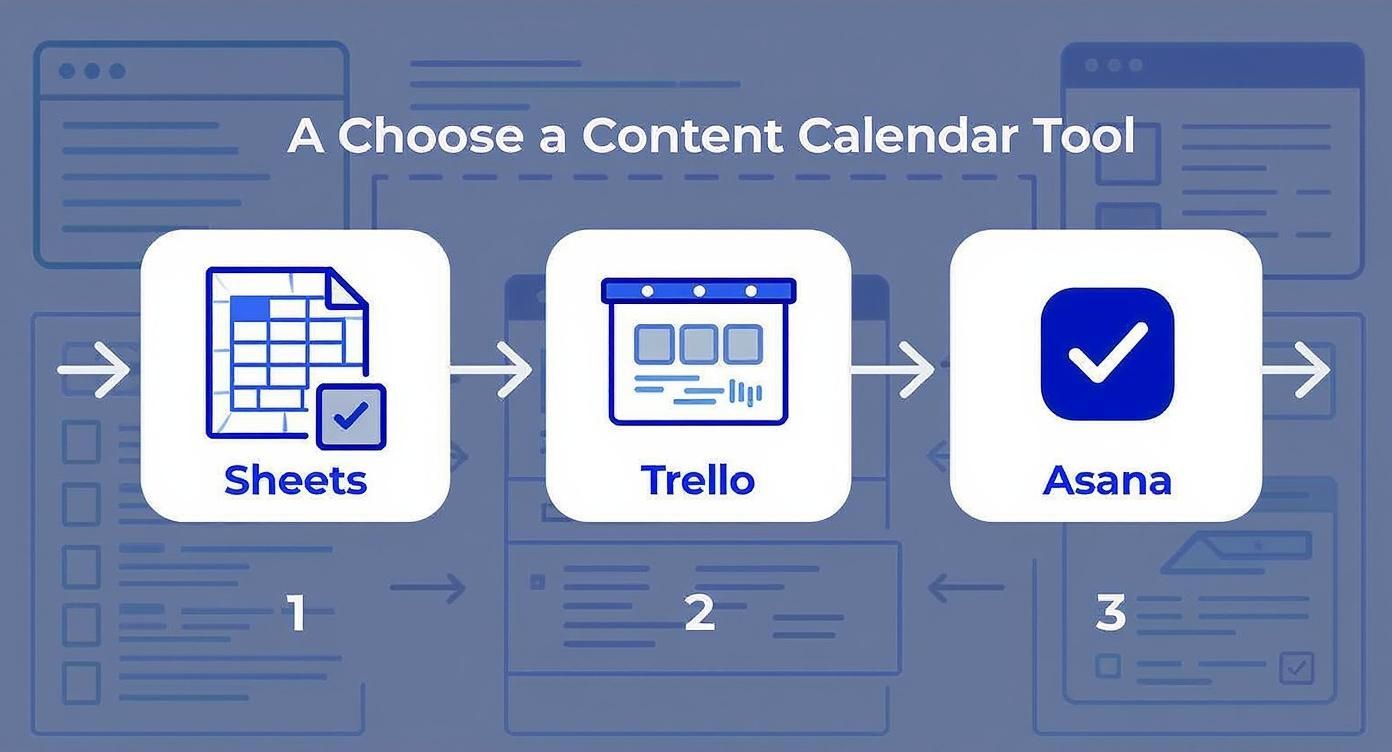 The key is that your tools should support your workflow, not complicate it.
Define clear stages that actually make sense for your team. A typical workflow might look something like this:
- Ideation: The initial concept is logged and waiting.
- Briefing: A detailed content brief is created so everyone's on the same page.
- Drafting: The first version of the content gets written.
- Review: Key stakeholders provide feedback and edits.
- Approval: The final version is signed off.
- Scheduling & Publishing: The content is loaded into your CMS or social media tool, ready to go live.
Assign a specific owner to each stage. This creates accountability and ensures everyone knows exactly who is responsible for moving the content forward. For teams looking to really scale, learning how to automate content creation can be a game-changer. It frees up your team to focus on strategy and creativity instead of getting bogged down in manual tasks.
Keeping Your Calendar Agile and Effective
Let's get one thing straight: a content calendar should never be a rigid, set-in-stone document. The best ones are living tools that breathe and adapt. Think of it less like a stone tablet and more like a dynamic whiteboard.
This flexibility is your secret weapon. It’s what lets you jump on a trending topic, react to a competitor's big launch, or pivot based on sudden industry news—all without throwing your entire strategy into chaos.
While long-term planning is absolutely essential, a truly great calendar has built-in wiggle room. A common approach I've seen work well is planning out the big "pillar" content pieces quarterly, but intentionally leaving a few slots open each month for those timely, reactive posts that can capture a ton of attention.
Conducting Regular Performance Reviews
To keep your calendar sharp, you have to know what's hitting the mark and what's falling flat. This means scheduling regular check-ins to review your content's performance. I recommend doing this monthly.
Don't just glance at vanity metrics like page views. You need to dig into the analytics to see what genuinely connects with your audience.
During these review sessions, ask yourself the tough questions:
- Which topics drove the most traffic or, more importantly, the most engagement?
- What formats are people loving? Are they watching videos or digging into long-form articles?
- Did a specific post actually generate qualified leads?
- What content was a total dud, and can we figure out why?
The insights you gather are pure gold. If you find out your audience can't get enough of short, educational videos, it’s time to adjust your calendar to deliver more of them. This data-driven approach transforms your calendar from a simple schedule into a strategic growth engine. As you get better at analyzing performance, you'll start to see clear patterns that show you how to scale content marketing by simply giving your audience more of what they've proven they want.
Your content analytics are a direct conversation with your audience. They're telling you exactly what they want more of—all you have to do is listen and adjust your calendar accordingly.
The Power of Evergreen Content
Chasing trends is part of the game, but the foundation of any agile and effective calendar is evergreen content. These are your timeless, high-value assets—the ultimate how-to guides, detailed case studies, and foundational "what is" articles that stay relevant for months, or even years.
A healthy calendar always has a solid mix of timely and evergreen topics. A pro move is to schedule time specifically to update and repurpose these powerhouse assets. For example, an old blog post that still gets decent traffic could be refreshed with new data, reimagined as an infographic, or expanded into a video series.
This strategy maximizes the value of everything you create, ensuring a steady, reliable stream of traffic and engagement with far less effort over the long haul.
Of course, here is the rewritten section, crafted to sound like it was written by an experienced human expert, following all your specific instructions.
Let's Tackle Some Common Content Calendar Questions
Even with the best-laid plans, a few questions always seem to pop up, especially when you're putting together a content calendar for the first time. It’s completely normal. Let's walk through some of the most common ones I hear so you can move forward with confidence.
Probably the biggest question is about posting frequency: "How often should we actually be publishing?"
There’s no magic number here. What truly matters is consistency, not volume. It’s a thousand times better to publish one fantastic, well-researched blog post every single week than it is to aim for three, burn out, and consistently miss the mark. Start with a pace you know you can maintain, prove the process works, and then you can think about scaling up.
Should My Calendar Be Set in Stone?
Absolutely not. Please don't treat your calendar like a rigid set of rules. Think of it more as a strategic guide—a North Star for your content efforts. You'll definitely want to plan your big-ticket items, like pillar pages or major campaign launches, at least a quarter in advance. This gives everyone on the team a clear direction to row towards.
But you have to leave some wiggle room. I always recommend leaving at least 20% of your schedule open for timely or reactive content. This is your secret weapon for jumping on emerging industry trends or addressing breaking news without throwing your entire strategy into chaos.
Your content calendar is a living document. The goal isn't to follow it perfectly to the letter, but to use it as a strategic tool that flexes with real-world opportunities and, just as importantly, your performance data.
How Far in Advance Should I Plan?
This really boils down to the size of your team and how complex your content is. For most teams, a tiered planning system is the way to go. It strikes the perfect balance between long-term vision and short-term agility.
Here’s how it usually breaks down:
- Quarterly Planning: This is your high-level strategy session. Map out the major themes, campaigns, and cornerstone content you want to tackle over the next 90 days.
- Monthly Planning: As you get closer, you'll flesh out the details for the upcoming month. This is where you assign specific topics, decide on formats, and lock in firm deadlines.
- Weekly Check-ins: A quick huddle to review the week ahead. You'll make any final tweaks and just make sure everything is polished and ready to go live.
What if I Run Out of Ideas?
It happens to the best of us. That feeling when the idea well runs dry is no fun. When you hit that wall, don't panic. Instead, turn to your two most reliable sources of inspiration: your audience and your data.
First, dive into your analytics. See what’s resonated in the past. Which topics got the most traffic or engagement? Brainstorm some follow-up posts or explore a different angle on that same winning theme.
Even better, go talk to your customer-facing teams. Ask your sales or support staff about the questions they get asked every single day. I guarantee you, each one of those questions is a golden content idea just waiting to be created, ensuring your calendar is always packed with topics your audience is genuinely desperate to know about.
Ready to stop brainstorming and start publishing? IndexPilot uses trainable AI Agents to automate your entire content workflow, from keyword research and strategy to writing, optimization, and publishing. Build an autopilot calendar that creates and schedules SEO-optimized content while you focus on growth. Learn more at https://www.indexpilot.ai.