People always ask, "How many keywords should I target?" and honestly, the answer is simpler than you'd think. Focus on one primary keyword for each page—this is your North Star. Then, support it with a family of 5 to 20+ secondary keywords to add depth, context, and a ton of relevance. This is how you build a resource that both people and search engines will actually love.
Ditching The Magic Number For A Keyword Ecosystem

The old SEO playbook was all about hitting a specific keyword count, which usually just led to clunky, keyword-stuffed content that was a pain to read. Today's SEO is a whole different ballgame. Forget obsessing over a single number; the real goal is to build a "keyword ecosystem" for every piece of content you create.
Think of your primary keyword as the sun—the center of your content's universe that gives it a clear purpose. Your secondary and long-tail keywords are the planets and moons orbiting around it. Each one adds to the system's gravitational pull and overall relevance, allowing you to answer a whole spectrum of related questions within a single, authoritative article.
Defining Your Keyword Layers
A strong keyword ecosystem isn't just a random list of terms. It's about understanding the different jobs each keyword has. The best strategies don't just count keywords; they assign them specific roles.
- Primary Keyword: This is your undisputed champion, the core topic. It's the main phrase you want the page to be known for, and it belongs in your title, main headings, and right in the introduction.
- Secondary Keywords: These are the closely related subtopics. If your primary keyword is "strength training," your secondaries might be things like "weightlifting for beginners" or "best dumbbell exercises."
- Long-Tail Keywords: Think of these as the specific, multi-word questions people are typing into Google, like "how to do a squat with proper form." They capture traffic from people who know exactly what they want.
Why More Is Often Better
Casting a wider net with your keyword strategy is non-negotiable these days. Google handles an mind-boggling number of searches, and about 15% of daily queries are phrases that have never been searched before. That fact alone shows why a rigid, narrow approach just doesn't cut it anymore.
By targeting a healthy mix of related keywords, you naturally create more thorough, helpful content. This sends a powerful signal to search engines that your page is an expert-level resource that can answer a bunch of related questions all in one place.
Of course, it's not just about quantity. Knowing how to choose the best keywords for SEO means picking terms that actually line up with your goals. The more user needs you can satisfy on a single page, the better that page is going to perform. And using a solid SEO content optimizer can make weaving these terms into your writing feel completely natural.
Understanding Your Primary And Secondary Keywords
To build a keyword strategy that actually works, you have to get the fundamentals right. Think of your primary keyword as the title of a book. It’s the main subject, the big idea, and the single most important thing your page is about. This is the term you want to own.
Your secondary keywords, then, are like the chapter headings inside that book. They add all the important depth, context, and detail, guiding both your readers and the search engines through everything your topic covers. It's this combination that signals to Google that your page is a true authority, not just a surface-level summary.
The Role Of Your Primary Keyword
Your primary keyword is the star of the show. It needs to have a laser-sharp focus on the main problem you're solving or the question you're answering for the user. Ideally, every single page on your site—from a blog post to a product page—should target its own unique primary keyword. This keeps things crystal clear for search engines.
When you dedicate one page to one primary keyword, you’re sending an unmistakable signal to Google: "This page is the definitive resource for this specific topic." That kind of focus is absolutely critical for ranking. You can dive deeper into how these terms create your foundation for visibility in our guide on organic search keywords.
This clarity also helps you sidestep a common SEO pitfall called keyword cannibalization. That's when multiple pages on your own site start competing with each other for the same search term, which just ends up splitting your authority and torpedoing your chances to rank for anything.
Unlocking Potential With Secondary Keywords
While the primary keyword points you in the right direction, your secondary keywords do most of the heavy lifting. They're all the variations, synonyms, and related subtopics that weave a rich, contextual net around your main idea. This is how you prove to search engines that your content isn't just relevant, but truly comprehensive.
Secondary keywords often fall into a few key buckets:
- Long-tail variations: These are more specific, multi-word phrases from users who know exactly what they need. If your primary is "running shoes," a long-tail could be "best running shoes for flat feet."
- Synonyms and related terms: Think of words or phrases that mean the same thing or are closely related concepts. For "running shoes," this could be "jogging sneakers" or "athletic footwear."
- User questions: Answering the exact questions people are typing into Google is a superpower. Terms like "how to choose running shoes" make for powerful secondary keywords.
Key Insight: A page that ranks well for its primary keyword often ends up ranking for hundreds—sometimes thousands—of related secondary and long-tail keywords. That’s the hallmark of true topical authority, and it goes way beyond simple keyword placement.
How Primary And Secondary Keywords Work Together
Let’s get practical. Imagine you're writing an article and your primary keyword is "home coffee brewing." That's a big, competitive term. On its own, it’s not clear what someone searching for that really wants. Are they looking for methods? Equipment recommendations? A comparison of different beans?
This is where secondary keywords come in to build the complete picture.
| Keyword Type | Example Keyword | User Intent Signal |
|---|---|---|
| Primary Keyword | home coffee brewing | General interest in making coffee at home. |
| Secondary Keyword | french press coffee tutorial | The user wants step-by-step instructions. |
| Secondary Keyword | best coffee grinder for home | The user is looking for product recommendations. |
| Secondary Keyword | pour over vs drip coffee | The user needs a comparison to make a decision. |
By weaving these secondary keywords into your article as subheadings and distinct sections, you create a powerhouse guide that helps multiple types of users. This tells Google that your page isn't just about "home coffee brewing" in theory; it's a deep, valuable resource covering the actual methods, tools, and comparisons people are actively searching for. The result? A single page that can rank for a much wider array of search queries, bringing in more of the right kind of traffic.
Building Topic Authority With Keyword Clustering
Thinking about how many keywords to target on a single page is a good starting point. But if you want to truly dominate your niche, you need to zoom out. The real power move is to stop chasing individual keywords and start owning entire topics.
This is where keyword clustering comes in. It’s a game-changing strategy that shifts your focus from writing one-off articles to building a powerful, interconnected web of content. Get this right, and you'll establish the kind of deep expertise that Google loves to reward.
The Hub-and-Spoke Model: How It All Connects
Imagine your main topic is the hub of a wheel. That central hub is your "pillar page"—a massive, comprehensive guide that targets a broad, high-volume keyword. The spokes are your "cluster content." These are shorter, more specific articles that each tackle a related long-tail keyword and, crucially, link back to the central hub page.
This structure isn't just for organization; it sends a massive signal to search engines. By strategically interlinking related articles, you’re not just telling Google you know about a topic—you’re proving you have a rich, multi-faceted understanding of it. You're showing them you're a genuine authority.
The diagram below breaks down this hierarchy, showing how a single primary keyword can serve as the foundation for countless more specific secondary and long-tail terms.
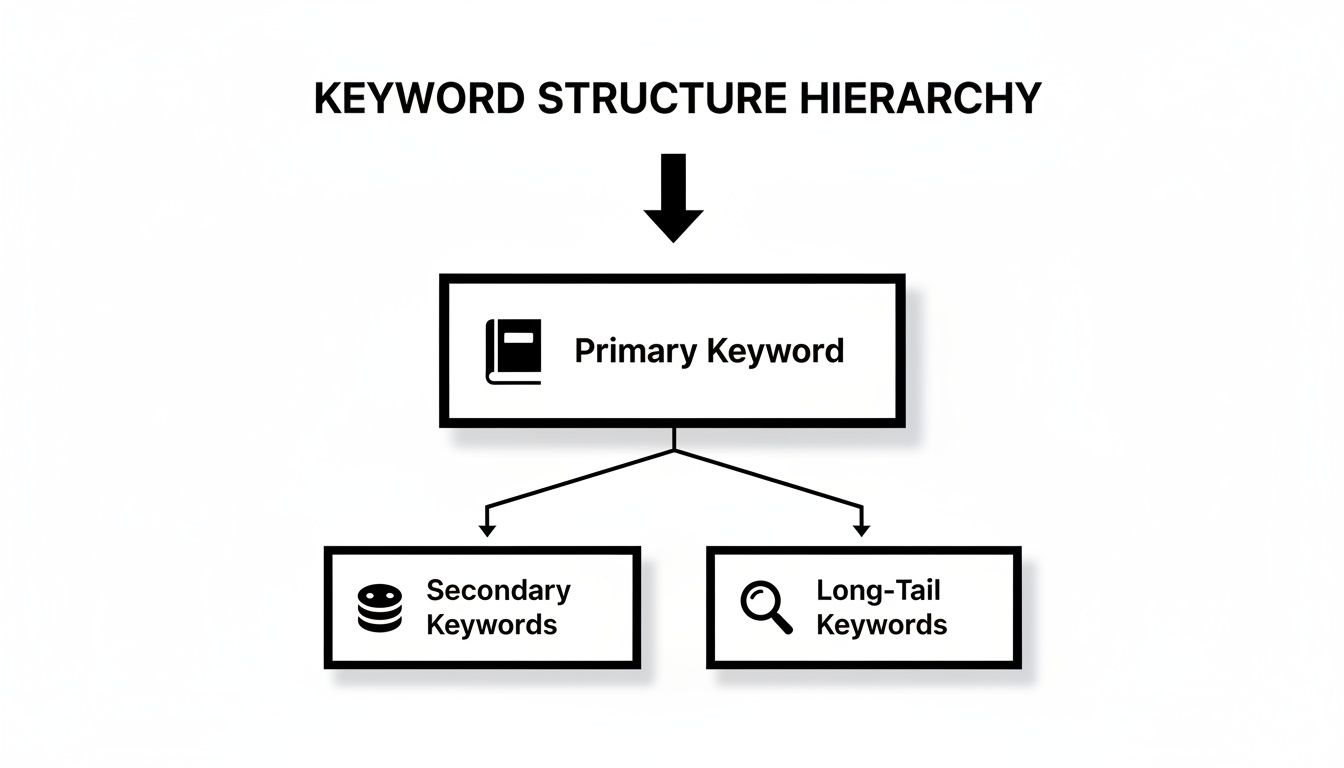
As you can see, one broad topic can branch out into dozens of sub-topics, creating a robust content ecosystem that satisfies user intent from every possible angle.
A Real-World Example: Kettlebell Training
Let's make this concrete. Say a fitness blog wants to become the number one resource online for "kettlebell training." A single article, no matter how epic, simply can't cover it all.
Here’s what a smart keyword cluster strategy would look like:
Pillar Page (The Hub): They'd create a massive, in-depth resource called "The Ultimate Guide to Kettlebell Training." This page’s main goal is to rank for the broad primary keyword "kettlebell training."
Cluster Content (The Spokes): Then, they'd publish a series of shorter, laser-focused articles that answer specific questions. Each one targets a long-tail keyword and links back to that pillar guide.
- Article 1: "5 Best Kettlebell Exercises for Beginners" (Targets: "beginner kettlebell exercises")
- Article 2: "How to Do a Perfect Kettlebell Swing" (Targets: "kettlebell swing form")
- Article 3: "Full Body Kettlebell Workout in 20 Minutes" (Targets: "20 minute kettlebell workout")
- Article 4: "Choosing the Right Kettlebell Weight for You" (Targets: "what kettlebell weight to buy")
Each of these "spoke" articles delivers immediate, targeted value. At the same time, their internal links back to the pillar page pass authority, making the central guide stronger. This creates a fantastic user journey, letting someone land on a specific article (like how to do a swing) and then easily navigate to the main guide for a deeper dive. This kind of intentional interlinking is fundamental to solid content SEO best practices.
Why Keyword Clustering Is Just a Better Strategy
Moving from a single-keyword mindset to a cluster model is a huge leap forward in SEO. Instead of trying to win one small battle, you’re building an entire fortress of content that’s incredibly difficult for competitors to touch. The benefits are massive and they compound over time.
Key Takeaway: A well-executed topic cluster can help you rank for dozens, or even hundreds, of related keywords with a single, coordinated effort. It transforms your site from a collection of disconnected articles into a library of expert knowledge.
Let's look at a direct comparison to see just how different these two approaches are.
Single Keyword Focus Versus Keyword Cluster Strategy
This table breaks down the strategic differences between chasing a single keyword and building a full topic cluster.
| Aspect | Single Keyword Strategy | Keyword Cluster Strategy |
|---|---|---|
| Content Scope | Narrowly focused on one search query. | Broadly covers an entire topic from multiple angles. |
| Ranking Potential | Ranks for the primary term and a few close variations. | Ranks for the broad term and a huge array of long-tail queries. |
| Internal Linking | Often haphazard or an afterthought. | Strategic and intentional, boosting authority across the entire topic. |
| User Experience | Can lead to dead ends, forcing users back to Google. | Guides users through a topic, increasing time on site and satisfaction. |
| Topical Authority | Limited; proves knowledge on one tiny piece of a puzzle. | High; proves comprehensive expertise on a whole subject. |
By embracing a keyword clustering model, you stop asking "how many keywords for one page?" and start asking, "how many related topics can we cover to build an unshakeable foundation of authority?" This approach doesn't just make search engines happy; it creates a far more valuable and engaging experience for the real people visiting your site.
How Many Keywords Should You Actually Target?
So, how many keywords should you cram into a single piece of content? It's a question I get all the time, and the honest answer is: there’s no magic number. It’s less about hitting a specific count and more about a strategic calculation based on your content's length, depth, and what you want it to accomplish.
Think of it like packing for a trip. If you're heading out for a quick weekend getaway (an 800-word blog post), you only need a few key outfits. But if you’re planning a month-long international adventure (a 3,500-word ultimate guide), you'll need a much bigger wardrobe. The goal is to pack exactly what you need for the journey—no more, no less.
Match Your Keyword Count to Your Content's Scope
The most straightforward factor here is content length. A longer, more comprehensive article naturally has more room to breathe. It creates more opportunities to tackle different subtopics and answer a wider range of user questions, making it the perfect home for a larger, more diverse keyword ecosystem.
For a shorter blog post, maybe around 800 words, you’d probably focus on one primary keyword and sprinkle in 5-8 secondary terms. This keeps the article tight and focused, preventing it from feeling rushed or shallow.
On the other hand, a massive pillar page or an "ultimate guide" clocking in at 3,500 words or more has the real estate to go deep. A piece like that could easily and naturally support a primary keyword along with 20-30 secondary and long-tail variations. The crucial part is that each keyword should map to a relevant section or idea within the content. This ensures a natural flow that actually helps the reader, instead of just checking an SEO box.
Here’s the bottom line: Don't force keywords into your content just to hit a number. The right quantity is however many relevant terms you can weave in organically while creating a genuinely valuable resource for your audience.
The Critical Role of User Intent
Word count is just one piece of the puzzle. The user's intent—the "why" behind their search—is your most powerful guide. Once you understand what someone is trying to accomplish, you can figure out which keywords to include and how many are really needed for the job.
There are three main types of user intent that will shape your keyword strategy:
- Informational Intent: The user is hunting for information or an answer. Think "how to brew cold brew coffee." Content targeting this intent should be packed with secondary keywords that answer all the follow-up questions they might have, like "best coffee beans for cold brew," "cold brew ratio," or "how long to steep cold brew."
- Navigational Intent: The user knows where they want to go and is just looking for the front door (e.g., "IndexPilot login"). These pages need very few keywords because the intent is so specific and brand-focused.
- Transactional Intent: The user is ready to buy or take action. They're searching for things like "buy organic espresso beans" or "best price on coffee grinders." Product pages targeting this intent should be loaded with keywords related to features, models, comparisons, and purchasing info.
When you align your content with the user's goal, choosing the right family of keywords to support your main topic becomes so much clearer.
Don't Sleep on Long-Tail Keywords
As you start targeting more keywords for your longer content, you should naturally find yourself using more long-tail keywords. These are the longer, more specific phrases that are absolute gold for capturing high-intent traffic. The search world has changed; long-tail keywords now make up a whopping 70% of all search traffic.
These specific queries are incredibly valuable because they usually mean a user is much further along in their research and closer to making a decision. In fact, data shows that these longer phrases can deliver conversion rates about 2.5 times higher than their shorter, broader counterparts. They're not just an add-on; they're a critical part of a modern keyword strategy. You can dive deeper into these kinds of SEO stats to learn how search behavior is changing.
Let's Get Practical: Examples by Content Type
Seeing it in action makes it click. Here’s how keyword quantity might look for a couple of different content formats.
1. E-commerce Product Page An e-commerce page for a "smart coffee maker" has to be lean, efficient, and persuasive.
- Primary Keyword: "smart coffee maker"
- Secondary Keywords (5-10): "wifi coffee maker," "programmable coffee pot," "12-cup smart coffee machine," "smart coffee maker with grinder," "best smart coffee maker 2024." These terms hit on specific features and queries from people ready to buy.
2. In-Depth How-To Guide A long-form blog post on "How to Master Pour-Over Coffee" has a much wider mission.
- Primary Keyword: "how to make pour-over coffee"
- Secondary Keywords (15-25): "pour-over coffee ratio," "best coffee grind for pour-over," "what temperature water for pour-over," "gooseneck kettle technique," "v60 vs chemex," "troubleshooting bitter pour-over." This sprawling list reflects the depth required to create a guide that's truly the last one a reader will ever need on the topic.
How To Measure And Refine Your Keyword Strategy
Picking your keywords is just the starting line. A winning SEO strategy isn't something you can just set up and walk away from; it’s a living thing that needs constant attention and a steady diet of data to keep it healthy. Measuring what’s working (and what’s not) is how you turn educated guesses into a reliable engine for growth.
Your best friend in this process is Google Search Console (GSC). It’s a completely free tool that gives you a backstage pass to how Google sees your website. Forget guesswork. GSC shows you the exact search queries people are using to land on your pages, offering a direct line into your audience’s thought process.
Uncover Your True Keyword Footprint
One of the most eye-opening parts of GSC is the Performance report. It doesn’t just show you the primary and secondary keywords you were trying to rank for—it shows you every single term your page is ranking for, period. More often than not, you'll be stunned to find you’re showing up for dozens of unexpected long-tail variations you never even considered.
This data is pure gold. It’s your audience telling you, in their own words, what they’re looking for. You can take that language and weave it back into your content to make it even stronger and more relevant. This feedback loop is the secret to continuous improvement. For a deeper dive, check out our guide on how to track keyword rankings using tools like GSC.
Identify Striking Distance Opportunities
As you dig through your GSC data, keep an eye out for what SEOs call "striking distance" keywords. These are the terms where you’re already ranking but are stuck on the second or third page of Google—usually somewhere in positions 11-30. This is your lowest-hanging fruit.
Think about it: Google already sees your page as relevant for these searches; it just needs a little nudge to get over the finish line. A simple content refresh is often all it takes. You could add a new section that directly tackles that keyword, update some old stats, or build a few more internal links to the page. That small push can be enough to bump it onto the first page and open up a brand-new stream of traffic.
Key Insight: Focusing on striking distance keywords gives you a much faster return on your time than trying to rank for a new keyword from scratch. You're building on momentum you already have.
Running a regular SEO audit is a great way to systematically hunt for these opportunities and catch any targeting mistakes. If you need a framework, you can learn how to perform an SEO audit to keep your strategy sharp.
Connect Keywords to User Behavior
Getting the ranking is only half the battle. The real goal is to make the person who clicked your link happy they did. This is where you need to connect the dots between your keyword data in GSC and user engagement metrics from a tool like Google Analytics.
For the pages that are ranking, take a look at these metrics:
- Time on Page: Are people actually sticking around to read what you wrote? A low time on page can be a red flag that your content doesn't match the keyword's intent.
- Bounce Rate: Are visitors hitting the back button as soon as they arrive? A high bounce rate might mean your content isn't delivering the answer they were hoping to find.
When you see a page with high rankings and strong engagement, you’ve hit the jackpot. That’s the formula you want to replicate. It tells you that your content doesn't just check a box for Google—it genuinely solves a problem for a real person. That positive user experience sends powerful signals back to Google, helping to lock in and even boost your rankings over time.
Common Keyword Targeting Mistakes And How To Fix Them

Knowing how many keywords to aim for is a great start, but it's only half the battle. Just as important is knowing what not to do. It’s surprisingly easy to trip up, and even a perfectly researched keyword list can fall flat if you get the execution wrong.
Avoiding a few classic mistakes can be the difference between landing on page one and getting completely buried. Two of the biggest offenders are keyword stuffing and keyword cannibalization. They might sound technical, but they boil down to basic problems: overuse and disorganization. Let's break them down.
The Outdated Practice Of Keyword Stuffing
Remember the early days of the internet? Keyword stuffing is a relic from that time. It’s the old-school, brute-force tactic of jamming your main keyword into a page over and over again, hoping it sticks.
This is a huge red flag for Google today. Search engine algorithms have gotten incredibly smart; they prioritize content that reads naturally and actually helps people. Forcing your keyword into every other sentence just makes for a terrible reading experience and can get you penalized.
Key Takeaway: Stop counting keywords. Google understands context, synonyms, and related ideas. Forcing your keyword in repeatedly is not only unnecessary, but it also hurts you.
Instead, shift your focus to covering your topic from every angle. When you write a truly comprehensive article, you'll naturally use your primary keyword along with a whole host of secondary and long-tail variations. The goal isn't keyword density—it's topical relevance.
Keyword Cannibalization Self Sabotage
This one is a classic case of accidentally shooting yourself in the foot. Keyword cannibalization happens when multiple pages on your own website are all trying to rank for the same primary keyword. It’s a common side effect of creating lots of content without a clear roadmap.
When Google finds two of your pages fighting for the same search query, it gets confused. It doesn't know which one is the definitive source. So what happens? It splits the authority between them, watering down the ranking potential of both. It’s like sending two runners from the same team to compete in the same race—they just end up splitting the votes and hurting their collective chances of winning.
The good news is, you can fix this by consolidating your content.
- Audit Your Content: Dive into Google Search Console and find which pages are competing for the same main keywords.
- Merge and Consolidate: Take your strongest, most comprehensive page on the topic and merge the content from the weaker ones into it. Then, redirect the old URLs to your new powerhouse page to pass along any link authority.
- Refocus Your Strategy: If you have two valuable pages that are just too similar, pivot one of them. Tweak the content to target a slightly different, more specific primary keyword. This gives each page its own clear mission.
A truly sharp keyword strategy also involves knowing which terms to actively avoid. Using the right negative keyword tools is a smart way to stop your content and ads from showing up for irrelevant searches, which saves you money and keeps your efforts focused. By sidestepping these common mistakes, you ensure every page on your site has a distinct purpose and a much better shot at ranking.
Frequently Asked Questions About Keyword Strategy
Even with the best strategy laid out, you're bound to have some questions once you start getting your hands dirty. That’s perfectly normal. Getting straight answers to these common sticking points can save you a ton of time and keep you from second-guessing every move. Let’s tackle some of the most frequent questions we hear.
Should Every Page Target A Unique Primary Keyword?
Yes. One hundred percent. Think of it this way: every single page on your website needs to have one clear job. Assigning a unique primary keyword gives it that job.
This is the single best practice for avoiding keyword cannibalization, which is a self-inflicted wound where your own pages start competing with each other in the search results. When two of your pages are fighting for the same keyword, Google gets confused about which one is the real authority. The result? It often ranks both of them lower.
By giving each page its own distinct focus, you’re sending a crystal-clear signal to search engines about which piece of content is the definitive resource for that specific query.
How Do I Find Good Secondary Keywords For My Content?
Finding great secondary keywords isn't about guesswork; it's about paying attention to the clues that search engines and users are already leaving for you. There are a few tried-and-true methods for unearthing a ton of relevant terms.
- Look at the SERPs: The Google search results page is an absolute goldmine. Check out the "People Also Ask" box and scroll down to the "Related Searches" section at the bottom. These are instant, high-quality ideas handed to you on a silver platter.
- Use Your Favorite SEO Tool: Platforms like Semrush or Ahrefs have fantastic keyword research features. They can uncover hundreds of related terms, common questions, and long-tail variations you would never have thought of on your own.
- Spy on the Competition: Take a look at the top-ranking articles for your primary keyword. What subheadings are they using? What related ideas do they cover in their content? This simple analysis shows you the exact semantic keywords Google already connects to your topic.
Is Keyword Density Still An Important SEO Metric?
Nope. In fact, keyword density is an obsolete concept, and chasing it will probably do more harm than good. Years ago, SEOs would try to hit a specific percentage of keyword repetition, but today’s search algorithms are light-years beyond that. They care about topic relevance and natural language above all else.
Forget about percentages. Your real goal is to write a comprehensive, high-quality article that completely solves the user's problem. When you do that, the right keywords and all their variations will naturally find their way into the text without you having to force them in.
Turn your keyword strategy into a reliable growth engine with IndexPilot. Our AI-powered platform automates the entire SEO content lifecycle—from research and writing to optimization and publishing—so you can scale your organic traffic without the manual busywork. Start compounding your traffic with IndexPilot.