Forget keyword stuffing—today's SEO is all about building topical relevance. The smartest, most effective strategy is to anchor each page with one primary keyword and then build around it with a handful of closely related secondary keywords.
This approach does more than just help you rank; it sends a clear signal to both users and search engines that your content is an authoritative, go-to resource on the subject.
The Modern Answer to Keyword Count
How many keywords should you use on a page? It’s a classic SEO question, but honestly, it’s a bit like asking a chef how many grains of salt to use. There's no magic number. The right amount depends entirely on the dish—or in this case, your content.
The old days of obsessing over keyword density are long gone. Good riddance.

Instead of trying to repeat a term a certain number of times, modern SEO is about creating a comprehensive piece that covers a topic from all angles. Think of your page as a chapter in a book. It needs one central idea (your primary keyword), but it uses related concepts, synonyms, and sub-topics to tell the full story.
Adopting the 1 + 4 Model
So, what’s a practical number to aim for? A solid, widely accepted industry standard is the 1 + 4 model: one primary keyword per page, supported by one to four closely related secondary keywords or variations.
This structure is effective because it keeps your content laser-focused. It also works perfectly with critical on-page elements, like title tags, where space is limited and clarity is everything. By keeping it simple, you help search engines understand exactly what your page is about, which dramatically improves your chances of ranking for that core topic.
Building Topical Authority
When you use a primary keyword as your North Star and support it with a constellation of secondary terms, you start to build something called topical authority. This is how you signal to Google that you’re not just dabbling in a subject—you’re a genuine expert.
Here's a simple way to think about it:
- Primary Keyword: This is the main question your page is built to answer.
- Secondary Keywords: These are the synonyms, subtopics, and long-tail questions that add crucial context and depth.
- Semantic Variations: These are all the related terms and concepts that would naturally come up in a conversation about the topic.
The real goal isn't hitting some arbitrary keyword count. It's about completely satisfying user intent. When you can answer a user's main question and all their follow-up questions in a single piece of content, you've nailed modern SEO.
This approach lines up perfectly with what Google wants: to give its users the most relevant, thorough answers possible. To see how this fits into a broader strategy, check out our guide on content SEO best practices.
To make this even clearer, here’s a quick-reference table that breaks down the strategy.
Keyword Targeting Strategy At a Glance
| Keyword Type | Recommended Count Per Page | Purpose |
|---|---|---|
| Primary Keyword | 1 | To provide a single, clear focus for the entire page and target the main user query. |
| Secondary Keywords | 1-4 | To build topical depth, capture related search queries, and add important context for search engines. |
| Semantic Variations | As needed for natural flow | To create comprehensive content that sounds human, covers the topic fully, and avoids repetition. |
Sticking to this focused approach ensures each page on your site has a distinct purpose, preventing keyword cannibalization and helping you build a library of truly authoritative content.
Primary vs Secondary Keywords Explained
 To really nail your keyword strategy, you have to understand the different jobs keywords do on a single page. It helps to think of your content like a movie: your primary keyword is the star of the show. It's the whole reason people showed up in the first place—the main character, the central theme.
Secondary keywords, then, are the incredible supporting cast. They aren't the main event, but the story would feel hollow and incomplete without them. These supporting terms are the synonyms, subtopics, and related questions that give your content the context and depth it needs to feel truly authoritative.
The Star and the Supporting Cast
Let’s break this down with a real-world example. Say you're writing a big guide, and your primary keyword is "sustainable home gardening." That's your star—the core idea that the entire article is built around.
Now, you need that supporting cast to bring the story to life. Your secondary keywords would naturally be terms like:
- Organic vegetable garden tips
- Composting for beginners at home
- Small space urban farming ideas
- How to build a raised garden bed
These secondary terms don't fight with your primary keyword for the spotlight; they support and enrich it. They're your chance to answer all the follow-up questions your audience is thinking about, which creates a much more helpful and satisfying experience for the reader.
Weaving primary and secondary keywords together is how you build powerful topical authority. You’re not just answering one question—you’re showing search engines you're an expert on the entire subject.
This is how you turn a simple article into a go-to resource. When search engines like Google see this web of interconnected ideas, they recognize that your page is a high-quality answer for a whole cluster of related queries, not just a single one.
Finding the Right Balance
The trick is to make it all feel natural. Your primary keyword is the headliner, so it belongs in the most important places: your page title, your main H1 heading, and right in the introduction.
Your secondary keywords can then take the stage in your subheadings (H2s and H3s) and throughout the body of your text. Use them to introduce new angles and dive deeper into specific sub-topics. This structure builds a logical flow for the reader while signaling your page’s relevance to search engines.
To get a better handle on this, it’s really helpful to understand the difference between long-tail and short-tail keywords, since many of your best secondary keywords will be long-tail phrases.
Ultimately, this methodical approach is at the heart of figuring out the ideal number of keywords per page. For a deeper dive into how different keyword targeting options play out, you can explore the fundamentals of keyword match types in our detailed guide.
Why Long-Tail Keywords Are Your Secret Weapon
While primary keywords often steal the spotlight, the real competitive edge in SEO often comes from mastering long-tail keywords. These are the longer, more specific search phrases that, at first glance, might seem less valuable because of their lower individual search volumes. But don't be fooled—they are incredibly powerful when you know how to use them.
Think of it like this: someone searching for "laptops" is just window shopping. They're at the very top of the sales funnel, casually exploring their options. But a person searching for a "lightweight 13-inch laptop for travel editing" knows exactly what they need. They're much closer to making a purchase, and that's the power of user intent.
Capturing High-Intent Searches
Long-tail keywords are your direct line to users who are much further along in their buying journey. They’re asking specific questions and looking for precise solutions, which makes them far more qualified leads. By targeting these phrases, you attract an audience that isn't just looking for general information, but for answers that lead to action.
And this strategy pays off, big time. An incredible 91.8% of all search queries are now considered long-tail keywords. More importantly, these super-specific phrases deliver conversion rates that are roughly 2.5 times higher than their short-tail counterparts. That makes them an essential tool for driving actual business results.
Long-tail keywords don't just bring traffic; they bring the right kind of traffic. By focusing on specificity, you naturally filter out the casual browsers and connect with highly motivated users who are actively looking for what you offer.
Weaving Long-Tails into Your Content
The best part? Integrating long-tail keywords should feel completely natural, adding real value for your reader. They're perfect for framing your subheadings, answering specific questions within your text, or even building out a dedicated FAQ section.
Here’s how you can strategically place them to get the most impact:
- In H2 or H3 Subheadings: Use a long-tail keyword like "how to choose a travel editing laptop" as a subheading to perfectly structure a section of your content.
- As Direct Questions: Answer the user's query directly within a paragraph. For instance, you could write, "So, what makes a laptop good for travel editing? The key factors include its weight, battery life, and screen accuracy."
- Within Bullet Points: Break down complex topics or features using long-tail phrases to highlight specific benefits and details.
By weaving these detailed phrases into your articles, you create a richer, more comprehensive resource that speaks directly to what your audience needs. This not only boosts your chances of ranking for these valuable terms but also builds trust by providing clear, targeted answers.
For a closer look at how these terms fit into your broader strategy, our guide on identifying organic search keywords provides deeper insights.
How Content Length Shapes Your Keyword Strategy
Does writing a longer article automatically mean you'll rank higher? Not exactly. The real magic isn't just about the word count; it's about the connection between content length and topical depth. A higher word count simply gives you more room to explore a subject from every angle.
Think of it like this: a short 500-word post is a small canvas, perfect for a detailed portrait. You can zero in on one primary keyword and a handful of its closest friends, creating a sharp, focused picture for both your readers and the search engines.
But a massive 3,000-word guide? That’s a sprawling mural. You have the space to naturally weave in dozens of related terms, LSI keywords, and long-tail questions, cementing your article as a true authority on the topic. The goal isn't just to write more words; it's to deliver more comprehensive value.
Scaling Keywords With Content Scope
It's a pretty direct relationship: the longer your content, the more keywords you can naturally include. A quick 500-word post might comfortably handle five to seven target phrases without sounding like a robot wrote it. In contrast, an in-depth 3,000-word guide can easily accommodate 20 or more keywords. This makes sense when you see that pages on the first page of Google average around 1,447 words. Longer content simply provides more real estate for natural keyword integration.
And this is where long-tail keywords really shine. They are much easier to work into longer, more detailed content.
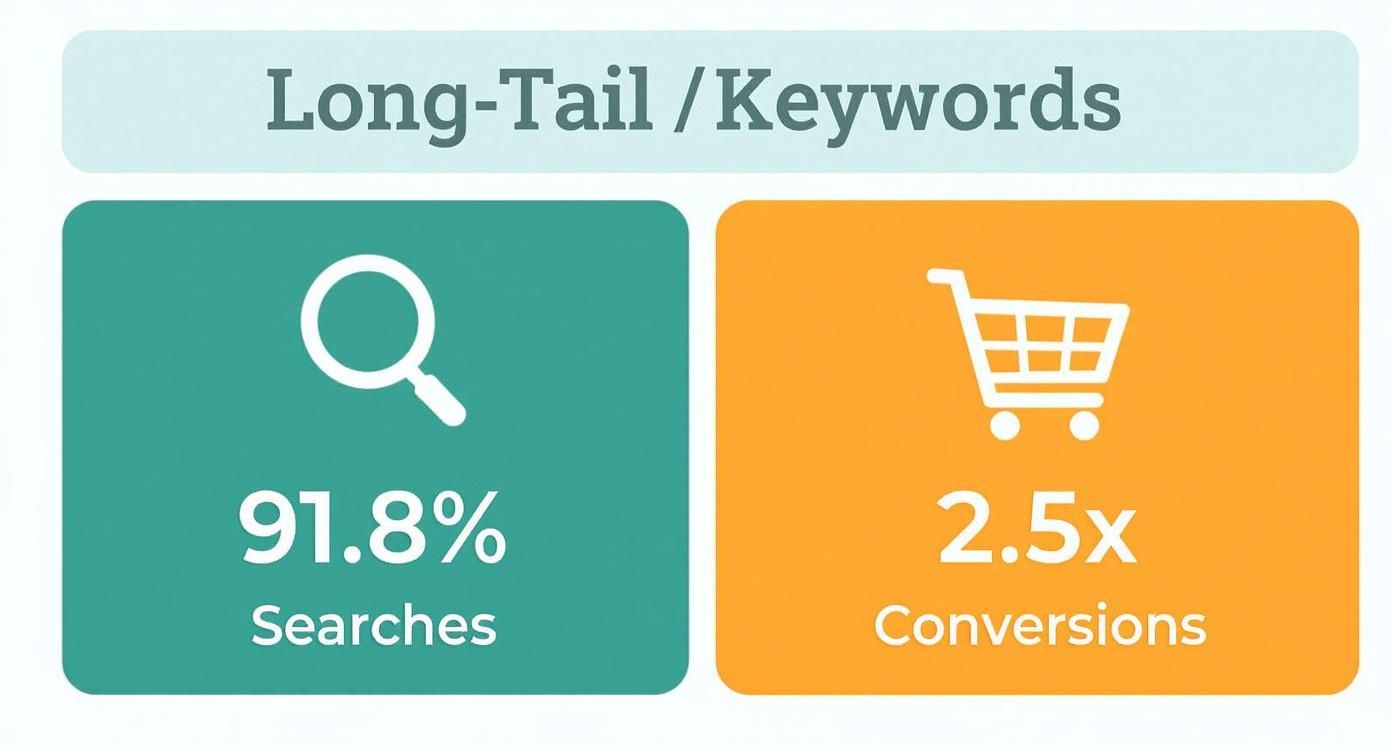
This data reveals something crucial: the overwhelming majority of searches are specific, long-tail phrases. And these high-intent queries convert at a much higher rate. Longer articles are the perfect vehicle for answering them.
To illustrate how keyword opportunities can scale with your content, here’s a quick breakdown:
| Content Length and Keyword Potential | ||
|---|---|---|
| Article Word Count | Estimated Keyword Capacity | Content Focus |
| 500-800 words | 3-5 keywords | A quick, targeted answer to a specific question. |
| 1,200-1,800 words | 5-10 keywords | A standard blog post covering a topic in detail. |
| 2,500+ words | 15-20+ keywords | A comprehensive pillar page or ultimate guide. |
This table provides a simple framework, showing that as you create more in-depth content, you unlock the ability to rank for a wider array of relevant terms.
A Practical Framework For Keyword Integration
So, what does this look like in practice? It’s all about matching your keyword ambitions to the scope of your content. Don’t try to shoehorn 20 keywords into a 500-word post. It will read horribly and Google will see right through it. Instead, let the depth of your content guide how many keywords you can realistically target.
The goal is to use length to create a richer user experience, not just to hit a word count. Every additional paragraph should serve to deepen a user's understanding and signal your comprehensive expertise to search engines.
Here’s a simple framework you can follow:
Short-Form Content (500-800 words): Stick to one primary keyword and 3-5 closely related secondary or long-tail keywords. The goal here is a quick, authoritative answer.
Standard Blog Posts (1,200-1,800 words): Target one primary keyword, but expand your reach to include 5-10 secondary keywords and long-tail variations. Use your subheadings to explore different facets of the topic.
Pillar Pages (2,500+ words): Go for one broad primary keyword and support it with 15-20+ secondary and long-tail keywords. This format is designed to be a comprehensive resource that covers a subject from A to Z.
Ultimately, let your topic's complexity be your guide. For more tips on putting this all together, check out our complete guide on how to optimize content for SEO.
Ditching Old Habits: How to Avoid Over-Optimization in Today's SEO
The ghost of "keyword density" still haunts a surprising number of SEO strategies, but let's be clear: it's a relic. If you're still obsessing over a specific repetition percentage, you're on a fast track to creating awkward, clunky content. That's the kind of thing modern search algorithms are specifically designed to penalize as keyword stuffing.
Search engines have grown up. They're far more sophisticated now, prioritizing things like semantic relevance and natural language. What does that mean? They understand the topic of your page through context, synonyms, and related concepts—not by simply counting how many times you jammed a phrase in there.
The game has changed. The new focus isn't on repetition; it's on resolution. Your primary goal is to resolve the user's query so thoroughly that they have no reason to hit the back button. That's the behavior search engines are built to reward.
So, instead of counting keywords, start thinking about your audience first. The real question isn't "How many times can I fit my keyword on this page?" It should be, "Does this content completely and clearly answer the user's search intent?"
Moving From Keyword Density to Topical Depth
Thinking about keywords is still absolutely essential, but the way we think about them has to change. Your goal is to signal topical depth, not just hit a keyword target. This means weaving your primary, secondary, and long-tail keywords into the content in a way that actually helps the reader.
There are a few high-impact spots where keywords still carry the most weight:
- Page Title (Title Tag): This is still the single most important place for your primary keyword. No question.
- H1 Heading: Your main on-page heading should clearly state what the page is about, and it almost always includes the primary keyword.
- Introduction: Mentioning your primary keyword within the first 100 words or so is a great way to confirm the topic for both users and search engines right away.
- Subheadings (H2, H3): These are perfect spots for your secondary and long-tail keywords. They help structure your content and signal that you're covering all the related sub-topics.
Beyond these key placements, your focus should shift entirely to readability and creating a valuable experience. If a keyword feels forced or doesn't fit naturally into a sentence, leave it out. The quality of your writing and the usefulness of your information are far more powerful ranking factors.
And as you build out your content, you need to make sure your pages aren't competing with each other. This is where addressing keyword cannibalization issues comes in, ensuring every single page has a clear, distinct purpose.
How Many Keywords You Should Actually Track
Once you’ve polished your on-page SEO, the game shifts from optimization to measurement. Now the big question pops up: how many keywords should you actually be tracking to know if any of this is working? Spoiler alert—there’s no magic number. The right answer is a strategy built around your specific website and what you’re trying to achieve.
Honestly, there’s no one-size-fits-all solution here. A local plumber might hit a home run by tracking just 20-50 high-intent, local keywords. On the flip side, a national e-commerce store could easily find itself monitoring thousands of terms across countless product categories. Your tracking strategy needs to be a direct reflection of your business's scale and priorities.
Creating a Practical Tracking Framework
Instead of pulling a number out of thin air, let's build a realistic framework based on your most important pages. The goal isn’t to track every keyword variation under the sun. It's about monitoring the terms that actually drive business value.
First things first, identify the pages that are absolutely crucial to your success.
Your core pages are usually:
- The Homepage: Your digital front door and the face of your brand.
- Service/Product Pages: These are the pages that directly bring in leads or sales.
- Key Blog Posts: Your top-performing content that pulls in new audiences.
For a service-based website with a few different offerings, a pretty solid formula is to multiply your number of organic landing pages by a range of 1-4 keywords per page.
Let’s say you have a site with five service pages, three important blog posts, and a homepage. That gives you a starting point of tracking somewhere between 9 and 36 keywords. If you want to dive deeper into this calculation, WallarooMedia.com has an in-depth analysis that breaks it down even further.
Tracking the right keywords is what allows you to measure your SEO performance accurately, spot new trends as they emerge, and uncover fresh opportunities for growth. It’s how you turn raw data into smart business decisions.
By zeroing in on your most valuable pages, you can build a tracking plan that's both manageable and incredibly effective. This targeted approach makes sure you're watching the metrics that really matter, giving you a clear picture of your SEO impact.
Ready to get your own system in place? Our guide on how to track keyword rankings will walk you through the entire process, step-by-step.
Frequently Asked Questions About Keyword Strategy
Even when you've got a solid plan, questions always pop up when the rubber meets the road. Let's dig into some of the most common things people ask about using keywords effectively.
Does Every Page Need a Unique Primary Keyword?
Yes. This one's a dealbreaker.
Giving every single page its own unique primary keyword is how you avoid "keyword cannibalization." That's what happens when your own pages start fighting each other for the same spot in the search results—a battle you'll always lose.
When you assign one primary keyword to one page, you're sending a crystal-clear signal to Google: this is the definitive resource for this specific topic.
How Do I Find Good Secondary Keywords?
Finding great secondary and long-tail keywords is a lot easier than most people think. Sure, SEO tools are a fantastic place to start, but you can strike gold just by paying attention to what Google is already telling you.
- The "People Also Ask" boxes are literally a list of questions your audience is asking.
- The "Related Searches" at the bottom of the page show you where people are headed next.
Another trick? Just think about the natural follow-up questions someone would have after reading your content. Those are your long-tail opportunities right there.
Key Takeaway: The best secondary keywords aren't just slight variations of your primary term. They represent the next logical step in your reader's journey, and answering them is how you build real authority.
Is It Bad if My Primary Keyword Only Appears a Few Times?
Not at all. The old days of stuffing keywords are long gone. Modern SEO is all about relevance and smart placement, not just raw numbers.
The most important thing is to make sure your primary keyword shows up in the high-impact spots: the title tag, meta description, and your H1 heading.
After that, your job is to write naturally and cover the topic like an expert. If the main keyword only fits in a couple of times but you've thoroughly explored the subject with related terms, that's perfect. Search engines are more than smart enough to connect the dots.
Ready to stop guessing and start scaling your SEO content? IndexPilot uses trainable AI Agents to automate your entire workflow, from keyword research and writing to optimization and publishing. Transform your SEO into a reliable growth engine. Turn keywords into compounding traffic with IndexPilot today.