Search is no longer a single-channel game. Generative AI models like ChatGPT, Claude, and Perplexity are reshaping how users discover brands, evaluate products, and make decisions — often without ever clicking a traditional blue link. For marketers, founders, and agencies, this shift demands a new playbook.
Traditional SEO still matters, but it must now be paired with generative engine optimization (GEO) techniques that ensure your brand surfaces in AI-generated answers, not just search engine results pages. The brands winning in 2026 are the ones showing up in both places simultaneously.
This article breaks down eight actionable generative AI SEO techniques that bridge the gap between classic search optimization and the emerging AI discovery landscape. Each strategy is designed to help you create content that ranks on Google and gets cited by AI models, giving you compounding visibility across every channel where your audience is searching.
Whether you're just starting to think about AI visibility or looking to refine an existing strategy, these techniques provide a clear implementation path from foundational structure to scaled production.
1. Structure Content for AI Extraction with Entity-Rich Markup
The Challenge It Solves
AI models and search engines both rely on structured signals to understand what a piece of content is about and whether it's authoritative enough to surface in responses. Without clear entity definitions and schema markup, even well-written content can be overlooked simply because machines can't parse its context efficiently. This is especially true for AI-generated answers, where models need to extract precise facts quickly.
The Strategy Explained
Schema markup using vocabulary from schema.org tells both search crawlers and AI models exactly what your content represents: a product, a person, an organization, a how-to guide, an FAQ. When you layer entity-rich markup onto your content, you're essentially handing AI systems a structured map of your expertise.
Think of it like labeling every file in a filing cabinet instead of throwing loose papers in a drawer. The more clearly you define your entities, the more likely an AI model is to pull from your content when constructing a relevant answer. Focus on consistent entity definitions across your site so that your brand, products, and core topics are always described in the same terms. For a deeper dive, explore our guide on semantic SEO optimization to understand how entity clarity drives discoverability.
Implementation Steps
1. Audit your existing pages for schema markup gaps using Google's Rich Results Test or a similar tool, prioritizing high-value content like product pages, guides, and FAQ sections.
2. Add appropriate schema types to each content category: Organization and Product schema for brand pages, HowTo and FAQPage schema for instructional content, and Article schema with author and date fields for editorial pieces.
3. Maintain consistent entity naming across your site so that your brand name, product names, and core topic terms appear identically in schema, headings, and body copy.
Pro Tips
Don't just add schema for the sake of it. Each markup type should reflect the actual content on the page. AI models are increasingly sophisticated at detecting mismatches between structured data and visible content. Pair schema implementation with clear, concise definitions of your key entities in the first paragraph of each page, since AI models often prioritize early-page signals when extracting information.
2. Build Topical Authority Clusters That AI Models Trust
The Challenge It Solves
AI models don't just look at individual pages in isolation. They assess the breadth and depth of a domain's coverage on a given topic. A site that publishes one strong article on a subject is less likely to be cited than a site that owns an entire topic cluster with interconnected, comprehensive coverage. Shallow content libraries leave authority gaps that competitors can exploit.
The Strategy Explained
Topic clusters work by organizing your content around a central pillar page that covers a broad subject comprehensively, supported by a network of more specific articles that each address a subtopic in depth. Internal links connect the cluster, signaling to both search engines and AI models that your domain has deep expertise in this area.
For example, if your pillar page covers generative AI SEO techniques broadly, your supporting content might include dedicated guides on schema markup for AI, conversational query optimization, llms.txt implementation, and AI visibility tracking. Each supporting piece reinforces the pillar's authority while capturing its own long-tail traffic. You can see this cluster approach in action with our generative AI SEO strategies overview.
Implementation Steps
1. Map out your core topics and identify the central pillar concept for each, then list every subtopic that falls under that umbrella and doesn't yet have dedicated coverage on your site.
2. Create or update your pillar page to provide a comprehensive overview of the topic, with clear internal links pointing to each supporting article in the cluster.
3. Publish supporting content systematically, ensuring each piece links back to the pillar and cross-links to related cluster articles where relevant.
Pro Tips
Prioritize depth over speed when building clusters. A tightly interlinked cluster of ten thorough articles will outperform thirty thin pieces every time. Also, regularly update pillar pages to reflect new developments in your topic area, since AI models tend to favor content that signals freshness and ongoing editorial investment.
3. Optimize for Conversational Query Patterns
The Challenge It Solves
Users interacting with AI assistants don't type keywords the way they would into a traditional search bar. They ask full questions, describe scenarios, and use natural language. Content optimized only for short-form keyword queries misses an enormous volume of AI-mediated discovery, where the query might be a paragraph-long prompt rather than a three-word phrase.
The Strategy Explained
Conversational query optimization means structuring your content to directly answer the kinds of questions users actually ask AI models. This involves targeting long-tail, question-based phrases and writing answers in a direct, conversational tone that mirrors the way AI responses are typically structured.
Here's where it gets interesting: AI models are trained on patterns of question and answer. Content that clearly poses a question and then answers it completely is structurally similar to training data, which may make it easier for models to extract and cite. Think of FAQ sections, "what is" definitions, and step-by-step explainers as particularly high-value formats for this reason. Understanding the nuances of SEO for AI-driven search can help you identify the right query patterns to target.
Implementation Steps
1. Use tools like Answer the Public, Google's "People Also Ask" data, or your own customer support logs to identify the actual questions your audience asks about your topic area.
2. Incorporate these questions as H2 or H3 subheadings within relevant content, and write concise, complete answers directly beneath each question heading.
3. Add a dedicated FAQ section to your most important pages, using FAQPage schema markup to make the Q&A structure machine-readable.
Pro Tips
Don't just target questions that are easy to answer. Target the questions your audience asks at the moment of decision: "What's the best way to...", "How do I know if...", "What's the difference between...". These high-intent conversational queries are exactly what users type into AI assistants, and answering them authoritatively positions your content as a citation candidate.
4. Create Quotable, Citation-Worthy Content Blocks
The Challenge It Solves
AI models construct answers by synthesizing and citing sources. For your content to be cited, it needs to contain clearly extractable, authoritative statements that an AI can confidently pull into a response. Vague, hedged, or overly complex writing is hard to extract. Content that lacks definitive statements gives AI models nothing concrete to quote.
The Strategy Explained
Citation-worthy content is built around what you might call "anchor statements": clear definitions, original frameworks, and decisive conclusions that stand on their own. Think about how journalists write nut grafs or how textbooks define terms. These formats are easy to extract because they're self-contained and authoritative.
Original frameworks are particularly powerful. When you introduce a named model, a proprietary methodology, or a defined concept, you create a unique intellectual asset that AI models may attribute back to your brand by name. This is one of the most effective ways to build brand recognition within AI-generated responses over time. Our article on generative AI SEO best practices covers additional techniques for crafting content that earns citations.
Implementation Steps
1. Audit your existing high-traffic content and identify opportunities to add clear, bolded definition statements at the top of key sections, following the format: "[Term] is [concise, authoritative definition]."
2. Develop at least one original framework or named model in your core content area, give it a distinctive name, and explain it consistently across multiple pieces to reinforce its association with your brand.
3. Use pull-quote formatting or visually distinct callout blocks for your most definitive statements, which also improves readability and encourages backlinks from other writers who want to reference your insights.
Pro Tips
Avoid burying your best insights in the middle of long paragraphs. AI models scan for extractable signals, and a strong statement surrounded by qualifications and caveats is harder to cite cleanly. Lead with your conclusion, then provide the supporting context. This structure serves both AI extraction and human readability.
5. Publish an llms.txt File and AI-Accessible Brand Summary
The Challenge It Solves
AI crawlers need to understand who you are, what you do, and what your brand stands for, but they don't always have a reliable, structured source for this information. Without explicit guidance, AI models may describe your brand inaccurately, incompletely, or not at all. This is a gap that a dedicated machine-readable brand file can close.
The Strategy Explained
The llms.txt convention is a growing standard that functions similarly to robots.txt for AI crawlers. By placing a plain-text file at yourdomain.com/llms.txt, you can explicitly communicate your brand identity, product descriptions, key differentiators, and preferred terminology to AI systems that crawl your site.
Think of it as writing a briefing document for AI models. You're telling them: here's who we are, here's what we do, here are the terms we use to describe our products, and here's the context you need to represent us accurately. This is particularly valuable for brands with nuanced offerings or technical products that are easy to mischaracterize. For a broader look at how this fits into your overall approach, see our guide on SEO for generative AI platforms.
Implementation Steps
1. Create a plain-text file named llms.txt and place it in the root directory of your website, ensuring it's publicly accessible and not blocked by your robots.txt configuration.
2. Populate the file with a concise brand overview, product descriptions using your preferred terminology, key use cases, and any clarifications about what your brand does and does not do.
3. Complement your llms.txt with an AI-accessible brand summary page on your website that provides the same information in structured HTML, complete with Organization schema markup for maximum machine readability.
Pro Tips
Keep your llms.txt file updated as your products and positioning evolve. An outdated file can be worse than no file at all if it causes AI models to describe deprecated features or incorrect positioning. Treat it as a living document and review it quarterly alongside your other brand assets.
6. Accelerate Content Discovery with Automated Indexing
The Challenge It Solves
Publishing great content is only half the battle. If search engines and AI crawlers don't discover your new pages quickly, you lose the freshness advantage that often influences early ranking and citation opportunities. Traditional sitemap submission can be slow, leaving new content undiscovered for days or even weeks after publication.
The Strategy Explained
IndexNow is a protocol supported by Microsoft Bing and other participating search engines that allows your website to instantly notify search engines when content is published, updated, or removed. Instead of waiting for crawlers to find your new pages on their own schedule, you push a signal that says "this URL has changed, come look now."
Pairing IndexNow with automated sitemap updates creates a two-layer discovery system. Your sitemap ensures comprehensive coverage of your content library, while IndexNow provides the real-time push notification that accelerates individual page discovery. For content teams publishing frequently, this combination can meaningfully compress the time between publication and indexing. Learn more about how these tools fit together in our roundup of SEO content optimization tools.
Implementation Steps
1. Implement IndexNow on your website by generating an API key, placing the key file at your domain root, and configuring your CMS or publishing workflow to automatically submit URLs to IndexNow upon publication.
2. Ensure your XML sitemap is dynamically updated whenever new content is published, and verify that your sitemap is correctly referenced in your robots.txt file for crawler discovery.
3. Use a platform like Sight AI that integrates IndexNow submission and automated sitemap management directly into your content publishing workflow, eliminating manual steps that slow down discovery.
Pro Tips
Don't limit IndexNow submissions to new content only. Submit URLs when you make significant updates to existing pages as well, since freshness signals can re-elevate content that has started to lose ranking momentum. Treat content updates as publishing events that deserve the same discovery acceleration as new posts.
7. Track and Measure Your AI Visibility Score
The Challenge It Solves
Most brands have no idea how AI models currently describe them. They're optimizing for search rankings they can measure while remaining completely blind to a growing discovery channel that operates on entirely different signals. Without a baseline measurement of AI visibility, you can't identify gaps, prioritize content investments, or know whether your GEO efforts are working.
The Strategy Explained
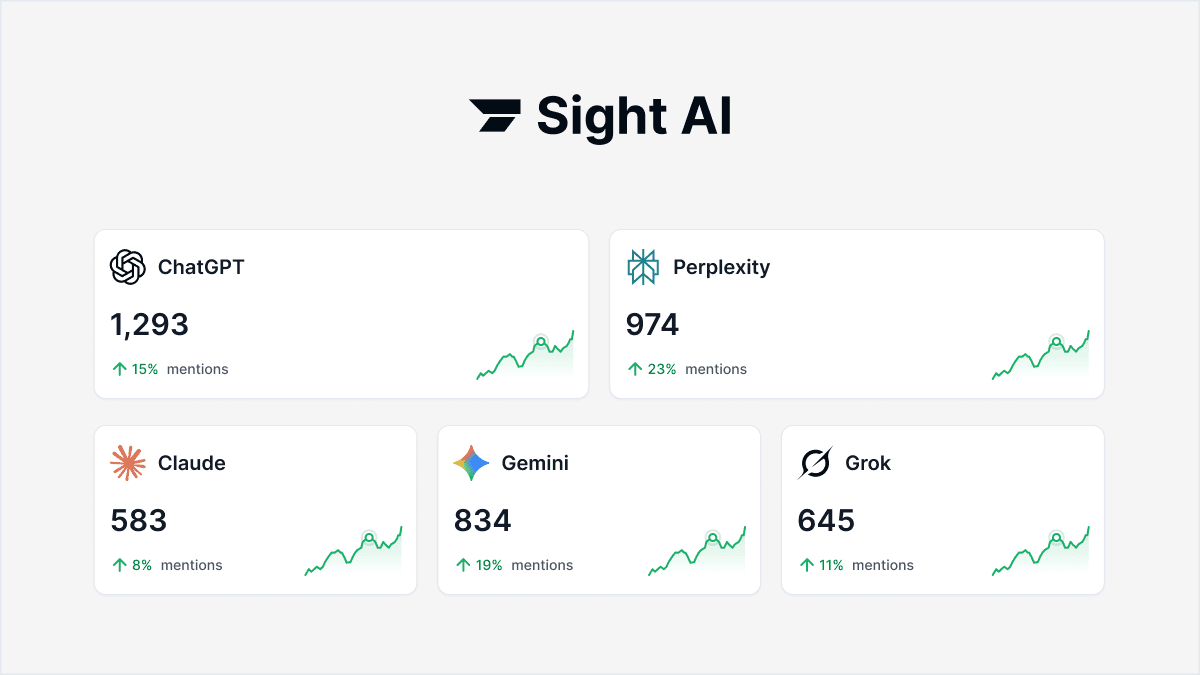
AI visibility tracking involves systematically monitoring how your brand is mentioned across major AI platforms like ChatGPT, Claude, and Perplexity in response to relevant prompts. This means tracking not just whether you're mentioned, but how you're described, what context surrounds the mention, and how your visibility compares to competitors in your space. Understanding the difference between GEO optimization vs traditional SEO is essential for interpreting these metrics correctly.
This is an emerging category with few established tools, but it's quickly becoming a critical measurement layer for sophisticated marketing teams. The natural question becomes: if you're not measuring AI mentions, how do you know which content investments are driving AI citation and which aren't?
Implementation Steps
1. Define the set of prompts most relevant to your brand: the questions your target audience asks AI models when looking for solutions like yours, including category queries, comparison queries, and problem-solution queries.
2. Establish a baseline by running your defined prompts across major AI platforms and documenting how your brand is currently mentioned, including sentiment, accuracy, and frequency of citation.
3. Use a dedicated AI visibility platform like Sight AI to automate ongoing monitoring across ChatGPT, Claude, Perplexity, and other AI platforms, tracking your AI Visibility Score over time and flagging changes in how models describe your brand.
Pro Tips
Pay close attention to sentiment and accuracy, not just mention frequency. An AI model that mentions your brand inaccurately or in a negative context can be more damaging than no mention at all. Use your tracking data to identify specific content gaps where publishing more authoritative material could correct or improve how AI models characterize your brand.
8. Scale GEO-Optimized Content Production with AI Agents
The Challenge It Solves
Building topical authority, creating citation-worthy content, and covering every conversational query pattern in your niche requires significant content volume. Most teams simply can't produce enough content manually to compete across both traditional search and AI discovery channels simultaneously. The production bottleneck becomes the limiting factor on visibility growth.
The Strategy Explained
Specialized AI writing agents can produce content that's pre-optimized for both traditional SEO and AI model citation, following GEO best practices at every stage of the writing process. The key distinction from generic AI content generation is specialization: different agents handle different content types, each trained on the structural and semantic patterns that perform best in their category. Our deep dive into AI content creation with SEO optimization explores how to maintain quality at scale.
Think of it like assembling a content team where each writer is a specialist. One agent handles listicles structured for AI extraction, another produces definitive explainers optimized for citation, and another generates FAQ content designed for conversational query matching. When combined with an Autopilot Mode that manages publishing workflows automatically, this approach can dramatically compress the time between identifying a content opportunity and having a fully optimized piece live on your site.
Implementation Steps
1. Identify your highest-priority content gaps by cross-referencing your topic cluster map with your AI visibility tracking data, focusing first on the topics where AI models most frequently mention competitors but not your brand.
2. Deploy specialized AI writing agents for each content type you need to produce, using a platform like Sight AI with 13+ purpose-built agents that generate SEO and GEO-optimized articles including listicles, guides, and explainers.
3. Integrate CMS auto-publishing capabilities into your workflow so that approved content moves directly from generation to live publication without manual handoffs, then use IndexNow to trigger immediate discovery of each new piece.
Pro Tips
Scale doesn't mean sacrificing quality. Use your AI visibility tracking data as a feedback loop: monitor which content types and topics are generating AI citations, and direct your agent-based production toward the formats that are proving most effective. This creates a data-driven content engine that gets smarter over time rather than simply producing more volume.
Putting It All Together: Your Generative AI SEO Roadmap
Eight techniques is a lot to absorb, so let's make the implementation path concrete. The key is sequencing: some of these strategies provide the foundation that makes others more effective, and trying to do everything simultaneously is a reliable way to do nothing well.
Start with measurement. Before you change a single piece of content, use AI visibility tracking to establish your baseline. Understand how AI models currently describe your brand, where you're being mentioned, and where competitors are appearing instead of you. This data shapes every subsequent decision.
Then fix your foundation. Implement schema markup, create or update your llms.txt file, and configure automated indexing with IndexNow. These are infrastructure changes that amplify everything else you do, and they're largely one-time investments that pay dividends across your entire content library.
Build authority systematically. Map your topic clusters, identify gaps, and begin publishing citation-worthy content optimized for conversational queries. Prioritize the topics where your AI visibility data shows the biggest gaps between competitor mentions and your own.
Finally, scale what's working. Once you have a clear picture of which content formats and topics are driving AI citations, deploy AI writing agents to accelerate production in those areas. Scale is the multiplier that turns a strong strategy into a compounding visibility advantage.
The brands that treat generative AI SEO as a core channel — not an afterthought — will compound their visibility advantage over competitors who wait. Every week you delay measuring your AI visibility is a week of competitive intelligence you'll never recover.
Start tracking your AI visibility today and see exactly where your brand appears across top AI platforms. Stop guessing how AI models like ChatGPT and Claude talk about your brand, and start using that data to build a content strategy that earns mentions across every channel where your audience is searching.