Imagine your online store is a real, physical shop. Ecommerce SEO is the art of picking the perfect location for that shop—right on the busiest street in town. It's about making sure your signs are big and clear, and your aisles are a breeze for customers to walk through. Essentially, it's how you make your store impossible to miss for both search engines like Google and, more importantly, your ideal customers.
Building Your Ecommerce SEO Foundation
SEO can feel like a massive, complicated puzzle, but it really boils down to one simple goal: making your store the best possible answer for whatever people are searching for. When someone types “waterproof running shoes” into Google, you want your product page to be one of the very first things they see. This isn't just for bragging rights; that visibility translates directly into more traffic, greater trust, and, of course, more sales.
The stakes here are incredibly high. Why? Because organic search is an absolute giant in the world of online retail. A massive 53% of all website traffic comes from people finding sites through a search engine, making it the most powerful channel for getting discovered. And the competition for that top spot is brutal. The first result on Google gets a jaw-dropping 27.6% of all clicks, while a tiny 0.63% of searchers ever click past the first page. The message is loud and clear: if you're not on page one, you're practically invisible.
This guide is here to cut through the noise and give you a straightforward blueprint for getting there.
The Three Pillars of Ecommerce SEO
To build an SEO strategy that lasts, you need to understand the three core components that hold it all together. Think of it like building a house: you need a solid foundation (Technical SEO), a smart and functional layout (On-Page SEO), and beautiful, appealing decor that makes people want to come inside (Content). Each part is critical for building a structure that not only stands strong but also attracts a crowd.
Here’s a quick rundown of each pillar:
- On-Page SEO: This is everything you optimize on the actual pages of your website. We're talking about smart keyword research, writing product descriptions that sell, and crafting title tags that beg to be clicked.
- Technical SEO: This is all the behind-the-scenes magic that makes your site fast, secure, and easy for search engines to understand. It covers things like site speed, mobile-friendliness, and having a logical site structure.
- Content & Off-Page SEO: This pillar is about creating genuinely useful stuff—like blog posts, buying guides, and videos—and building your store's authority by earning links from other trusted websites.
This flowchart shows how these pieces all fit into the bigger picture.
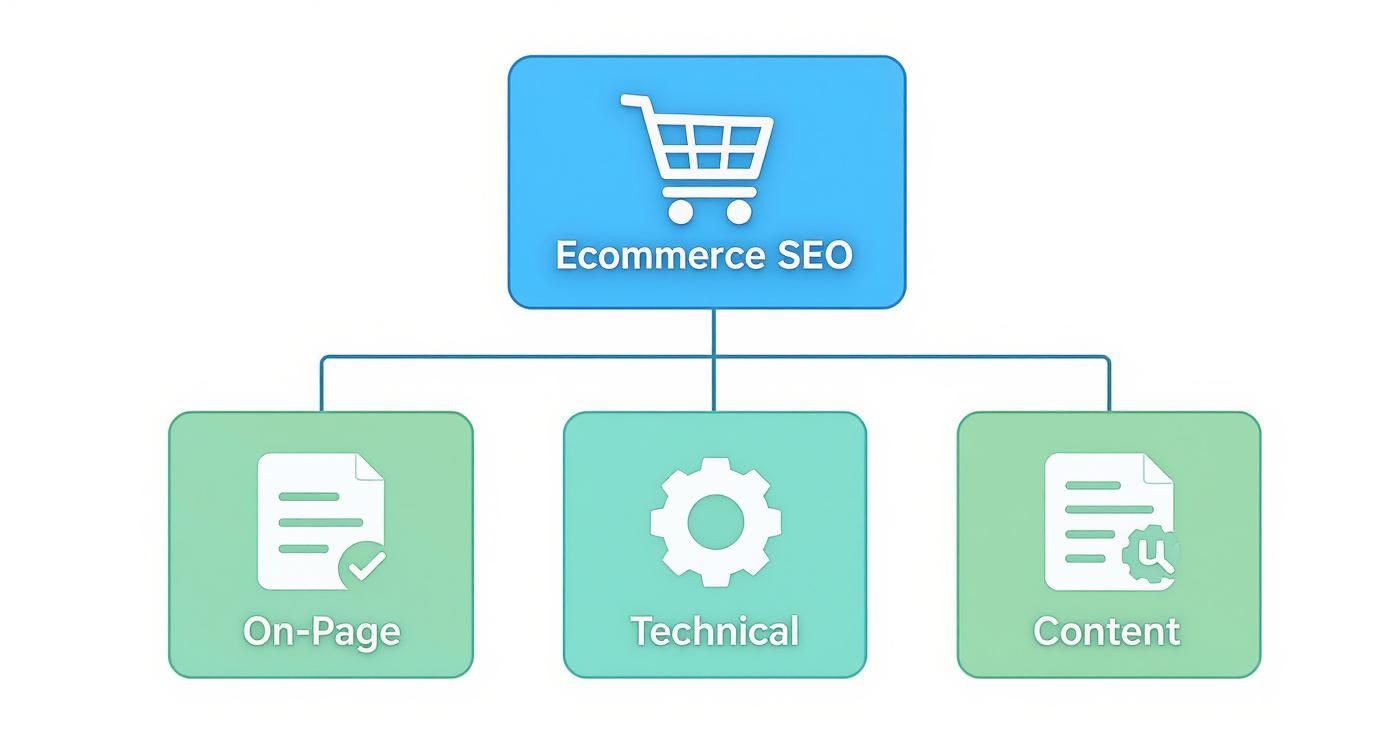
As you can see, a winning strategy needs a healthy balance of all three. You can't just focus on one and expect amazing results.
To give you a clearer snapshot, here’s a table summarizing how these core pillars function in an ecommerce SEO strategy.
Core Pillars of Ecommerce SEO at a Glance
| Pillar | Primary Goal | Key Actions |
|---|---|---|
| On-Page SEO | Make individual pages highly relevant and user-friendly for target keywords. | Keyword research, title tag optimization, compelling product descriptions, user-generated reviews. |
| Technical SEO | Ensure search engines can efficiently crawl, index, and understand your site. | Improve site speed, implement HTTPS, create an XML sitemap, ensure mobile-friendliness. |
| Content & Off-Page SEO | Build authority, trust, and drive traffic through valuable content and external validation. | Blogging, creating buying guides, link building from reputable sites, social media engagement. |
Nailing these fundamentals sets the stage for sustainable growth and a powerful competitive advantage in the search results.
Mastering these pillars is the key to creating a sustainable growth engine for your store. It’s not about finding quick tricks or loopholes; it’s about building a robust, customer-focused experience that search engines are literally designed to reward. By consistently improving your visibility, you can significantly improve your organic search ranking over time.
Throughout this guide, we'll dive deep into each of these areas, giving you actionable steps and proven strategies to turn your online store into a revenue-generating powerhouse.
Architecting Your Site for Users and Search Engines
Ever walked into a massive superstore with no signs, jumbled aisles, and products scattered everywhere? You'd get frustrated and leave. Fast. Your ecommerce site is exactly the same—a confusing layout is a one-way ticket to lost sales and tanking search rankings. Site architecture is the blueprint for your online store, dictating how everything is organized and connected.
A smart structure makes it dead simple for shoppers to find what they're looking for, creating a smooth path from discovery to checkout. At the same time, it gives search engine crawlers a clear map of your site, helping them understand your most important pages. The goal is straightforward: build a logical hierarchy that guides both people and bots from your homepage to a specific product without any friction. This is a non-negotiable cornerstone of ecommerce SEO best practices.
A clean site architecture isn't just a "nice-to-have" for user experience; it's a direct signal to Google about your site's organization and authority. A logical structure helps spread "link equity" (think of it as ranking power) throughout your site, giving all your pages a lift.
This means no product should ever be buried so deep that a user has to click endlessly to find it. The classic rule of thumb here is the three-click rule: a shopper should be able to get to any product from your homepage in three clicks or less.
Building a Scalable Site Hierarchy
The best structure for nearly any ecommerce store is a simple pyramid. It’s broad at the top and gets more specific as you drill down, which is just how people naturally shop.
- Homepage: This is the peak of your pyramid, the front door to your entire store. It should link out to all your major product categories.
- Category Pages: Think of these as the main aisles in your store, like "Men's Shoes" or "Women's Apparel." They group together related subcategories to make browsing intuitive.
- Sub-Category Pages: Here, you're getting more specific, breaking down "Men's Shoes" into "Men's Running Shoes" or "Women's Apparel" into "Women's Dresses." This level lets users narrow their search without getting overwhelmed by too many options.
- Product Pages: This is the final destination where your individual products live, ready for a customer to add to their cart.
This kind of "flat" architecture isn't just great for users; it's also incredibly efficient for search engine crawlers. It prevents important pages from becoming "orphaned"—cut off with no internal links pointing to them—and ensures Google and Bing can find and index everything you sell.
Crafting Clean URLs and Breadcrumbs
Once you've mapped out your hierarchy, you need to make sure your URLs and on-page navigation reflect it. These are the digital signposts that constantly reinforce your site’s structure for both shoppers and search engines.
Optimize Your URL Structure
A clean URL tells someone exactly where they are on your site at a glance. Ditch the long, cryptic URLs full of random numbers and symbols. Instead, keep them short, descriptive, and packed with relevant keywords.
- Bad URL:
yourstore.com/prod_id=8974/cat=45/p=998?ref=t - Good URL:
yourstore.com/mens-shoes/running-shoes/product-name
See how the good example mirrors the site hierarchy? It’s instantly understandable.
Implement Breadcrumb Navigation
Breadcrumbs are those little secondary navigation links you see at the top of a page, showing the path you took from the homepage. They look like this:
Home > Men's Shoes > Running Shoes > Product Name
These are surprisingly powerful for a few reasons:
- Improved User Experience: They let users jump back to a previous category with a single click, saving them from mashing the "back" button.
- Reduced Bounce Rate: Easier navigation encourages people to stick around and explore more of your store instead of just leaving.
- SEO Benefits: Breadcrumbs create another layer of internal links with keyword-rich anchor text, helping search engines lock in their understanding of your site structure.
A well-planned architecture is the bedrock of a successful store. It’s an upfront investment that pays dividends in happier customers, better crawlability, and ultimately, higher rankings. And if crawlability is on your mind, you can dive deeper with our guide to sitemap optimization. That process is all about making sure search engines can find and index every important page on your site efficiently.
Optimizing Product and Category Pages That Convert
Let's get right to it: your product and category pages are the digital sales floor of your store. They're the final, critical steps where a curious browser becomes a paying customer. Mastering how to optimize these pages is one of the most impactful things you can do for your business, directly boosting both your search rankings and your revenue.
This is so much more than just stuffing keywords into a description. It's about getting inside a shopper's head and aligning their psychology with what search engines want to see. Your goal is to pinpoint the high-intent keywords people use when they're ready to buy, write copy that genuinely sells, and build your page in a way that Google can easily understand and reward.

Uncovering High-Intent Keywords
Every great product or category page is built on a foundation of the right keywords. You need to dig up the specific, long-tail phrases that scream "I want to buy this." Think like a customer who has already done their research and knows exactly what they're looking for.
Someone searching for "shoes" is just window shopping. But the person searching for "men's waterproof trail running shoes size 11" is ready to pull out their credit card. Your job is to capture that second searcher.
Here are a few proven ways to find these golden keywords:
- Spy on Your Competitors: Look at the top-ranking pages for the products you sell. What words are they using in their page titles, headings, and descriptions? Tools like Ahrefs can pull back the curtain and show you the exact keywords driving traffic to their pages.
- Use Google Autocomplete: Just start typing a product name into Google's search bar and watch the suggestions that pop up. These are real, popular searches that give you a direct line into what features or attributes people actually care about.
- Mine Your Customer Reviews: Your own reviews are a goldmine of natural language. Look for the recurring phrases and descriptive words your customers use—these are often perfect long-tail keywords served up on a silver platter.
Writing Product Descriptions That Sell and Rank
A product description has two jobs: it has to convince a person to buy, and it needs to give search engines enough context to rank the page. Just listing a bunch of features won't cut it. You have to translate those features into benefits that solve a customer's problem or fulfill a desire.
Think of your product description as your 24/7 salesperson. It should answer questions, overcome objections, and create an emotional connection. Don't just describe the "what"; sell the "why."
For example, instead of just saying a backpack has "padded shoulder straps," explain that it has "ergonomic, padded shoulder straps for all-day comfort on long hikes." See the difference? That small change frames a feature as a direct benefit, making it far more compelling. For a deeper dive, our guide on https://trysight.ai/blog/how-to-write-product-descriptions provides a complete framework.
Maximizing Click-Through Rates with Optimized Titles and Metas
Your page's title tag and meta description are your ad copy in the search results. They are often the very first thing a potential customer sees from your brand, so making them irresistible is critical for earning that click.
Best Practices for Title Tags:
- Front-Load Your Main Keyword: Get your most important keyword right at the beginning of the title.
- Keep it Concise: Stick to around 50-60 characters to prevent your title from getting awkwardly cut off in the search results.
- Add Modifiers: Sprinkle in words like "Buy," "Deals," "Sale," or "Free Shipping" to attract shoppers who are ready to make a move.
Best Practices for Meta Descriptions:
- Include Keywords Naturally: Weave your primary and secondary keywords into the description so it reads smoothly.
- Focus on the User Benefit: What makes your product special? Highlight a key selling point that grabs attention.
- Add a Call to Action: Nudge them to click with phrases like "Shop Now," "Learn More," or "Discover the Difference."
Leveraging Schema Markup for Rich Snippets
Schema markup is a type of code you add to your product pages that acts as a translator for search engines, helping them understand your information more clearly. When you do this, Google often rewards you with "rich snippets"—those eye-catching enhancements in the search results like star ratings, price, and availability.
Implementing product schema is one of the most powerful ways to stand out on a crowded search results page. Pages with rich snippets consistently see a higher click-through rate because they give users valuable info at a glance and build instant trust.
This level of detail is what separates the top-tier stores from the rest. The average ecommerce brand now ranks for about 1,783 unique keywords, which brings in thousands of organic visits each month. This kind of growth is driven by sophisticated strategies like schema and deep content optimization. But traffic is only half the battle. To turn those visitors into customers, check out this practical guide to improving website conversion rates and close the loop.
Mastering Technical SEO and Mobile Experience
Technical SEO is the engine humming away under the hood of your ecommerce store. Your customers will never see it, but this powerful system dictates how fast, reliable, and accessible your site is. If that engine starts to sputter, your entire business can stall out, no matter how incredible your products are.
Think of it this way: your beautifully designed product pages are the shiny exterior of a race car. But technical SEO? That's the fine-tuned engine, the aerodynamic frame, and the high-performance tires. Without a solid technical foundation, you’re just not going anywhere fast. This is one of the most critical areas of ecommerce seo best practices because it directly impacts both user experience and your search rankings.

Prioritize Blazing-Fast Site Speed
In ecommerce, speed isn't just a feature—it's everything. Today’s shoppers have absolutely zero patience for slow-loading pages. A delay of even a single second can cause your conversion rates to plummet as frustrated users simply click away to find a faster competitor.
Google knows this, which is why it has made page speed a major ranking factor. A sluggish site sends a clear negative signal to search engines, telling them your store provides a poor user experience.
Here are a few actionable steps you can take to boost your site speed right now:
- Compress Your Images: Large, unoptimized product images are the #1 cause of slow ecommerce sites. Use tools to compress them without sacrificing visual quality.
- Leverage Browser Caching: This technique stores parts of your website on a visitor's browser, so it doesn’t have to reload everything from scratch on their next visit. Think of it as giving repeat visitors an express lane.
- Minimize Third-Party Apps: While apps and plugins add cool functionality, too many can seriously bog down your site. Regularly audit your apps and get rid of anything that isn't absolutely essential.
Embrace a Mobile-First Design
The shift to mobile commerce isn't a trend anymore; it's the standard. A massive majority of online shoppers now browse and buy on their smartphones. If your site isn't designed for a small screen, you're actively turning away a huge slice of your potential customers.
Google now uses mobile-first indexing, which means it primarily looks at the mobile version of your website to determine its rankings. A clunky, hard-to-navigate mobile site won't just frustrate users—it will drag down your rankings across all devices.
A responsive design, which automatically adapts your site's layout to fit any screen size, is the bare minimum. A true mobile-first approach means designing the entire experience with the mobile user as your top priority from day one.
Keep Your Site Clean and Crawlable
Before Google can rank your pages, its crawlers (or "bots") need to be able to find and understand them. Technical SEO ensures this process is as smooth and efficient as possible. A clean, well-organized site allows search engine bots to use their resources wisely, which is especially important for large ecommerce stores with thousands of product and category pages.
This is where your XML sitemap comes into play. It’s basically a roadmap of your website that you hand over to Google, listing all of your important URLs to make sure they get discovered and indexed.
Similarly, it's vital to manage how search engines access your content. For large sites, effective crawl budget optimization ensures Google's bots spend their time crawling your most valuable pages, not getting lost in a maze of unimportant ones. To really get a handle on this, check out our detailed guide on crawl budget optimization for some practical strategies.
Solve Duplicate Content with Canonical Tags
Ecommerce sites are notorious for creating duplicate content, often without anyone realizing it. Product filters and sorting options can generate dozens of different URLs that all show the same page content (for example, one URL for a category sorted by price, another sorted by color).
This creates a huge headache for search engines, forcing them to guess which version is the "real" one. Canonical tags are the solution. They're a simple piece of code that tells Google which URL is the master version you want to have indexed, consolidating all your ranking power onto that single, preferred page.
Finally, securing your site with HTTPS is completely non-negotiable. It encrypts the data between your customers' browsers and your server, protecting sensitive information like credit card details. It’s a massive trust signal for shoppers and a confirmed, albeit small, ranking factor for Google.
To help you get started, here's a quick rundown of where to focus your efforts first.
Technical SEO Priority Checklist
| Technical Task | Primary Impact | Priority Level |
|---|---|---|
| Mobile-First Design | User Experience, Rankings | Critical |
| Site Speed Optimization | User Experience, Conversions, Rankings | Critical |
| HTTPS Security | User Trust, Security, Rankings | High |
| XML Sitemap | Indexing, Crawlability | High |
| Canonical Tags | Duplicate Content, Ranking Signals | Medium |
| Crawl Budget Management | Indexing Efficiency (for large sites) | Medium |
This checklist isn't exhaustive, but it covers the foundational elements that will deliver the biggest impact. Nailing these basics sets you up for long-term success and ensures your site is built on solid ground.
Driving Traffic with a Strategic Content Plan
Great content does more than just fill space on your website—it’s the engine that pulls in, educates, and converts customers long before they even land on a product page. Your product pages are laser-focused on shoppers ready to pull out their wallets, but there's a massive audience out there still in the research phase. A smart content plan is your ticket to capturing this top-of-funnel traffic and cementing your brand as a trusted authority.
This is how you graduate from being just a product catalog to becoming an indispensable industry resource. By creating genuinely valuable blog posts, in-depth buying guides, and insightful comparison articles, you start answering your customers' biggest questions. This strategy is all about targeting valuable informational keywords—the phrases people type into Google when they’re learning, not just buying.

From Answers to Authority
Think about the real journey your customers take. Before they search for a specific product, they’re usually searching for solutions. Someone in the market for a new tent might first Google "how to choose a backpacking tent" or "best tents for winter camping."
Your content needs to meet them right there, at that crucial moment of discovery. When you provide the best, most helpful answer to their question, you build instant trust and brand recognition. This isn't just fluffy marketing; it's a foundational element of effective ecommerce SEO best practices that turns your blog into a powerful customer acquisition machine.
And the results? They can be absolutely staggering. One recent case study showed that after rolling out a plan that included adding 5–6 new blogs monthly and tightening up on-page elements, a client's keyword rankings exploded by 3,403%. They went from ranking for just 157 keywords to over 5,500.
Building Your Content Funnel
Not all content is created equal. To really work, your articles need to align with the different stages of the buyer's journey. A well-rounded content plan needs a mix of formats designed to attract, engage, and ultimately convert.
- Top-of-Funnel Blog Posts: These articles go after broad, informational keywords. Think "How-To" guides, beginner's tutorials, or listicles that tackle common questions in your niche.
- Middle-of-Funnel Buying Guides: This is where you help shoppers compare their options and narrow down their choices. Content like "The Ultimate Guide to Buying Running Shoes" or "Brand X vs. Brand Y: Which is Right for You?" fits perfectly here.
- Bottom-of-Funnel Case Studies: These articles show your products in action, delivering the social proof and confidence a shopper needs right before they decide to buy.
Your content strategy should be a bridge, not an island. Each piece of content must have a clear purpose to guide the reader one step closer to making a purchase, connecting their initial query to the perfect product solution on your site.
The Art of Strategic Internal Linking
Look, creating great content is only half the battle. You absolutely have to connect it to your commercial pages. Internal linking is the simple, yet incredibly powerful, practice of linking from your blog posts back to your relevant category and product pages.
When a high-authority blog post links to a product page, it passes along some of its "link equity," or ranking power. It’s like giving that page a vote of confidence. This tells search engines that your product and category pages are important and relevant, helping them rank higher for those critical commercial keywords.
For instance, a blog post titled "10 Tips for Better Sleep" should have natural, contextual links pointing to your "memory foam pillows" category page or even a specific best-selling pillow. This creates a logical pathway for both users and search engine crawlers, guiding them seamlessly from informational content to a page where they can make a purchase. To really nail this, you should explore these essential content SEO best practices.
Frequently Asked Questions About Ecommerce SEO
Diving into ecommerce SEO can feel like opening a can of worms. Even with a great plan, questions and roadblocks are just part of the game. This section is all about giving you clear, straightforward answers to the questions we hear most often from online store owners, so you can make smarter decisions for your business with confidence.
Let's get into the stuff that keeps founders and marketers up at night.
How Long Does Ecommerce SEO Take to Show Results?
This is the million-dollar question, isn't it? The only honest answer is: it depends. SEO is a long game, not a quick fix. It’s not like flipping a switch on paid ads and seeing traffic pour in tomorrow. Organic growth is a slow burn that builds on itself.
Generally, you can expect to see some early signs of life within 3 to 6 months. This might be a few keyword rankings starting to climb or a small, but noticeable, bump in organic traffic. But for the kind of results that really move the needle—a real, sustained increase in organic revenue—you’re typically looking at 6 to 12 months of consistent, focused work.
What makes the timeline so variable? A few things:
- Your Website's Age and Authority: An established site with some history is going to get traction faster than a brand-new store starting from absolute zero.
- How Tough Your Niche Is: Trying to rank for "women's running shoes" is a marathon. Ranking for "handmade leather wallets for dads" is more like a 5k.
- Your Budget and Resources: The more you can invest in great content, quality links, and technical fixes, the faster you’ll see the needle move.
Think of SEO like planting a tree. You won't get shade tomorrow, but if you water it consistently, it will grow into a massive asset that pays dividends for years. The work you put in today is building the foundation for free, sustainable traffic down the road.
Should I Focus on Product Pages or Blog Content First?
In a perfect world, you’d tackle both at the same time, because they do different jobs that support each other. But when resources are tight, you have to prioritize. The right move depends on your immediate goals.
Here’s how to think about it: Product pages capture people who are ready to buy. They're at the bottom of the funnel, credit card in hand. Blog content attracts people who are still figuring things out, doing their research at the top of the funnel.
Here’s a simple framework to follow:
- Start with Your Product and Category Pages: This is your low-hanging fruit. Optimizing these pages for transactional keywords (like "buy men's waterproof hiking boots") can drive sales much faster. Get your titles, descriptions, and on-page content dialed in before you do anything else.
- Then, Build Out Supporting Blog Content: Once your core money pages are solid, start writing blog posts that answer your customers' questions. An article like "How to Choose the Best Hiking Boots" attracts a much broader audience. From there, you can link back to your product page, passing along authority and guiding those researchers toward a purchase.
Ultimately, it’s a powerful cycle. The blog builds your authority and brings in fresh eyes, while your perfectly tuned product pages turn that new traffic into customers.
How Do I Prioritize SEO Tasks on a Limited Budget?
When you can't do everything at once, you have to be ruthless about focusing on what gives you the biggest bang for your buck. Luckily, not all ecommerce seo best practices come with a big price tag. Some of the most powerful moves are about smart strategy, not a huge spend.
Here’s your priority list for a tight budget:
- On-Page SEO Basics: This is priority number one. Optimizing title tags, meta descriptions, and product descriptions is completely free and has a huge impact.
- Technical SEO Hygiene: Use free tools like Google Search Console to hunt down and fix critical errors like broken links or pages that aren't getting indexed. Making sure your site is mobile-friendly and secure with HTTPS is non-negotiable.
- Keyword Research: You can get incredibly far with free tools. Use Google's own search suggestions, the "People Also Ask" box, and Google Keyword Planner to find valuable terms your customers are searching for.
- Internal Linking: This is another powerful and totally free tactic. Go through your existing content and find natural opportunities to link product pages and blog posts together. This helps spread ranking power throughout your site and keeps users engaged.
- Content Creation: Don't try to be a content machine. Focus on creating one truly excellent, in-depth blog post a month instead of four mediocre ones. Quality will always win in the long run.
By focusing on these high-impact, low-cost actions first, you can build a solid SEO foundation that starts generating momentum without breaking the bank.
Ready to put your content creation on autopilot and transform your SEO strategy into a predictable growth engine? IndexPilot uses trainable AI Agents to handle everything from keyword research and writing to optimization and publishing. Stop the manual busywork and start scaling your organic traffic. Discover how IndexPilot can accelerate your growth today.