When users ask ChatGPT, Claude, or Perplexity for product recommendations, are they hearing about your competitors instead of you? This visibility gap in AI-generated responses represents one of the most significant shifts in how brands get discovered online. Unlike traditional SEO where you can track rankings and clicks, AI mentions happen in conversational contexts that many marketers aren't even monitoring.
The good news: you can systematically improve your brand's presence in AI responses by understanding what makes AI models recommend certain brands over others.
This guide walks you through the exact process of identifying why competitors are getting mentioned, analyzing the content patterns that drive AI recommendations, and implementing changes that position your brand as the authoritative answer. Whether you're a SaaS founder watching competitors dominate AI conversations or an agency helping clients navigate this new landscape, these steps will give you a clear path to improved AI visibility.
Step 1: Audit Your Current AI Visibility Baseline
Before you can close the gap with competitors, you need to know exactly where you stand. Think of this like taking a diagnostic test before starting treatment—you're establishing your starting point so you can measure progress.
Start by querying major AI models with prompts your target audience actually uses. Don't just ask "What is [your product category]?" Instead, use realistic questions like "What's the best project management tool for remote teams?" or "Which CRM should a startup use?" These conversational queries mirror how real users interact with AI.
Document which brands appear in responses and in what context. There's a crucial difference between being mentioned in passing, being recommended as a top choice, and being compared directly to alternatives. Create categories for each mention type: recommended (AI actively suggests the brand), mentioned (brand appears in the response), and compared (brand is positioned against competitors).
Create a tracking spreadsheet with prompt categories, AI platforms, and mention frequency. Your columns should include: prompt text, AI platform used, date tested, brands mentioned, your brand's position (if mentioned), and context of mention. Test the same prompts across ChatGPT, Claude, Perplexity, and other relevant AI platforms. You'll often find significant variation—a brand that dominates ChatGPT responses might be absent from Claude's recommendations.
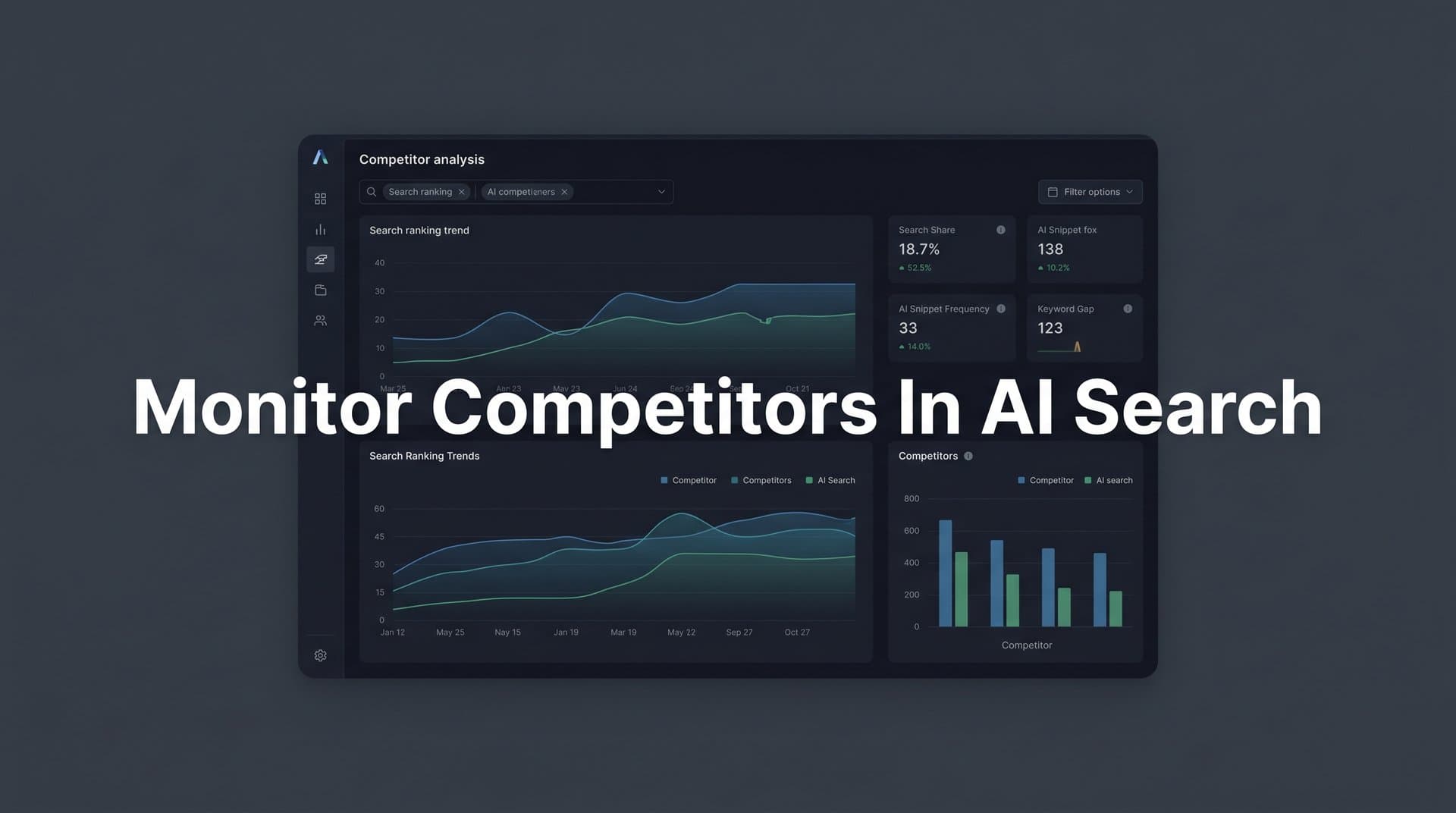
Identify patterns in when your brand appears versus when competitors dominate. Look for themes: Do competitors get mentioned more for specific use cases? Do they appear when users ask about integrations or pricing? Are there entire prompt categories where you're completely absent? Learning to track competitors in AI search results systematically will reveal these patterns.
Use AI visibility tracking tools to automate ongoing monitoring. Manual checks give you the initial baseline, but you need systematic tracking to spot trends and measure the impact of your optimization efforts. Set up weekly checks across your core prompt set to build a historical dataset.
Step 2: Analyze Why Competitors Are Getting Mentioned
Now comes the detective work. You know competitors are getting mentioned more—but why? Understanding the mechanics behind AI recommendations gives you the blueprint for your own strategy.
Examine competitor content that AI models frequently cite or reference. When an AI mentions a competitor, ask follow-up questions like "What sources did you use for that recommendation?" or "Why did you suggest that brand?" AI models will often reveal the content they drew from, giving you direct insight into what's working.
Identify the structural elements that make content AI-friendly. Competitors winning in AI search typically have content with clear definitions in opening paragraphs, structured hierarchies using proper heading tags, FAQ sections that directly answer common questions, and comparison tables that position them alongside alternatives. This isn't about keyword stuffing—it's about creating content AI models can confidently parse and cite.
Review competitor backlink profiles and authoritative mentions across the web. AI models don't just look at what competitors say about themselves—they weight external validation heavily. Check where competitors are being mentioned: industry publications, comparison sites, review platforms, and expert roundups. These third-party signals tell AI models which brands are legitimate players in the space. Understanding why AI models are recommending competitors helps you reverse-engineer their success.
Check if competitors have optimized their technical SEO for AI crawlers. Look at their site structure, implementation of structured data markup, presence of clear navigation hierarchies, and whether they've created resources like llms.txt files to guide AI crawlers. Technical optimization directly impacts whether AI models can access and understand competitor content.
Note the specific language and positioning competitors use that AI models echo. Pay attention to how competitors describe themselves, the problems they solve, and their differentiators. If AI models are repeating specific phrases or positioning statements, those elements are resonating in the training data.
Step 3: Identify Your Content and Authority Gaps
With competitor analysis complete, it's time to hold up a mirror to your own content strategy. This step is about honest assessment—where are you falling short?
Map competitor content topics against your own content library. Create a simple matrix: list the content topics competitors have covered on one axis and mark which ones you've addressed on the other. The empty cells represent your content gaps. You'll likely find competitors have comprehensive guides, comparison pages, and use case content you're missing entirely.
Find high-intent queries where you have no content but competitors do. These are the prompts from Step 1 where competitors dominated and you were absent. Prioritize queries that indicate buying intent or problem-solving need—"best [solution] for [use case]" or "how to solve [specific problem]" formats.
Assess whether your existing content provides clear, quotable answers. Even if you have content on a topic, it might not be structured in a way AI models can easily cite. Read your content through the lens of an AI model: Can it extract a clear definition in the first paragraph? Are there direct answers to common questions? Or is everything buried in marketing fluff and vague positioning statements? If your brand is not mentioned in AI responses, content structure is often the culprit.
Evaluate your brand's presence on third-party sites AI models trust. This is your external authority gap. Search for "[your brand] vs [competitor]" and see what comes up. Check major review platforms, industry directories, and comparison sites. If you're absent from these authoritative sources while competitors have robust profiles, you've identified a critical gap.
Prioritize gaps based on business impact and achievability. Not all gaps are created equal. A missing comparison page might be quick to create and have high impact, while getting featured in Wikipedia could take months. Create a prioritized list that balances quick wins with longer-term authority building.
Step 4: Create AI-Optimized Content That Gets Cited
Here's where strategy meets execution. Creating content that AI models cite isn't about gaming the system—it's about producing genuinely helpful resources that deserve to be recommended.
Structure content with clear hierarchies, definitions, and direct answers in the first paragraph. AI models prioritize content they can quickly parse and confidently cite. Start every piece with a clear definition or direct answer to the core question. Use proper heading tags to create logical hierarchies. Make it easy for both humans and AI to understand your content structure at a glance.
Include comparison content that positions your brand alongside competitors. This might feel counterintuitive—why mention competitors? Because users ask comparative questions, and AI models need content that addresses those queries. Create honest comparison pages that explain when your solution is the best fit and when alternatives might work better. This transparency builds trust with both AI models and human readers.
Add structured data markup to help AI models understand your content. Implement schema markup for products, articles, FAQs, and how-to guides. Following LLM SEO best practices ensures your structured data acts like metadata that tells AI models exactly what your content covers, making it easier to cite accurately.
Create comprehensive resource pages that become authoritative references. Think ultimate guides, definitive glossaries, and complete how-to libraries. AI models favor comprehensive resources over thin content. If you can create the single best resource on a topic in your industry, AI models will naturally gravitate toward citing it.
Write content that answers follow-up questions users might ask AI. When someone asks an AI about your product category, what's the next question they'll ask? Anticipate these conversation flows and create content that addresses the entire journey. This increases the likelihood your brand stays relevant throughout multi-turn AI conversations.
Step 5: Build External Authority Signals AI Models Trust
Your own content is only part of the equation. AI models weight external validation heavily—what others say about you matters as much as what you say about yourself.
Get featured in industry publications and comparison sites AI models frequently reference. Research which sites AI models cite when discussing your industry. These might be established publications, popular blogs, or specialized comparison platforms. Reach out with expert commentary, case studies, or partnership opportunities. A single mention in a highly-cited source can significantly boost your AI visibility.
Pursue mentions in Wikipedia, industry directories, and authoritative databases. While Wikipedia can be challenging to get into, industry-specific databases and directories are often more accessible. Ensure your brand has complete profiles on platforms like Crunchbase, G2, Capterra, and industry-specific directories. These structured data sources help AI models understand your company's legitimacy and positioning.
Generate authentic reviews and testimonials across trusted platforms. AI models consider review platforms as signals of real-world usage and satisfaction. Encourage satisfied customers to leave reviews on platforms relevant to your industry. Focus on platforms AI models actually reference—these vary by industry but often include G2, Trustpilot, and industry-specific review sites. These efforts directly support getting mentioned in AI responses more frequently.
Participate in expert roundups and thought leadership content. When industry publications create "experts weigh in" articles or roundup posts, participate actively. These mentions position you as an authority and create citation-worthy content AI models can reference. The key is consistency—regular participation builds sustained visibility.
Ensure consistent NAP and brand information across the web. Name, Address, Phone consistency matters for AI models trying to understand your brand. Inconsistent information creates confusion. Audit your brand mentions across the web and correct any discrepancies in how your company is described, categorized, or positioned.
Step 6: Accelerate Content Discovery and Indexing
Creating great content means nothing if AI models can't access it. This step ensures your content gets discovered and incorporated into AI knowledge as quickly as possible.
Implement IndexNow to notify search engines of new and updated content immediately. IndexNow is a protocol that lets you ping search engines the moment you publish or update content, rather than waiting for them to discover it through traditional crawling. This dramatically reduces the time between publishing content and having it available for AI model training data updates.
Ensure your sitemap is current and submitted to all major search engines. Your XML sitemap acts as a roadmap for crawlers. Make sure it's automatically updated when you publish new content and submitted to Google Search Console, Bing Webmaster Tools, and other relevant platforms. A stale or incomplete sitemap means content might go undiscovered for weeks. Using automated website indexing tools can streamline this process significantly.
Fix any crawlability issues that prevent AI training data from accessing your content. Run a technical SEO audit to identify problems: pages blocked by robots.txt, broken internal links, orphaned pages with no inbound links, or JavaScript rendering issues that hide content from crawlers. Each of these issues prevents your content from being included in the datasets AI models train on.
Create an llms.txt file to guide AI crawlers to your most important content. This emerging standard lets you specify which pages are most relevant for AI models to reference. Think of it as a curated reading list for AI—directing models to your definitive resources rather than letting them randomly sample your site.
Monitor indexing status and address any pages stuck in limbo. Use Search Console to check which pages are indexed and which are being excluded. Pages that aren't indexed by search engines are unlikely to appear in AI training data. Investigate why important pages aren't getting indexed and fix the underlying issues.
Step 7: Monitor Progress and Iterate on Your Strategy
Improving AI visibility isn't a one-time project—it's an ongoing optimization process. This final step ensures you're building on what works and adjusting what doesn't.
Set up weekly AI visibility checks across target prompts and platforms. Create a routine where you test your core prompt set every week. This regular cadence helps you spot trends early: Are you gaining mentions? Losing ground? Staying flat? Weekly checks give you enough data to identify patterns without becoming overwhelming. Learning how to monitor ChatGPT brand mentions is essential for this ongoing tracking.
Track changes in mention frequency and sentiment over time. Build a historical dataset that shows not just whether you're mentioned, but how you're positioned. Are mentions becoming more positive? Is your brand moving from "also mentioned" to "recommended"? These qualitative shifts matter as much as raw mention frequency.
A/B test different content formats to see what drives more AI citations. Try different approaches: comparison tables versus narrative comparisons, FAQ formats versus traditional blog posts, technical documentation versus beginner guides. Track which formats lead to increased mentions in AI responses. This experimentation builds institutional knowledge about what works for your specific industry and audience.
Adjust your content calendar based on competitive movement. If you notice competitors gaining traction with specific content types or topics, respond strategically. Don't just copy their approach—find ways to create more comprehensive, authoritative content on the same topics. Use competitive intelligence to inform your content priorities.
Document what works to build a repeatable playbook for your team. As you discover tactics that improve AI visibility, codify them into processes. Create templates for AI-optimized content, checklists for external authority building, and standard procedures for monitoring. This documentation ensures your entire team can execute the strategy consistently.
Putting It All Together
Closing the gap when competitors are mentioned more in AI requires a systematic approach: audit your current visibility, understand what's working for competitors, fill your content and authority gaps, and continuously monitor progress.
The brands winning in AI search aren't necessarily the biggest—they're the ones producing clear, authoritative content that AI models can confidently cite. They've built external validation across trusted sources. They've ensured their content is discoverable and structured for AI comprehension. And they're monitoring their progress to double down on what works.
Use this checklist to track your progress: ✓ Baseline audit completed across major AI platforms ✓ Competitor content and authority analysis documented ✓ Content gaps prioritized by business impact ✓ AI-optimized content published and indexed ✓ External authority building in progress ✓ Monitoring system active for ongoing tracking.
Start with Step 1 today, and within weeks you'll have actionable data showing exactly where to focus your efforts. The visibility gap isn't permanent—it's a solvable problem with the right strategy and consistent execution.
Start tracking your AI visibility today and see exactly where your brand appears across top AI platforms. Stop guessing how AI models like ChatGPT and Claude talk about your brand—get visibility into every mention, track content opportunities, and automate your path to organic traffic growth.