You've spent years perfecting your Google SEO. Your website ranks on page one. Your content strategy is dialed in. Yet when someone asks ChatGPT, Claude, or Perplexity to recommend solutions in your category, your brand doesn't exist.
This isn't a hypothetical problem. Right now, millions of users are discovering products, researching solutions, and making purchase decisions through conversations with AI assistants. They're asking for recommendations, comparing options, and seeking advice—and AI models are responding with curated lists of brands. If yours isn't among them, you're invisible in an entirely new search ecosystem that operates by fundamentally different rules than the one you've mastered.
The jarring truth? Traditional SEO dominance doesn't transfer to AI visibility. Your backlink profile, domain authority, and keyword rankings mean little when an AI model is deciding which three project management tools to recommend or which marketing platforms deserve mention. Welcome to the new frontier of brand discovery, where being found requires understanding how AI models think, what content they value, and why they mention some brands while ignoring others.
The Hidden Search Engine Your Brand Is Ignoring
Think of it like this: while you've been optimizing for Google's crawlers, a parallel search infrastructure has quietly become the go-to resource for a growing segment of users who prefer conversational answers over blue links.
ChatGPT, Claude, Perplexity, and Gemini aren't just chatbots—they've evolved into de facto search engines. Users treat them as trusted advisors, asking questions like "What's the best CRM for small businesses?" or "Which email marketing platform should I choose?" The responses they receive shape purchasing decisions, influence brand consideration, and drive discovery in ways that bypass traditional search results entirely.
Here's where it gets interesting. These AI models don't work like Google. They don't crawl your site daily, they don't use PageRank algorithms, and they don't care about your keyword density. Instead, they form brand associations through two primary mechanisms: their training data and real-time retrieval systems.
Training data creates the foundation. AI models learn about your brand from the vast corpus of text they were trained on—articles, reviews, forum discussions, social media, and published content up to a specific cutoff date. If your brand wasn't frequently mentioned in authoritative contexts before that cutoff, the model has limited knowledge of your existence. It's like trying to recommend a restaurant you've never heard of—impossible, regardless of how good the food actually is.
Real-time retrieval systems, particularly RAG (Retrieval-Augmented Generation), add a dynamic layer. When you ask Perplexity or newer versions of ChatGPT a question, they don't just rely on training data—they actively search the web for current information, pull relevant content, and synthesize answers. This is your opportunity. If your content is structured in ways these systems can easily parse and cite, you can appear in AI responses even if you weren't prominent in the original training data. Understanding why your website isn't appearing in Perplexity is the first step toward fixing this gap.
But here's the critical distinction: ranking #1 on Google for "project management software" doesn't guarantee ChatGPT will mention your tool when someone asks for recommendations. Google indexes pages and ranks them based on links and relevance signals. AI models need something different—clear entity associations, explicit use-case descriptions, and presence in the comparative conversations that training data and retrieval systems draw from.
The brands winning in this new ecosystem aren't necessarily the ones with the biggest SEO budgets. They're the ones whose content speaks the language AI models understand—structured, clear, and embedded in the broader industry conversation.
Five Reasons AI Models Don't Mention Your Brand
Let's diagnose why your brand might be invisible. The reasons are more specific—and more fixable—than you might think.
Insufficient Authoritative Content AI Can Actually Cite: Your website might be beautiful, but if your best content is locked behind paywalls, buried in PDFs, or presented primarily as images and videos without accompanying text, AI models can't reference it. They need crawlable, parseable text that clearly explains what you do, who you serve, and why you matter. Thin content pages with generic descriptions don't cut it. AI models look for substantive explanations they can confidently cite when answering user queries. This is a common reason for content not showing in AI results.
Lack of Clear Brand Positioning and Entity Associations: Does your content explicitly state what category you belong to? Can an AI model easily understand that you're a "customer data platform for e-commerce brands" or a "project management tool for remote teams"? Many brands assume context is obvious, but AI models need explicit signals. If your homepage says you "transform digital experiences" without clearly defining your product category, use cases, or target audience, AI models struggle to form the entity associations needed to recommend you in relevant contexts.
Missing From the Conversations AI Models Reference: Here's a reality check: AI training data doesn't just include your website. It includes industry publications, comparison articles, forum discussions, Reddit threads, review sites, and "best of" listicles. If your brand isn't mentioned in these third-party conversations—if you're not part of the comparative content landscape where people discuss alternatives and evaluate options—you're absent from the source material AI models draw from. Being mentioned only on your own properties isn't enough.
Recent Brand Changes or Market Entry: If you launched recently, pivoted your positioning, or rebranded after major AI models completed their training, you face an uphill battle. Training data has cutoff dates. A model trained on data through early 2024 has no knowledge of brands that emerged or significantly evolved after that point. While real-time retrieval helps, you're still fighting against the foundational knowledge baked into the model's parameters.
Content That Doesn't Match How Users Ask Questions: People ask AI assistants questions differently than they type into Google. Instead of "best CRM software," they ask "I need a CRM that integrates with Shopify and costs under $100/month—what should I use?" If your content doesn't address these specific, conversational queries with clear answers, AI models default to brands whose content does. The question isn't whether you have content—it's whether your content matches the natural language patterns of how users seek recommendations.
The good news? Each of these problems has a solution. The bad news? Fixing them requires a fundamentally different approach than traditional SEO.
How AI Models Decide Which Brands to Recommend
Understanding the recommendation logic helps you reverse-engineer your way into AI visibility. Think of AI models as highly efficient research assistants with specific criteria for what makes a brand worth mentioning.
Training data creates the initial knowledge base. When GPT-4 or Claude was trained, it absorbed billions of text examples—news articles, blog posts, documentation, reviews, and discussions. During this process, it formed associations: "Salesforce" connects to "enterprise CRM," "Slack" connects to "team communication," "Notion" connects to "all-in-one workspace." These associations strengthen based on frequency and context. Brands mentioned consistently across authoritative sources in clear, specific contexts become part of the model's core knowledge. Learning how LLMs choose brands to recommend reveals the patterns you need to replicate.
This is where timing matters. If your brand wasn't frequently discussed in authoritative contexts before the training cutoff, the model has weak or nonexistent associations with your name. It's not bias—it's simply that the model learned about the market landscape from what was most prominently documented during its training period.
Real-time retrieval systems change the game. When you ask Perplexity a question, it doesn't just rely on training data—it searches the web, retrieves relevant content, and synthesizes an answer based on what it finds right now. This is your window of opportunity. If your content is structured to be easily discoverable and parseable by these retrieval systems, you can appear in responses even without strong training data presence.
What makes content retrieval-friendly? Structured information with clear headings, explicit statements about what your product does and who it serves, comparison tables that position you alongside competitors, and use-case descriptions that match how users frame questions. When a retrieval system scans content, it looks for signals that this source can authoritatively answer the user's query. Vague marketing speak doesn't cut it—specific, factual content does.
Authority signals matter tremendously. AI models don't recommend brands randomly—they look for consensus across trusted sources. If your brand appears in multiple authoritative publications, comparison articles, and industry roundups, the model gains confidence in mentioning you. It's the AI equivalent of social proof. One mention in a single blog post carries little weight. Consistent presence across TechCrunch, industry-specific publications, review platforms, and expert roundups creates the authority threshold AI models need before recommending you.
Unambiguous product descriptions act as a quality filter. AI models prefer recommending brands where they can confidently explain what the product does, who it's for, and why someone might choose it. Ambiguity creates risk—if the model isn't certain about your core value proposition, it defaults to safer choices with clearer positioning. This is why brands with precise, jargon-free descriptions of their offering tend to get mentioned more frequently than those relying on abstract marketing language.
The recommendation logic isn't mysterious—it's pattern recognition at scale. AI models recommend brands they have strong knowledge about, that appear in authoritative contexts, and that match the specific criteria users are asking for. Your job is to ensure your brand meets these thresholds.
Diagnosing Your Brand's AI Visibility Problem
You can't fix what you can't measure. Before developing a strategy, you need to understand your current AI visibility baseline and identify specific gaps.
Start with strategic prompt testing across multiple AI platforms. Don't just search for your brand name—that tells you nothing about whether AI models recommend you organically. Instead, ask the questions your potential customers would ask. Try prompts like "What are the best [your category] tools for [your target audience]?" or "I need a [product type] that [specific use case]—what should I consider?" Run these across ChatGPT, Claude, Perplexity, and Gemini. Track whether your brand appears, in what context, and how it's described. Our prompt tracking for brands guide walks you through this process systematically.
The pattern that emerges tells you everything. If you appear consistently across platforms, your AI visibility is strong. If you're mentioned occasionally with caveats or outdated information, you have a content freshness or clarity problem. If you're completely absent while direct competitors are recommended, you have a fundamental visibility gap that requires systematic intervention.
Competitive gap analysis reveals the specific dimensions where you're falling short. When AI models recommend your competitors but not you, pay attention to how they describe those brands. What use cases do they associate with them? What specific features or benefits do they highlight? What sources do they cite when making recommendations? This competitive intelligence shows you exactly what AI models value and what content patterns drive recommendations in your category. Understanding why competitors are appearing in AI results while you're not is crucial for developing your strategy.
Source citation analysis provides actionable intelligence. When Perplexity or ChatGPT mentions competitors, it often cites specific sources—articles, reviews, comparison posts. Examine these sources. Are they industry publications you're not present in? Comparison articles that don't include your brand? Review platforms where you lack coverage? These gaps represent concrete opportunities. Getting mentioned in the same sources AI models already trust is often faster than building entirely new content from scratch.
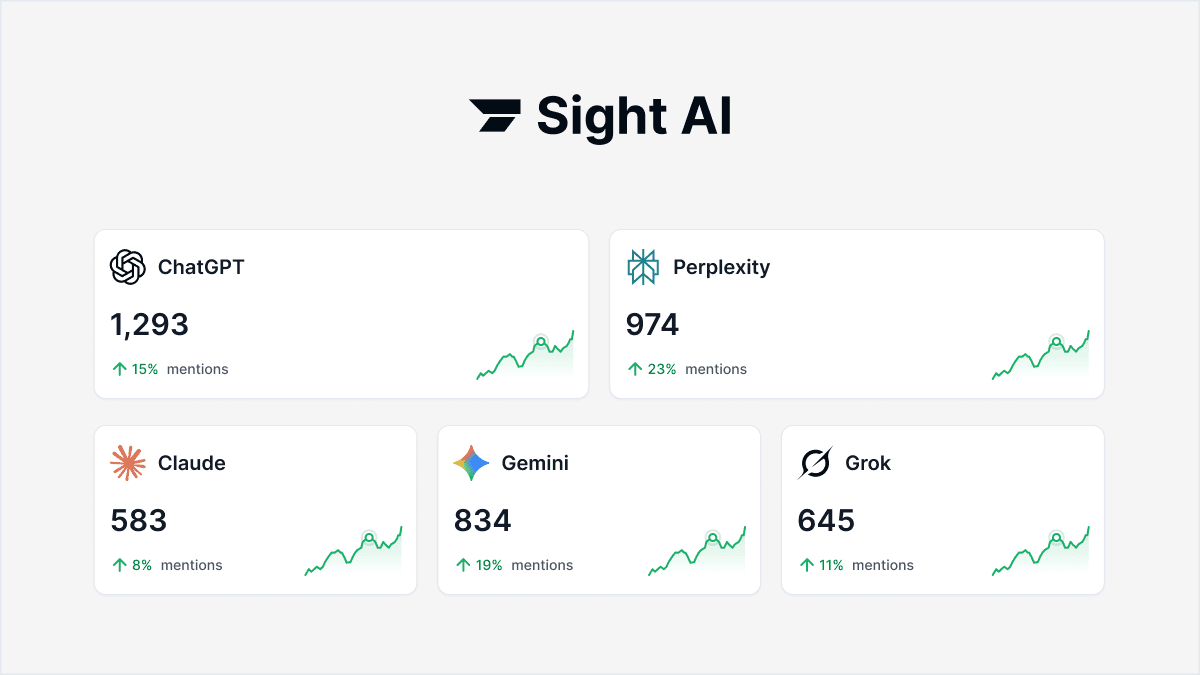
Systematic monitoring beats one-off testing. AI visibility tracking tools let you monitor brand mentions, sentiment, and prompt patterns across multiple platforms continuously. You can track how often your brand appears in response to specific prompts, what context it's mentioned in, whether sentiment is positive or neutral, and how your visibility trends over time. This systematic approach reveals whether your optimization efforts are working and where you need to adjust strategy.
The diagnostic phase isn't optional. Without understanding your current state and specific gaps, you're optimizing blind. Spend time here—it pays dividends in strategic focus.
Building Content That AI Models Actually Reference
Now we get tactical. Creating content AI models reference requires understanding what makes information citation-worthy in the first place.
GEO-Optimized Content Structure: Generative Engine Optimization isn't just SEO with a new name—it's a different approach. AI models prefer content with clear definitions, structured comparisons, and explicit use-case explanations. Instead of writing "Our platform helps teams collaborate better," write "Our project management platform is designed for remote teams of 10-50 people who need real-time task tracking, integrated video conferencing, and budget management in a single tool." The second version gives AI models specific, parseable information they can confidently cite when answering user questions. Investing in GEO optimization tools for brands can accelerate this process significantly.
Presence in Comparative Content: Here's the reality: AI models frequently draw from listicles, comparison articles, and "best of" roundups because these formats naturally contain the comparative information users seek. If you're absent from "Top 10 Marketing Automation Tools" or "Salesforce vs. HubSpot vs. [Your Brand]" articles, you're missing from a primary source AI models reference. Getting included in these comparative pieces—whether by creating them yourself or earning mentions in third-party content—dramatically increases your citation probability.
Clear Use-Case Associations: Don't make AI models guess who you're for. Create content that explicitly connects your brand to specific use cases, industries, and customer profiles. Write articles like "How [Your Product] Helps E-commerce Brands Reduce Cart Abandonment" or "Why Remote Teams Choose [Your Tool] for Async Collaboration." These clear associations help AI models understand when to recommend you. When someone asks "What tools help e-commerce brands with cart abandonment?" you've given the model explicit content to reference.
Technical Accessibility Matters: AI retrieval systems need to access and parse your content. Implement proper schema markup that clearly identifies your organization, products, and offerings. Ensure your most important content isn't hidden behind JavaScript that crawlers can't execute. Use semantic HTML with clear heading structures. Make your content available in text format, not just video or images. These technical optimizations make your content retrieval-friendly. If your new content isn't getting indexed quickly, these technical barriers may be the culprit.
Depth Over Breadth: AI models value authoritative, comprehensive content over thin pages optimized for keywords. A single 3,000-word guide that thoroughly explains your product category, compares approaches, and provides specific implementation advice is more valuable than ten 300-word blog posts. Depth signals authority—it shows you're a credible source worth citing. Invest in fewer, better content pieces that genuinely help users understand complex topics.
Update Existing High-Authority Content: You probably have content that already ranks well and attracts links—it just isn't optimized for AI citation. Go back and enhance it. Add clear definitions, structured comparisons, and explicit use-case examples. Update outdated statistics and add current context. This approach leverages existing authority while making the content more AI-friendly—often a faster path than creating entirely new content.
The content strategy isn't about gaming AI models—it's about creating genuinely useful, clearly structured information that both humans and AI systems can understand and reference with confidence.
Turning Invisibility Into AI-Driven Discovery
AI visibility isn't a one-time project—it's an ongoing strategic priority that requires systematic execution and continuous optimization.
Start by developing a content roadmap specifically for AI visibility. Identify the key prompts and questions your target audience asks AI assistants. Map your existing content against these queries and identify gaps. Prioritize creating or updating content that addresses high-value questions where you're currently invisible. This focused approach beats randomly publishing content and hoping AI models notice.
Quick wins deserve priority. Updating existing high-authority content to be more AI-friendly often delivers faster results than creating new content from scratch. If you have a well-linked guide that ranks on Google but doesn't get cited by AI models, enhance it with clearer structure, explicit comparisons, and specific use-case examples. You're leveraging existing authority while optimizing for a new discovery channel. If you're dealing with AI models not mentioning your brand, this approach can yield rapid improvements.
Build systematic monitoring into your workflow. Track your AI visibility across key platforms monthly. Monitor which prompts trigger brand mentions, what context you appear in, and whether sentiment is positive. Watch competitor mentions and identify new sources AI models are citing. Using ChatGPT tracking software for brands makes this monitoring scalable and actionable.
Measure what matters. AI visibility should connect to business outcomes—organic traffic, lead generation, and ultimately revenue. Track whether improvements in AI brand mentions correlate with increases in branded search, direct traffic, or conversions. If you're getting mentioned by AI models but not seeing downstream impact, refine your approach. The goal isn't just visibility—it's discovery that drives business results.
Think long-term competitive advantage. The brands that establish strong AI visibility now will compound that advantage as AI-powered search grows. Every authoritative mention creates training data for future model versions. Every citation builds association strength. Early movers in AI visibility optimization are creating a moat that becomes harder for competitors to cross over time.
The opportunity window is open, but it won't stay that way forever. As more brands recognize AI visibility as a strategic priority, competition for mentions will intensify. The time to act is now, while systematic AI optimization still provides outsized returns.
Your Path From Invisible to Indispensable
AI invisibility isn't a permanent condition—it's a content and strategy problem with clear, actionable solutions. The brands currently dominating AI recommendations aren't there by accident. They've created content AI models can parse and cite, established presence in authoritative sources, and built clear associations between their brand and specific use cases.
You now understand the diagnostic steps: test your current AI visibility across platforms, analyze competitive gaps, identify the sources AI models trust, and systematically monitor your presence. You know the content approaches that work: GEO-optimized structure, presence in comparative content, clear use-case associations, and technical accessibility that makes your content retrieval-friendly.
The strategic imperative is clear. As AI-powered search continues growing, brands that act now will capture the discovery advantage while competitors remain invisible. This isn't about chasing a trend—it's about adapting to a fundamental shift in how users discover and evaluate solutions. The question isn't whether AI search will matter to your business. It's whether you'll be visible when it does.
Start by auditing your current AI visibility. Run strategic prompts across ChatGPT, Claude, Perplexity, and Gemini. See where you appear, where you don't, and what gaps exist compared to competitors. Then build a systematic approach to getting mentioned—one that combines content optimization, strategic publishing, and continuous monitoring.
Start tracking your AI visibility today and see exactly where your brand appears across top AI platforms. Stop guessing how AI models like ChatGPT and Claude talk about your brand—get visibility into every mention, track content opportunities, and automate your path to organic traffic growth. The brands that dominate tomorrow's discovery landscape are building their AI visibility foundation today.