When someone asks ChatGPT "What's the best project management software for remote teams?" your brand either gets mentioned—or it doesn't. That single moment determines whether you're part of the conversation or completely invisible to a potential customer. This isn't hypothetical. Millions of users have shifted from typing queries into Google to asking AI models for recommendations, and this fundamental change in search behavior is reshaping how brands get discovered.
The stakes are straightforward: if AI models don't mention your brand, you're effectively invisible to a rapidly growing segment of your target audience. Traditional search rankings matter less when users receive synthesized answers instead of clicking through search results. Your brand needs to be part of the AI's response, positioned favorably, and recommended in the right context.
This guide breaks down everything you need to know about brand visibility in AI search engines—how AI models decide which brands to mention, how to measure your current visibility, and how to build a strategy that gets your brand recommended consistently. You'll learn practical approaches to tracking your presence across multiple AI platforms, optimizing content specifically for AI discovery, and avoiding the mistakes that cause AI models to recommend competitors instead of you.
How AI Search Engines Decide Which Brands to Mention
Traditional search engines rank pages. AI search engines synthesize information and make recommendations. This distinction changes everything about how brands get discovered.
When Google displays search results, it's essentially saying "here are relevant pages about your query." When ChatGPT or Claude answers a question, it's saying "based on everything I know, here's what I recommend." The AI model interprets your query, considers context, and generates a response that directly answers your question—often including specific brand recommendations.
Several factors influence whether AI models mention your brand when responding to user queries. Training data forms the foundation—AI models learn from vast amounts of text data, and brands that appear frequently in high-quality, authoritative content during training have better baseline visibility. Understanding how AI search engines work is essential for grasping these underlying mechanics. But training data alone doesn't determine recommendations.
Web content freshness plays a crucial role, especially for models with retrieval capabilities. When AI platforms like Perplexity or ChatGPT with browsing enabled search the web to supplement their responses, they prioritize recent, relevant content. A comprehensive article published last month about your product category has more influence than outdated content from years ago.
Brand authority signals matter significantly. AI models recognize patterns of credibility—mentions in reputable publications, consistent positive coverage, expert endorsements, and comprehensive documentation all contribute to how confidently an AI model recommends your brand. If your brand appears frequently in contexts that signal expertise and reliability, AI models are more likely to include you in recommendations.
Contextual relevance determines whether your brand gets mentioned for specific queries. An AI model might know about your brand but only recommend it when the query context matches your actual strengths. If you sell email marketing software, you want mentions when users ask about email automation—not just general marketing tools. The specificity and accuracy of how your brand is discussed across the web directly impacts when AI models consider you relevant.
Here's the critical insight: traditional SEO alone isn't sufficient for AI visibility. SEO optimizes for ranking in search results. AI visibility requires optimizing for being understood, remembered, and recommended by AI models. You need content that clearly explains what you do, who you serve, and why you're valuable—in formats that AI models can easily interpret and cite.
Measuring Your Current AI Visibility Score
You can't improve what you don't measure. Understanding your current AI visibility establishes the baseline for all optimization efforts.
An AI visibility score represents how frequently and favorably AI models mention your brand across various queries relevant to your industry. Think of it as your share of voice in AI-powered conversations. A high score means AI models regularly recommend your brand in appropriate contexts. A low score means you're being overlooked, even when users ask questions you're perfectly positioned to answer.
Measuring AI visibility requires systematic auditing across multiple platforms. Start by identifying 20-30 queries that potential customers might ask when looking for solutions like yours. These should range from broad category questions ("what's the best CRM for small businesses") to specific feature queries ("which CRM has the best mobile app") to comparison questions ("Salesforce vs HubSpot alternatives").
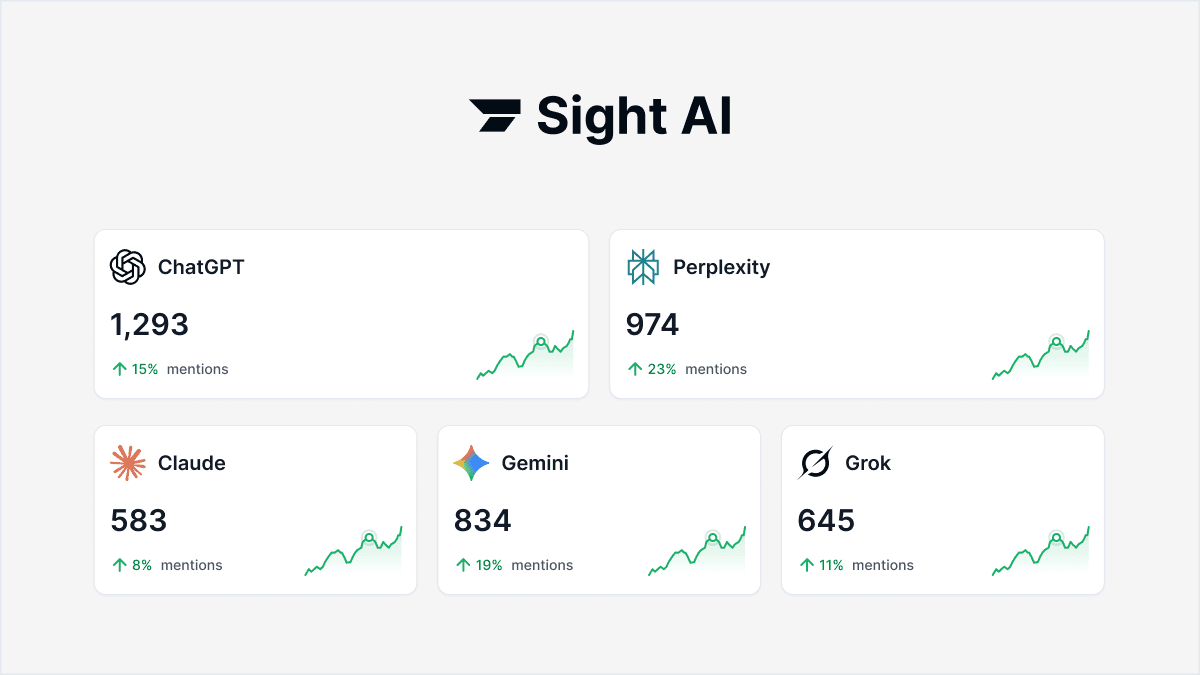
Test each query across different AI platforms—ChatGPT, Claude, Perplexity, Google's AI Overviews, and Gemini. Document whether your brand gets mentioned, how it's positioned, and what context surrounds the mention. This cross-platform approach matters because each AI model has different training data, retrieval methods, and recommendation patterns. Your brand might appear prominently in ChatGPT responses but rarely in Claude's answers. Dedicated AI search visibility tools can automate much of this monitoring process.
Sentiment analysis adds crucial depth to visibility measurement. Getting mentioned isn't enough—you need to understand how you're being discussed. Are AI models recommending your brand enthusiastically or mentioning it with caveats? Are you positioned as a leader, an alternative, or a budget option? Does the AI model accurately describe your key features and differentiators?
Track three sentiment categories: positive positioning (enthusiastic recommendations, highlighting strengths), neutral positioning (factual mentions without strong endorsement), and negative positioning (mentions with warnings, limitations, or unfavorable comparisons). The sentiment breakdown reveals whether your current web presence is building the right perception. Managing your brand reputation in AI search requires ongoing attention to these sentiment signals.
Establish a scoring framework that accounts for both frequency and quality. A simple approach: assign points for each mention (1 point), bonus points for positive positioning (2 additional points), and track total score across your query set. This creates a quantifiable baseline you can track over time as you implement optimization strategies.
Content Strategies That Get Brands Mentioned by AI
Generative Engine Optimization—GEO—represents the evolution of traditional SEO for the AI era. While SEO focuses on ranking in search results, GEO focuses on being cited and recommended by AI models.
AI models favor comprehensive, authoritative content that directly answers specific questions. The content format matters significantly. In-depth guides that thoroughly explore a topic, comparison articles that provide balanced analysis, and tutorial content that walks through implementation all tend to get cited by AI models more frequently than surface-level blog posts.
Structure your content for AI interpretation. Use clear hierarchical headings that outline your content's organization. Include explicit answers to common questions—AI models often pull direct quotes from content that clearly states "the answer is..." or "the best approach involves..." Make your key points easy to identify and extract.
Comprehensiveness beats brevity when optimizing for AI visibility. A 3,000-word guide that thoroughly covers a topic provides AI models with more context and quotable insights than a 500-word overview. This doesn't mean adding fluff—it means genuinely exploring topics in depth, addressing nuances, and providing actionable information that serves user needs. Our comprehensive guide on how to optimize for AI search engines covers these principles in greater detail.
Authority signals within your content influence AI recommendations. When you cite research, reference industry standards, or demonstrate deep expertise, AI models recognize these credibility markers. Include relevant statistics from reputable sources, reference established frameworks, and demonstrate practical experience through detailed examples.
Answer the questions your customers actually ask. AI models respond to user queries by synthesizing information that addresses those specific questions. If potential customers frequently ask "how long does implementation take," create content that explicitly answers that question. Understanding search intent in SEO helps you align content with what users genuinely want to know. If they wonder "what's the learning curve," address it directly. This query-focused approach aligns your content with the exact prompts that trigger AI responses.
Update content regularly to maintain freshness. AI models with retrieval capabilities prioritize recent content when generating responses. A comprehensive guide from 2023 has less influence than updated content from 2026. Establish a content refresh cycle that keeps your most important pages current with new examples, updated statistics, and recent developments in your industry.
Create content that naturally positions your brand as a solution. Rather than purely promotional content, develop resources that genuinely help users understand their problems and evaluate solutions—while clearly articulating what makes your approach valuable. AI models cite helpful, informative content far more often than obvious sales pitches.
Tracking AI Mentions Across Multiple Platforms
Different AI models have different perspectives on your brand. Comprehensive tracking requires monitoring across the entire AI ecosystem.
Each AI platform operates with distinct training data and retrieval methods. ChatGPT's knowledge comes from its training data plus web browsing capabilities. Claude has its own training corpus and approach to generating responses. Perplexity specializes in real-time web search and citation. Google's AI Overviews pull from Google's massive search index. These differences mean your brand might be highly visible on one platform but barely mentioned on another.
Establish a systematic monitoring process. Select your core set of relevant queries—those questions potential customers ask when looking for solutions in your category. Test these queries across all major AI platforms weekly or biweekly. Document not just whether you're mentioned, but your position in the response (first recommendation, mentioned alongside competitors, or briefly referenced), the context of the mention, and any specific features or benefits the AI model highlights. Implementing AI search visibility monitoring as a regular practice ensures you catch changes quickly.
Prompt tracking reveals which user queries trigger mentions of your brand. This intelligence is invaluable for content strategy. If AI models consistently mention your brand when users ask about specific features but never mention you for broader category queries, you've identified both a strength to leverage and a gap to address. Understanding your prompt triggers helps you double down on what's working and expand into new territory.
Track competitor mentions alongside your own. When AI models recommend competitors for queries where you should be relevant, you've found content gaps to fill. If a competitor consistently gets mentioned with positive framing while you're mentioned neutrally, you need to strengthen your authority signals and brand positioning across the web. Analyzing competitors ranking in AI search results reveals opportunities you might otherwise miss.
Establish baseline metrics before implementing any optimization strategies. Record your initial visibility score, mention frequency across platforms, sentiment breakdown, and which queries trigger mentions. This baseline becomes your reference point for measuring improvement. Without it, you're flying blind—unable to determine whether your optimization efforts are actually working.
Monitor trends over time rather than obsessing over individual data points. AI model responses can vary based on numerous factors. What matters is the trend line: Are you being mentioned more frequently this month than last month? Is sentiment improving? Are you gaining visibility for new query types? These directional trends indicate whether your strategy is working.
Common Mistakes That Hurt AI Search Visibility
Understanding what damages AI visibility is just as important as knowing what improves it. Several common mistakes cause AI models to overlook brands or recommend competitors instead.
Content gaps create the most significant visibility problems. When your website lacks comprehensive information about your product, features, use cases, or implementation, AI models have nothing substantial to cite. If a competitor has published detailed guides, comparison content, and thorough documentation while your site only has basic product pages, AI models will naturally favor the competitor when generating recommendations. They can't recommend what they don't understand.
Thin content particularly hurts AI visibility. A 300-word blog post that barely scratches the surface of a topic provides little value to AI models looking for substantive information to cite. When AI platforms retrieve web content to supplement their responses, they prioritize comprehensive resources that thoroughly address user questions. Surface-level content gets passed over. If you're experiencing this issue, our guide on fixing a brand not appearing in AI searches provides actionable solutions.
Outdated content sends negative signals. If your most detailed content references outdated versions of your product, mentions features you no longer offer, or includes statistics from years ago, AI models may present you as less current or relevant than competitors with fresh content. This is especially problematic in fast-moving industries where AI models need recent information to make accurate recommendations.
Inconsistent brand messaging across web properties confuses AI models. If your website describes your product one way, review sites present different information, and third-party articles emphasize completely different features, AI models struggle to form a coherent understanding of what you offer and who you serve. This inconsistency often results in vague or inaccurate mentions—or no mentions at all.
Ignoring the questions customers actually ask creates a disconnect between your content and AI search queries. You might have extensive content about your product's technical architecture, but if customers are asking practical questions about implementation time, learning curve, or specific use cases, that technical content doesn't help your AI visibility for the queries that matter.
Focusing exclusively on promotional content rather than informative resources limits your citation potential. AI models rarely cite obvious sales pages when answering user questions. They look for content that genuinely helps users understand topics, evaluate options, and make informed decisions. If all your content is promotional, you're invisible to AI-powered search.
Building a Long-Term AI Visibility Strategy
AI visibility isn't a one-time optimization project. It requires an ongoing cycle of monitoring, analysis, content creation, and tracking.
Start with regular visibility audits. Monthly or biweekly, test your core query set across major AI platforms. Track your mentions, sentiment, and positioning. This consistent monitoring reveals trends, identifies new opportunities, and catches visibility drops before they become serious problems. You can't optimize effectively without knowing your current status. Using brand visibility tracking software streamlines this entire process.
Analyze the data to identify content opportunities. Which queries never trigger mentions of your brand? Those are content gaps to fill. Which queries result in competitor mentions with positive framing? Those indicate areas where competitors have stronger content you need to match or exceed. Which features or benefits do AI models mention when they recommend your brand? Those are strengths to emphasize and expand upon.
Create content strategically based on your visibility analysis. Prioritize comprehensive guides that address queries where you're currently invisible. Update and expand existing content that's getting some mentions but could be stronger. Develop comparison content that positions you favorably against competitors who are currently getting more AI visibility than you. Implementing proven AI search optimization strategies accelerates your progress.
Content velocity impacts AI model awareness. Publishing one article per quarter won't significantly move the needle. AI models, especially those with retrieval capabilities, favor brands with consistent, recent content. Establish a sustainable publishing cadence—whether that's weekly, biweekly, or monthly—and maintain it. Regular content publication signals that your brand is active, current, and worth paying attention to.
Integrate AI visibility tracking into your existing marketing workflows. Don't treat it as a separate initiative. When you publish new content, test how it impacts your visibility for relevant queries. When you update product features, ensure your web content reflects those changes so AI models have accurate information. When competitors launch new offerings, monitor whether it affects their AI visibility and adjust your strategy accordingly.
Optimize your indexing speed to ensure AI models with retrieval capabilities find your new content quickly. When you publish a comprehensive guide that addresses an important query, you want AI platforms to discover and potentially cite it as soon as possible. Learning how to get indexed by search engines faster means your content becomes part of AI responses sooner, giving you competitive advantage over slower-moving competitors.
Track the business impact of improved AI visibility. As your mention frequency and sentiment improve, monitor whether you're seeing corresponding increases in organic traffic, brand searches, or direct traffic. This connection between AI visibility and business outcomes justifies continued investment in optimization efforts.
Taking Control of Your AI Search Presence
Brand visibility in AI search engines represents a fundamental shift in how customers discover products and services. The brands that AI models recommend gain access to a growing segment of potential customers who have moved beyond traditional search. The brands that AI models overlook become invisible to these users, regardless of how strong their traditional SEO might be.
The path forward requires three core actions. First, measure your current AI visibility across multiple platforms—understand where you stand today, which queries trigger mentions, and how you're being positioned. Second, optimize your content specifically for AI discovery through comprehensive, authoritative resources that answer the questions your customers actually ask. Third, continuously track your performance and adjust your strategy based on what's working.
The competitive advantage goes to brands that invest in AI visibility now, while many competitors are still focused exclusively on traditional search. As AI-powered search adoption accelerates, the gap between visible brands and invisible brands will widen. The question isn't whether to optimize for AI search engines—it's how quickly you can establish strong visibility before your market becomes saturated with competitors doing the same.
Stop guessing how AI models like ChatGPT and Claude talk about your brand—get visibility into every mention, track content opportunities, and automate your path to organic traffic growth. Start tracking your AI visibility today and see exactly where your brand appears across top AI platforms.