When someone types "best project management software" into ChatGPT instead of Google, something fundamentally different happens. They don't get ten blue links—they get a curated answer with specific brand recommendations. Maybe Asana gets mentioned. Maybe Monday.com appears. Maybe your product gets the spotlight, or maybe it's completely invisible.
This shift is happening at scale. Millions of users now turn to ChatGPT, Claude, Perplexity, and Gemini for product recommendations, service comparisons, and buying advice. These aren't just productivity queries anymore—they're discovery conversations. Someone asks "Which CRM should a small marketing agency use?" and the AI responds with confident recommendations, often naming three to five specific brands.
Here's the uncomfortable reality: Your brand is either part of these conversations or it isn't. And most companies have absolutely no idea which side of that divide they're on. They've spent years mastering Google rankings, building social media presence, and tracking traditional brand mentions—but they're flying completely blind when it comes to what AI models actually say about them. Brand citation tracking in AI solves this visibility gap, giving you systematic insight into how large language models recommend (or ignore) your business across the platforms reshaping how customers discover products.
The Hidden Conversation: How AI Models Recommend Brands
Large language models don't randomly pick brands to recommend. They form associations through a complex interplay of training data, real-time web retrieval, and contextual understanding. When ChatGPT suggests Notion for knowledge management or Claude recommends Stripe for payment processing, those mentions stem from patterns the model learned during training combined with how those brands appear across millions of web pages.
The mechanics vary significantly across platforms. ChatGPT primarily relies on training data—the massive corpus of text it learned from during development—supplemented by web browsing capabilities when explicitly enabled. Claude similarly draws from training data but demonstrates different brand preferences based on its distinct training approach. Perplexity takes a fundamentally different path, using retrieval-augmented generation (RAG) to pull real-time information from the web with every query, meaning its brand recommendations can shift as new content gets published.
This distinction matters enormously for tracking. If you publish a comprehensive guide today, Perplexity might start citing your brand within days as it retrieves that fresh content. ChatGPT's core knowledge won't reflect that new content until its next training update, though its web browsing mode might surface it sooner. Understanding these different retrieval mechanisms helps explain why your brand might appear in one AI platform's responses but not another's.
The context in which brands get mentioned reveals even more complexity. Ask "What's the best email marketing platform?" and you might get Mailchimp, ConvertKit, and ActiveCampaign. Ask "What email marketing tool works best for e-commerce stores with abandoned cart sequences?" and suddenly Klaviyo dominates the response. The specificity of the prompt dramatically influences which brands surface, because AI models match brand mentions to contextual relevance, not just general popularity. This is why prompt tracking for brands has become essential for understanding your AI visibility.
Different AI models also demonstrate distinct "personalities" in their recommendations. Some lean toward established enterprise brands, others favor newer startups with strong developer communities, and some show regional preferences based on their training data composition. Testing the same prompt across ChatGPT, Claude, Perplexity, and Gemini often yields four different brand lists—each reflecting that model's unique understanding of your industry landscape.
What Brand Citation Tracking Actually Measures
Brand citation tracking in AI centers on four core metrics that together paint a complete picture of your AI visibility. Mention frequency measures how often your brand appears across a standardized set of industry-relevant prompts. If you test fifty queries related to your category and your brand appears in twelve responses, that's your baseline frequency—the foundation for tracking improvement over time.
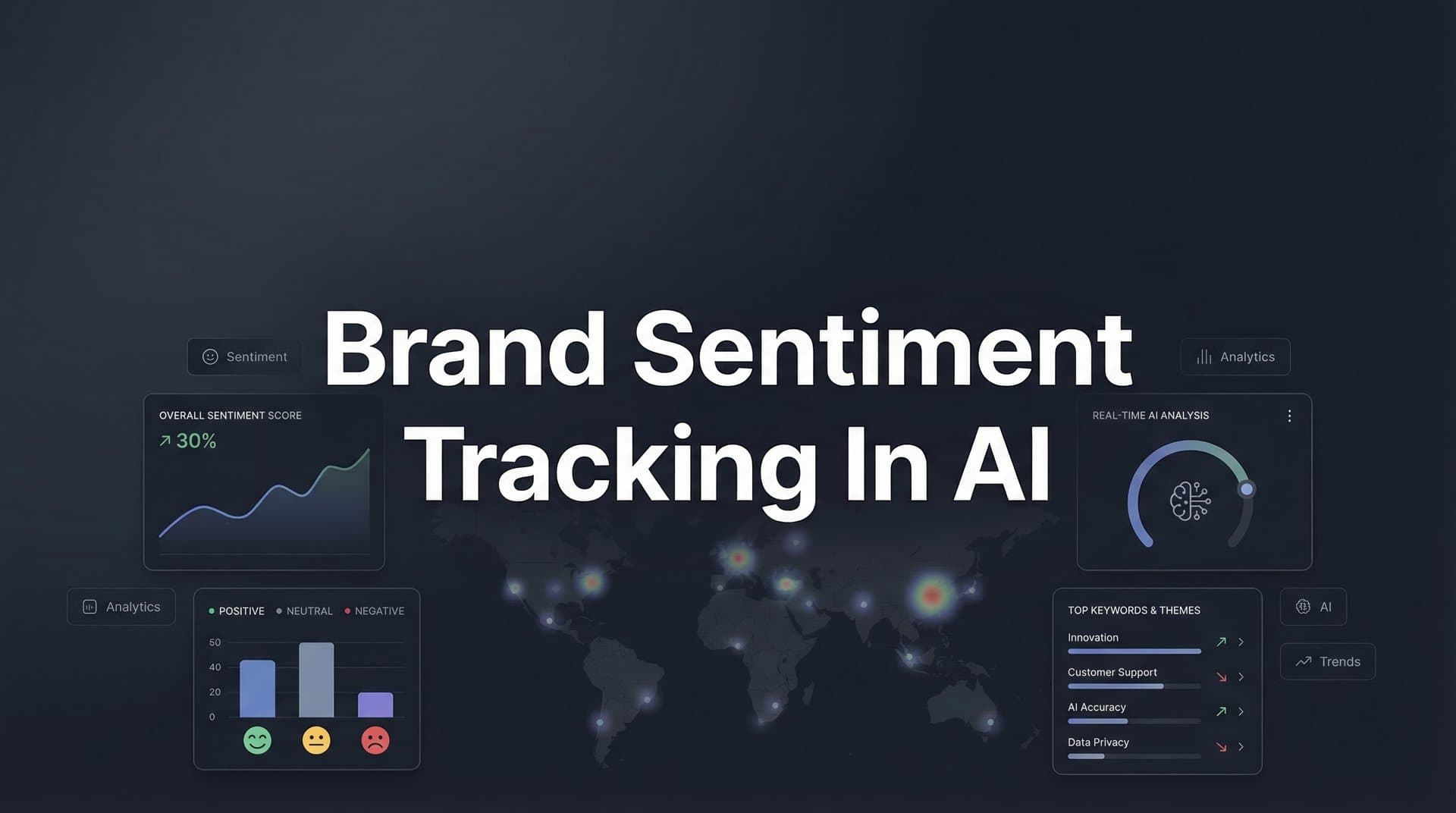
Sentiment analysis examines not just whether you're mentioned, but how you're characterized. A positive recommendation ("Ahrefs offers the most comprehensive backlink analysis") carries completely different value than a neutral mention ("Ahrefs is another option") or a negative context ("While tools like Ahrefs exist, many users find them overly complex"). Being mentioned negatively is often worse than not being mentioned at all, because it plants doubt in the user's mind before they've even visited your site. Understanding brand sentiment tracking in AI helps you monitor these crucial distinctions.
Context accuracy tracks whether AI models describe your product correctly. Many brands discover that AI platforms mention them in the wrong category, attribute features they don't have, or describe outdated pricing models. When Perplexity says your tool "starts at $49/month" but you've changed to $79/month, that misattribution creates friction for potential customers who arrive expecting different pricing.
Competitive share of voice reveals your position relative to industry players. If you're mentioned in twenty percent of relevant prompts while your main competitor appears in sixty percent, that gap represents lost discovery opportunities. This metric helps benchmark performance and identify which competitors dominate AI recommendations in your space.
Prompt tracking adds another critical layer—monitoring which specific user queries trigger your brand mentions. You might discover that you're frequently cited for "enterprise project management" prompts but never appear in "small team collaboration tool" queries, even though you serve both markets. This insight directly informs content strategy, revealing exactly where you need stronger topical coverage to earn mentions in underrepresented query categories.
The temporal dimension matters too. AI citation tracking isn't a one-time audit—it's ongoing monitoring that reveals trends. Are your mentions increasing after publishing new content? Did a competitor's product launch shift share of voice? Has sentiment changed following a pricing update or feature release? Tracking these patterns over weeks and months exposes the relationship between your marketing activities and AI visibility.
Why Traditional Brand Monitoring Falls Short
Social listening tools excel at tracking Twitter mentions, Reddit discussions, and news coverage. PR monitoring platforms catch when journalists write about your brand. Google Alerts notify you when new web pages mention your company. None of these tools tell you what ChatGPT says when someone asks for product recommendations in your category.
The fundamental challenge is that AI responses aren't indexed anywhere. When ChatGPT recommends three CRM platforms to a user, that response doesn't appear on a web page you can find through traditional monitoring. It's an ephemeral conversation between the user and the model, invisible to conventional tracking tools that rely on publicly accessible content. This is precisely why AI brand mention tracking software has emerged as a distinct category.
AI responses also vary by user, making them impossible to monitor through simple observation. The same prompt asked by two different users might yield different brand recommendations based on conversation history, user location, or subtle variations in how the model's randomness parameters are set. You can't simply "search" for your brand in ChatGPT the way you'd Google your company name and review the results, because there are no static results to review.
Traditional SEO tools face similar limitations. Rank tracking shows your position in Google search results, but AI models don't have "positions" in the same way. Your brand either gets mentioned in a response or it doesn't, and that binary outcome depends on complex factors beyond traditional ranking signals. The metrics that matter for AI visibility—prompt relevance, contextual authority, structured content quality—don't map neatly to traditional SEO KPIs.
The temporal challenge compounds these issues. AI models update their knowledge irregularly and opaquely. You might publish authoritative content that immediately influences Perplexity's RAG-based responses but takes months to affect ChatGPT's core recommendations. Without systematic tracking across platforms over time, you can't identify these patterns or measure the impact of your content efforts on AI visibility. The difference between AI brand monitoring vs manual tracking becomes stark when you consider these complexities.
Setting Up Your AI Citation Tracking System
Building an effective tracking system starts with identifying which AI platforms matter for your audience. ChatGPT dominates general usage, making it a universal priority. Claude has strong adoption among technical and research-focused users. Perplexity attracts users specifically seeking web-sourced answers with citations. Gemini brings Google's ecosystem integration. For most brands, multi-platform brand tracking software that covers these four platforms provides comprehensive coverage of the AI discovery landscape.
Creating your prompt library is where strategic thinking becomes crucial. These aren't random questions—they're carefully crafted queries that mirror how real customers discover products in your category. Start by listing the core problems your product solves, then phrase them as natural questions a potential customer would ask an AI assistant.
If you sell email marketing software, your prompt library might include direct comparison queries ("What's the best email marketing platform for e-commerce?"), feature-specific questions ("Which email tools have the best automation workflows?"), use-case scenarios ("What email marketing software should a content creator use?"), and budget-conscious prompts ("What are affordable alternatives to Mailchimp?"). Aim for thirty to fifty prompts that cover the full spectrum of how customers in your market seek recommendations.
Establishing your tracking cadence depends on your resources and how quickly your market moves. Weekly tracking provides granular insight into changes and helps correlate AI visibility shifts with specific content publications or product updates. Bi-weekly tracking offers a practical middle ground for most teams. Monthly tracking works for stable markets where you're building long-term baseline data. The key is consistency—irregular tracking makes it impossible to identify meaningful trends.
Your first tracking cycle establishes baseline measurements. Run your entire prompt library across all target AI platforms and document the results systematically. Record not just whether your brand was mentioned, but the context, sentiment, competing brands that appeared, and any factual inaccuracies. This baseline becomes your benchmark for measuring future improvement.
Documentation structure matters for long-term tracking value. Create a simple spreadsheet with columns for prompt text, AI platform, date tested, your brand mentioned (yes/no), mention context (direct recommendation, alternative option, negative mention), competing brands mentioned, and notes on accuracy. This structured data lets you spot patterns: which prompts never trigger your brand, which competitors dominate specific query types, and how your visibility changes over time.
Consider segmenting your prompt library by customer journey stage. Some prompts represent early research ("What types of project management tools exist?"), others indicate active comparison ("Asana vs Monday.com vs ClickUp"), and some signal buying intent ("Which project management software has the best free trial?"). Tracking performance across these segments reveals where you're strong in the discovery journey and where you're losing potential customers to competitors.
From Tracking to Action: Improving Your AI Visibility
Citation tracking data becomes valuable when it drives content strategy decisions. When your tracking reveals that you're never mentioned for "small business accounting software" prompts despite serving that market, you've identified a content gap. The solution isn't just writing a blog post—it's creating comprehensive, structured content that helps AI models understand your relevance to that query category.
Structured content performs particularly well in AI citations because models can extract clear information from well-organized pages. Comparison tables, feature lists with clear descriptions, use-case breakdowns, and FAQ sections give AI models concrete data points to reference when formulating recommendations. A detailed comparison page showing how your product stacks up against competitors in specific categories provides exactly the kind of structured information that influences AI responses. Exploring AI model citation tracking methods can help you understand which content formats drive the most mentions.
Authority signals matter differently in AI contexts than traditional SEO. While backlinks still contribute to overall domain authority, AI models also weigh factors like content comprehensiveness, technical accuracy, and topical depth. Publishing a series of in-depth guides that thoroughly cover different aspects of your product category builds topical authority that influences how confidently AI models recommend your brand.
The feedback loop makes tracking actionable. After identifying underperformance in specific prompt categories, you create targeted content to address those gaps. Wait an appropriate timeframe based on the AI platform's update mechanisms—days for Perplexity's RAG system, potentially weeks for ChatGPT's core knowledge. Then re-run those specific prompts to measure whether your new content improved citation frequency or quality.
Sentiment improvement requires a different approach. If tracking reveals that your brand gets mentioned but with negative or outdated context, the solution often involves updating existing content rather than creating new pages. Ensure your pricing page clearly states current costs, your features page accurately describes capabilities, and your positioning is consistent across all published content. AI models pull from the entire web—contradictory information across different pages creates confusion that manifests as inaccurate citations. Tools for AI model brand sentiment tracking can help you monitor these shifts.
Competitive displacement strategies emerge from share-of-voice analysis. When tracking shows a competitor dominating specific prompt categories, analyze what content they have that you lack. Often you'll find they've published comprehensive guides, detailed comparison pages, or use-case studies that establish their authority in that specific context. Creating superior content on those topics—more comprehensive, more current, better structured—gives AI models reason to cite you instead. Using brand tracking for competitive analysis helps you identify exactly where competitors are winning.
Putting It All Together: Your AI Citation Tracking Roadmap
Brand citation tracking in AI boils down to four metrics that matter: mention frequency shows your baseline visibility, sentiment analysis reveals how you're characterized, context accuracy ensures AI models describe you correctly, and competitive share of voice benchmarks your position against industry players. Together, these metrics expose exactly where you stand in the AI discovery landscape.
Start tracking this week by choosing two AI platforms—ChatGPT for broad reach and Perplexity for real-time web retrieval. Create fifteen prompts that represent how customers discover products in your category. Run those prompts, document the results, and you've established your baseline. That's your starting point for systematic improvement.
Prioritize content creation based on gap analysis. Focus first on prompt categories where you're completely absent despite clear product relevance—these represent the highest-value opportunities. Next, address areas where you're mentioned but with negative sentiment or inaccurate context. Finally, work on competitive displacement in categories where you're occasionally mentioned but competitors dominate.
AI visibility is becoming as critical as traditional SEO rankings because the discovery landscape is fundamentally shifting. Every week, more users ask AI assistants for recommendations instead of searching Google. The brands that appear in those AI responses gain discovery advantages that compound over time, while invisible brands lose ground even if their traditional SEO remains strong.
The companies tracking their AI visibility now are identifying content opportunities and optimization strategies before competitors recognize the game has changed. They're building topical authority that influences AI recommendations, creating structured content that models can easily reference, and establishing the citation patterns that drive discovery in AI-first search behaviors. This isn't preparation for a future shift—it's responding to the present reality of how customers find products.
Your Next Steps
Brand citation tracking in AI isn't a future concern—it's a present-day competitive advantage. While most companies remain unaware that AI models are recommending competitors in response to product discovery queries, the brands tracking these conversations are systematically building the content and authority that earns those recommendations.
The visibility gap won't last forever. As more marketers recognize that ChatGPT, Claude, and Perplexity have become discovery platforms, competition for AI citations will intensify. The advantage belongs to companies who start tracking now, identify their citation gaps, and build comprehensive content strategies before their markets become saturated with competitors pursuing the same AI visibility.
Every day you're not tracking is another day of missed insight into how AI models talk about your brand, which competitors dominate your category in AI responses, and what content gaps are costing you discovery opportunities. Stop guessing how AI models like ChatGPT and Claude talk about your brand—get visibility into every mention, track content opportunities, and automate your path to organic traffic growth. Start tracking your AI visibility today and see exactly where your brand appears across top AI platforms.