
Automated content marketing turns repetitive tasks—keyword research, draft creation and SEO checks—into a smooth, data-driven workflow. The payoff is real: leading brands slash manual effort by up to 50% while keeping every piece of content on point. Think of it as an assembly line for your digital strategy.
Understanding Automated Content Marketing
In its simplest form, automated content marketing weaves together four big steps—research, creation, optimization and distribution—into a single, repeatable process. Rather than treating each article or blog post like a one-off project, you set up triggers that launch each stage automatically.
Early adopters report faster turnaround times and clearer ROI. By replacing tedious, manual tasks with intelligent workflows, teams can focus on strategy and creativity, not endless edits.
Key Components:
- Research and Topic Discovery powered by AI engines that surface emerging trends
- SEO Analysis with automated keyword scoring and tailored content suggestions
- Template-Based Drafting that enforces brand voice and structure
- Scheduled Publishing across channels, complete with instant indexing triggers
- Internal Linking Automation to guide crawlers and boost SEO
Core Workflows In Action
Imagine each stage handing off to the next, just like parts move down a factory line. Your researchers feed AI with trend data. That AI hands an outline to your writers. The draft moves to an optimizer that tweaks keywords and structure. Finally, it’s queued for publishing—and indexed the moment it goes live.
As a snapshot of adoption: 79% of marketers now automate at least one step of the customer journey, and the market for marketing automation is on track to hit $13.97 billion by 2030. Learn more about these growth projections on EmailVendorSelection.com.
Here’s how different teams stack up:
Automation Adoption Levels Among Marketers
This table shows the distribution of automation levels used by marketers based on the latest industry report.
| Automation Level | Percentage | Examples |
|---|---|---|
| Basic | 25% | Email scheduling, social media post reminders |
| Moderate | 35% | Automated SEO reports, content calendar automation |
| Advanced | 30% | AI-driven topic ideation, template-based drafting |
| Full Automation | 10% | End-to-end content production and publishing |
While full automation remains rare, most teams are at least dipping their toes in—and seeing real benefits.

This view shows how rule-based triggers and analytics dashboards connect to speed up your content pipeline.
Think of marketing automation as an assembly line where every station hands off neatly to the next—no bottlenecks, no dropped balls.
For a deep dive into setting up your own system, check out our guide on Automating Content Creation with IndexPilot and explore What is Content Automation? for additional context.
Understanding Core Concepts In Automated Content Marketing
Imagine automated content marketing as a busy factory floor where machines spring into action the moment raw materials arrive. Instead of waiting on emails or shared spreadsheets, each task kicks off the second data points hit their mark.
Traditional teams often shuttle drafts back and forth. An automated setup replaces that handoff with precise triggers, so topic research, drafting, editing and publishing flow without pause.
- Content Orchestration Engines keep all steps in sync, like a production manager overseeing each station
- Rule Based Workflows fire off tasks the moment set conditions are met
- AI Assistants jump in for drafting, fine-tuning language and polishing structure
- Data-Driven Triggers monitor performance and launch the next step when thresholds arrive
- Indexing Hooks ping search engines the second an article goes live
In practice, a content orchestration engine serves as a single dashboard. It forwards outlines, hands off drafts and flags the next task—eliminating bottlenecks and freeing your team to focus on ideas, not logistics.
When Workflows Replace Manual Handoffs
Waiting for approvals can drag a project from hours into days. Automated workflows cut out those hold-ups by using triggers—say, a publish date or a keyword score—to advance a draft automatically.
You could set a rule that any draft scoring above 70% moves straight to review, bypassing manual checks and keeping quality consistent.
79% of marketers automate at least one stage of their content processes and report faster publishing.
Exploring Rule Based Workflows
Rule based workflows are essentially “if-then” instructions for your content engine. They handle everything from distribution to internal linking, so nothing falls through the cracks.
- Time-Based Triggers schedule posts at your site’s peak traffic hours
- Performance Thresholds boost promotion when engagement climbs
- Content Gap Alerts flag missing topics your audience wants
- Version Updates refresh posts the moment data changes
A small team might automate monthly reports, while a global enterprise strings together multi-step campaigns across departments. Either way, each rule adds clarity and scale.
Roles Of AI Assistants
AI assistants slot into every stage of your pipeline. They’re the apprentices who handle routine tasks so your senior writers can focus on strategy.
- Topic Discovery tools scan trends to surface fresh ideas
- Drafting engines produce outlines—or full posts—based on your brief
- Optimization modules refine keywords, structure and readability
- Publishing and Indexing connect via APIs to alert search engines immediately
Over time, terms like “content orchestration,” “trigger” and “indexing hook” become second nature to your team. For a deep dive, check out our guide on AI Content Writing.
This factory-floor view shows how content moves from concept to indexed asset without ever stalling. Later chapters will unpack the specific tools and workflows you need.
Manual Vs Automated Pipelines
| Aspect | Manual Pipeline | Automated Pipeline |
|---|---|---|
| Handoff | Email or chat delays | Rule triggers and APIs |
| Accuracy | Varies by editor skill | Consistent thanks to preset rules |
| Speed | Hours to days | Minutes to hours |
Comparing these side by side makes it clear: automation slashes handoff friction and brings uniform quality to every piece.
Main Takeaways
- Grasp terms like orchestration, triggers and hooks
- Picture your content process as an assembly line
- Build a shared vocabulary to keep teams aligned
- Let AI assistants take on repetitive tasks
With these fundamentals under your belt, you’re ready to explore the toolbox and step-by-step roadmap for building your own automated content factory. Let’s dive in!
Key Components And Workflow For Automated Content Marketing
Imagine your content program as a modern factory floor. Each station hands off its work with clockwork precision, from topic scouting to final indexing. It all starts when AI spots promising subjects and ends with search engines being notified the moment you hit publish.
Believe it or not, 67% of marketers use AI tools for content marketing, with 58% diving into topic research, 52% fine-tuning copy, and 50% generating new material from scratch using generative AI. Discover more in the content marketing trends report on Blogging Wizard.
At the heart of this system are five core modules:
- Keyword Research powers topic discovery via AI-driven insights
- Content Drafting feeds generative templates that mirror your brand’s voice
- SEO Scoring checks drafts against on-page best practices
- Internal Linking weaves each article into your site’s structure
- Publishing handles distribution and kicks off indexing requests
Combined, these parts create a hands-off, end-to-end pipeline that keeps fresh content flowing.
Keyword Research And Topic Discovery
This is where the process boots up. Smart tools sift through search queries, social trends, and competitor data to find the topics your audience cares about.
- Pinpoint high-volume, low-competition keywords for broader reach
- Uncover long-tail phrases that indicate strong purchase intent
- Use predictive models to estimate topic performance
Platforms like Ahrefs, SEMrush, Google Trends, and AnswerThePublic run large-scale keyword audits in minutes. The results plug straight into your editorial calendar, trimming planning time by up to 40%.
Keyword discovery powers the rest of the workflow by ensuring your topics align with user intent.
Content Generation And Template Orchestration
With topics approved, AI engines can spin up outlines or full drafts in moments. The trick is to feed them clear briefs and brand rules.
- Supply the AI with a concise brief and style guide
- Generate an outline or draft using reusable templates
- Review and polish the draft to match your desired tone
Defining style rules up front keeps “tone drift” at bay and lets drafts move smoothly to the next station.
SEO Scoring And Optimization
Think of this step as the quality control department. Automated checks scan for:
- Proper heading hierarchy, meta tags, and ideal keyword density
- Readability scores that match your target audience
- Suggested internal link placements based on content clusters
Tools like Surfer SEO and Clearscope slot right in here. They flag weak spots and reroute drafts for manual edits if needed.
73% of content teams report faster optimization cycles with automated scoring tools.
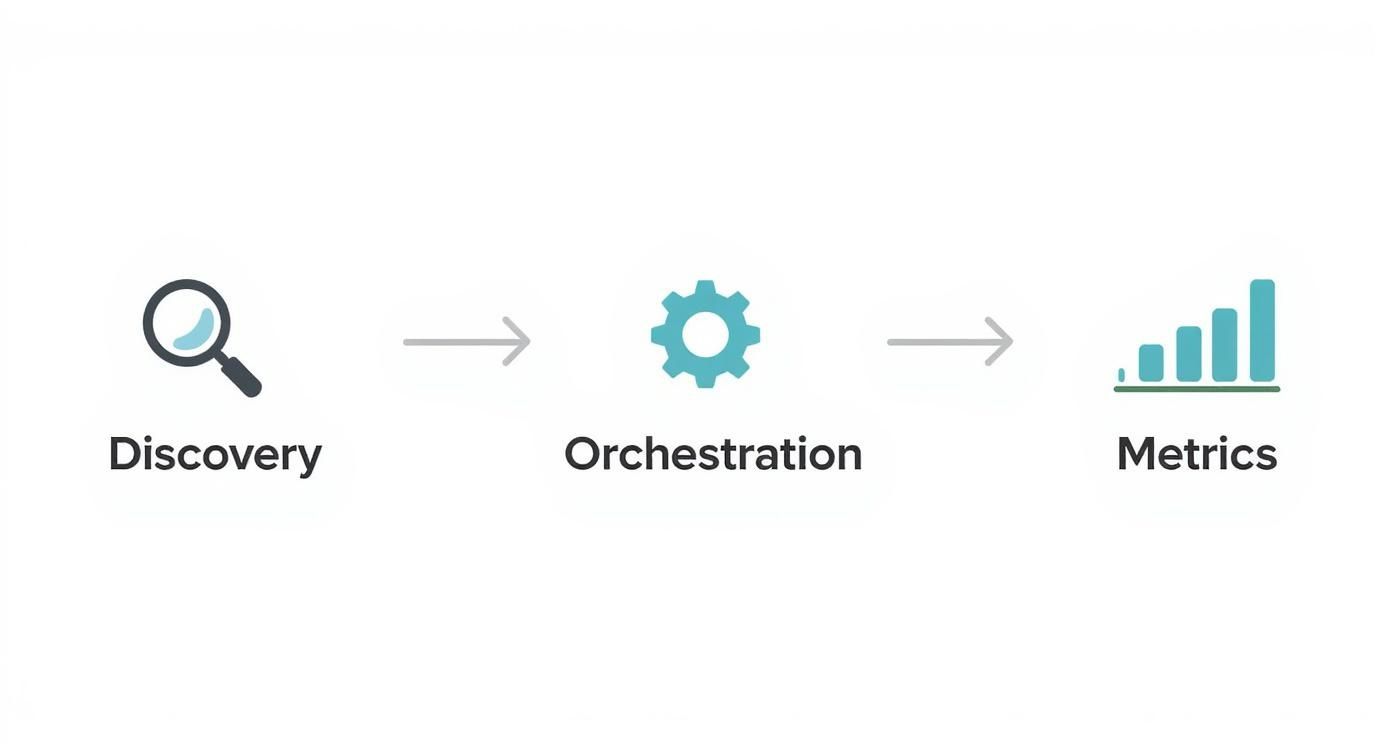
This graphic lays out how Discovery, Orchestration, and Metrics fit together to eliminate handoff delays and boost throughput.
Automated Linking And Multi-Channel Publishing
Next, internal links are added automatically to reinforce your site’s pillar pages. At the same time, articles get queued for social media, email newsletters, and RSS feeds.
- Map related items to strengthen your SEO network
- Trigger link updates whenever new posts drop
- Schedule outbound publishing across platforms in one go
Solutions like Link Whisper or IndexPilot’s built-in link builder handle anchor text selection for you, saving hours of manual work.
Indexing Hooks And Performance Feedback
Finally, your content fires off indexing pings the instant it goes live.
- Generate and submit sitemap entries to Google and Bing
- Pull in performance metrics via API
- Feed those insights back into your dashboard for continuous tweaks
IndexPilot’s auto-submission API alone can speed up crawl rates by 30%. From there, performance stats highlight which posts need a refresh, closing the loop on quality improvement.
For a deeper dive into end-to-end SEO automation, check out our detailed guide. Learn how to integrate AI in SEO workflows
With this blueprint in hand, you can build a scalable, self-driving content pipeline that keeps pace without ever sacrificing quality.
Happy automating your pipeline.
Benefits And Risks Of Automated Content Marketing
When a marketing team treats content like a production line, workloads speed up—but oversight can slip. Automated content marketing gives you the power to roll out assets fast, yet keeping the brand’s voice intact becomes more challenging.
By automating routine steps—publishing, tagging, segment targeting—you gain serious momentum. At the same time, templates and data feeds can go off-script if you don’t set strict rules.
- Faster Content Velocity To Outpace Competitors
- Tighter Audience Segmentation For Improved Engagement
- Data-Backed Optimization That Learns From Performance
- Reduced Manual Effort For Repetitive Tasks
Below is a snapshot of how three common email automation workflows compare in revenue and engagement.
Email Marketing Automation ROI Metrics
| Workflow Type | Revenue Per Recipient | Click Through Rate Increase | Revenue Increase |
|---|---|---|---|
| Segmented Campaigns | $17 | 57% | 57% |
| Abandoned Cart | $12 | 45% | 45% |
| Welcome Sequences | $10 | 30% | 30% |
These figures highlight why teams lean on email automation to hit targets faster and measure impact clearly.
Major Advantages In Focus
One of the most appealing perks is the clear ROI. Studies show email automation delivers $42 in ROI for every $1 spent, with segmented campaigns driving 57% more revenue and top workflows generating nearly $17 per recipient. Learn more in content marketing statistics.
Meanwhile, creative teams reclaim their time. Instead of wrestling with scheduling or formatting, writers dive into big-picture strategy and ideation. Editors shift their focus to polishing tone, not policing deadlines.
"Automation is effective when teams set clear guardrails and review outputs regularly," says a marketing director at a leading software firm.
Brand consistency also gets a boost. Rule-based templates and built-in style guides can slash manual editing by up to 40%, so quality doesn’t drift as you ramp up volume.
This dashboard view illustrates how sequence steps and triggers align with customer actions, ensuring each message lands at the right moment.
Potential Pitfalls To Watch
Overreliance on templates risks bland, cookie-cutter copy. A sprinkling of human-led storytelling and manual edits keeps narratives fresh and engaging.
Compliance can become a blind spot if approvals aren’t baked into the workflow. Legal and brand reviews must be automated or you might miss critical checkpoints.
Check out our article on the benefits of AI content tools to see how others balance automation and creativity.
Data hiccups are another threat. If a system pulls from stale or incorrect feeds, your content could misfire. Schedule regular audits of your rules, triggers, and data sources to keep everything running smoothly.
In short, automated content marketing delivers efficiency and sharper insights—yet demands a careful blend of technology and human review.
To move forward, start by auditing which tasks deliver the highest ROI and then layer in automation where it makes sense.
Be sure to track metrics like time saved per article, engagement lift, error reduction, and conversion rates. Pilot small workflows, review outputs manually at each stage, and refine your triggers over time. That way, you’ll scale with confidence and keep quality front and center.
Implementation Roadmap And Key Metrics
First, take a close look at your current content workflows. Sketch every approval step, handoff and review to uncover where manual effort is bogging things down. That clarity will show you exactly where automation can save hours and boost consistency.
Next, pick platforms that fit your team’s style and budget. Connect your CMS, analytics tools and any other apps through APIs or plugins so data flows seamlessly.
Finally, roll out hands-on training sessions. Walk your team through each new process and tool feature to avoid confusion when you flip the switch.
Audit And Platform Setup
Start by mapping each stage of content creation from ideation to publication. Pinpoint manual tasks ripe for automation and score them by potential impact.
Use integration checklists to link everything—your CMS, editorial calendar and Google Search Console. Keep API documentation up to date so everyone knows the who, what and why behind each connection.
- Audit existing workflows and tools for gaps.
- Link CMS to automation platforms through APIs.
- Train teams on workflows and best practices.
Pilot Campaign Checklist
Run a small-scale experiment to test your setup in a real environment. Define measurable goals—like hours saved or engagement lift—to judge success.
Track every step with a simple template that records task status, approvals and blockers. That way, nothing slips through the cracks.
- Draft pilot scope and goals.
- Configure platform settings and triggers.
- Run and collect performance data.
- Review results and adjust rules.
Scale And Feedback Loops
When your pilot hits the mark, expand into new channels—email, social and blog feeds. Set up regular checkpoints so teams can fine-tune rules and spot hiccups early.
Dashboards give everyone a transparent view of performance and bottlenecks. Share insights across teams to foster collaboration.
Consistent reviews keep automated systems accurate.
- Expand to email, social, and blog feeds.
- Adjust rules when data shifts.
Key Metrics To Track
If you’re not measuring, you’re guessing. Keep an eye on how much time you’re saving per campaign and watch content velocity rise as you publish more often.
Also track engagement lift—clicks, shares and conversions—and watch error rates drop as automation handles repetitive tasks. For deeper metric strategies read our guide on tracking key website metrics to track: Key Website Metrics To Track
To effectively measure the success of any automated content marketing initiative it is paramount to know how to identify Key Performance Indicators that align with your growth objectives. Use this insight to benchmark against industry standards.
- Time saved per campaign measured in hours.
- Content velocity tracked by publish frequency.
- Engagement lift via click and share rates.
- Conversion rates from gated content and CTAs.
- Error reduction by audit frequency.
Timing And Templates
Aim for a 4 to 6-week pilot to gather actionable data. Use a template library for each phase—audit, setup, pilot, review and scale—to speed planning.
- Audit and setup ready in week one.
- Pilot runs weeks two to four.
- Review and adjust in week five.
- Scale in week six.
Regular check-ins maintain momentum and catch drift early.
A template library can cut planning time by 30%.
Finally, feed performance insights back into your workflows. Those feedback loops will keep refining content quality and boost ROI.
By following this roadmap, you’re turning strategy into action at every step. Automated content marketing becomes a repeatable engine that scales growth.
Now gather your team, choose the right tools and launch your pilot campaigns. The checklist and KPIs above give you a clear path to turning every idea into measurable results.
Scaling depends on solid data, team alignment and well-defined processes. Keep tweaking your triggers and always review outputs before a full-blown launch. That way, your automated content marketing stays on track and delivers against your goals.
Let this roadmap be your guide to success.
Real World Automated Content Marketing Examples

These case studies pull back the curtain on real brands that turned automation into tangible results. You’ll see before-and-after metrics, the tools that powered each project, the roadblocks they faced and the lessons they learned. Let these stories spark ideas for your own content workflows.
Most ecommerce sites bleed revenue when shoppers abandon their carts. One online retailer set up an abandoned-cart email series that stitched those lost opportunities back together. The results:
- Recovered $200K in six months
- Email open rates climbed from 22% to 45%
- Conversion rates doubled—from 1.5% to 4.2%
Key Details
- Tools: Mailchimp automation with dynamic email templates
- Challenge: Making each message feel personal at scale
- Lesson: Use behavior-based segmentation to keep relevance high
In effect, automation patched holes in the funnel and channeled prospects straight to checkout. Think of it as turning a leaky bucket into a precision pipeline.
AI Content Drafting And Traffic Growth
A B2B software company needed to share technical insights faster. They rolled out AI-driven draft templates alongside an optimization engine that sharpened their prose. The payoff was swift:
- Web traffic tripled in three months
- Average engagement time jumped 60%
“AI let us draft in minutes what used to take days,” recalls their content lead.
Still, machines can’t capture every nuance. To preserve their brand voice, they added a senior-editor review before publication.
- Tools: OpenAI API + Surfer SEO integration
- Challenge: Avoiding generic takes on complex topics
- Lesson: Always layer in human edits for depth and individuality
This example proves you can multiply output without sacrificing thought leadership.
Evergreen Content Updates And Revenue
Keeping evergreen posts fresh is like servicing a high-performance engine. One publisher connected their articles to live data feeds so charts and stats updated automatically. The impact:
| Metric | Before | After |
|---|---|---|
| Recovered Sales | $0 | $200K |
| Traffic Growth | 1X | 3X |
| Ad Revenue Change | Baseline | +25% |
Rather than manually chasing down new figures, APIs did the heavy lifting. That kept search engines happy and readers engaged.
Quick Tips
- Hook up auto-update triggers to trustworthy data sources
- Watch performance dashboards to tweak refresh schedules
- Keep editorial checks in place to catch any anomalies
These three snapshots illustrate how automated content marketing can recover lost revenue, triple your audience and drive sustained value. Use them as a blueprint:
- Map your content journey from creation to publication
- Choose tools that integrate seamlessly with your stack
- Pilot one automation, measure impact, then scale out
Start small, track time saved, engagement lifts and revenue bumps—then prove ROI and expand. Automate thoughtfully, keep an eye on results and adjust as you go.
Automated Content Marketing Best Practices
Rolling out automated content marketing is like tuning a high-performance engine—you need both precision and a human touch. Start small, validate your workflows, then ramp up once you’ve ironed out the kinks.
- Define clear goals for each pilot: measure time saved and quality gains.
- Keep the scope tight—one channel or content type—so troubleshooting stays simple.
- Gather your team’s feedback after each cycle and refine those editorial guidelines.
Editorial Oversight And Quality Checks
Before you press “go,” lock down your voice guidelines. Think of this as your brand’s style compass, steering every AI-generated draft in the right direction.
Next, schedule regular audits to catch any tonal drift or accuracy slip-ups.
Expert Insight: Regular reviews keep brand voice consistent and accurate.
Finally, invest in hands-on training so everyone understands how human creativity and AI can collaborate. Strike a balance between reliable templates and room for genuine storytelling.
Continuous Optimization And KPI Monitoring
Automated content isn’t “set and forget.” Embrace a loop of monitoring, refining, and iterating to keep your program sharp.
Track metrics like content velocity, engagement lift, and error reduction.
- Review performance dashboards weekly.
- Tune triggers based on real user feedback.
- Update workflows to boost both speed and quality.
| Metric | Goal | Action |
|---|---|---|
| Time Saved | 20%+ | Review slow steps |
| Engagement Lift | 10%+ | Adjust content angles |
| Error Rate | <5% | Audit triggers |
Voice Guidelines And Creativity
Think of your brand voice guidelines as guardrails that let creativity run free without veering off course. For example, draft a five-point tone sheet covering:
- Preferred vocabulary and banned phrases
- Tone parameters: formal, conversational, or playful
- Do’s and don’ts with real examples
Creativity needs guardrails to flourish.
Cross-team collaboration—from marketing through IT to compliance—prevents silos and ensures smooth integration.
Key Takeaway: A united team scales automation with confidence.
Save manual touchpoints for strategic storytelling where human nuance matters most.
Schedule Routine Audits
Block out time—monthly or quarterly—for a full content check-up. Hunt down outdated statistics, broken links, and any compliance gaps.
Then use audit insights to refine your triggers and tighten your rules.
Audits are the lifeblood of dependable automation. Always.
Ready to scale your content with AI? Explore IndexPilot.