The search landscape has fundamentally changed. When someone asks ChatGPT about the best project management tools or queries Perplexity for marketing advice, your brand either appears in that AI-generated response—or it doesn't. Traditional SEO tools that track Google rankings can't tell you whether Claude mentioned your product, how often Gemini cites your content, or what context AI systems use when discussing your industry.
This creates a visibility gap that most businesses haven't addressed. You might rank #1 on Google for your target keywords, but if AI platforms never mention your brand when answering related queries, you're invisible to a rapidly growing segment of search behavior. The challenge isn't just monitoring these mentions—it's understanding which optimization strategies actually increase your chances of being cited by AI systems.
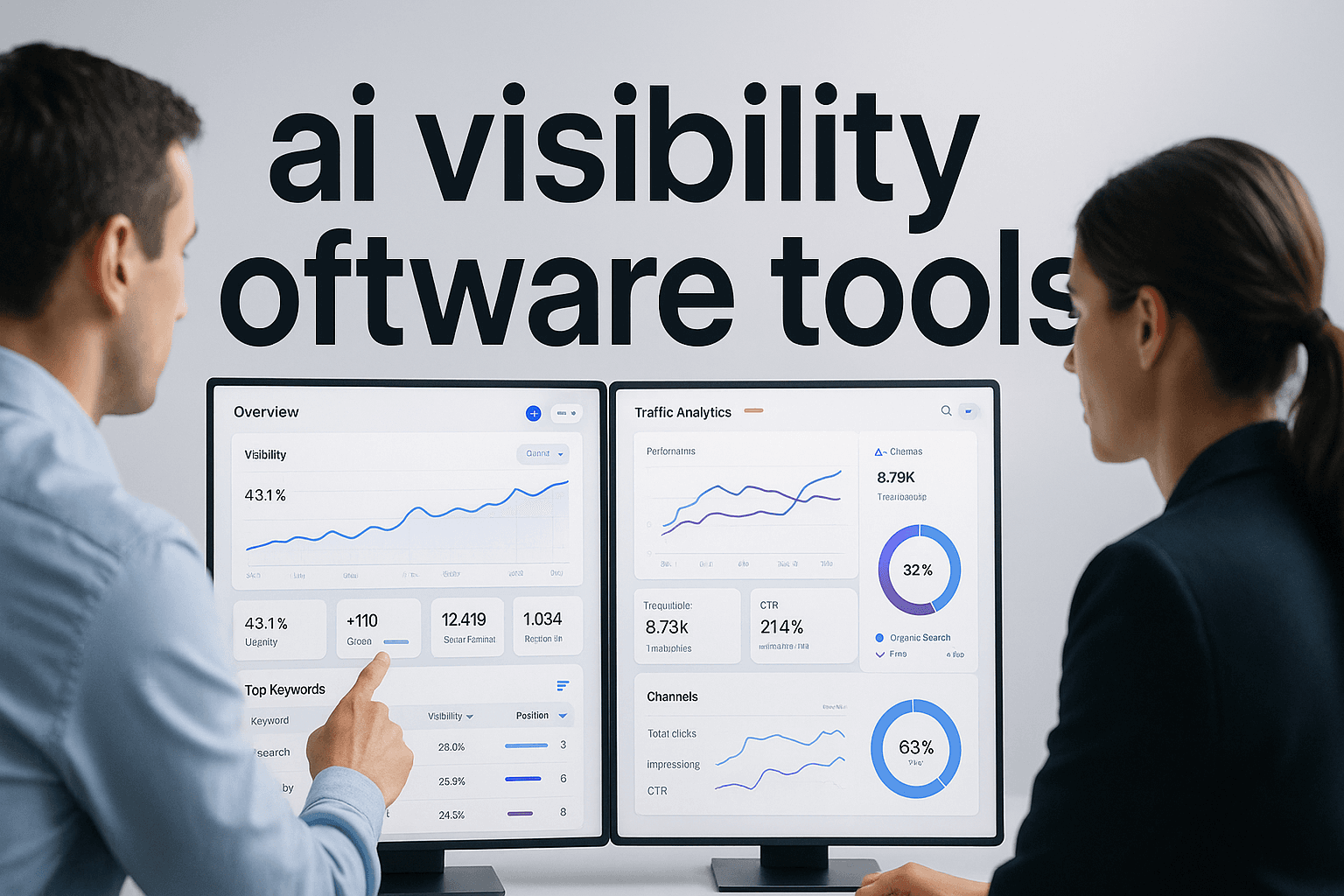
AI visibility software tools solve this problem by tracking, analyzing, and helping you optimize your presence across AI-powered search platforms. These specialized tools monitor citation frequency, analyze mention context, benchmark against competitors, and provide actionable recommendations for improving your AI search presence.
Here are eight leading platforms that help businesses dominate both traditional search engines and the expanding universe of AI-powered answer engines.
1. Sight AI
Best for: Real-time AI visibility tracking with comprehensive citation analysis across all major AI platforms
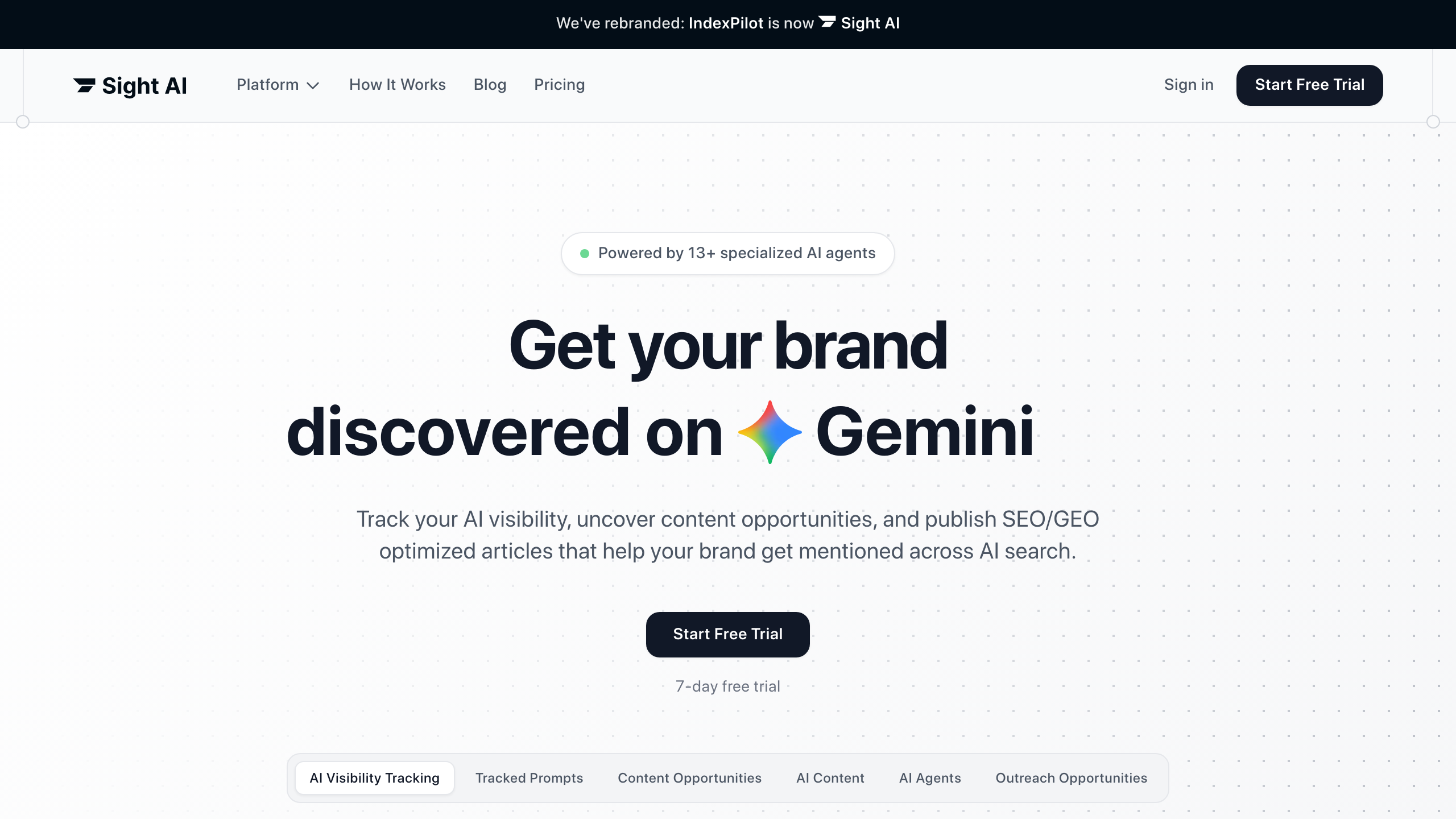
Sight AI is a specialized platform built specifically for monitoring and optimizing brand visibility across AI-powered search engines and large language models. Unlike traditional SEO tools that have added AI features as an afterthought, Sight AI was designed from the ground up to solve the unique challenges of AI search visibility.
Where This Tool Shines
Sight AI excels at providing granular visibility into how AI systems reference your brand across different contexts and query types. The platform tracks citations across ChatGPT, Claude, Perplexity, Gemini, and other emerging AI platforms, giving you a complete picture of your AI search presence rather than fragmentary data from individual sources.
What sets Sight AI apart is its citation context analysis. The platform doesn't just tell you that your brand was mentioned—it shows you the exact context, whether the mention was positive or neutral, what competitors appeared alongside your brand, and which specific queries triggered the citation. This contextual intelligence reveals patterns you can act on immediately.
For businesses taking AI visibility seriously, Sight AI provides the depth of data needed to make strategic decisions. You can identify which content assets generate the most AI citations, understand why certain pages perform better than others, and track improvement over time as you implement optimization strategies. The platform's alerting system notifies you when significant changes occur in your AI visibility, allowing you to respond quickly to both opportunities and potential issues.
Key Features & Capabilities
✅ Comprehensive AI Platform Monitoring: Track brand mentions and citations across all major AI search engines and chatbots in one unified dashboard.
✅ Citation Context Analysis: See the full context of how AI systems reference your brand, including sentiment, competitor mentions, and query patterns that trigger citations.
✅ Query-Level Tracking: Monitor specific questions and searches that generate brand mentions to understand which topics drive AI visibility.
✅ Competitive Benchmarking: Compare your AI visibility metrics against competitors to identify gaps and opportunities in your market.
✅ Content Performance Insights: Discover which pages and content types generate the most AI citations, informing your content optimization priorities.
✅ Real-Time Alerts: Receive notifications when significant changes occur in your AI visibility or when new citation patterns emerge.
✅ Optimization Recommendations: Get actionable suggestions for improving AI visibility based on analysis of high-performing content in your niche.
✅ Historical Tracking: Monitor trends over time to measure the impact of optimization efforts and identify seasonal patterns.
Best For / Ideal Users
Sight AI is ideal for businesses that view AI search as a strategic priority rather than an experimental channel. It works particularly well for B2B SaaS companies, professional services firms, and e-commerce brands where appearing in AI-generated recommendations directly impacts lead generation and revenue.
The platform suits marketing teams and SEO professionals who need detailed analytics to guide optimization decisions. If you're moving beyond basic awareness of AI search into active optimization, Sight AI provides the depth of data required to make informed strategic choices about where to invest resources.
Organizations with competitive markets will find the benchmarking features especially valuable. When your competitors are already optimizing for AI visibility, understanding exactly where you stand and what's working for others in your space becomes essential for maintaining competitive positioning.
Pricing
Professional plans designed for growing businesses with transparent pricing. Visit their website for current plan details and features. Free trial available to explore the platform's capabilities before committing.
2. PromptWatch
Best for: Development teams optimizing AI prompts and monitoring LLM application performance
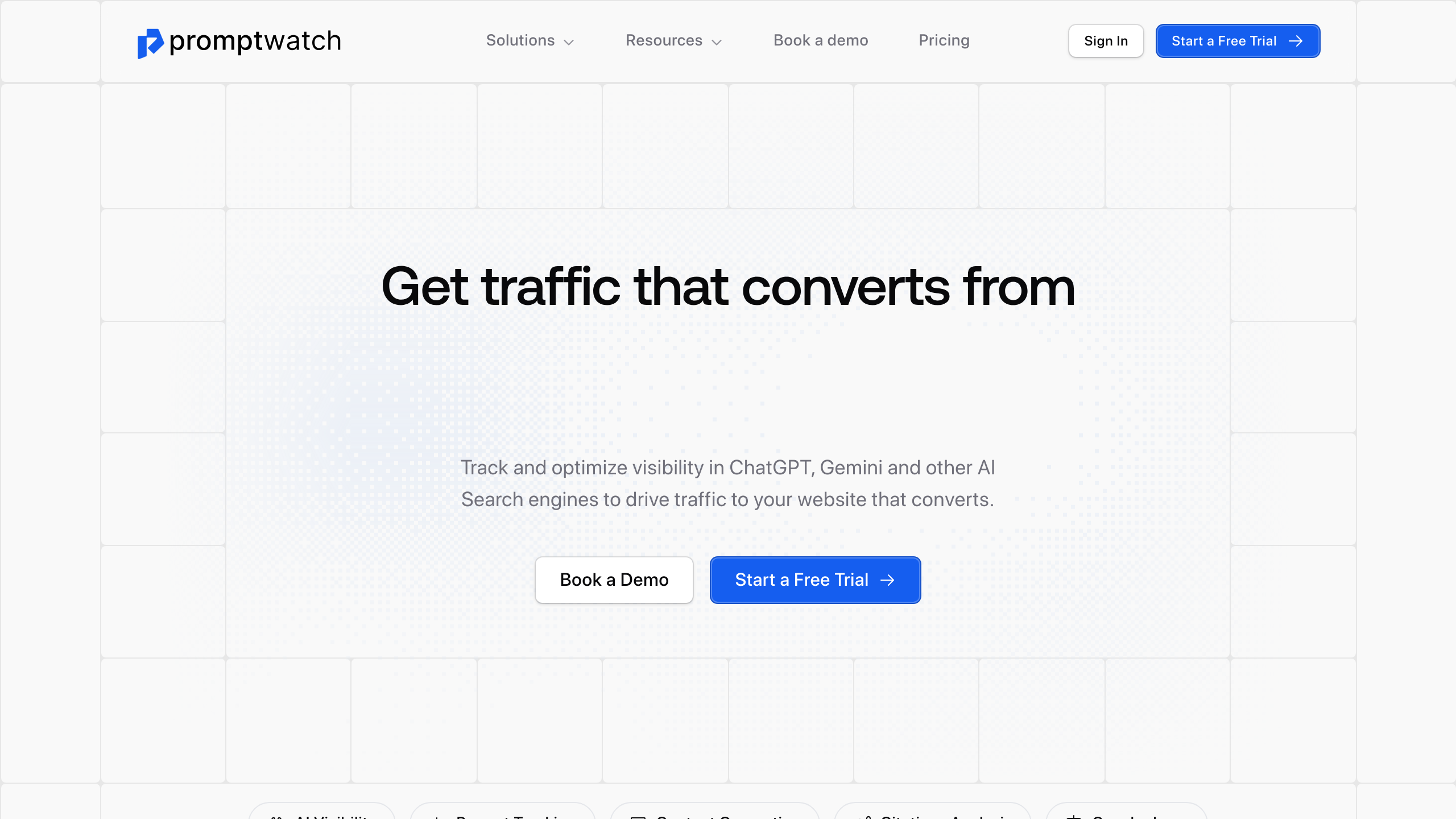
PromptWatch takes a different approach to AI visibility by focusing on the technical infrastructure behind AI interactions. Rather than simply tracking whether your brand appears in AI responses, PromptWatch helps development teams understand and optimize how their AI applications perform, making it particularly valuable for businesses building AI-powered features or integrations.
Where This Tool Shines
PromptWatch excels at providing technical visibility into AI system behavior that goes beyond surface-level citation tracking. The platform monitors prompt performance, tracks token usage, analyzes response quality, and identifies optimization opportunities in real-time. This technical depth makes it indispensable for companies that aren't just trying to appear in AI responses—they're actively building AI experiences for their users.
For businesses developing AI chatbots, recommendation engines, or other LLM-powered features, understanding prompt effectiveness becomes critical. PromptWatch reveals which prompts generate the most relevant responses, where inefficiencies waste tokens and budget, and how response quality varies across different AI models and configurations.
The platform's logging and debugging capabilities help development teams quickly identify issues when AI responses don't meet quality standards. Rather than manually testing countless prompt variations, you can systematically track performance metrics and optimize based on actual usage data. This approach transforms AI optimization from guesswork into data-driven iteration.
Key Features & Capabilities
✅ Prompt Performance Monitoring: Track how different prompts perform across various AI models, measuring response quality, latency, and token efficiency.
✅ Token Usage Analytics: Monitor API costs and identify optimization opportunities to reduce expenses while maintaining response quality.
✅ Response Quality Tracking: Evaluate AI outputs against quality metrics to ensure consistent user experiences.
✅ Model Comparison: Test prompts across different LLMs to identify which models deliver optimal performance for specific use cases.
✅ Real-Time Debugging: Access detailed logs of prompt-response pairs to quickly diagnose issues and refine configurations.
✅ Version Control for Prompts: Track changes to prompts over time and measure the impact of modifications on performance metrics.
✅ Team Collaboration Tools: Share insights and coordinate optimization efforts across development and product teams.
✅ Custom Analytics Dashboards: Build views that surface the specific metrics most relevant to your AI application's success criteria.
What Makes This Different
While most AI visibility tools focus on brand mentions and citations, PromptWatch addresses the technical performance of AI interactions. This makes it complementary rather than competitive with citation-tracking platforms—you might use PromptWatch alongside tools like Sight AI to cover both technical performance and brand visibility.
The platform's strength lies in helping teams understand the "why" behind AI behavior. When a prompt generates inconsistent results or fails to produce desired outcomes, PromptWatch's detailed logging reveals exactly what happened and points toward solutions. This level of technical insight proves invaluable when building production AI applications where reliability and consistency matter.
Best For / Ideal Users
PromptWatch is ideal for software development teams, AI engineers, and product managers building applications that integrate large language models. It works particularly well for SaaS companies adding AI features to existing products, startups building AI-native applications, and enterprises developing custom AI solutions for internal or customer-facing use cases.
The platform suits technical teams comfortable with API integration and performance metrics. If your organization is actively developing AI functionality rather than simply trying to appear in AI search results, PromptWatch provides the operational visibility needed to build reliable, cost-effective AI experiences.
Companies concerned about AI implementation costs will find the token usage analytics especially valuable for identifying inefficiencies that drive up API expenses without improving output quality.
Pricing
PromptWatch offers flexible pricing based on usage volume and team size. Visit their website for current plan details and features. Free tier available for small-scale testing and evaluation.
3. Semrush
Best for: Comprehensive digital marketing suite with emerging AI tracking capabilities
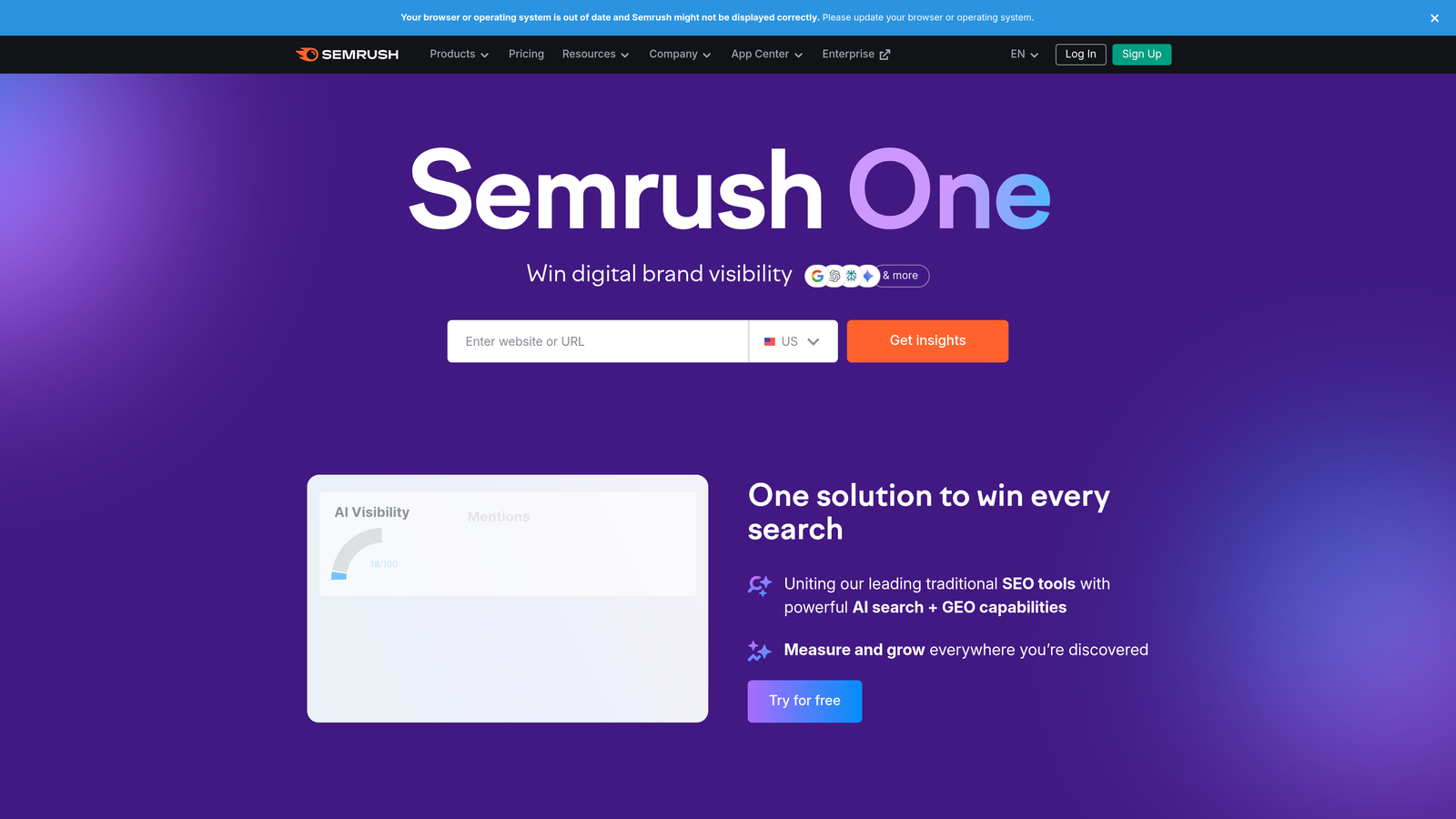
Semrush has begun integrating AI visibility features into its already extensive SEO and digital marketing platform, offering basic tracking alongside its robust traditional search capabilities.
Where This Tool Shines
For businesses already using Semrush for SEO, keyword research, and competitive analysis, the addition of basic AI visibility tracking provides value without requiring a separate tool. The platform's real strength is breadth—you get AI monitoring plus comprehensive SEO tools, content marketing features, social media management, and competitive intelligence in one place.
This makes it practical for small to mid-sized marketing teams who need multiple capabilities but can't manage numerous specialized tools. The learning curve is manageable since many marketers already know the Semrush interface, and the AI visibility features integrate naturally with existing workflows you're already using daily.
Key Features & Capabilities
✅ Basic AI Citation Tracking: Monitor brand mentions across major AI platforms like ChatGPT and Perplexity.
✅ Comprehensive Keyword Research: Tools that inform both traditional SEO and AI optimization strategies.
✅ Content Audit Features: Identify optimization opportunities across your existing content library.
✅ Backlink Analysis: Authority signals that support both traditional SEO rankings and AI visibility.
✅ Competitive Analysis: Track competitors across multiple digital marketing channels in one dashboard.
✅ Position Tracking: Monitor traditional search engine rankings alongside emerging AI visibility metrics.
Best For / Ideal Users
Semrush works well for small to mid-sized businesses and marketing agencies that need a general-purpose digital marketing platform with basic AI visibility monitoring. It's particularly valuable for teams already invested in the Semrush ecosystem who want to add AI tracking without learning an entirely new tool.
The platform suits marketing generalists who manage multiple channels rather than specialists focused exclusively on AI search optimization. If you need solid performance across many marketing functions with basic AI capabilities, Semrush delivers practical value.
Pricing
Plans start at $129.95/month for basic features. AI visibility tracking is available in higher-tier plans starting at $249.95/month. Annual subscriptions offer modest discounts compared to monthly billing.
4. Ahrefs
Best for: SEO-focused teams adding AI visibility monitoring to existing workflows
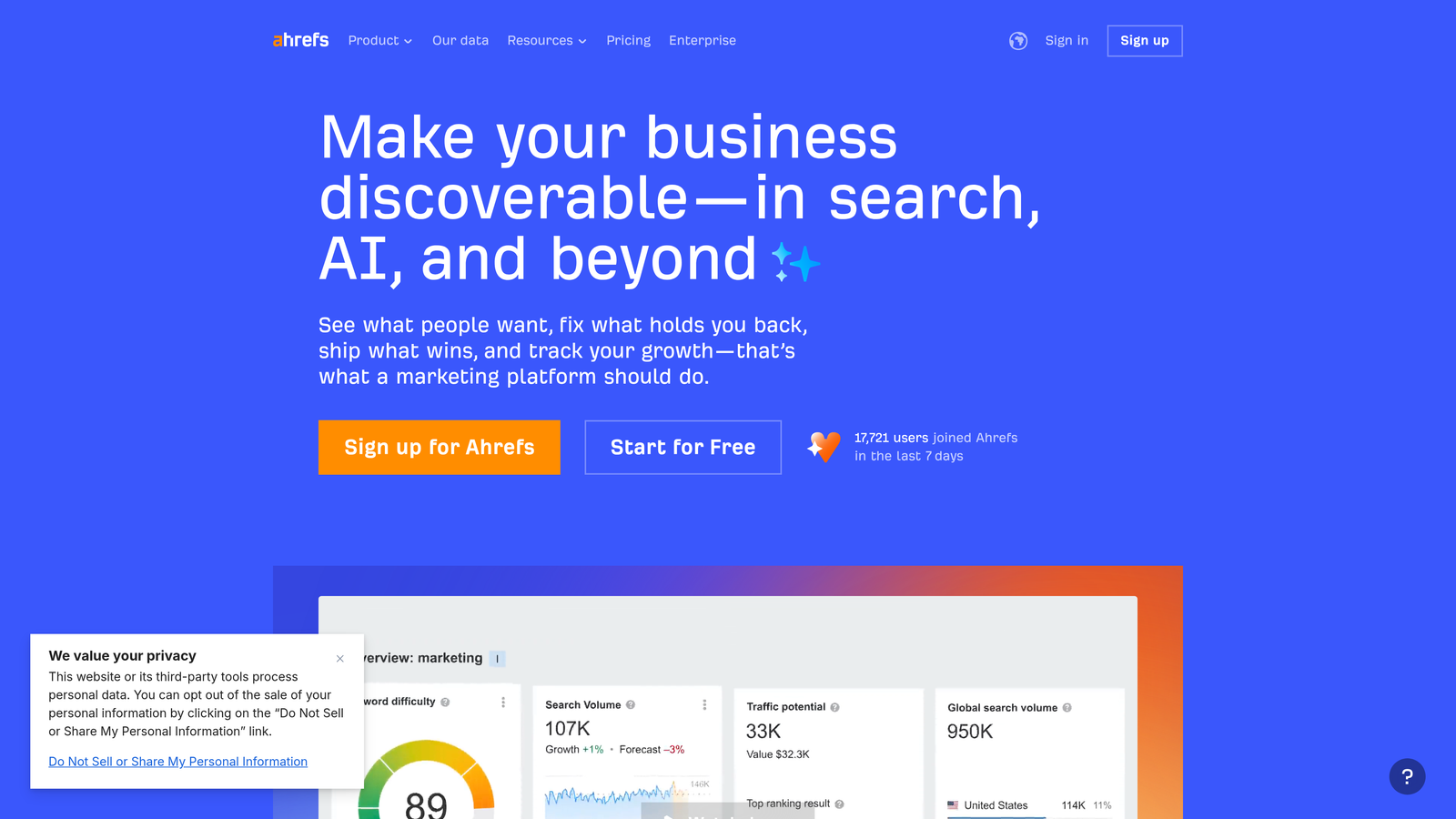
Ahrefs has introduced AI search monitoring features to complement its industry-leading backlink analysis and SEO tools, approaching AI visibility through the lens of content optimization and authority building.
Where This Tool Shines
Ahrefs excels at connecting the dots between traditional SEO authority signals and AI visibility. The platform operates on a compelling hypothesis: many factors that drive traditional search rankings—quality backlinks, comprehensive content, topical authority—also influence AI citations.
For teams with deep SEO expertise, this approach feels natural and leverages existing knowledge. You're not learning an entirely new discipline; you're extending optimization practices you already understand to a new channel. The content gap analysis features work particularly well for identifying topics where competitors have AI visibility that you lack, revealing specific opportunities to close the gap.
What makes Ahrefs especially valuable is how it helps identify which content assets perform well in both traditional search and AI responses. This dual-channel visibility reveals patterns you can replicate across your content library, maximizing the return on optimization efforts.
Key Features & Capabilities
✅ AI Citation Tracking: Monitor brand mentions across major AI platforms while viewing traditional SEO metrics in the same dashboard.
✅ Content Gap Analysis: Identify topics where competitors generate AI citations that you're missing, prioritizing optimization opportunities.
✅ Backlink Intelligence: Understand how authority signals from quality backlinks may influence both search rankings and AI mentions.
✅ Site Audit Features: Identify technical issues that could prevent AI systems from properly accessing or understanding your content.
✅ Keyword Research Tools: Discover query patterns optimized for both traditional search engines and AI platforms.
✅ Rank Tracking with AI Overlay: Monitor traditional search positions alongside AI visibility metrics to understand your complete search presence.
Best For / Ideal Users
Ahrefs is ideal for SEO professionals and content teams who want to extend their existing optimization practices to AI platforms. It works particularly well for businesses with strong SEO foundations—established backlink profiles, quality content libraries, and technical excellence—looking to expand into AI visibility without abandoning what's already working.
The platform suits mid-sized to enterprise organizations with dedicated SEO resources who understand concepts like domain authority, topical relevance, and link equity. If your team already speaks the language of SEO, Ahrefs provides a familiar framework for tackling AI visibility challenges.
Pricing
Plans start at $129/month for basic features, with AI visibility tracking available in higher-tier plans. Annual subscriptions offer discounts compared to monthly billing.
5. SparkToro
Best for: Audience research and influence tracking across AI platforms
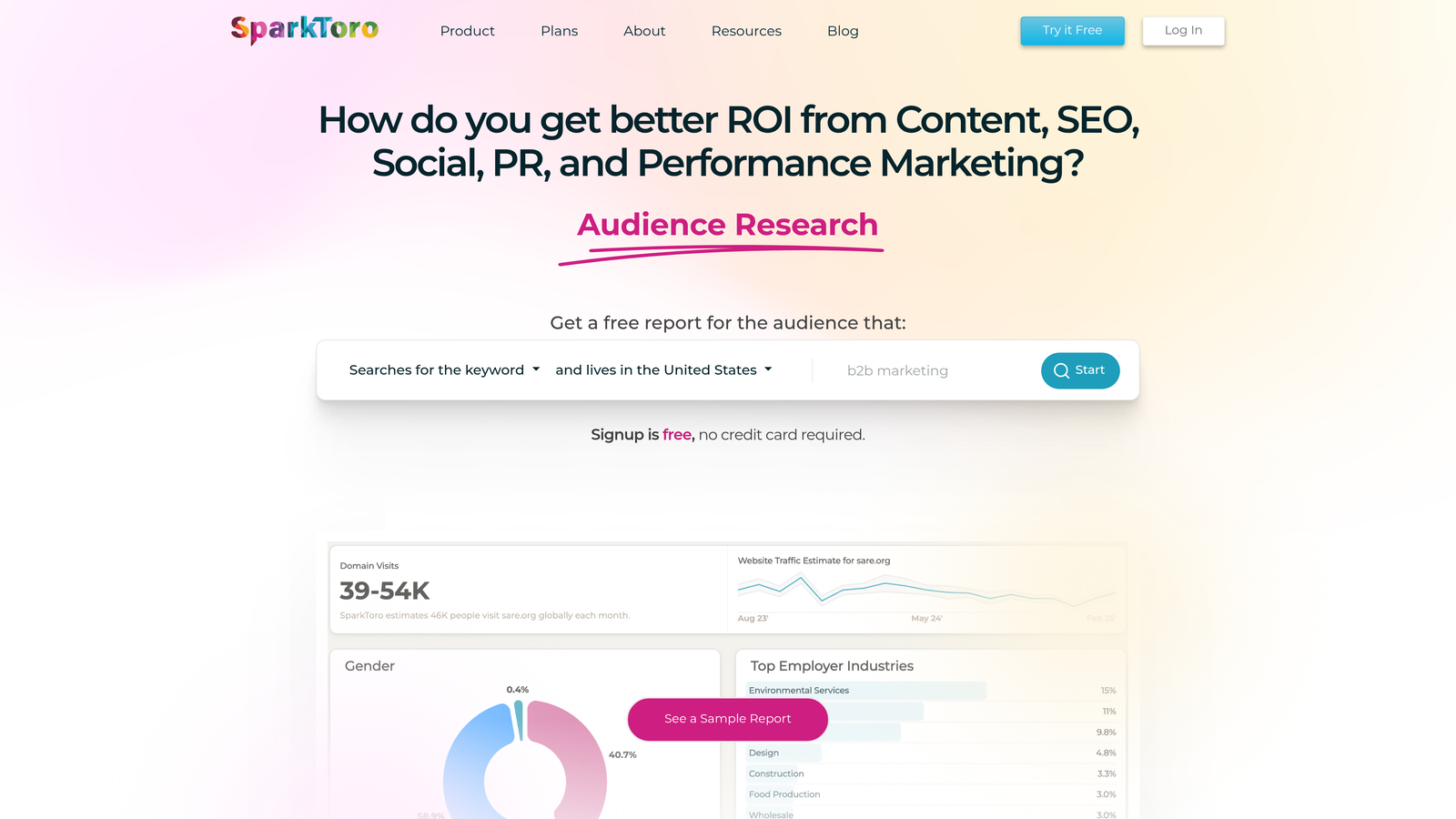
SparkToro focuses on understanding where your audience spends time online and which sources influence them—including AI platforms.
Where This Tool Shines
SparkToro takes a unique approach to AI visibility by starting with audience behavior rather than rankings or citations. The platform reveals which AI tools your target audience uses most frequently, what questions they're asking, and which sources those AI systems tend to cite. This intelligence helps prioritize optimization efforts on the AI platforms that matter most to your specific audience.
SparkToro's social listening capabilities also track conversations about AI search behavior, revealing how user expectations are evolving. For businesses trying to understand the strategic importance of AI visibility before investing heavily in optimization, SparkToro provides valuable context that prevents wasted effort on platforms your audience doesn't use.
Key Features & Capabilities
✅ Audience Intelligence: Shows which AI platforms your target users prefer and how frequently they use them for different query types.
✅ Source Authority Analysis: Reveals which websites AI systems cite most frequently in your niche, identifying potential partnership or citation opportunities.
✅ Social Listening: Tracks AI-related conversations and trends to understand how your audience discusses and uses AI search tools.
✅ Influencer Identification: Maps influence across both traditional and AI-powered platforms to understand who shapes opinions in your space.
✅ Content Consumption Patterns: Analyzes what types of content your audience engages with and how they discover information.
✅ Competitive Audience Overlap: Shows where your audience intersects with competitors' audiences across different platforms and channels.
Best For / Ideal Users
SparkToro works best for marketing strategists, content teams, and business leaders who need to understand audience behavior before committing to specific optimization tactics. It's particularly valuable for companies entering new markets or launching new products where understanding the competitive landscape and audience preferences is essential.
The platform also serves agencies managing multiple clients who need to quickly assess which AI platforms matter most for different industries or audience segments. Teams with limited resources benefit from SparkToro's ability to focus optimization efforts on high-impact channels rather than spreading thin across all platforms.
Pricing
Plans start at $50/month for basic features. Professional plans with full AI audience intelligence start at $225/month. Free tier available with limited searches.
6. Moz Pro
Best for: Traditional SEO teams exploring AI visibility with familiar tools
Moz Pro has added AI search monitoring features to its established SEO platform, allowing existing users to track AI visibility alongside traditional metrics they already monitor.
Where This Tool Shines
Moz Pro's approach to AI visibility emphasizes accessibility and education. The platform provides clear explanations of AI visibility metrics that help teams new to this space understand what they're measuring and why it matters.
Moz's domain authority metrics, while designed for traditional SEO, provide useful context for understanding which sites AI systems are likely to cite. The tool's site crawl features identify technical issues that might prevent AI systems from accessing or understanding your content. For teams with limited AI expertise, Moz's educational resources and straightforward interface reduce the learning curve significantly.
Key Features & Capabilities
✅ AI Citation Tracking: Monitor brand mentions across major AI platforms with clear metric definitions that explain what you're measuring.
✅ Domain Authority Analysis: Leverage established authority metrics that correlate with AI citation likelihood.
✅ Technical Site Crawl: Identify barriers preventing AI systems from accessing or understanding your content.
✅ Keyword Research Tools: Adapted specifically for AI query patterns and natural language searches.
✅ Link Building Features: Support both traditional SEO and AI authority development simultaneously.
✅ Unified Rank Tracking: Compare traditional search performance with AI visibility in one dashboard.
What Makes This Different
Moz Pro takes an educational approach that other platforms often skip. When you're looking at AI visibility metrics for the first time, the platform doesn't just show numbers—it explains what those numbers mean and why they matter for your business.
The integration with existing Moz features creates natural workflows. Your site crawl identifies technical issues affecting both traditional search and AI visibility. Your link building efforts support authority signals that matter for both channels. Your keyword research informs content that performs across multiple platforms.
This unified approach means you're not managing separate strategies for SEO and AI visibility. The same content improvements, technical fixes, and authority building efforts serve both objectives.
Best For / Ideal Users
Moz Pro is ideal for small to mid-sized businesses and marketing teams that prioritize ease of use and educational support. It works well for organizations taking their first steps into AI visibility monitoring without overwhelming them with complexity.
The platform particularly suits teams that value understanding over raw data volume. If your organization learns best through clear explanations and guided workflows rather than diving into advanced analytics, Moz Pro provides the right balance of capability and accessibility.
Pricing
Plans start at $99/month for basic features. AI visibility tracking is available in higher-tier plans starting at $179/month. Annual subscriptions offer discounts compared to monthly billing.
7. Conductor
Best for: Enterprise content operations optimizing for both search and AI platforms
Conductor is an enterprise-grade content intelligence platform that has evolved to address the dual challenge of traditional search optimization and emerging AI visibility requirements.
Where This Tool Shines
Conductor excels at managing AI visibility at scale for organizations with extensive content libraries. The platform's workflow tools help content teams systematically optimize existing assets for AI citations while maintaining quality standards across hundreds or thousands of pieces.
What sets Conductor apart is its content intelligence engine that identifies which topics and formats generate the most AI visibility. Rather than guessing what might work, you see actual patterns in your content performance across AI platforms. This data-driven approach enables strategic decisions about where to invest optimization resources for maximum impact.
The platform's integration capabilities allow AI visibility data to flow directly into existing content management systems. This means optimization becomes part of your standard editorial workflow rather than a separate process that teams must remember to execute. For enterprises producing substantial content volumes, this systematic approach prevents AI optimization from becoming overwhelming or falling through the cracks.
Key Features & Capabilities
✅ Enterprise-Scale Monitoring: Track AI citations across large content libraries with automated alerts for significant changes.
✅ Workflow Automation: Systematize content optimization with approval processes and team collaboration features built for distributed operations.
✅ Content Intelligence: Identify high-performing topics, formats, and optimization patterns that drive AI visibility in your specific industry.
✅ CMS Integration: Connect with major content management platforms and marketing technology stacks for seamless data flow.
✅ Team Collaboration: Manage complex editorial workflows with role-based permissions and approval processes designed for large content teams.
✅ Executive Reporting: Generate stakeholder-ready analytics that communicate AI visibility ROI in business terms leadership understands.
Best For / Ideal Users
Conductor is best suited for large enterprises and major publishers with substantial content operations. Organizations with dedicated content teams, complex approval workflows, and hundreds of content pieces will find the most value in Conductor's systematic approach to AI visibility management.
The platform works particularly well for companies that have already invested in content marketing and need to optimize existing assets for AI platforms without disrupting established editorial processes. If your organization produces content at scale and needs enterprise-grade workflow management, Conductor provides the infrastructure to make AI optimization sustainable.
Pricing
Enterprise pricing with custom quotes based on content volume and feature requirements. Typically requires annual commitment and includes implementation support and training for content teams.
8. Authoritas
Best for: International businesses tracking AI visibility across multiple markets and languages
Authoritas specializes in global SEO and has extended its capabilities to include AI visibility monitoring across different languages, regions, and AI platforms popular in specific markets.
Where This Tool Shines
Authoritas addresses a challenge many global businesses face: AI platforms show different results based on language, location, and regional preferences. A query about "best project management software" in English might generate completely different AI responses than the same query in German, Japanese, or Spanish. The tool tracks AI visibility across multiple markets simultaneously, revealing these geographic patterns in AI citations.
This becomes particularly valuable for international brands that need to understand whether their AI visibility is consistent globally or varies significantly by region. You might dominate AI mentions in North American markets but be virtually invisible in European or Asian AI responses. Authoritas also monitors region-specific AI platforms that might not be on the radar of businesses focused primarily on English-language markets—platforms that are hugely popular in specific countries but unknown elsewhere.
Key Features & Capabilities
✅ Multi-market AI visibility tracking: Monitor brand mentions across languages and regions simultaneously to identify geographic strengths and weaknesses.
✅ Region-specific AI platform monitoring: Track visibility on local AI tools popular in specific markets beyond major global platforms.
✅ Competitive analysis by geography: See how competitors perform in different markets to identify regional opportunities.
✅ International SEO integration: Combine traditional search metrics with AI visibility data for comprehensive global performance views.
✅ Localization insights: Understand how content performance and citation patterns vary across markets and languages.
✅ Multi-currency reporting: Generate reports in local currencies and languages for regional stakeholders and teams.
Best For / Ideal Users
Authoritas is ideal for multinational corporations, international e-commerce businesses, and global brands that need to manage AI visibility across multiple markets. It works particularly well for companies with regional marketing teams who need localized data and insights. Organizations expanding into new geographic markets will find the competitive intelligence especially valuable for understanding the AI visibility landscape before committing resources.
Pricing
Enterprise pricing based on number of markets monitored and feature requirements. Typically structured as annual contracts with quarterly business reviews and dedicated account management.
Putting It All Together
The right AI visibility tool depends on where you are in your journey. If AI search is a strategic priority and you need purpose-built monitoring with deep citation analytics, IndexPilot delivers the most focused capabilities—tracking exactly how AI systems reference your brand and providing specific optimization paths forward.
For teams already using comprehensive SEO platforms, Semrush and Ahrefs offer practical entry points with basic AI monitoring integrated into familiar workflows. Enterprise organizations managing large-scale content operations will find the workflow automation and team collaboration features in BrightEdge or Conductor worth the premium investment.
International businesses face unique challenges that require multi-market tracking—Authoritas addresses this directly. And if you're still determining whether AI visibility matters for your specific audience, SparkToro's intelligence reveals which AI platforms your users actually prefer before you commit resources to optimization.
The AI search landscape evolves rapidly. Choose a platform demonstrating active development and regular feature updates—tools that haven't adapted in recent months are already falling behind. More importantly, remember that software enables strategy but doesn't replace it. The best tool won't help if you haven't defined why AI visibility matters for your business and which actions you want users to take after encountering your brand in AI responses.
Start with strategy, then select the tool that aligns with your goals and resources. Many platforms offer trials or demos—test the interface, evaluate the insights provided, and confirm the data actually informs decisions you'll make. For businesses ready to take AI visibility seriously with comprehensive tracking and optimization, starting your free trial today provides immediate visibility into where you stand and clear direction on how to improve.
Frequently asked questions
What is AI visibility?
AI visibility is how often and how favorably AI systems mention your brand when people ask buying or research questions. The best AI visibility products measure prompt coverage, citation share, and sentiment across ChatGPT, Claude, Perplexity, Gemini, and similar answer engines.
What are the best AI search visibility tools?
Leading AI visibility optimization tools combine prompt tracking, competitor share-of-answer, source citation analysis, and content recommendations. The strongest AI search visibility tracking tools also connect those gaps to publishable content opportunities — not just vanity mention charts.
How is AI brand visibility tracking different from SEO rank tracking?
SEO rank tracking measures Google positions. AI brand visibility tracking tools measure whether LLMs recommend you. You can rank #1 on Google and still be invisible in ChatGPT. Teams serious about AI search need both AI visibility analytics and classic SEO monitoring.
Which platform excels in AI visibility metrics?
Look for accurate AI visibility metrics software that samples real prompts, shows trend lines, and ties mentions back to content you can improve. Platforms that only scrape one model or report vanity scores without opportunities rarely move the needle.