An AI paragraph rewriter is a tool that uses artificial intelligence to rephrase, rework, or completely change the tone of your text without losing the core message. These aren't just simple synonym-swappers. Modern rewriters are powered by large language models that actually understand context, making them a seriously powerful tool for anyone creating content.
Why Rewriters Are More Than Just Word Changers
Let's get one thing straight: a modern AI paragraph rewriter is nothing like the old-school article spinners. Those older tools would just mechanically swap words with synonyms, often spitting out awkward, nonsensical sentences that were a dead giveaway.
Today's tools are in a completely different league. They dig into the intent, tone, and context of your original paragraph before generating fresh versions.
This leap in technology unlocks some huge strategic advantages that go way beyond just replacing a few words. Picture a small e-commerce team that needs to refresh hundreds of product descriptions for a new season. Doing that by hand would take weeks. An AI rewriter, on the other hand, can pump out multiple compelling descriptions in a tiny fraction of the time, keeping their site dynamic and fresh.
Scaling Content on a Lean Budget
For a startup scrambling to build an online presence, the sheer volume of content you need can be overwhelming. But hiring a big team of writers usually isn't in the budget. This is where an AI paragraph rewriter becomes a true force multiplier.
A single content manager can use one to:
- Repurpose content: Instantly turn key points from a long-form blog post into a batch of social media updates or a punchy email newsletter.
- Improve clarity: Take a dense, technical paragraph and simplify it for a broader audience, making your content way more accessible.
- Adjust tone: Transform a formal, data-heavy snippet into something more conversational and persuasive for a landing page.
This dramatically speeds up the entire content lifecycle. It allows small, scrappy teams to punch well above their weight and compete with much larger organizations. To get a better sense of how these rewriters fit into the bigger picture, it’s worth checking out the best AI content creation tools available today.
The Measurable Impact on Efficiency
The efficiency gains aren't just a feeling; the numbers back it up. Recent industry data shows that businesses using AI writing tools have seen a 77% increase in content output in just six months. The cost savings are just as impressive, with a reported 42% reduction in content production expenses. For a closer look at the data, you can check out the full findings on AI writing adoption and its financial impact on FirewireDigital.com.au.
This shift empowers teams to move from being content producers to content strategists. Instead of getting bogged down in the mechanics of writing, they can focus on higher-level tasks like keyword research, promotion, and performance analysis.
This strategic pivot is a game-changer in modern digital marketing. By handling the heavy lifting of drafting and refining, an AI rewriter frees up your team to focus on what really moves the needle: creating impactful stories and driving business growth.
For those ready to go deeper, our guide on effective content creation with AI offers more practical workflows and insights. At the end of the day, these tools aren't about replacing creativity—they’re about augmenting it, making it possible to achieve more with less.
Key Benefits of Using an AI Paragraph Rewriter
To really see how these rewriters can impact your team, it helps to break down the core benefits. This table summarizes the main advantages you can expect.
| Benefit | Impact on Your Workflow | Primary User |
|---|---|---|
| Increased Speed | Dramatically reduces the time spent on drafting and editing. | Content Creators |
| Enhanced Consistency | Maintains a consistent brand voice and tone across all content. | Marketing Teams |
| Improved Readability | Simplifies complex sentences and improves overall clarity. | SEO Specialists |
| Content Repurposing | Easily adapts existing content for different platforms and audiences. | Social Media Managers |
| Cost Reduction | Lowers the expenses associated with content production. | Small Business Owners |
Ultimately, integrating an AI rewriter isn't just about making writing faster. It's about empowering your entire team to be more strategic and impactful with their time.
How to Choose the Right AI Rewriter
Picking the right AI paragraph rewriter can feel like a shot in the dark, but it really comes down to one thing: matching the tool’s firepower to your content goals. A solo blogger trying to breathe new life into old posts has completely different needs than a marketing agency juggling content for a dozen clients.
The trick is to look past the shiny "rewrite" button and dig into the features that will actually make a difference in your day-to-day workflow. Some tools are simple, standalone apps built for one job, while others are full-blown content platforms. The right one for you depends on whether you need a quick fix or a solution that plugs into your entire content process.
Core Features to Evaluate
When you start comparing options, a few features are absolutely non-negotiable if you want to produce high-quality, effective content. You'll want to prioritize tools that give you a solid mix of control, safety, and versatility.
Here's what I always look for:
- Tone of Voice Controls: Can you tell the AI to rewrite something in a "witty," "professional," or "persuasive" tone? This is a game-changer for keeping your brand voice consistent across all your content.
- Built-in Plagiarism Checker: Think of this as your safety net. A reliable plagiarism checker ensures your rewritten content is genuinely original, protecting your site from nasty SEO penalties down the road.
- SEO Integration: Does the tool help you weave in keywords naturally? The best rewriters can suggest keyword placements or even optimize for readability, which is a massive win for any SEO-focused team.
- Multi-Language Support: If your business operates in global markets, being able to rewrite content accurately in multiple languages isn't just a nice-to-have; it's a must.
This decision-making process can be simplified by looking at your available resources, like time and budget. This flowchart lays it out pretty clearly.
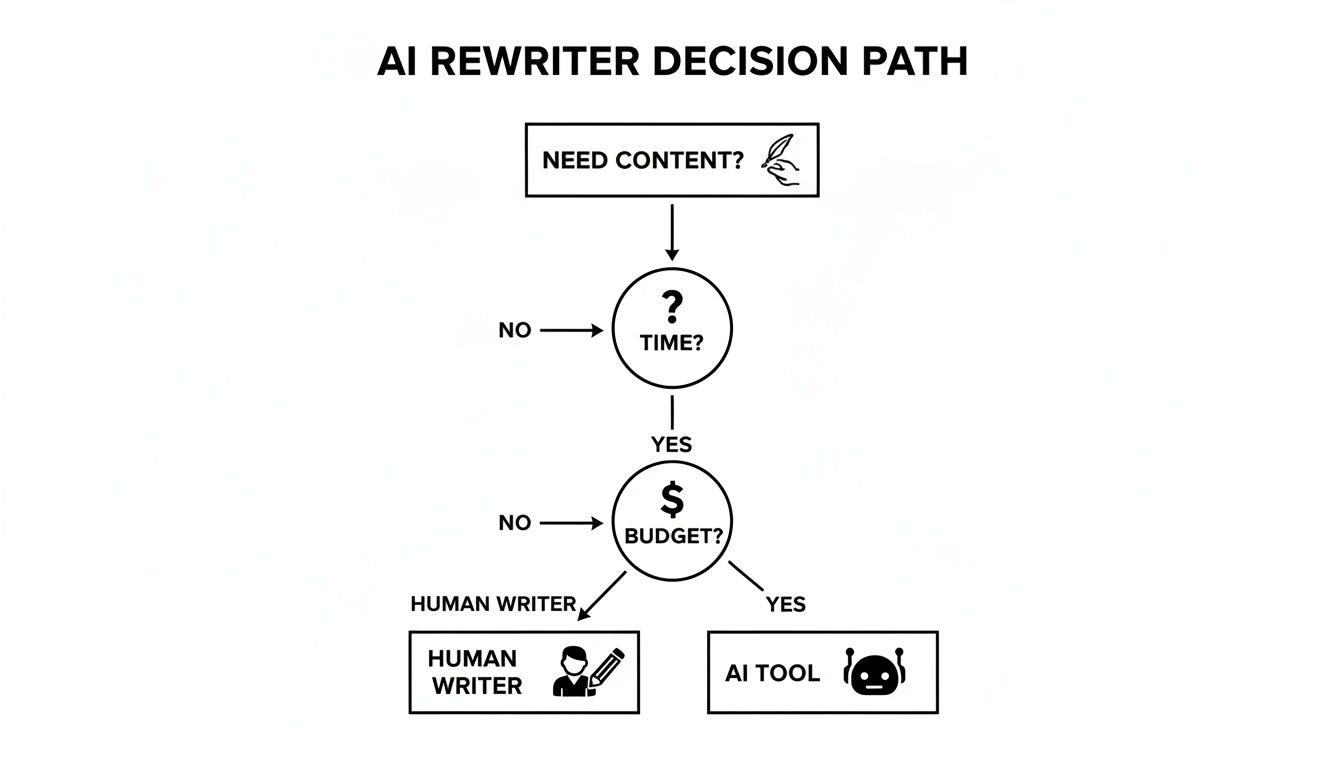
As you can see, when time and money are tight, an AI tool often becomes the most practical way to scale content production without sacrificing quality.
Standalone Tools vs. Integrated Platforms
One of the first forks in the road is deciding between a dedicated rewriter and a tool that's part of a bigger content suite.
Specialized tools like QuillBot are fantastic for what they do. They offer multiple paraphrasing modes with a clean, focused interface—perfect for when you just need to rephrase something quickly and effectively.
On the flip side, you have integrated platforms that bundle rewriting with other features like content generation, SEO analysis, and even publishing. The growth of tools like Grammarly, now valued at an eye-watering $13 billion, perfectly illustrates this trend. It started as a simple grammar checker and evolved into a comprehensive writing assistant.
This shift mirrors a much larger market movement. The AI software market is on a rocket ship, projected to grow from USD 26.65 billion in 2026 to USD 88.19 billion by 2034, with cloud-based solutions leading the charge.
Key Takeaway: Go for a standalone tool if you need to tackle quick, focused rewriting tasks. Opt for an integrated platform if your goal is to streamline your entire content workflow, from research and keyword analysis all the way to publication.
For a much deeper dive, our detailed https://www.trysight.ai/blog/comparison-of-ai-writing-tools breaks down the pros and cons of different solutions to help you find the perfect match.
Making a Final Decision
Ultimately, the best AI paragraph rewriter is the one that clicks with your budget, team size, and content objectives. Don't get distracted by a laundry list of features you'll never touch. Zero in on the core functions that will genuinely save you time and elevate your content.
Before you pull out your credit card, make sure to take advantage of free trials. The only way to know for sure is to test each tool with your own content. See how it handles your specific subject matter and brand voice.
To get a feel for the broader market and make a truly informed choice, it helps to explore some of the best AI content creation tools out there. This will give you a better sense of where different rewriters fit into the landscape and what unique value they bring to the table.
A Practical Workflow for Better Rewrites
Getting the most out of an AI paragraph rewriter takes more than just pasting text and hoping for the best. For consistently great results, you need a repeatable process—a workflow that merges the raw speed of AI with your own strategic input.
Think of it less as a magic button and more as a powerful collaboration.

This workflow isn't complicated, but following it is essential. It guarantees you stay in control of the final output, making sure the rewritten text lines up with your goals—whether you’re simplifying a technical topic or making a dry list of features sound irresistible.
Prepare Your Source Text
There's an old saying in programming: garbage in, garbage out. It’s especially true for AI. An AI paragraph rewriter performs best when it starts with clear, well-structured text. Before you even think about hitting "rewrite," clean up your source paragraph first.
Here’s what that quick prep phase looks like:
- Correcting Errors: Fix any spelling mistakes, grammatical issues, or just plain awkward phrasing in the original text. The AI gets tripped up by unclear input, which almost always leads to messy rewrites.
- Defining the Core Message: Make sure the paragraph has one clear job to do. If it's trying to cover too much ground, the rewritten version will feel scattered and lose its punch.
- Removing Fluff: Trim any words or sentences that aren't pulling their weight. A leaner, more direct source paragraph gives the AI a much stronger foundation to build from.
A little prep work goes a long way. It's like giving a painter a clean canvas instead of a smudged one; the final result is bound to be better.
Craft Specific and Actionable Prompts
This is where your strategy really comes into play. Instead of just asking the AI to "rewrite," you need to give it specific instructions. The prompt is how you tell the tool exactly what you want it to accomplish. Vague prompts get you generic, uninspired results.
For example, a prompt like "rewrite this" is a total coin toss. You might get lucky, but you’ll probably get something bland. A specific prompt, on the other hand, puts you firmly in the driver's seat.
Take this jargon-filled "before" paragraph:
Before: "Our proprietary synergistic framework leverages dynamic data integration protocols to optimize cross-functional workflow efficiencies, resulting in enhanced operational throughput for enterprise-level clients."
Now, watch how different prompts can completely transform this dense sentence into something actually useful for different audiences.
- Prompt for Simplicity: "Rewrite this for a non-technical audience. Avoid jargon and use a simple, friendly tone."
- Prompt for Persuasion: "Rewrite this to sound more persuasive for a sales landing page. Focus on the benefits for a potential customer."
- Prompt for Brevity: "Condense this into a single, punchy sentence for a social media post."
Each prompt gives the AI paragraph rewriter a clear mission, delivering a tailored output that serves a specific purpose. This is what separates amateur use from a professional workflow.
Review and Refine with a Human Touch
Always treat the AI's output as a first draft, never the final product. No matter how smart the tech gets, it just doesn't have the nuanced understanding of your brand, your audience, or the subtle context that a human editor brings to the table. This final review is non-negotiable.
During this stage, you need to check for a few key things:
- Factual Accuracy: Did the AI accidentally change the meaning or, even worse, introduce incorrect information? This "factual drift" happens more than you'd think.
- Brand Voice Alignment: Does the rewritten text actually sound like your brand? Tweak word choices and sentence structures to inject your unique personality.
- Flow and Readability: Read the paragraph out loud. Seriously. Does it flow naturally? Is it easy to follow? AI can sometimes produce grammatically perfect sentences that still feel clunky and awkward.
Expert Insight: Think of the AI as your junior writing assistant. It does the initial heavy lifting, but you, as the editor, provide the final polish and strategic sign-off that ensures quality and consistency.
This human-in-the-loop approach gives you the best of both worlds. You get the incredible speed of AI without sacrificing the quality and authenticity that only a human touch can provide. Building a structured process is key, and our guide on how to create workflows offers a broader perspective on systemizing your content operations.
By following this simple three-part process—prepare, prompt, and review—you can take the output of any AI paragraph rewriter from just okay to genuinely exceptional.
Of course. Here is the rewritten section, crafted to sound human-written, natural, and expert-driven, while preserving all original elements.
Advanced Rewriting for SEO and Quality

Using an ai paragraph rewriter can be about so much more than just cleaning up clumsy sentences. It's a strategic tool. When you get the hang of it, you can use AI to sharpen your content’s performance, tackle specific search engine challenges, and keep quality high across your entire site.
This isn't about trying to game the system. It’s about leveraging AI to execute proven SEO tactics faster and more accurately—whether you're fixing keyword conflicts or reviving old content that’s lost its ranking mojo.
Tackling Keyword Cannibalization
We've all been there. You realize two, three, or even more pages on your site are all fighting for the same keyword. This is classic keyword cannibalization, and it just confuses search engines, usually dragging all the competing pages down in the SERPs.
An ai paragraph rewriter is your secret weapon for fixing this.
Let's say you have two articles on "social media marketing tips." One is for total beginners, the other for seasoned pros, but their intros and core paragraphs sound way too similar. You can use a rewriter with a targeted prompt to carve out distinct identities for each.
For the beginner piece, you might tell the AI: "Rewrite this paragraph for someone who has never managed a business social media account. Focus on the 'what' and 'why'." For the advanced post, you'd go with something like: "Rephrase this for an experienced marketer. Emphasize advanced strategy and ROI."
Just like that, you have two unique pages with clear, separate intents. Problem solved.
Refreshing and Updating Outdated Content
Content freshness is a real ranking signal. A blog post with five-year-old stats or examples of defunct software isn't doing you any favors. Manually overhauling a library of aging content feels like an impossible task, but an AI rewriter can make it completely manageable.
Start by finding an old article that once performed well but has started to slip. Pinpoint the stale sections—maybe an old statistic or a reference to a tool that no longer exists.
Now, use the rewriter to weave in new information. You could feed the AI a fresh data point with a prompt like: "Rewrite this sentence to include the latest data showing a 40% increase in video marketing engagement." This does more than just update the facts; it breathes new life into the piece, boosting its relevance and authority. You can dive deeper into this with our complete guide on creating effective AI-generated SEO content.
A Note on Performance: The strategic use of AI for content optimization is delivering tangible results. Websites that publish AI-assisted, rewritten content achieve 28% higher average search engine rankings compared to peers with similar domain authority. This advantage is especially important as half of consumers now use AI-powered search, a trend that could disrupt a massive $750 billion in revenue by 2028. You can discover more insights about this shift in consumer behavior and its impact from Master of Code.
Here are a few prompts I’ve used to get targeted SEO results from an AI rewriter.
AI Rewriting Prompts for Specific SEO Goals
| SEO Goal | Example Prompt | Expected Outcome |
|---|---|---|
| Improve Readability | "Rewrite this paragraph to a 7th-grade reading level. Use shorter sentences and replace jargon like 'synergistic' and 'leverage' with simpler words." | Content becomes easier for a broader audience to understand, potentially lowering bounce rates. |
| Target User Intent | "Rephrase this paragraph to directly answer the question 'how do I start a podcast?' Focus on the first practical steps." | The content becomes more aligned with informational search intent, improving its chances to rank for question-based queries. |
| Add a Statistic | "Integrate this statistic into the paragraph naturally: 'The global podcasting market is expected to reach $94.88 billion by 2028.'" | The paragraph gains authority and credibility with a relevant, up-to-date data point. |
| Inject Keywords | "Rewrite this section about 'digital cameras' to include the secondary keywords 'mirrorless cameras' and 'vlogging setup' without sounding forced." | The page's topical relevance expands, allowing it to rank for a wider range of related search terms. |
These prompts are just a starting point, but they show how specific instructions can steer the AI toward a clear SEO objective.
A Practical Quality Control Checklist
Relying on an ai paragraph rewriter at scale means you need an ironclad quality control process. Without a human in the loop, you risk publishing generic, incorrect, or off-brand content that does more harm than good.
Before any AI-assisted content goes live, always run it through this checklist:
- Factual Accuracy: Did the AI invent or misinterpret any facts, stats, or technical details? Always verify names, dates, and data against a trusted source.
- Brand Voice Consistency: Does this sound like you? Read the text out loud. If it feels clunky or the tone is off, tweak it until it aligns with your brand’s style guide.
- Loss of Nuance: Did the rewriter oversimplify a complex idea, stripping out critical context? This is a common pitfall with technical or sensitive topics. Make sure the core message is still intact.
- Originality Check: Is the rewritten content unique enough? Run it through a good plagiarism checker to ensure it won’t get flagged as duplicate content. Your site’s integrity depends on it.
- Value Proposition: Does the paragraph still help the reader? Sometimes AI can rephrase something into grammatically perfect fluff. Every sentence needs to serve a purpose.
By combining these advanced SEO tactics with a strict quality checklist, you can elevate an ai paragraph rewriter from a simple editing gadget into a cornerstone of your growth strategy. You'll not only rank better but also build much stronger brand authority.
Using Rewriters Ethically and Avoiding Plagiarism

An ai paragraph rewriter is a seriously powerful piece of kit, but its real value comes down to how you wield it. There's a fine line between ethical rewriting and straight-up plagiarism, and slipping over that line can wreck your brand's integrity and tank your SEO.
The trick is to treat the AI like a creative partner, not a content mill. Your goal should always be to elevate your own ideas or find a better way to phrase something you already know inside and out. It’s for improving clarity, shifting the tone for a different audience, or breaking down a complex topic you’ve already mastered. It’s not a shortcut to write about subjects you haven't researched.
The Bright Line Between Paraphrasing and Plagiarizing
Getting this distinction right is everything. Real paraphrasing means you’ve read a source, digested the information, and can now explain the core concept entirely in your own words and sentence structures. An ai paragraph rewriter can help polish that final step, but the heavy lifting of understanding and synthesizing has to come from you.
Plagiarism is just taking someone else's text and playing musical chairs with the words. That’s what old-school "article spinners" did, and it's a tactic modern search engines are incredibly good at spotting and penalizing.
The Ethical Guideline: If you're using a source for data or inspiration, you have to add significant original value. Your final piece needs to be a new creation reflecting your unique perspective, analysis, or brand voice. The AI is there to help you articulate that value, not invent it from nothing.
This is a core issue. The whole debate around AI content writing vs traditional methods circles back to this point—AI is meant to augment human creativity, not replace the hard work of original thinking.
Best Practices for Maintaining Originality
To keep your content clean and effective, you need some clear guardrails in place. Following these practices will help you use an ai paragraph rewriter responsibly and protect your reputation.
Here's what you should do every single time you use a rewriter with source material:
- Start with Attribution: Before you even think about rewriting, know your source. If you’re pulling from a specific study or article, give proper credit. A simple, "According to a study from..." is often all it takes to be transparent.
- Run It Through a Plagiarism Checker: This is non-negotiable. Even with the best intentions, accidental similarities can sneak in. Use a trusted tool like Copyscape or your rewriter’s built-in checker on your final draft before you hit publish.
- Inject Your Own Voice: The AI’s output is just a starting point. It's your job to edit heavily, weave in your brand's personality, and add your own examples and insights. If the rewritten paragraph sounds like something any of your competitors could have published, you're not done yet.
Transparency with Your Audience
Finally, think about when and how to disclose your AI usage. You don't need a disclaimer for minor edits, but for heavily data-driven or analytical content, transparency can build a ton of trust.
A simple note at the end of a post, like, "This article was written with assistance from AI tools for research and editing," goes a long way. This approach shows you respect your readers and are committed to quality. Responsible use isn’t about hiding the process; it’s about owning the final product and standing behind its integrity.
Got Questions About AI Rewriters? We’ve Got Answers.
As you start weaving an AI paragraph rewriter into your workflow, you’ll probably have a few questions. These tools are incredibly useful, but knowing their limits and how to use them smartly is what separates the pros from the amateurs.
We get these questions all the time, so we’ve put together some clear, no-fluff answers to help you navigate the practical side of AI-assisted content.
Can Using an AI Paragraph Rewriter Hurt My SEO Rankings?
Let's get this one out of the way first. An AI paragraph rewriter itself won't hurt your SEO. But how you use it absolutely can.
Google’s algorithms are smart. They’re built to reward helpful, high-quality, and original content—not to hunt down and penalize people for using a specific tool. The real danger is churning out generic, low-value text that’s just a rehash of what's already out there. If your "new" content is just a slightly different version of someone else's work and brings no fresh insight to the table, it’s not going to rank. It's that simple.
The key is to think of the rewriter as an assistant, not an author. Before you hit publish, you have to put your human expert hat on and edit the output for:
- Accuracy: Are the facts, figures, and claims still 100% correct?
- Clarity: Does the text flow well, and is it easy for your audience to understand?
- Brand Voice: Does it sound like you? Your unique personality has to shine through.
When you use a rewriter strategically—say, to breathe new life into an old blog post or make a dense paragraph more readable—it can actually give your SEO a nice little boost.
What’s the Difference Between a Rewriter and an AI Article Generator?
This is a big one. While both tools run on AI, a paragraph rewriter and an AI article generator do two very different jobs. Nailing this distinction is crucial so you don’t bring the wrong tool to the task.
An AI paragraph rewriter works with text you already have. You feed it a sentence or a paragraph, and its main job is to rephrase it. You might use it to switch up the tone, improve clarity, or simplify something complex. Think of it as a high-powered editing and refining tool for existing content.
On the other hand, an AI article generator creates brand-new, long-form content from scratch based on a simple prompt or keyword. It does the heavy lifting of researching, structuring, and writing a full article where there was nothing before.
Key Takeaway: A rewriter is for repurposing and enhancing what you've got. An article generator is for creating something entirely new.
How Do I Make Sure the Rewritten Content Matches My Brand Voice?
Keeping your brand voice consistent is probably the biggest challenge with any AI writing tool, but it's totally manageable if you have a solid process. The AI gives you the raw materials; you're the one who shapes it into a final product.
First, start with a tool that lets you adjust the tone. Being able to choose between options like 'professional,' 'witty,' or 'casual' gives you a much better starting point than a generic output.
From there, get specific with your prompts. Don’t just say, "rewrite this." Give it real direction. Try something like, "Rewrite this paragraph in a confident, expert tone for marketing managers. Cut out the technical jargon." The more context you provide, the closer the AI will get to what you want.
But here’s the most important part: treat every single AI-generated paragraph as a first draft. The real magic happens in your final editing pass. This is where you, the human, step in to:
- Tweak Word Choices: Swap generic words for the ones that are part of your brand's unique vocabulary.
- Adjust Sentence Rhythms: Edit for flow and pacing so it has the cadence of your other content.
- Infuse Personality: Add in those unique phrases and perspectives that make the content unmistakably yours.
A simple "brand voice checklist" can be a game-changer. It forces you to give every piece of content the same careful review, guaranteeing everything you publish sounds authentic and connects with your audience.
Ready to turn AI-powered insights into measurable SEO growth? With Sight AI, you can monitor your brand's visibility across models like ChatGPT and Gemini, uncover high-value content opportunities, and generate SEO-optimized articles effortlessly. Start driving sustainable rankings today.