Using AI for blog writing has gone from a niche trick to a core part of how modern content teams operate. The secret isn't to replace your writers. It's to treat AI as a powerful assistant that can slash the time spent on research, outlining, and rough drafting. This frees up your human talent to focus on what really matters: strategy, expert insights, and nailing your brand's voice.
Building Your AI Content Strategy Foundation

Before you generate a single word, you need a plan. A solid strategy is what separates successful AI-powered blogs from all the generic content floating around the web. This groundwork ensures every article you publish has a purpose, moving beyond a simple list of keywords to get at the heart of what searchers really want.
It’s all about creating content that answers the right questions for the right people.
This strategic, human-led approach is exactly how the pros are using these tools. Adoption among bloggers has exploded, jumping from around 65% in 2023 to nearly 80% by early 2025. But almost no one is just hitting "generate" and publishing. Only about 6% let AI produce entire drafts without a human stepping in.
Instead, they’re using it for the heavy lifting: 54% for idea generation, 41% for headline help, and 40% for outlining. This keeps people firmly in control of the final product. You can see more details on these trends in the latest blogging statistics research from Orbit Media.
Defining Your Core Objectives
First things first: what's the point of your blog? Without a clear goal, your AI-generated content will just be noise. Are you trying to pull in organic traffic, capture leads, position yourself as a thought leader, or directly support product sales?
Each of those goals demands a different kind of content:
- Driving Traffic: Your focus should be on informational keywords and top-of-funnel topics that answer common questions.
- Generating Leads: This is where you create content around bottom-of-funnel keywords, like case studies, product comparisons, or in-depth "how-to" guides.
- Building Authority: Think bigger. Develop deep-dive pillar pages and expert interviews that prove you know your stuff.
By setting these goals upfront, you can write specific prompts and briefs that steer the AI toward producing strategically sound drafts right from the get-go.
Understanding Search Intent
Just targeting a keyword is old-school SEO. Today, you have to understand why someone is searching for that term. Generally, search intent falls into one of four buckets: informational, navigational, commercial, or transactional.
This is a great task for an AI tool. Have it analyze the top-ranking pages for your target keyword and summarize the common themes, content formats, and questions they answer. This gives you a clear picture of what Google thinks users want to see, which is invaluable for structuring your own article.
Key Takeaway: A winning AI content strategy starts with human decisions. Your knowledge of your audience and your business goals is the one thing AI can't replicate. It’s the blueprint that tells the tool what to build.
For example, a search for "best running shoes" has clear commercial intent. People expect reviews, side-by-side comparisons, and lists of features. But a search for "how to start running" is purely informational—they're looking for beginner tips and training plans. Giving your AI this context is the difference between a helpful article and one that completely misses the mark. To see this in action, check out our guide on powerful content marketing strategy examples.
Crafting a Detailed Content Brief
The content brief is, without a doubt, the most critical document in your AI writing workflow. It’s the instruction manual you hand the machine. A weak, lazy brief gets you a generic, off-target draft that needs a ton of editing. A great one gets you 80% of the way there.
Your brief needs to be a comprehensive guide for the AI. It should include:
- Primary Keyword: The main search term you want to rank for.
- Secondary Keywords: Related LSI keywords to build topical depth.
- Target Audience Persona: A quick sketch of who you're writing for.
- Search Intent: What does the reader want to accomplish?
- Tone of Voice: Be specific. Use adjectives like "professional yet witty" or "technical and authoritative."
- Key Talking Points: Must-have topics or questions the article absolutely has to cover.
- Competitor Links: Show the AI what's already ranking well so it can understand the standard.
Mastering Prompts to Generate Quality First Drafts
The biggest myth in the AI for blog writing world? That the tool you use is the most important factor. The truth is, the quality of what you get out is a direct reflection of the quality of what you put in.
A vague, one-sentence command will spit out a generic, unusable draft every single time. But a detailed, layered prompt? That’s how you get a nuanced, well-structured article that’s already 80% of the way to being publishable.
This is the real work of prompt engineering. It’s how you turn your AI from a simple text generator into a strategic content partner. Forget just asking, "Write a blog post about X." You need to hand it a rich set of instructions that leaves nothing to chance.
The Anatomy of a Powerful Prompt
A truly great prompt works just like a comprehensive content brief. It guides the AI on every critical element of the article you want to create. Think of it as giving a chef a detailed recipe instead of just a list of ingredients.
Every solid prompt you write should have these core components:
- Role and Goal: Kick things off by giving the AI a specific persona. Try something like, "Act as an expert SEO content writer with 10 years of experience in the SaaS industry. Your goal is to write an in-depth, authoritative blog post."
- Target Audience: Get specific about who you're writing for. For example, "The audience is startup founders who are new to SEO and need practical, actionable advice without getting buried in technical jargon."
- Tone of Voice: Don't just say "friendly." Be descriptive. "Adopt a witty, conversational, and slightly informal tone, like a knowledgeable mentor explaining a complex topic over coffee."
- Keywords: Provide both primary and secondary keywords, and tell the AI how to use them. "Naturally incorporate the primary keyword 'AI for blog writing' in the H1, at least one H2, the intro, and the conclusion. Weave in secondary keywords like 'prompt engineering for blogs' and 'AI content workflow' throughout the body."
- Structure and Formatting: This is your chance to take full control. Demand specific formatting—like bullet points, bold text, and blockquotes—to get a scannable, engaging article right from the first draft.
Pro Tip: Don't be afraid to show the AI your own work. Paste in a paragraph or two of your writing and add this instruction: "Emulate this writing style, paying close attention to sentence length, rhythm, and word choice." This is one of the fastest shortcuts to aligning the AI's output with your brand voice.
Layering Instructions for More Complex Content
Simple prompts are fine for simple tasks, but a comprehensive blog post needs more depth. The key is to layer your instructions, telling the AI not just what to write, but how to write it.
You can actually request specific structural elements right in the prompt, which saves a ton of time during editing.
For instance, you could add a formatting instruction like this: "Include a blockquote that summarizes the main takeaway of the section on prompt engineering. Also, create a bulleted list that outlines the five essential components of a powerful prompt."
Here’s a look at what a detailed prompt like this looks like when you plug it into a tool like Claude.
This prompt gives the AI a role, audience, specific tone, and structural commands. That forces it to produce a much more targeted and genuinely useful first draft.
This level of efficiency isn't just a nice-to-have; it's essential. With an estimated 600 million blogs online and 70 million new WordPress posts published every single month, you need both speed and quality to stand out. In fact, aggregated 2024-2025 survey data shows that 57.4% of content marketers are now using AI for drafting. Some reports even cite up to a 120% increase in organic traffic for teams that merge smart AI workflows with solid SEO fundamentals, although human oversight is always the secret ingredient.
No matter how much help you get from AI, the core goal never changes: you still need to understand how to create engaging content that connects with your audience and drives results.
An Adaptable Prompt Template
Instead of starting from a blank page every time, create a go-to prompt template that you can tweak for different articles. This builds consistency and saves you a ton of mental energy.
Here’s a simple structure you can steal and build on:
| Component | Description | Example Instruction |
|---|---|---|
| Persona | Define the AI's role and expertise. | "Act as a seasoned tech journalist." |
| Audience | Specify exactly who you're writing for. | "Write for non-technical small business owners." |
| Objective | State the article's primary goal. | "The goal is to demystify cloud storage options." |
| Keywords | List your primary and secondary terms. | "Primary: 'best cloud storage for business'. Secondary: 'secure file sharing'." |
| Tone | Describe the voice you're aiming for. | "Use a helpful, clear, and authoritative tone. Avoid hype and sales language." |
| Outline | Provide the key sections and headings. | "Cover these topics: 1. Why You Need Cloud Storage, 2. Key Features to Compare..." |
| Constraints | Set rules for what to avoid. | "Do not mention our direct competitors by name. Avoid overly technical terms." |
When you truly master prompting, you stop being a passive user of AI and become its active director. That control is the key to consistently producing high-quality, SEO-driven content that actually sounds like your brand and hits your business goals.
The Essential Human Editing Workflow
An AI-generated draft is not the finish line; it’s the starting block. The real magic that separates generic, forgettable content from an authoritative, trustworthy blog post happens in the editing room. Your expertise, your voice, and your critical eye are what transform raw output into something truly valuable.
Treating an AI draft as final is the single biggest mistake you can make when using AI for blog writing. It’s far better to adopt a multi-pass workflow designed to layer in the human elements that algorithms just can’t replicate. This isn't just about catching typos; it's about owning the content and making it undeniably yours.
The First Pass for Factual Accuracy
Before you touch a single word for style, your first job is to become a relentless fact-checker. AI models are notorious for "hallucinating"—confidently stating incorrect information. Every statistic, name, date, and claim must be verified against a credible source.
This is a non-negotiable step. Publishing unverified information erodes reader trust and can damage your brand's reputation permanently. If the AI provides a source, check it. If it doesn't, you must find one yourself.
Editor's Note: Think of this stage as quality control for your raw materials. You wouldn't build a house with untested lumber, and you shouldn't build an article on a foundation of unverified facts. Accuracy is the price of entry for authority.
The Second Pass for Voice and Originality
With the facts locked down, it's time to inject your brand's personality. An AI draft often sounds generic and a bit too formal, like a slightly smarmy encyclopedia entry. Your goal here is to rewrite, reshape, and reimagine the text until it sounds like it came from you.
This is where you should:
- Add Personal Anecdotes: Share a short, relevant story from your own experience.
- Insert Expert Opinions: What's your unique take on the topic? Don't be afraid to disagree with common wisdom.
- Rewrite Clunky Phrasing: Break up long, robotic sentences. Read the text aloud—you'll hear the awkward rhythms immediately.
- Check for Plagiarism: Always run the draft through a plagiarism checker to ensure it's original, even after your edits.
The following infographic illustrates the core process of guiding AI from the very beginning, which makes this editing stage much smoother down the line.
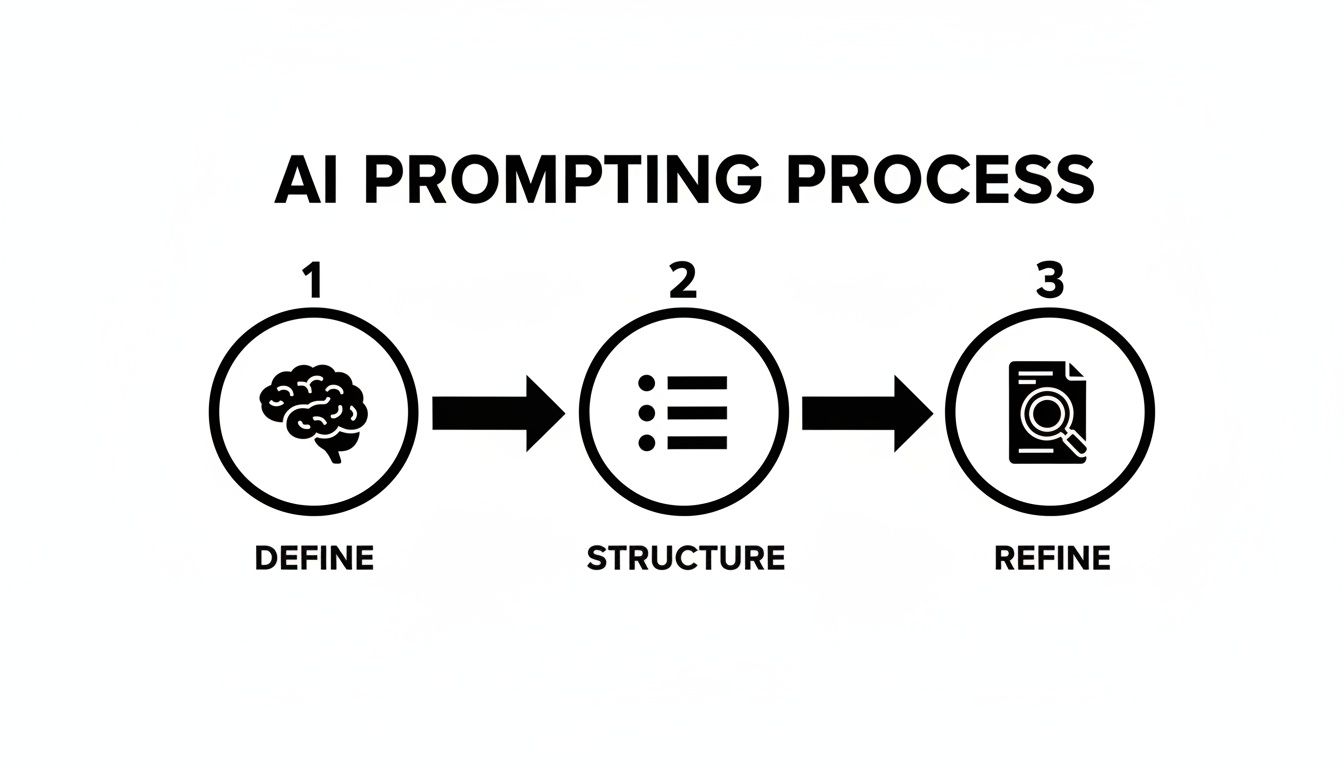
This simple flow—defining your goal, structuring the output, and refining the prompt—directly impacts how much work you'll have to do later.
This human-led editing is what separates content that performs from content that just exists. Recent stats show mixed outcomes for those using AI in blogging. While adoption is high—around 80% in 2024—about half of bloggers reported AI didn't materially change their results. This suggests the tool itself isn't a silver bullet; success hinges on human oversight.
For instance, bloggers who use AI to write full drafts and those who avoid it report similar rates of "strong results" (25% vs. 20% respectively). You can dig into the mixed AI blogging outcomes on MasterBlogging.com, but the takeaway is clear: editorial quality control is the real differentiator.
The Third Pass for Flow and SEO
Your final pass is all about structure, readability, and search optimization. The goal is to make the content effortless to read while ensuring it meets all the technical requirements to rank well.
Here, you'll want to refine the elements that make your content perform. This includes checking that your keywords are used naturally in headings and body text, ensuring your internal links add value, and breaking up long paragraphs. Polishing these details is a crucial part of the process, and understanding fundamental SEO copywriting best practices is essential for turning a good draft into a high-ranking asset.
To make sure nothing slips through the cracks, use a simple checklist for this final review.
Human-Led Editing Checklist for AI Drafts
This quick checklist ensures your AI-assisted content meets the quality and SEO standards required to perform before you hit publish.
| Check Stage | Key Action | Goal |
|---|---|---|
| Readability | Read the entire post aloud from start to finish. | Catch awkward phrasing and ensure a smooth, logical flow between sections. |
| Formatting | Review headings, bullet points, and bold text. | Break up "walls of text" and make the content easy to scan for busy readers. |
| On-Page SEO | Confirm keyword placement and meta descriptions. | Ensure the post is optimized to be found by search engines and attract clicks. |
| Internal Links | Check that all internal links are relevant and useful. | Guide readers to other valuable content and build topical authority for your site. |
This three-pass system turns editing from a chore into a structured, strategic process. It ensures every piece of AI-assisted content you publish is accurate, original, and optimized to perform, blending the efficiency of automation with the irreplaceable value of human expertise.
Optimizing and Publishing Your AI-Enhanced Content

Okay, you've got a polished draft that's been edited by a human. Now it's time for the final push: getting it ready for the search engines. This is where the technical side of on-page SEO gets a huge boost from the efficiency of AI for blog writing, ensuring all your hard work actually gets seen.
Think of this as the staging phase before the big debut. The article itself is ready, but now we need to send all the right signals to Google that this page is valuable, relevant, and deserves a top spot.
Crafting Click-Worthy Meta Elements with AI
Your meta title and description are your pitch on the search results page. In a sea of competing links, yours has to be compelling enough to earn the click. AI is a fantastic brainstorming partner here.
Instead of staring at a blank field, feed your final article to your AI tool and ask for a few options.
- Prompt for Meta Titles: "Generate five unique meta title variations for the attached blog post. Each title must be under 60 characters, include the keyword 'AI-assisted content', and use action-oriented language to encourage clicks."
- Prompt for Meta Descriptions: "Write three compelling meta descriptions for this article, each under 160 characters. They should summarize the key benefit for the reader and end with a clear call-to-action."
This simple process instantly gives you multiple creative angles to work with. I often find the AI comes up with a hook I hadn't considered. You can then mix and match the best parts to create a killer final version.
Key Takeaway: A strong meta title and description can massively improve your click-through rate (CTR), which is a huge ranking signal. Using AI to generate options saves time and almost always sparks more creative, effective ideas than just writing one version yourself.
Perfecting On-Page SEO Essentials
Beyond the meta tags, a few other on-page elements need a quick check before you hit publish. These technical details are non-negotiable for helping search engines understand and categorize your content.
SEO-Friendly URLs: Keep your URL slug short, clean, and descriptive. Best practice is to make it your primary keyword. For example, a good URL is yourblog.com/ai-for-blog-writing—not the messy default yourblog.com/post-id-123-final-draft.
Image Alt Text: Every single image needs descriptive alt text. This is crucial for accessibility and also gives search engines more context about your page. AI can knock this out in seconds. Just ask it to "write descriptive alt text for an image of [describe the image]."
Internal Linking Strategy: Internal links are your secret weapon for building topical authority and keeping users on your site longer. An AI assistant can scan your new post and suggest relevant articles from your own blog to link to. It’s way faster than manually searching through your content library.
Getting these on-page factors right is what turns a good article into a traffic-driving machine. For a deeper look, our complete guide on how to optimize content for SEO lays out the entire framework. A critical step is to follow a comprehensive guide to organic SEO optimization to ensure maximum visibility.
Final Review Before Publishing
Before you schedule the post in your CMS, do one last sweep. I always recommend using the "preview" mode in your CMS to see exactly how it will look live. This is where you catch weird formatting issues from the copy-paste.
Here’s my final checklist:
- Are all headings (H1, H2, H3) tagged correctly?
- Do all internal and external links work and open in a new tab?
- Are the images loading properly and aligned how you want?
- Does the article look good on mobile? Is it easy to scan?
This final check takes just a few minutes but ensures a professional look and a great user experience the second your article is live. By combining AI's speed with your own careful oversight, you can consistently publish high-performing content that hits your SEO goals.
Time to Track Performance and Sharpen Your Strategy
Hitting ‘publish’ isn't the finish line. Honestly, it’s just the starting gun. The real success with using AI for blog writing comes from obsessively tracking what works, what doesn't, and constantly refining your approach. If you aren't looking at the data, you're just guessing.
How that new blog post performs right out of the gate is a direct reflection of your strategy. By hooking up your analytics tools, you can finally move from gut feelings to data-backed decisions, turning your blog into an asset that actually grows in value.
What to Measure: Focusing on the Right KPIs
Look, not all metrics are created equal. Chasing vanity numbers like raw page views won't tell you if your content is actually doing its job. You need to focus on the KPIs that signal real engagement and, more importantly, get a thumbs-up from the search engines.
Here are the core metrics you should have your eyes on:
- Organic Traffic: This is your bread and butter—the number of visitors coming directly from search engines. A steady climb here is the clearest signal your SEO efforts are paying off.
- Keyword Rankings: Are you actually showing up for the keywords you targeted? You need to monitor your position in the search engine results pages (SERPs) to know for sure.
- Click-Through Rate (CTR): This percentage tells you how many people saw your article in the search results and actually clicked it. A low CTR could mean your title and meta description aren't compelling enough to grab their attention.
- Time on Page: How long are people sticking around? Longer session times are a great indicator that your content is valuable and holding their interest.
These numbers tell a story about your content's health. For a much deeper dive into the numbers that matter, check out our full guide on how to measure SEO success.
Turning Analytics into Actionable Insights
Tools like Google Analytics and Google Search Console are non-negotiable here. They are your direct window into how both users and search engines are interpreting your content.
You’ll be looking at dashboards just like this one in Google Analytics to see where your traffic is coming from.
This view makes it crystal clear which channels are bringing in the most users and engagement, so you know exactly where to double down.
My Two Cents: Don’t just stare at the numbers; hunt for the patterns. A post with tons of traffic but a sky-high bounce rate probably ranks for the wrong keywords, pulling in people who aren't finding what they expected. On the flip side, an article with low traffic but a high time on page is a hidden gem that just needs a bigger promotional push.
Using AI to Close the Loop and Refine Content
This is where the whole process comes full circle. Once you have real-world performance data, you can plug it back into your AI tools to spot opportunities and act on them fast.
Find Your Underperformers Dive into your analytics and find those articles that are just stuck on page two or three of the search results. These are your golden opportunities for a content refresh. Take the original article and its target keyword and feed it into your AI tool.
Then, give it a prompt like this:
"Analyze this blog post alongside the top 3 ranking articles for the keyword '[your keyword]'. Pinpoint any content gaps, outdated information, or areas where my article is thin. Generate a list of recommended updates and new sections I should add to boost its E-E-A-T (Experience, Expertise, Authoritativeness, and Trustworthiness)."
What used to be a tedious manual analysis now becomes a quick, actionable to-do list. By creating this cycle of measuring, analyzing, and refining with AI's help, you build a powerful growth engine that constantly improves your blog's performance and ROI.
Common Questions About AI for Blog Writing
Diving into AI for blog writing is exciting, but it's natural to have a few questions bubble up. The tech is moving at a breakneck pace, and it’s smart to get a handle on how it all fits into a real-world workflow. Let's clear the air on some of the most common concerns.
Getting these answers straight helps build the confidence you need to make AI a responsible—and seriously effective—part of your content toolkit.
Will Google Penalize My Site for Using AI Content
This is the question I hear more than any other, and thankfully, the answer is refreshingly simple: Google rewards quality, not production methods. Their entire focus is on helpful, reliable, people-first content.
Whether you typed every word by hand or used an AI to help you draft it is completely irrelevant to Google. The final product is all that matters.
The real risk of penalties comes from using AI to pump out low-quality, spammy articles at scale just to try and game the search rankings. As long as you keep a "human-in-the-loop" process—meaning you fact-check every claim, inject your own unique insights, and ensure the final piece is original—your content will be perfectly in line with Google’s guidelines. Your expertise is the secret sauce. If you want to dig deeper into this, our article on why to use AI for blog articles really breaks down the strategic benefits.
What Is the Best AI Tool for Blogging
There's no single "best" tool out there. The right choice really comes down to your specific needs and how you like to work. The market is packed with great options, each with its own strengths.
- Generalist Models: Tools like ChatGPT and Claude are absolute powerhouses for drafting, brainstorming, and deep research. They're incredibly flexible and can tackle a huge range of complex prompts.
- Specialized Platforms: Services like Jasper or Copy.ai are built with marketers in mind, offering structured templates for things like ad copy, social media posts, and specific blog post formats.
- SEO-Integrated Suites: Then you have platforms like SurferSEO or our own IndexPilot, which weave AI writing directly into the SEO workflow, combining it with real-time optimization guidance, keyword research, and content briefs.
My advice? Take a few for a spin using their free trials. See which one feels the most intuitive and which one gives you output that's closest to what you need.
My Takeaway: Don't get caught up chasing the "perfect" tool. Find one that's good enough and pour your energy into mastering your prompting and editing skills. A brilliant prompt in a decent tool will always beat a lazy prompt in an expensive one. Your skill is the real game-changer here.
How Do I Make AI Content Sound Like My Brand
This is where your human touch becomes absolutely non-negotiable. An AI can mimic a voice, but it can't originate your personality. The key is a combination of crystal-clear instructions upfront and meticulous editing on the back end.
First, get super specific with your prompts. Don't just tell it to be "friendly." Describe the exact tone you're after, like "witty and informal, but still authoritative" or "highly technical and precise, like an engineer explaining a concept." You can even feed the AI examples of your existing content and explicitly ask it to emulate that style.
Second—and this is the most critical part—is the human edit. This is your chance to rewrite clunky sentences, inject personal anecdotes and opinions, and tweak the rhythm of the paragraphs so they sound like you. The AI gives you the raw clay; you're the artist who shapes it into something with a soul.
Ready to stop the manual busywork and put your SEO on autopilot? IndexPilot turns keywords into traffic with trainable AI Agents that handle your entire content workflow. Schedule a demo and see how it works.