Your brand is being discussed in AI conversations right now—but do you know what's being said? As large language models like ChatGPT, Claude, and Perplexity become primary information sources for millions of users, tracking how these AI systems reference your brand has become essential for modern marketers.
Unlike traditional search where you can monitor rankings and clicks, LLM brand references happen in real-time conversations you can't see. Someone might ask ChatGPT for project management tool recommendations, and your product either gets mentioned or it doesn't. That conversation happens in a black box, invisible to your analytics dashboard.
This creates a fundamental challenge: How do you optimize for visibility you can't measure? How do you know if AI models are recommending your brand to potential customers, positioning you against competitors, or missing you entirely?
The answer lies in systematic LLM brand reference tracking—a new practice that's becoming as critical as traditional SEO monitoring. This guide walks you through exactly how to set up comprehensive tracking, from identifying which AI platforms matter most for your industry to implementing automated monitoring systems that alert you when your brand gets mentioned—or when it should be mentioned but isn't.
Think of this as your roadmap to AI visibility. By the end, you'll have a clear process for understanding, measuring, and ultimately improving how AI systems talk about your brand.
Step 1: Identify Your Priority AI Platforms and Reference Types
Not all AI platforms matter equally for your brand. Your first step is identifying where your target audience actually goes for AI-powered information.
The major platforms to consider include ChatGPT, Claude, Perplexity, Google Gemini, and Microsoft Copilot. Each has distinct characteristics that affect how they reference brands. ChatGPT relies heavily on training data with a knowledge cutoff, meaning recent brand developments might not appear. Perplexity integrates real-time web search, making it more responsive to current content. Claude tends toward more nuanced, context-aware responses that can include detailed comparisons.
Map Platform Usage to Your Audience: Start by understanding which platforms your potential customers prefer. B2B software buyers often use ChatGPT for research and comparison. E-commerce shoppers might lean toward Perplexity for product recommendations. Enterprise decision-makers increasingly use Copilot integrated into their Microsoft workflow.
Survey your existing customers or run informal polls on social media to identify patterns. You're looking for the 2-3 platforms that represent the highest concentration of your target audience's AI usage. Understanding brand tracking across AI models helps you prioritize which platforms deserve the most attention.
Understand Reference Types: LLM brand references aren't binary. They exist on a spectrum from direct mentions to subtle citations. Direct mentions occur when the AI explicitly names your brand in response to a query. Recommendations happen when your brand is suggested as a solution to a specific need. Comparisons position your brand against alternatives, often in feature tables or pros-and-cons lists. Citations reference your content as a source without necessarily recommending your product.
Each reference type has different value. A recommendation in response to "best email marketing tools for small businesses" carries more weight than a passing mention in a general industry overview.
Establish Your Baseline: Before setting up automated tracking, manually test 10-15 prompts relevant to your business. Try variations like "best [product category] for [use case]" or "how to solve [problem your product addresses]." Document which platforms mention your brand, in what context, and with what sentiment.
This baseline becomes your reference point for measuring improvement. You might discover that ChatGPT mentions your brand in comparison queries but misses you in recommendation prompts—a critical insight for content strategy.
Create a simple spreadsheet tracking: Platform name, Prompt tested, Your brand mentioned (yes/no), Reference type (mention/recommendation/comparison), and Sentiment (positive/neutral/negative). This manual exercise takes 2-3 hours but provides invaluable context for everything that follows.
Step 2: Define Your Brand Reference Tracking Scope
Effective LLM tracking requires comprehensive coverage of every term that represents your brand in user conversations. This goes far beyond just your company name.
Build Your Core Brand Term List: Start with the obvious—your official company name. Then expand to include product names, feature names, and any branded terminology unique to your offering. If you're a SaaS company with multiple products, each product name becomes a separate tracking term.
Don't forget founder names if they're publicly associated with your brand. In many industries, users ask questions like "what's the tool that [founder name] created?" or "companies founded by [name]." These queries represent genuine search intent that you need to capture.
Account for Variations and Misspellings: Users don't always type your brand name perfectly. Include common misspellings, abbreviations, and alternative phrasings. If your company is "DataVision Analytics," track "Data Vision," "Datavision," and "DV Analytics" as well.
Pay special attention to how your brand name might be confused with similar terms. A brand called "Summit" needs to distinguish between mentions of the company versus generic uses of the word summit. Context matters, and your tracking system needs to account for it. Learning how to track brand mentions in LLMs effectively requires this level of detail.
Map Competitor Brands: You can't understand your AI visibility without competitive context. Identify your 3-5 primary competitors and add their brand terms to your tracking scope. This allows you to measure share of voice—how often your brand appears versus theirs in similar prompts.
Competitive tracking reveals positioning opportunities. You might discover that AI models consistently mention Competitor A for enterprise use cases but your brand for small business scenarios. That insight shapes both your content strategy and product messaging.
Identify Category Terms: Beyond specific brand names, track the industry categories where your brand should appear. If you sell project management software, track prompts containing "project management tools," "team collaboration platforms," and "workflow software."
Category tracking shows you the total addressable conversation space. Your brand might be mentioned in 30% of "email marketing" prompts but only 5% of "marketing automation" prompts—revealing an opportunity to expand into adjacent categories.
Document everything in a master tracking taxonomy. Organize it hierarchically: Company brand terms at the top, then product names, then features, then category terms. This structure will inform how you set up monitoring and analyze results.
Step 3: Set Up Automated LLM Monitoring Systems
Manual testing established your baseline, but sustainable tracking requires automation. You have three primary approaches, each with distinct tradeoffs.
Manual Tracking: The simplest approach involves regularly running test prompts yourself across target platforms. Set a recurring calendar reminder to test your core prompt list weekly or biweekly. Document results in a spreadsheet, tracking changes over time.
This works for small brands with limited resources, but it's time-intensive and lacks consistency. Different team members might phrase prompts slightly differently, introducing variability into your data. Manual tracking also can't scale beyond a handful of platforms and prompts.
API-Based Solutions: More technical teams can build custom monitoring using AI platform APIs. OpenAI, Anthropic, and others offer API access that allows you to programmatically submit prompts and capture responses.
You'd create a script that runs your test prompts on a schedule, parses the responses for brand mentions, and logs results to a database. This approach offers maximum flexibility and control but requires development resources and ongoing maintenance. API costs can also add up with high-frequency testing across multiple platforms. For teams seeking turnkey solutions, LLM brand tracking software can handle these complexities automatically.
Dedicated AI Visibility Platforms: Purpose-built tools designed for LLM brand tracking offer the most comprehensive solution. These platforms handle the technical complexity of monitoring multiple AI systems, parsing responses, and presenting insights in actionable dashboards.
Look for platforms that support tracking across major LLMs, allow custom prompt creation, provide sentiment analysis, and offer historical trending. The investment typically makes sense once you're tracking more than 20-30 prompts across multiple platforms.
Configure Tracking Frequency: How often should you monitor? It depends on your industry's conversation volume and how quickly your competitive landscape changes. Fast-moving consumer tech might warrant daily checks on key prompts. B2B enterprise software could track weekly.
Start with weekly monitoring for your core prompt set. Increase frequency for high-priority prompts where you're actively working to improve visibility. Reduce frequency for baseline monitoring of long-tail category terms.
Set Up Smart Alerts: Configure notifications for significant changes. You want to know immediately if your brand suddenly disappears from a high-value prompt or if sentiment shifts negative. Set thresholds based on your baseline data—perhaps an alert when mention frequency drops 25% or when negative sentiment appears in responses that were previously positive.
Alerts transform passive monitoring into active intelligence. Instead of discovering problems during your weekly review, you learn about them in real-time and can investigate causes quickly. Implementing real-time brand monitoring across LLMs ensures you never miss critical changes.
Whichever approach you choose, document your methodology clearly. Note which prompts you're testing, on which platforms, at what frequency. This documentation ensures consistency if team members change and provides context when analyzing trends.
Step 4: Analyze Sentiment and Context of Brand References
A brand mention isn't inherently valuable—context and sentiment determine whether it helps or hurts your visibility goals.
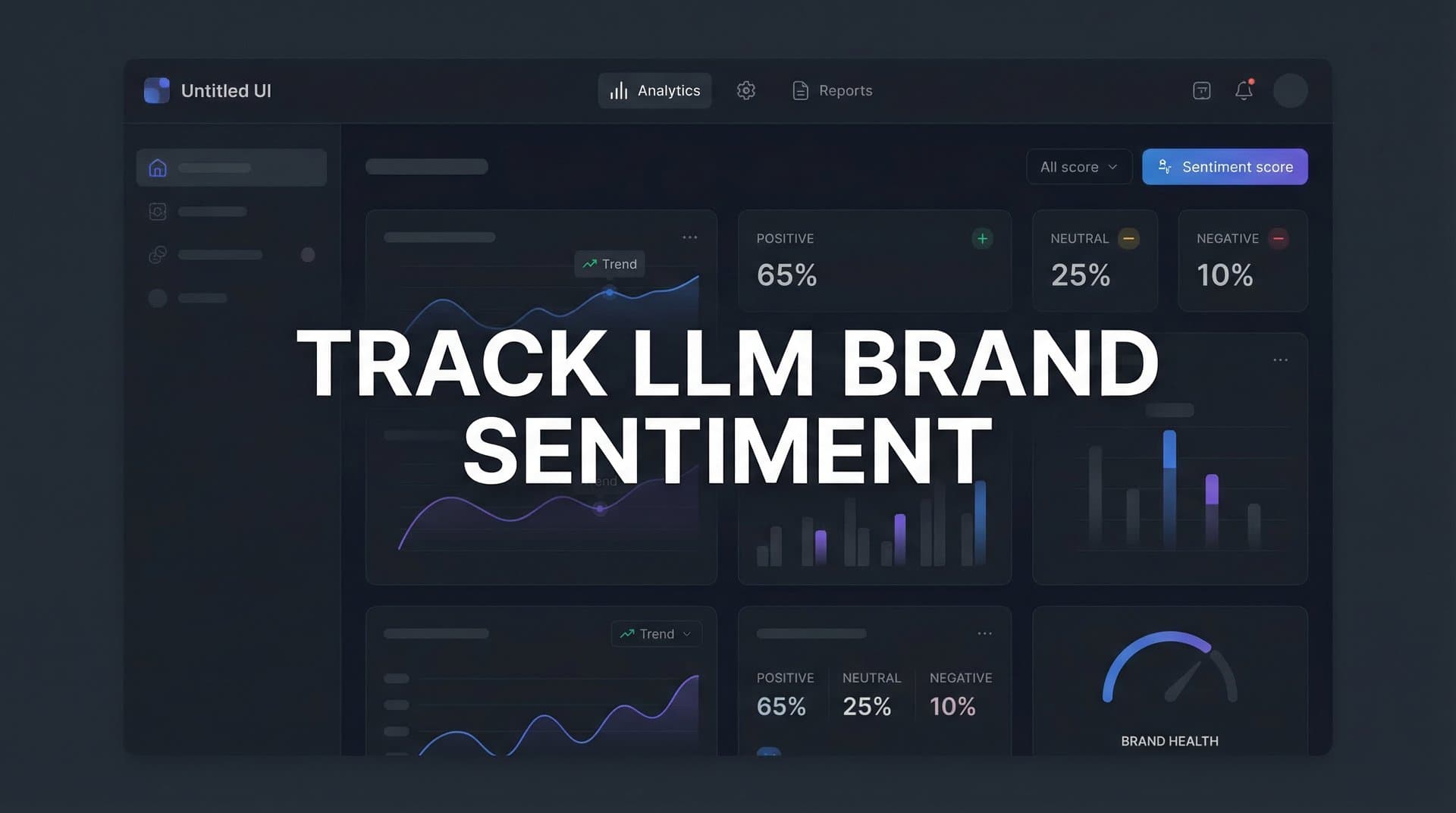
Categorize Mention Sentiment: Every brand reference falls into one of four categories. Positive mentions recommend your brand, highlight strengths, or position you favorably against alternatives. Neutral mentions acknowledge your existence without judgment—your brand appears in a list without editorial commentary. Negative mentions criticize your product, highlight limitations, or recommend alternatives instead.
The fourth category is the most insidious: absent mentions. These occur when AI models should reference your brand based on the prompt but don't. A query for "best CRM tools for real estate" should mention your real estate CRM if it's genuinely competitive, but if the AI overlooks you, that's an absent mention—and a clear optimization opportunity. Understanding why your brand is not visible in LLM searches is crucial for addressing these gaps.
Track the distribution across these categories. A brand with 100 mentions split 70 positive, 20 neutral, 10 negative has a very different profile than one with 40 positive, 30 neutral, 30 negative—even though total mention volume is similar.
Understand Recommendation Context: When your brand is mentioned, what role does it play in the response? Is it the primary recommendation, one of several alternatives, or a footnote? Position matters enormously.
Analyze the structure of responses. If ChatGPT lists five project management tools and yours appears third, that's different than appearing first with a detailed explanation of why it's recommended. Track your position in lists and the depth of explanation accompanying your mention.
Pay attention to qualifiers. Does the AI say "Brand X is excellent for enterprise teams" or "Brand X works but has limitations for larger organizations"? These subtle phrasings shape user perception and indicate how the AI model has synthesized information about your brand.
Identify Trigger Patterns: Which types of prompts consistently generate brand mentions versus which ones miss you? You might discover that your brand appears in direct comparison queries but disappears in broader category exploration prompts.
Create a prompt taxonomy based on user intent: Informational queries seeking to understand a category, comparison queries evaluating specific alternatives, and solution queries looking for recommendations to solve a problem. Map your mention rate across each intent type.
This analysis reveals content gaps. If you're invisible in informational queries, you need more educational content establishing category authority. If you're missing from solution queries, your content isn't connecting product capabilities to user problems effectively.
Track Competitive Positioning: How do AI models position your brand relative to competitors? Are you consistently described as the budget option, the enterprise solution, or the innovative newcomer? This positioning might not match your intended brand identity—revealing a perception gap to address. Implementing brand sentiment tracking in LLMs helps you monitor these perception patterns over time.
Document specific comparison patterns. If AI models always mention Competitor A alongside your brand, that's your closest perceived alternative. If they mention Competitor B only in enterprise contexts but your brand in SMB contexts, that's market segmentation you need to either reinforce or challenge.
Create a competitive mention matrix showing how often each competitor appears in the same responses as your brand. This visualizes your competitive set from the AI's perspective—which may differ from your internal competitive analysis.
Step 5: Create Your LLM Reference Dashboard and Reporting
Raw tracking data becomes actionable when you transform it into clear metrics and visualizations that reveal trends and inform decisions.
Build Your AI Visibility Score: Create a single metric that quantifies your overall brand presence across AI platforms. This score combines mention frequency, sentiment distribution, and competitive context into one trackable number.
A simple formula might weight positive mentions at 100%, neutral at 50%, and negative at -50%. Track this score over time to measure whether your optimization efforts are working. An AI Visibility Score that increases from 45 to 62 over three months indicates meaningful progress. Dedicated brand visibility tracking software can automate these calculations for you.
You can create platform-specific scores to identify where you're strong versus weak. Maybe your ChatGPT visibility score is 70 but your Perplexity score is only 35—signaling where to focus optimization efforts.
Establish Reporting Cadence: Decide how often stakeholders need visibility into LLM reference data. Weekly reporting works for active optimization campaigns where you're publishing new content and want to measure immediate impact. Monthly reporting suits ongoing monitoring where you're tracking gradual trends.
Quarterly business reviews should include LLM visibility as a standard metric alongside traditional SEO and paid acquisition data. This elevates AI visibility to a core marketing KPI rather than a side project.
Tailor reporting depth to audience. Executives want high-level trends and the AI Visibility Score. Content teams need detailed prompt-level data showing which topics to prioritize. Product teams benefit from sentiment analysis revealing feature perception gaps.
Track Trends Over Time: The real value emerges when you analyze how metrics change. Are mentions increasing month-over-month? Is sentiment improving? Are you gaining ground against competitors in key category prompts?
Create trend visualizations showing your AI Visibility Score over the past 6-12 months. Overlay major content initiatives or product launches to identify what drives improvement. You might discover that publishing comprehensive guides increases mentions more effectively than short blog posts.
Watch for correlation between LLM visibility and business outcomes. Do increases in AI mentions correspond with upticks in organic traffic or trial signups? This connection helps justify investment in AI visibility optimization.
Connect to Business Impact: Where possible, link LLM reference data to downstream metrics. If you can track that users coming from AI-generated recommendations have higher conversion rates than other channels, that transforms AI visibility from a vanity metric to a revenue driver.
Track the prompts that generate the most valuable mentions—those that lead to website visits or trial signups. Prioritize optimization for these high-value queries even if they represent lower total mention volume.
Build a simple dashboard that surfaces the metrics that matter most: AI Visibility Score trend, mention volume by platform, sentiment distribution, competitive share of voice, and high-priority prompt performance. Keep it focused and actionable rather than overwhelming with every possible data point.
Step 6: Take Action on Your Tracking Insights
Tracking without action is just data collection. The final step transforms insights into optimization initiatives that improve your AI visibility.
Identify Content Gaps: Review prompts where your brand should appear but doesn't. These absent mentions represent your highest-priority content opportunities. If users ask "how to improve email deliverability" and AI models recommend competitors but not your email platform, you need authoritative content addressing deliverability.
Create a prioritized content roadmap based on three factors: Search volume for the topic, business value of users asking that question, and current visibility gap. A high-volume, high-value prompt where you're completely absent gets top priority.
Focus on becoming the definitive source that AI models cite. This means comprehensive guides, original research, and content that answers questions more thoroughly than existing alternatives. AI systems tend to reference authoritative sources, so surface-level content won't move the needle. Learning how to improve brand visibility in LLM responses requires this commitment to quality content.
Optimize for High-Value Prompts: Not all prompts matter equally. Identify the 10-20 queries that represent the highest business value—those asked by users with strong purchase intent or significant budget authority.
For each high-value prompt, analyze what content currently ranks in traditional search and what AI models reference in their responses. Look for patterns in content depth, format, and angle. Then create content specifically designed to become the authoritative reference for that query.
This might mean publishing detailed comparison guides, creating original data that AI models can cite, or developing frameworks that become the standard way to think about a topic in your category.
Address Negative Sentiment: When tracking reveals negative mentions, investigate the root cause. Is the AI model citing outdated information about your product? Are there legitimate criticism patterns you need to address through product improvements?
Sometimes negative sentiment stems from information gaps. If your brand is criticized for lacking a feature you actually offer, you need better documentation and content explaining that capability. Publish detailed feature guides, use case examples, and comparison content that sets the record straight. Effective AI brand reputation tracking helps you catch and address these issues before they spread.
Other times, negative sentiment reflects genuine product limitations. Feed this intelligence back to product teams. If AI models consistently mention that your tool lacks enterprise features, that's market feedback worth acting on.
Iterate and Measure Impact: Treat AI visibility optimization as an ongoing experiment. Publish content targeting specific visibility gaps, then measure whether mentions improve over the following weeks. Track which content formats and topics drive the biggest visibility gains.
You might discover that long-form guides improve ChatGPT visibility but have less impact on Perplexity, where real-time news content performs better. These insights shape your content strategy over time.
Set quarterly goals for AI Visibility Score improvement. Aim for 10-15% increases per quarter through systematic content optimization. Review what worked, what didn't, and adjust your approach accordingly.
Create feedback loops between tracking insights and content creation. Your LLM reference dashboard should directly inform your editorial calendar, ensuring every piece of content serves a strategic visibility goal rather than being created in isolation.
Your Path to AI Visibility Mastery
Tracking LLM brand references isn't a one-time project—it's an ongoing practice that becomes more valuable as AI-powered search continues to grow. The brands that master this discipline now will have a significant advantage as AI becomes the dominant way people discover and evaluate products and services.
Start with Step 1 today: identify your priority platforms and run manual tests to establish your baseline. You don't need a sophisticated monitoring system to begin learning how AI models currently talk about your brand. Those initial manual tests will reveal immediate opportunities and inform everything that follows.
Then systematically work through each step to build a comprehensive monitoring system. Choose the tracking approach that fits your resources—whether that's manual monitoring, API-based solutions, or dedicated platforms. The key is consistency and commitment to acting on the insights you uncover.
Your Quick-Start Checklist: Map 3-5 priority AI platforms based on where your target audience seeks information. List all brand terms and variations to track, including product names, founder names, and common misspellings. Choose your monitoring approach and set up your first tracking cadence. Run initial sentiment analysis on your baseline prompts to understand current positioning. Set up your first dashboard view with AI Visibility Score and key metrics. Schedule your first optimization sprint based on the highest-priority content gaps you've identified.
Remember that AI visibility optimization works differently than traditional SEO. You're not chasing keyword rankings—you're establishing authority that makes AI systems cite your brand as a trusted source. This requires depth, originality, and genuine expertise rather than surface-level content optimized for algorithms.
The insights you gain from systematic LLM tracking will transform how you think about content strategy, competitive positioning, and brand perception. You'll see exactly where you're winning, where competitors dominate, and where white space opportunities exist.
Most importantly, you'll stop guessing about how AI models represent your brand. Instead, you'll have data-driven clarity about your AI visibility and a systematic process for improving it over time. Start tracking your AI visibility today and see exactly where your brand appears across top AI platforms.