When someone asks ChatGPT about the best tools in your category, does your brand come up? What about when they ask Claude for product recommendations, or query Perplexity for solutions to problems your product solves? These aren't hypothetical scenarios anymore. AI-powered search has fundamentally changed how people discover brands, and if you're not tracking what AI models say about you, you're flying blind in one of the fastest-growing discovery channels.
The challenge is this: Unlike traditional search where you can monitor rankings and click-through rates, AI model responses happen in a black box. You don't know if your brand is being recommended, ignored, or worse—if competitors are being suggested instead. Every time someone asks an AI model about your industry, there's a discovery moment happening, and you need to know whether you're part of that conversation.
Tracking AI model prompt responses reveals three critical insights. First, whether your brand appears when people ask AI about your category. Second, how you're positioned relative to competitors in those responses. Third, what sentiment surrounds your mentions—are you being recommended enthusiastically or mentioned as a cautionary tale?
This guide walks you through building a systematic approach to tracking AI prompt responses. You'll learn how to identify which prompts matter most, set up monitoring across multiple AI platforms, structure your tracking data for actionable insights, and turn what you learn into content that improves your AI visibility. By the end, you'll have a working framework that shows you exactly how AI models talk about your brand and where your biggest opportunities lie.
Step 1: Identify Your Core Tracking Prompts
Your first challenge is figuring out which prompts to track. You can't monitor every possible question someone might ask an AI model, so you need to identify the highest-value discovery moments—the prompts that represent real purchase intent or problem-solving searches in your category.
Start by mapping the questions your target audience actually asks. Think about the different stages of their journey. Someone early in their research might ask "What are the best tools for content marketing?" while someone further along might ask "ChatGPT vs. Jasper for SEO content—which is better?" Both are valuable, but they represent different intent levels and require different tracking strategies.
Create four distinct prompt categories to organize your tracking. Branded queries include your company name directly: "What does Sight AI do?" or "Is Sight AI worth it?" Category queries ask about your industry without naming specific brands: "What's the best AI visibility tracking tool?" Competitor queries specifically mention your competitors: "Alternatives to [Competitor Name]." Problem-solution queries describe the challenge your product solves: "How do I know if AI models mention my brand?" Understanding AI prompt tracking for brands helps you categorize these effectively.
Prioritize prompts based on purchase intent and how frequently they're likely to be asked. A prompt like "best AI SEO tools for agencies" has higher commercial intent than "what is AI visibility?" The former indicates someone actively evaluating solutions, while the latter suggests early-stage research. Both matter, but the higher-intent prompts deserve more frequent tracking.
Document 15-25 seed prompts that represent your most valuable discovery moments. This becomes your core tracking list—the foundation of your monitoring system. For each prompt, note why it matters to your business. "Best AI content tools for marketers" matters because it targets your ideal customer at decision-making time. "How to improve SEO with AI" matters because it addresses a problem your product solves, even if it doesn't mention tools directly.
Include variation in your prompt list. AI models respond differently to "What's the best tool for X?" versus "I need help with X, what should I use?" The phrasing changes the context, and that context influences whether your brand appears. Test different question formats for the same underlying intent to see which variations generate the most relevant responses.
Step 2: Select AI Models and Response Channels to Monitor
Not all AI models matter equally for your business. Your next step is choosing which platforms to monitor based on where your audience actually goes for AI-powered answers.
The major players to consider are ChatGPT, Claude, Perplexity, Google Gemini, and Microsoft Copilot. Each has different strengths and user bases. ChatGPT dominates general AI assistant usage and often serves as the default for many users. Perplexity positions itself as an AI search engine and tends to attract users specifically looking for research and recommendations. Claude has gained traction among technical and business users who value its analytical capabilities.
Understanding response variations across models is crucial. The same prompt can generate completely different answers depending on which AI you're querying. ChatGPT might recommend three tools with detailed comparisons, while Perplexity might cite specific sources and provide a more research-oriented answer. Claude might focus on different evaluation criteria altogether. These variations mean you can't assume that visibility on one platform translates to visibility on others. A multi AI model tracking platform helps you monitor these differences systematically.
Consider the trade-offs between API access and manual monitoring. Some AI platforms offer API access that allows you to programmatically submit prompts and capture responses at scale. This is powerful for frequent tracking but comes with costs and technical complexity. Manual monitoring—where you submit prompts through the regular interface and record responses—is free but time-intensive and harder to scale.
Set up accounts and access methods for each platform you'll track. Even if you start with manual monitoring, having accounts ready means you can scale up later. For platforms with API access, review their documentation and pricing to understand what's possible within your budget. For manual tracking, bookmark the direct URLs and create a consistent process for submitting prompts and capturing responses.
Start with three to four platforms rather than trying to monitor everything at once. If your audience is primarily marketers and business professionals, prioritize ChatGPT, Perplexity, and Claude. If you're targeting developers or technical users, add Gemini to the mix. You can always expand your monitoring later once you've established a working system with your core platforms.
Step 3: Build Your Response Tracking System
Now that you know what to track and where to track it, you need a system to capture, organize, and analyze the data consistently over time. The right tracking system depends on your resources, technical capabilities, and how much automation you want.
Your options range from manual spreadsheet tracking to custom scripts to dedicated AI visibility platforms. Manual tracking works when you're starting out or monitoring a small number of prompts. Create a spreadsheet with columns for prompt text, AI model, date tracked, full response text, whether your brand was mentioned, sentiment of the mention, and position if it appeared in a list. This approach is free and flexible but becomes unsustainable as you scale beyond 20-30 prompts tracked weekly.
Custom scripts offer a middle ground if you have technical resources. You can write code that submits prompts via APIs, captures responses, and logs them to a database automatically. This scales better than manual tracking but requires development time and ongoing maintenance as AI platforms update their APIs. The advantage is complete control over your data structure and analysis methods. Learn more about how to track AI model responses effectively.
Dedicated AI visibility platforms like Sight AI automate the entire process across multiple models simultaneously. These tools handle prompt submission, response capture, mention detection, and sentiment analysis automatically. They're designed specifically for tracking how AI models talk about brands, which means they include features like competitive tracking, trend analysis, and content gap identification built in. The trade-off is cost versus the time saved and insights gained from purpose-built analytics.
Whichever approach you choose, structure your tracking database consistently. Every entry should capture the exact prompt used, which AI model responded, the date and time of the query, the complete response text, whether your brand was mentioned (yes/no), the sentiment of any mention (positive/neutral/negative), and the position if your brand appeared in a ranked list. This structure allows you to analyze patterns over time and compare performance across different prompts and platforms.
Set your tracking frequency based on available resources and how quickly your competitive landscape changes. Daily tracking makes sense for critical prompts where you're actively optimizing content and want to see rapid feedback. Weekly tracking works for broader monitoring where you're looking for trends rather than immediate changes. Monthly tracking is sufficient for baseline category queries that change slowly. The key is consistency—tracking the same prompts on the same schedule so you can identify meaningful changes rather than random variation.
Build in version control for your prompts. AI models update frequently, and their training data changes over time. What you track in May might generate different responses in August even if nothing about your brand changes. Timestamping every tracking session and noting any major AI model updates helps you distinguish between changes in your visibility and changes in model behavior.
Step 4: Analyze Brand Mentions and Sentiment
Collecting data is only valuable if you extract insights from it. Your analysis process should reveal not just whether you're mentioned, but how you're mentioned and what that means for your visibility strategy.
Score each response using a tiered system that captures mention quality, not just presence. A prominent mention—where your brand is recommended as a top solution with explanation of why—scores higher than a brief mention in passing. Track these separately: mentioned prominently, mentioned briefly, not mentioned, or competitor mentioned instead. This nuance matters because a brief mention buried in a paragraph has different value than being listed as the first recommendation in a "top tools" response.
Evaluate sentiment whenever your brand appears. Positive recommendations sound like "Sight AI excels at tracking brand mentions across multiple AI platforms" or "For comprehensive AI visibility monitoring, Sight AI offers robust features." Neutral mentions simply state facts without endorsement: "Sight AI is a tool that tracks AI model responses." Negative context is rare but critical to catch: "While Sight AI offers tracking features, users report..." Understanding sentiment helps you identify not just visibility gaps but perception issues that need addressing. Consider using AI model sentiment tracking software to automate this analysis.
Track your position in listicle-style responses where AI models recommend multiple options. Being the first recommendation carries more weight than being fifth in a list of seven tools. Record your position numerically and monitor whether it changes over time. If you consistently appear third or fourth, that's actionable intelligence—you have visibility but aren't the top-of-mind recommendation yet.
Identify patterns in which prompt types generate mentions versus which don't. You might discover that you appear frequently in responses to "AI visibility tracking tools" but never show up for "content marketing analytics platforms" even though your product serves both use cases. These patterns reveal content gaps—areas where you need to create or optimize content that explicitly addresses those prompt themes.
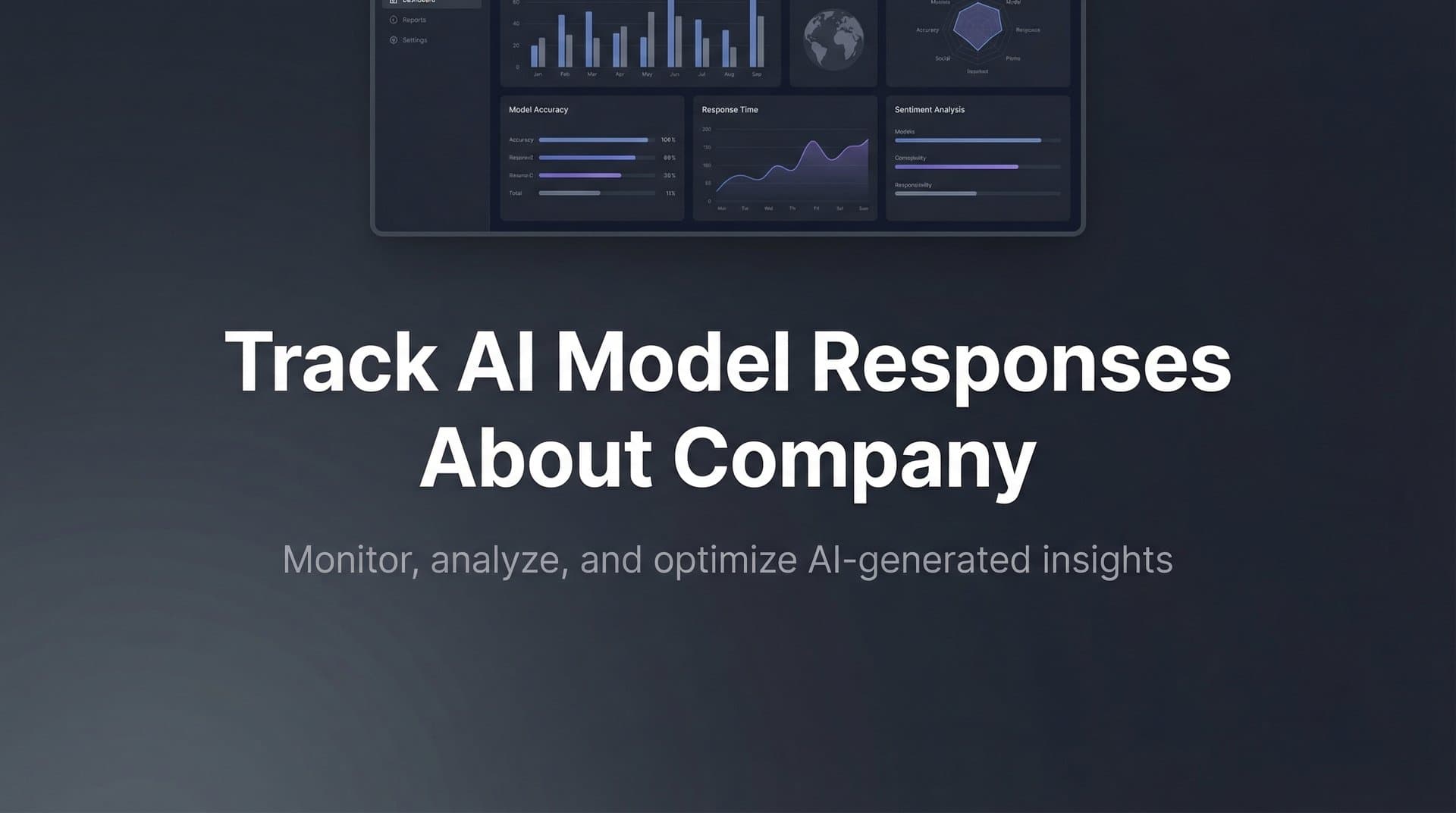
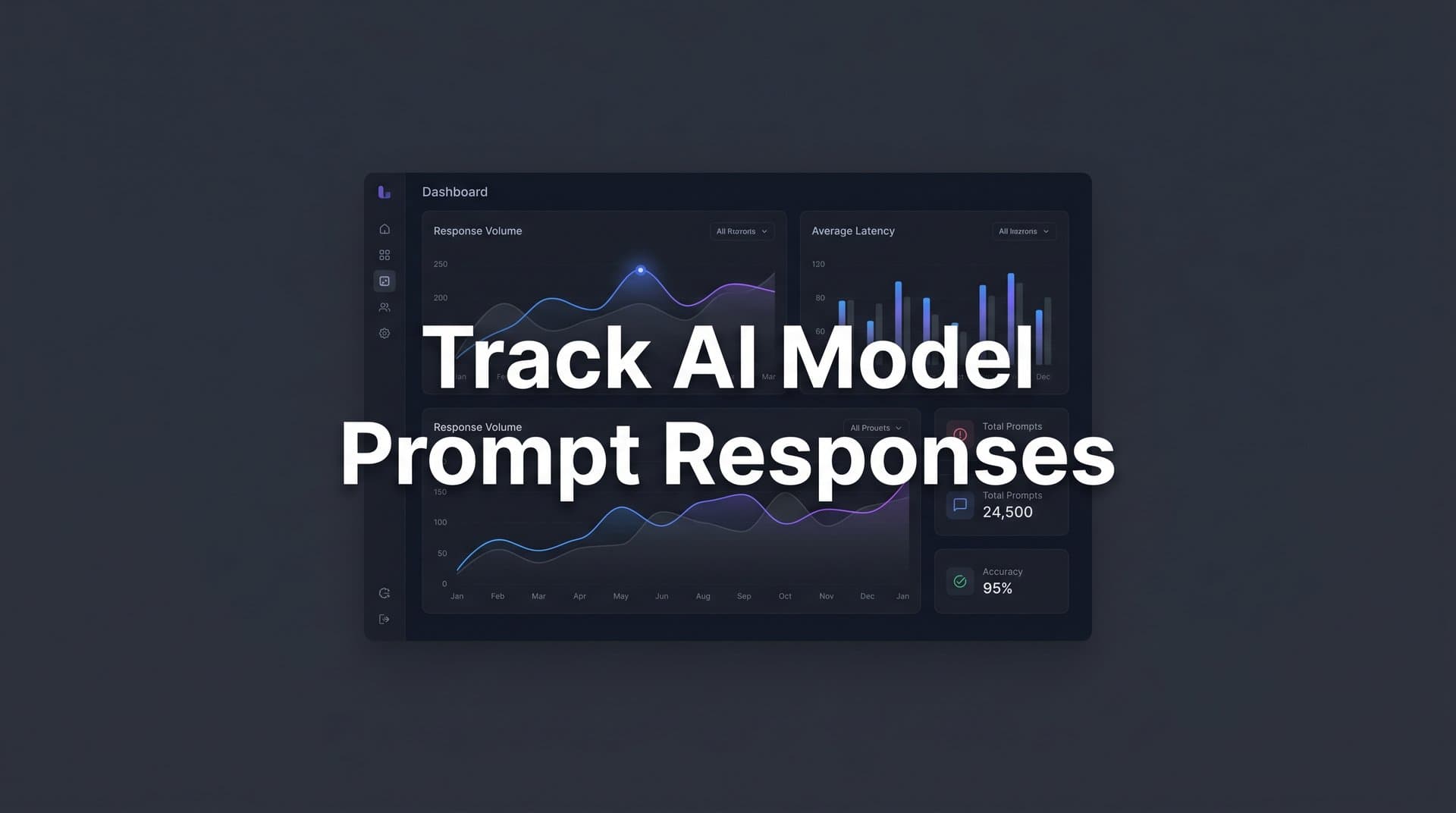
Create a simple visibility scorecard that summarizes your performance. Calculate your mention rate: what percentage of tracked prompts include your brand? Track your average position when you do appear. Monitor sentiment distribution: what percentage of mentions are positive versus neutral? Compare these metrics week over week or month over month to see if your efforts are moving the needle. An AI model tracking dashboard can visualize these metrics effectively.
Step 5: Monitor Competitor Visibility Alongside Your Own
Understanding your own AI visibility is incomplete without knowing how you compare to competitors. The prompts where competitors appear and you don't represent your biggest growth opportunities.
Track which competitors appear in responses where you're absent. When you submit "best AI content tools for agencies" and the response mentions three competitors but not you, record which competitors those are. Do the same competitors dominate across multiple prompts, or does visibility vary by prompt type? This reveals who your real AI visibility competitors are—which might differ from your traditional competitive set. Effective brand tracking across AI models includes competitive monitoring.
Analyze what competitors are doing differently in their content strategy. When a competitor consistently appears for prompts where you don't, investigate their content. Are they publishing comprehensive guides on topics you've only covered briefly? Do they have case studies that demonstrate specific use cases AI models reference? Are they using terminology in their content that matches how people phrase prompts? These insights guide your content development priorities.
Create a competitive visibility scorecard comparing mention rates across your key prompts. Build a simple matrix with prompts as rows and competitors as columns, then mark which brands appear in each response. This visual representation quickly shows you where you're winning, where you're competitive, and where you're invisible. Update this scorecard monthly to track relative movement—are you gaining ground or losing visibility share?
Use competitor gaps as opportunities for your content strategy. If you notice a competitor consistently mentioned for "AI SEO tools with indexing features" but they don't actually offer robust indexing, that's an opportunity to create content that positions your indexing capabilities as superior. The AI model is looking for content about that specific feature combination—give it authoritative content that makes you the obvious answer.
Don't obsess over competitors who operate in adjacent but different spaces. Focus on direct competitors who serve the same audience with similar solutions. If an AI model recommends a general analytics platform when someone asks about AI visibility tracking, that's less concerning than if it recommends a direct competitor's AI visibility tool instead of yours.
Step 6: Turn Tracking Data Into Content Action
The ultimate purpose of tracking AI prompt responses is to improve your visibility through strategic content creation. Your tracking data should directly inform what content you create, how you structure it, and which topics you prioritize.
Identify content gaps by analyzing prompts where you should appear but don't. If "how to track brand mentions in ChatGPT" is a high-value prompt in your category and you never appear in responses, you have a content gap. Either you haven't published content addressing that specific question, or your existing content doesn't match how AI models interpret and answer that query. Both are fixable through targeted content creation. Our guide on how to track brand mentions in AI models addresses this directly.
Create or optimize content specifically designed to answer the prompts you're tracking. This isn't about keyword stuffing—it's about comprehensively addressing the questions people ask AI models. If you're tracking "best AI visibility tools for marketers," create a detailed guide that explains what AI visibility means, why it matters for marketers specifically, what features to look for, and how different tools compare. Make your content the definitive answer to that prompt.
Apply Generative Engine Optimization principles to improve AI discoverability. GEO focuses on making your content easily interpretable and citable by AI models. Use clear headings that match common question formats. Include specific, factual statements that AI models can extract and reference. Structure comparison content with explicit criteria and evaluations. Add context that helps AI models understand when your solution is the right fit versus when alternatives might be better—this builds trust and authority.
Establish a feedback loop that turns tracking into continuous improvement. Track your baseline visibility for key prompts, create content targeting those prompts, publish and index that content, wait for AI models to potentially incorporate it into their responses, then re-track the same prompts to measure improvement. This cycle—track, analyze, create, re-track—becomes your systematic approach to building AI visibility over time. Understanding tracking AI model recommendations helps refine this process.
Prioritize content creation based on prompt value and current visibility gaps. High-value prompts where you have zero visibility should be your top priority. Medium-value prompts where you're mentioned briefly are opportunities to improve from presence to prominence. Low-value prompts where you already appear prominently need maintenance but not immediate attention. This prioritization ensures you're investing content resources where they'll have the biggest impact on discovery.
Your Path to Systematic AI Visibility
Tracking AI model prompt responses isn't a one-time audit—it's an ongoing discipline that reveals how your brand shows up in the AI-driven discovery landscape that's reshaping how people find solutions. The brands that build systematic tracking now will capture discovery opportunities that others miss simply because they don't know those opportunities exist.
Start with your foundation: identify 15-25 priority prompts that represent your most valuable discovery moments. Choose three to four AI models where your audience actually goes for answers. Build a tracking system that fits your resources, whether that's a structured spreadsheet for weekly manual checks or an automated platform that monitors continuously. The sophistication matters less than the consistency—regular tracking with basic tools beats sporadic tracking with advanced ones.
Establish weekly analysis reviews where you look for patterns, not just individual data points. Which prompts consistently generate mentions? Where do competitors appear and you don't? What sentiment patterns emerge across different prompt types? These patterns guide your content strategy more effectively than any single response ever could.
Turn insights into action by creating content that directly addresses your visibility gaps. Don't just publish more—publish strategically, targeting the specific prompts where you need visibility. Apply GEO principles to make your content easily discoverable and citable by AI models. Then close the loop by re-tracking to measure whether your content efforts are improving your visibility.
Your quick-start checklist: Identify your core tracking prompts this week. Set up accounts on your priority AI platforms. Create your tracking system structure and log your first baseline measurements. Schedule your weekly analysis time. Identify your top three content gaps and start creating content that addresses them. Within a month, you'll have a working visibility tracking system and the beginnings of a content strategy informed by real data about how AI models talk about your brand.
Stop guessing how AI models like ChatGPT and Claude talk about your brand—get visibility into every mention, track content opportunities, and automate your path to organic traffic growth. Start tracking your AI visibility today and see exactly where your brand appears across top AI platforms.