
If you've ever asked, "how many keywords should I target per page?" you're not alone. The answer has changed dramatically over the years. Today, it’s less about a magic number and more about a strategic approach: focus on one primary topic per page, supported by a whole family of related keywords.
This strategy ensures your content is a deep, comprehensive resource on a single subject, which is exactly what both users and search engines are looking for.
The Real Answer to Keyword Count Per Page
Let's get one thing straight: the old method of stuffing as many keywords as you can onto a page is dead. SEO today is about creating an expert guide on a single, focused subject—not just checking off a list of repeated phrases.
The most effective strategy is to build each page around a core topic. This topic is represented by your primary keyword, which is then fleshed out with a cluster of semantically related terms.

Think of it like baking a cake. Your primary keyword is the cake itself—the main attraction. Let's say it's a "chocolate lava cake recipe." Every single ingredient and instruction on the page should contribute to making the absolute best chocolate lava cake possible.
Supporting Your Primary Keyword
Of course, your primary keyword can't carry the page all on its own. It needs backup from other related terms to give search engines the full picture. These supporting terms generally fall into two categories:
- Secondary Keywords: These are your essential ingredients and critical steps. For our lava cake, these would be terms like "how to melt chocolate," "cake baking time," and "unsweetened cocoa powder." They're directly related and absolutely necessary for a complete guide.
- Long-Tail Keywords: These are the super-specific questions or detailed phrases people type into Google. Think "why did my lava cake not erupt" or "can I make lava cakes ahead of time." Answering these questions shows you really know your stuff and helps you capture very specific search traffic.
When you target one main keyword and surround it with these supporting terms, you create a topically rich page that satisfies a user's entire need on that subject.
Why This "One Topic" Approach Works
This strategy lines up perfectly with how modern search engines, especially Google, actually understand content. They've moved way beyond simply matching exact words. Now, they analyze the relationships between concepts to figure out how authoritative a page is on a given topic.
A single, focused page that thoroughly covers one topic will almost always outperform a page that tries to target multiple, unrelated primary keywords. Why? Because search engines prioritize content that best satisfies a specific user's intent.
Focusing on a single topic and its keyword family sends a crystal-clear signal to search engines: "This page is the definitive resource for X." That clarity is what gets you ranked. A page properly optimized for "chocolate lava cake recipe" will naturally start ranking for dozens, sometimes hundreds, of related queries without you ever having to "stuff" them in. Keeping an eye on this is crucial, and you can learn more about it in our guide on how to track keyword rankings.
This method also keeps you from confusing both your audience and the search engine bots. A user lands on your page and finds a complete answer. A search engine crawls it and immediately understands its core purpose. It's a win-win that builds real authority and drives the kind of organic traffic that lasts.
Moving Beyond Keyword Density to Topical Depth
If you’ve been in the SEO game for a while, you probably remember the days of keyword density. We were all told to aim for a magic number, often around 2%, to make sure our main keyword popped up just enough.
Let's be clear: that era is over.
Sticking to that outdated playbook won't just stall your progress; it can actively hurt your rankings. Search engines have gotten much, much smarter. They've moved way beyond simply counting words and now focus on understanding the meaning and context of your entire page.
The Shift from Repetition to Relevance
Everything changed when Google rolled out sophisticated algorithms like BERT and MUM. These systems don't just scan for keywords. They analyze the relationships between all the words and concepts on a page to figure out what it's really about. This was a fundamental change in how search works.
Think of it this way: an old-school robot would just repeat "buy cheap widgets" ten times because it was programmed to. A modern AI, on the other hand, can process a whole conversation about widget materials, manufacturing costs, and user reviews and conclude, "Ah, this is about buying cheap widgets," without ever needing the exact phrase repeated over and over.
This is why the central question for SEOs has shifted from "How many times did I use my keyword?" to "How well did I cover this topic?" Proving your topical depth is now the name of the game.
Why Keyword Density Is a Dead Metric
The old obsession with keyword density was just a clumsy attempt to signal relevance. Today, Google can spot genuine expertise without the clumsy hints. When you force keywords into your text, it sounds awkward and unnatural, which tanks the user experience—and user experience is a massive ranking factor.
The modern SEO approach rewards pages that serve as a comprehensive, one-stop resource. Your goal isn't to repeat a term; it's to be the most authoritative and helpful answer for what someone is searching for. That's achieved through quality and depth, not repetition.
In fact, obsessing over density can seriously backfire. A recent analysis of over 1,500 Google search results flipped the old wisdom on its head. It found that the average keyword density for top-ranking pages was a tiny 0.04%. The data makes it pretty clear: high-ranking content uses target keywords sparingly, focusing instead on natural, helpful language.
How to Build Topical Authority
So, if you're not counting keywords, what should you be doing? Building a rich, comprehensive page that explores your main topic from every angle. This is a pillar of today's most effective content SEO best practices.
Here’s how to start making that shift:
- Answer Related Questions: Use SEO tools to find out what other questions people are asking about your topic. Weaving those answers into your content adds a ton of value and relevance.
- Cover Subtopics Thoroughly: Break down your main topic into its logical parts. Writing about the "keto diet for beginners"? You absolutely need to cover subtopics like "what is ketosis," "keto-friendly foods," and "common side effects."
- Use Synonyms and Variations: Don't just repeat "keto diet." A rich vocabulary signals expertise. Use natural variations like "ketogenic lifestyle," "low-carb high-fat eating," or "keto meal planning."
To really get ahead, it helps to understand how search engines actually interpret language. Getting familiar with Natural Language Processing (NLP) basics can give you incredible insight into how machines grasp topical depth and semantic relationships. When you understand that, you can create content that perfectly aligns with how modern algorithms think, earning top rankings by showing you're a true expert.
Using Keyword Clustering to Dominate Topics
Instead of asking, "how many keywords can I target on one page," let's flip the script. The real question you should be asking is, "how can one single page rank for hundreds of keywords?" The answer is a strategy that modern SEOs swear by: keyword clustering. It's all about shifting your focus from chasing individual keywords to completely owning a topic.
At its core, this method is about grouping keywords that all share the same user intent. Once you have that group, you build one authoritative page to serve that single intent. It's the difference between writing one article on "baking sourdough bread," a separate one for "sourdough starter recipe," and yet another for "how to score bread," versus creating one monster guide that covers all of it in one place.
When you create a single, comprehensive resource like this, you kill a few birds with one stone. You avoid your own content competing against itself, you signal deep expertise to Google, and you create a page that has the potential to rank for a massive number of related searches.
The Parent and Child Keyword Model
The easiest way to think about keyword clustering is like a family tree. At the very top, you have the main topic, which we'll call the "parent." This is your primary keyword—the broadest term that nails down the core subject. For example, your parent topic could be something like "indoor gardening."
Branching out from that parent topic are all the "child" keywords. These are the specific questions, long-tail phrases, and variations that people are actually typing into Google. All these child keywords together form your cluster.
- Question-Based Keywords: "how to start an indoor garden"
- Synonyms and Variations: "houseplant gardening," "growing plants indoors"
- Specific Subtopics: "best indoor plants for low light," "indoor herb garden kits"
Clustering these terms together lets you build a single page that walks a user through their entire journey on the topic of indoor gardening—from their first spark of curiosity all the way to troubleshooting specific problems.
This idea represents a fundamental shift in how SEO works today. We've moved away from just repeating keywords and are now focused on building out real topical depth.
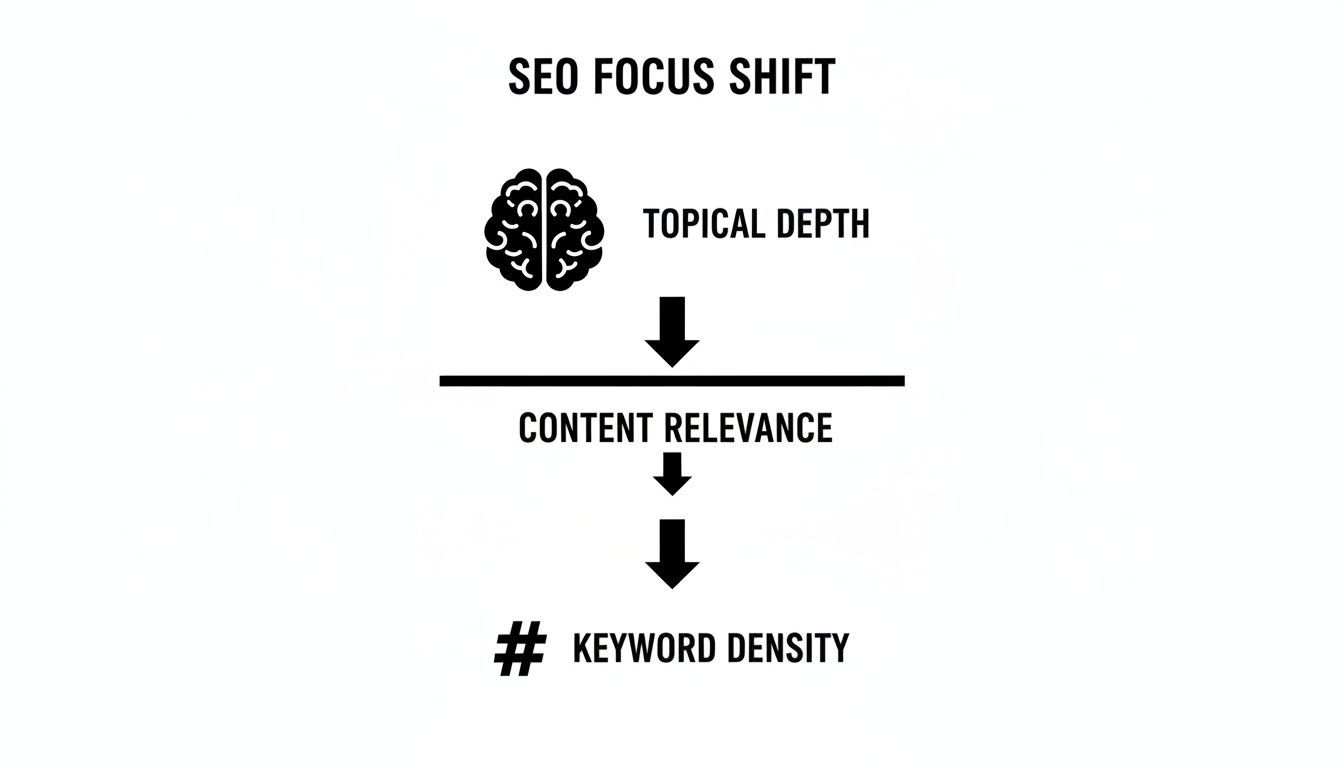
As the graphic shows, today's SEO is all about deep, contextual understanding. The old, formulaic approach just doesn't cut it anymore.
How to Build Your First Keyword Cluster
Putting together a keyword cluster isn't guesswork; it's a systematic process of discovery and organization. You start with a big idea and then drill down until you have a tight-knit group of related terms that all point to the same user need.
The process usually breaks down into these four steps:
- Identify Your Parent Topic: Kick things off with a high-level keyword that captures the page's main theme. It should have decent search volume and, most importantly, align with your business goals. For an e-commerce site selling coffee, a great parent topic might be "cold brew coffee."
- Uncover Child Keywords: Now, fire up your keyword research tool and find all the related queries. Dig into questions, long-tail variations, and the "people also ask" section on Google. For "cold brew coffee," you’d likely find terms like "how to make cold brew concentrate," "cold brew ratio," and "best coffee beans for cold brew."
- Group by Search Intent: This is the most important step, so don't skip it. Analyze the search results for each of your child keywords. If you see the same top-ranking pages showing up for multiple keywords, that's Google telling you it views them as part of the same topic. Keywords like "cold brew recipe" and "how to make cold brew" clearly share the same informational intent and belong together.
- Map the Cluster to a Single Page: Once you have your cluster validated by intent, you can confidently build one piece of content that answers all of those related questions. This page becomes your definitive guide—your pillar page—for that topic.
By focusing on intent-based clusters, you stop chasing individual keyword rankings and start building topical authority. A single well-executed page can attract traffic from hundreds of related searches because it provides the comprehensive answer users and search engines are looking for.
This approach is so much more efficient and powerful than creating dozens of thin, competing pages. Of course, using a specialized tool can make a world of difference. To see how technology can streamline this, check out our guide on using an SEO content optimizer to find clusters and structure your articles.
Strategically Placing Keywords for Maximum Impact
Knowing what keywords to use is only half the battle. The real secret sauce is knowing where to put them. Think of your webpage as a piece of prime real estate—some spots are just way more valuable than others for catching the eye of both users and search engines. Your job isn't to cram keywords into every nook and cranny, but to place them in these high-visibility locations where they send the strongest possible signals about your page's relevance.
This isn’t about trying to game the system; it's just about clear communication. When you put your primary keyword in these key spots, it’s like putting up a big, bright signpost. It tells Google exactly what your page is about and, just as importantly, reassures visitors that they've landed in the right spot. This is a core part of effective SEO copywriting, making sure your message is crystal clear from the very first glance.

Pinpointing Your High-Value Placement Zones
Let's get straight to it. Certain elements on a page carry a lot more weight with search engines. By strategically placing your primary and most important secondary keywords here, you give your content its best shot at ranking.
Here’s your checklist for the most critical spots:
- SEO Title Tag: This is, without a doubt, the most important place for your primary keyword. It's that blue link people see in the search results and the title that shows up in their browser tab. Putting your keyword here has a massive impact on both click-through rates and rankings.
- Meta Description: While it's not a direct ranking factor, the meta description is your sales pitch in the search results. Including your keyword here confirms your page is relevant and gives users a compelling reason to click your link instead of a competitor's.
- Main Heading (H1 Tag): Your H1 is the main headline on the page. It needs to include your primary keyword and clearly state the page's purpose, delivering on the promise you made in the SEO title.
- The First 100 Words: This is a classic on-page SEO move for a reason. Placing your primary keyword within the first paragraph—ideally the first 100 words—instantly confirms the topic for both your readers and search engine crawlers.
Weaving Keywords into Your Content Naturally
Beyond those critical zones, your secondary and long-tail keywords should be woven naturally throughout the body of your content. This is where you really start to build topical depth and show your expertise.
The best keyword placement feels completely invisible. The goal is a seamless reading experience where keywords appear as a natural part of the conversation, not as forced, awkward interruptions.
Your subheadings (H2s and H3s) are perfect homes for your secondary keywords and any question-based phrases you're targeting. This not only breaks up your text and makes it easier to scan but also helps search engines understand the structure and hierarchy of your information. The same goes for image alt text; describing your images with relevant keywords gives Google another contextual clue.
Of course, to make all this work, you need to make sure your website's backend is set up correctly. Following SEO best practices for your CMS is crucial, as it ensures your on-page efforts are built on a solid technical foundation.
Modern Guidelines on Keyword Frequency
The days of obsessing over rigid keyword density rules are long gone. Thank goodness. Still, it's helpful to have a general guideline. Today, a flexible range of 0.5% to 2% keyword density is a good rule of thumb, though you'll often see top-performing pages using even fewer.
For a 1,000-word article, that means using your primary keyword just 5-20 times. Research from 2025 even shows that a single, well-placed keyword in the title tag can often outperform a page where the term is repeated excessively. It just goes to show that in the debate over how many keywords to target per page, smart placement will always win over sheer quantity.
How to Avoid Keyword Cannibalization
Competing with yourself is one of the most frustrating yet fixable mistakes you can make in SEO. This problem, known as keyword cannibalization, pops up when multiple pages on your site are all trying to rank for the same primary keyword and user intent. When this happens, you’re basically asking Google to pick a favorite among your own pages.
Imagine sending two of your best salespeople to pitch the same client. They’d likely step on each other's toes, confuse the client, split the commission, and ultimately weaken the sale. That's exactly what keyword cannibalization does to your SEO—it dilutes your authority, splits traffic and backlinks, and muddies the waters for search engines, often causing both pages to rank lower than they should.
Identifying Cannibalization in Your Content
The first step, as always, is figuring out if you even have a problem. You might be dealing with cannibalization if you see rankings for a core keyword bouncing around like a yo-yo, or if you notice different URLs swapping in and out of the top spots in the search results. These are tell-tale signs that Google can't decide which page is the definitive resource for a query.
You can usually sniff this out in Google Search Console. Just head to the "Performance" report and filter it down to a specific query you think is causing trouble. Next, click over to the "Pages" tab. If you see more than one URL getting a decent number of impressions and clicks for that single query, you've probably found your culprit.
Keyword cannibalization isn't just some technical glitch; it's a breakdown in your content strategy. A well-organized site gives every page a unique job and a clear user intent. Fixing these overlaps is about more than just rankings—it’s about strengthening your website's entire foundation.
Let's say you run a fitness blog and both "/best-cardio-workouts" and "/cardio-exercises-for-beginners" are showing up for the term "best cardio workouts." You've got a classic conflict on your hands. The user's goal is practically identical for both, so your content is essentially fighting itself for the spotlight.
Practical Solutions to Fix the Problem
Once you’ve pinpointed a cannibalization issue, you have a few solid ways to fix it. The right move depends on the content itself and what you're trying to achieve. And don't worry—this doesn't mean you have to delete all your hard work. It's more about consolidating your power.
To help you get started, this table outlines the common issues and their fixes.
Fixing Keyword Cannibalization Issues
| Issue | How to Identify | Solution |
|---|---|---|
| Competing Blog Posts | Two or more articles rank for the same primary keyword (e.g., "how to bake sourdough bread" and "sourdough bread for beginners"). | Merge and Redirect. Combine the best parts of both articles into the stronger-performing one. Then, apply a 301 redirect from the weaker URL to the new, comprehensive page. |
| Blog Post vs. Product Page | An informational blog post is outranking a transactional product page for a commercial keyword (e.g., a "what is a standing desk" post ranks for "buy standing desk"). | Re-optimize and Differentiate. Sharpen the focus of each page. Add more commercial terms ("buy," "sale," "deals") to the product page. Beef up the informational content on the blog post and link it to the product page. |
| Similar Product/Service Pages | Multiple service pages target nearly identical terms (e.g., "/seo-services-for-small-business" and "/small-business-seo-packages"). | Consolidate or Canonicalize. If the pages are truly redundant, merge them into one authoritative page and redirect the other. If they must remain separate, use a canonical tag on the weaker page pointing to the preferred one. |
| Homepage vs. Internal Page | Your homepage is ranking for a specific, long-tail keyword that an internal page should be ranking for instead. | Strengthen Internal Linking. Add more internal links from relevant pages (including the homepage) to the target internal page using keyword-rich anchor text. This signals to Google which page is the true expert on that topic. |
Here’s a deeper dive into the most effective solutions:
Merge and Consolidate: This is usually your best bet. Figure out which page is the stronger performer—the one with more traffic, better backlinks, or higher conversion rates. Take the best content from the weaker page and fold it into the stronger one to create a single, powerhouse resource.
Redirect the Weaker Page: After merging the content, set up a permanent (301 redirect) from the old, weaker URL to the newly consolidated one. This is a critical step. It tells search engines that the page has moved for good and passes most of its authority over to your new, stronger page.
Re-Optimize and Differentiate: Sometimes, both pages are valuable but serve slightly different purposes. If that's the case, you don't want to merge them. Instead, sharpen the focus of each one. For our cardio example, you could tweak one page to target "best cardio workouts at home" and the other to target "gym cardio exercises for beginners." Now, each has a unique, distinct purpose.
By systematically finding and fixing these content overlaps, you build a much cleaner, more powerful site structure. Every page gets a clear job to do, which sends strong, unambiguous signals to search engines about what your content is about and why it deserves to be at the top. This focused approach is the key to mastering how many keywords per page you should target—and ensuring every single page pulls its own weight.
Frequently Asked Questions About Keyword Optimization
Even with a solid strategy, you'll always bump into practical questions when the rubber meets the road. Let's tackle some of the most common follow-ups I hear about keyword optimization so you can move forward with confidence. These are the direct, no-fluff answers you need to handle the nuances of modern SEO.
How Many Secondary Keywords Should I Use?
This is a classic question, but the truth is, it’s the wrong one to ask. Instead of aiming for a magic number like "10 secondary keywords," you need to shift your focus to comprehensiveness. The real goal is to cover a topic so thoroughly that you answer every related question a user might have.
A good keyword research process will naturally uncover anywhere from 5 to 15+ highly relevant secondary keywords, long-tail questions, and related terms for a single core topic. Don't think of these as a checklist. See them as guideposts for building out your content outline.
Think about it: a page on "how to bake sourdough bread" is pretty useless if it doesn't also touch on "sourdough starter feeding schedule" or "what is autolyse." The number of secondary keywords you end up using is just a side effect of how well you’ve covered the topic. Focus on creating the most helpful resource possible, and the right number will just fall into place.
Is It Bad to Use My Primary Keyword Only a Few Times?
Not at all. In fact, it's often a sign that you're doing modern SEO the right way. The old days of cramming your exact-match phrase into a page over and over again are long gone. Thank goodness.
If you’ve placed your primary keyword strategically in high-impact spots—like the SEO title, H1 heading, and your opening paragraph—you've already done most of the heavy lifting. From there, search engines like Google use topical relevance and natural language to figure out what your page is about.
The quality and depth of your content are far more powerful ranking signals than just repeating a keyword. A page that completely covers a topic using synonyms, variations, and related concepts will almost always beat a page that awkwardly stuffs the same phrase everywhere.
Trust the process. If your content is genuinely an expert guide on its topic, search engines are smart enough to get it without you needing to shout it at them. This also creates a much better reading experience, which is a massive ranking factor in itself. For a deeper dive into how this all works, check out our guide on understanding organic search keywords.
Can One Page Rank for Two Different Primary Keywords?
It's possible, but it’s a very specific scenario. A single page can successfully rank for two distinct "primary" keywords if—and this is a big if—they share nearly identical search intent. The user is essentially looking for the exact same thing, just typing it in a different way.
A perfect example is "how to fix a leaky faucet" and "leaky faucet repair guide." Someone searching for either of those wants the same result: a step-by-step tutorial on how to stop a drip. In this case, one comprehensive page can and absolutely should rank for both.
But this is where a lot of people go wrong. If the intent behind the keywords is even slightly different, you are much better off creating separate pages. Trying to force two distinct topics onto one page is just a recipe for ranking for neither.
Take the keywords "best running shoes" (commercial investigation) and "how to choose running shoes" (informational). They’re related, sure, but they serve different needs. Mashing them into one article usually creates content that doesn't fully satisfy either searcher, so it ends up ranking poorly for both.
When in doubt, split them out. Creating separate pages avoids keyword cannibalization and gives each page a crystal-clear purpose, making it far more likely to rank for its target query.
Ready to stop guessing and start dominating topics with precision? Sight AI is the AI visibility and content platform that turns complex keyword strategy into a simple, automated workflow. Our specialized AI agents research, outline, and write SEO-optimized articles that rank, so you can build topical authority and drive organic traffic on autopilot. https://www.trysight.ai