Search has evolved beyond blue links and meta descriptions. When someone asks ChatGPT for marketing tool recommendations or queries Perplexity about content optimization strategies, the AI doesn't return a list of websites to click—it synthesizes an answer, often mentioning specific brands by name. If your brand isn't part of that answer, you've just lost a potential customer to a competitor who optimized for this new reality.
This is generative search, and it's fundamentally reshaping how users discover brands and information online. Instead of scrolling through search results, users receive direct, synthesized responses from AI models like ChatGPT, Claude, Perplexity, and Google's AI Overviews. For marketers and founders, this shift presents both a challenge and an opportunity: your content must now be structured and optimized not just for traditional search crawlers, but for the large language models that power these AI-driven experiences.
The good news? You can influence which brands AI models mention and recommend. This guide walks you through the exact steps to optimize your content for generative search, helping your brand get mentioned, cited, and recommended when AI models respond to user queries. Whether you're starting from scratch or refining an existing strategy, you'll learn how to audit your current AI visibility, restructure content for LLM comprehension, and track your progress over time.
Step 1: Audit Your Current AI Visibility and Brand Mentions
Before you can improve your AI visibility, you need to know where you stand today. This baseline assessment reveals which AI platforms mention your brand, under what contexts, and—crucially—where competitors appear instead of you.
Start by querying your brand name across the major AI platforms: ChatGPT, Claude, Perplexity, and Google's AI Overviews. But don't just search for your brand in isolation. Ask questions that potential customers would actually ask: "What are the best tools for [your category]?" or "How do I solve [problem your product addresses]?" These queries reveal whether AI models associate your brand with the solutions you provide.
Document every mention systematically. Create a spreadsheet tracking which prompts trigger your brand name, how you're described, the sentiment of mentions, and whether you appear alongside competitors. Pay special attention to the context—are you mentioned as a leader, an alternative, or just part of a generic list?
The gaps matter most. Identify queries where your brand should logically appear but doesn't. If you're a project management tool and ChatGPT recommends five competitors without mentioning you, that's not an accident—it's an optimization opportunity. Understanding why competitors are ranking in AI search results helps you identify what they're doing differently and where you need to improve.
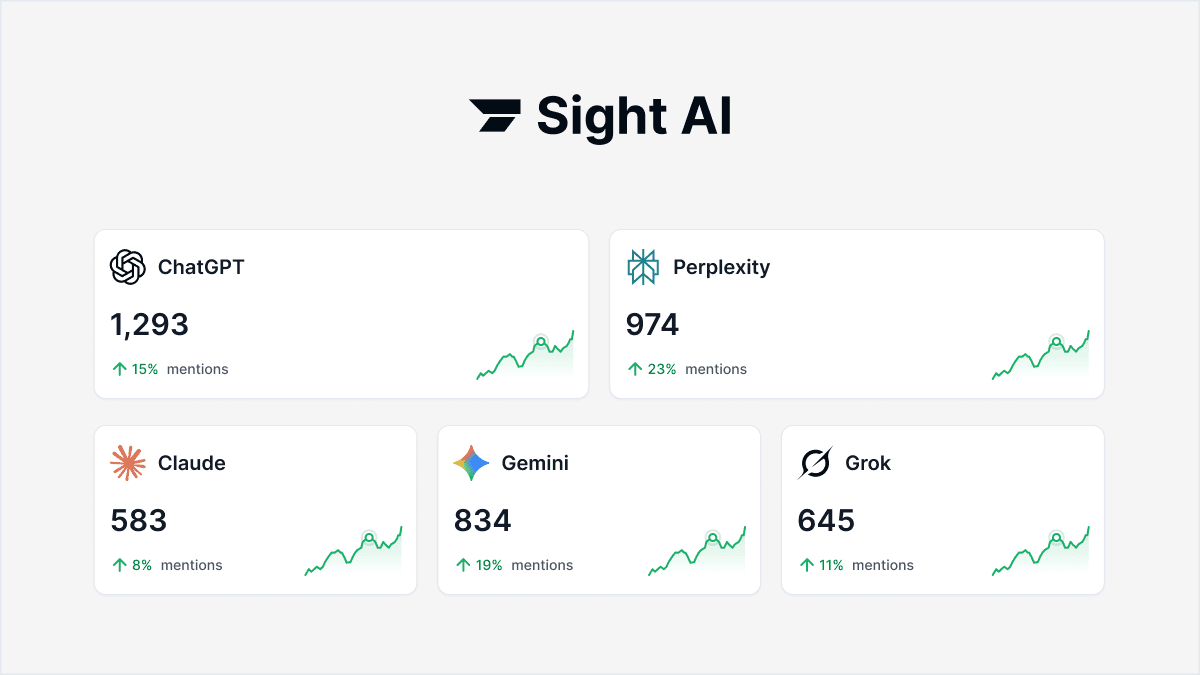
Manual querying works for initial assessment, but it doesn't scale. AI models update regularly, and your visibility can shift as they process new training data. This is where AI visibility tracking tools become essential. Platforms that monitor brand mentions across multiple AI models automate this process, tracking sentiment, citation frequency, and competitive positioning over time. This ongoing monitoring turns AI visibility from a one-time audit into a continuous optimization process.
Think of this step as your diagnostic phase. You're establishing the baseline that everything else builds on. Without knowing where you currently stand, you can't measure improvement or identify which optimization tactics actually move the needle.
Step 2: Research How AI Models Source and Synthesize Information
Understanding how large language models work changes how you create content. These models don't simply regurgitate information—they synthesize it from patterns they've learned across billions of documents. Your job is to become part of those patterns.
LLMs prioritize authoritative, well-structured, and frequently cited content. When an AI model encounters your content multiple times across different contexts, especially when it's linked to and referenced by other authoritative sources, it strengthens the association between your brand and relevant topics. This isn't about gaming the system—it's about creating genuinely valuable content that naturally gets cited.
Analyze the content that currently gets cited for your target topics. When you query AI models about your industry, which brands and resources do they reference? Study those pieces carefully. Note their format, depth, structure, and how they present information. Are they comprehensive guides? Quick reference lists? Comparison tables? Understanding the key AI search engine ranking factors reveals what LLMs find easiest to parse and cite.
Different query types require different content approaches. Informational queries ("What is generative search?") benefit from clear, definitive explanations. Comparison queries ("ChatGPT vs Claude for research") need structured breakdowns of differences. Recommendation queries ("Best AI tools for marketers") reward content that explicitly positions solutions for specific use cases.
Map your content gaps against what AI models currently recommend to competitors. If Perplexity consistently cites a competitor's comparison guide when users ask about your product category, you need a better comparison guide. If ChatGPT references a competitor's tutorial for a common use case, you need more comprehensive how-to content.
This research phase prevents wasted effort. Instead of creating content based on assumptions, you're building exactly what AI models need to cite you as an authoritative source. You're reverse-engineering AI visibility by studying what already works.
Step 3: Structure Content for LLM Comprehension
AI models don't read content the way humans do. They parse structure, extract key information, and identify patterns that signal authority and relevance. Your content structure directly impacts whether an LLM can understand, extract, and cite your information.
Start with clear hierarchical headings that directly answer common questions. Instead of clever, abstract H2 headings, use explicit question-and-answer formats: "How Does AI Visibility Tracking Work?" rather than "The Visibility Revolution." LLMs scan these headings to understand content organization and can extract them as direct answers to user queries.
Lead each section with definitive statements that can stand alone as answers. The first sentence after a heading should provide a complete, quotable response. Think of it as writing for featured snippets—but for AI models instead of Google. "AI visibility tracking monitors how often and in what context AI models mention your brand across platforms like ChatGPT, Claude, and Perplexity" works better than a paragraph that eventually gets to the point.
Include structured data that LLMs can easily parse and cite. Numbered lists, comparison tables, and step-by-step processes provide clear frameworks that AI models can extract and reformat in their responses. When you present "5 Ways to Improve AI Visibility," that structure makes it simple for an LLM to synthesize your content into a coherent answer. For a deeper dive into formatting approaches, explore proven strategies to optimize content for AI models.
The llms.txt standard is gaining adoption as a way to help AI crawlers understand your site structure. This simple text file, placed in your site's root directory, provides a roadmap of your most important content, similar to how robots.txt guides traditional crawlers. While not yet universally adopted, implementing llms.txt signals to AI systems which pages represent your core expertise and should be prioritized for citation.
Clean, semantic HTML matters too. Proper use of heading tags, paragraph structure, and list formatting helps LLMs extract information accurately. Avoid relying on visual formatting alone—what looks structured to human eyes might be meaningless to an AI model if the underlying HTML doesn't reflect that structure.
Step 4: Build Topical Authority Through Comprehensive Coverage
AI models don't cite brands that wrote one good article about a topic. They cite brands that demonstrate consistent, comprehensive expertise across multiple dimensions of that topic. Building topical authority means becoming the go-to source that LLMs learn to associate with your subject area.
Create content clusters that cover your core topics from multiple angles and intent types. If your focus is content marketing, don't just write about strategy—cover tools, metrics, common mistakes, industry trends, case study analyses, and implementation guides. Each piece reinforces your expertise while targeting different user intents and query types. Understanding search intent in SEO helps you create content that matches what users actually need at each stage of their journey.
Develop pillar pages that serve as authoritative resources AI models can reference. These comprehensive guides should cover a topic thoroughly enough that an LLM could extract valuable information regardless of the specific question asked. A 3,000-word pillar page on "Content Marketing Strategy" provides more citation opportunities than three 1,000-word surface-level articles.
Internal linking reinforces your expertise signals across related content. When your pillar page links to supporting articles, and those articles link back to the pillar and to each other, you create a web of topical authority. LLMs that process your content recognize these connections, understanding that you've built a knowledge network rather than isolated articles.
Freshness signals matter to AI models. Content that gets regularly updated signals ongoing expertise and relevance. Understanding how content freshness signals impact search helps you prioritize which pages to update and how often. Set a schedule to review and refresh your core content quarterly. Add new sections addressing emerging trends, update statistics, and expand on topics that have evolved.
Think of topical authority as building a reputation with AI models. The more consistently you demonstrate expertise across a topic area, the more likely LLMs are to cite you when synthesizing answers related to that topic.
Step 5: Optimize for Entity Recognition and Brand Association
Large language models think in entities—people, brands, products, concepts—and the relationships between them. For your brand to appear in AI-generated responses, the model must recognize you as an entity and associate you with relevant categories, solutions, and use cases.
Consistently use your brand name alongside key product categories and use cases throughout your content. Don't just say "our platform"—say "Acme Analytics, the customer behavior tracking platform." This repetition helps LLMs build strong associations between your brand name and what you do. When someone asks an AI model about customer behavior tracking, you want your brand entity to activate in the model's response.
Build entity associations by appearing in industry roundups, comparisons, and expert content. When authoritative sites mention your brand in "Top 10" lists, comparison articles, or industry analyses, LLMs encounter your brand in contexts that signal credibility and relevance. These third-party mentions are particularly valuable because they come from sources the AI model already trusts.
Earn mentions and citations from authoritative sources that LLMs already trust. Contributing expert commentary to industry publications, participating in research studies, and getting featured in reputable media outlets creates citation pathways. Learning how to optimize for AI recommendations helps you understand which citation sources carry the most weight with different AI models.
Create content that positions your brand as the answer to specific problem-solution queries. Instead of generic thought leadership, write articles that explicitly connect problems to your solution: "How to Track Customer Behavior Without Privacy Violations" positions your brand as the solution to a specific challenge. When AI models process these problem-solution patterns, they learn to recommend your brand for those specific use cases.
Entity optimization is about making it easy for AI models to understand what you do, who you serve, and why you're relevant. The clearer these associations, the more likely LLMs are to mention you when synthesizing answers.
Step 6: Accelerate Content Discovery with Indexing Optimization
Even the best-optimized content can't influence AI models if those models never encounter it. Accelerating content discovery ensures that your optimized pages get processed and incorporated into the knowledge that LLMs draw from when generating responses.
Implement IndexNow to notify search engines immediately when you publish or update content. This protocol, supported by Microsoft Bing and Yandex, tells search engines about new or changed content in real-time rather than waiting for crawlers to discover it organically. Understanding the differences between IndexNow and Google Search Console helps you choose the right approach for your indexing strategy.
Maintain clean, updated sitemaps that reflect your current content structure. Your XML sitemap should include all important pages, be free of broken links, and get updated automatically when you publish new content. Many content management systems handle this automatically, but verify that your sitemap accurately represents your site's current state.
Page speed and mobile optimization affect crawl priority. Search engines allocate crawl budget based partly on site performance—faster sites get crawled more frequently and thoroughly. Since many AI models rely on search engine data for training and retrieval, improving your crawl efficiency indirectly improves your AI visibility potential.
Remove or consolidate thin content that dilutes your site's overall authority signals. Pages with minimal content, duplicate information, or low value can drag down your entire site's perceived quality. A focused site with 50 excellent pages signals more authority than a sprawling site with 500 mediocre pages mixed with good ones.
Technical optimization creates the foundation for AI visibility. You can have the most perfectly structured, authoritative content in your industry, but if AI models never encounter it because of indexing issues, it might as well not exist. This step ensures your optimization efforts actually reach the models you're trying to influence.
Step 7: Track, Measure, and Iterate Your GEO Strategy
Generative Engine Optimization isn't a one-time project—it's an ongoing process of measurement, learning, and refinement. AI models evolve, competitors adjust their strategies, and user query patterns shift. Systematic tracking turns GEO from guesswork into a data-driven discipline.
Set up regular monitoring of brand mentions across multiple AI platforms. Don't just check once and assume nothing changes. AI models get updated, retrained, and fine-tuned regularly. What worked last month might not work this month. Weekly or bi-weekly monitoring helps you spot trends early and respond to changes before they become problems.
Track which content pieces drive the most AI citations and analyze their common characteristics. When you notice certain articles getting mentioned frequently by AI models, study what makes them citation-worthy. Is it the format? The depth? The way headings are structured? The inclusion of specific data points? These patterns reveal what resonates with LLMs and should inform your future content creation.
Test content structures and formats to identify what works best for generative search. Try different approaches: comparison tables versus narrative comparisons, Q&A format versus traditional article structure, comprehensive guides versus focused how-tos. Leveraging the right AI search optimization tools helps you track which formats generate more AI citations so you can double down on what works.
Monitor competitor movements and changes in AI model behavior. When a competitor suddenly starts appearing in AI responses where they didn't before, investigate what changed. Did they publish new content? Restructure existing pages? Earn new citations? Understanding competitive shifts helps you stay ahead rather than react after you've lost visibility.
Build feedback loops between your tracking data and your content strategy. If you notice AI models consistently cite your comparison content but rarely mention your thought leadership pieces, adjust your content mix accordingly. Let the data guide your resource allocation toward what actually drives AI visibility.
The brands winning at generative search aren't necessarily the ones with the biggest budgets or the most content. They're the ones measuring what matters and iterating based on real AI visibility data rather than assumptions.
Putting It All Together
Optimizing for generative search requires a fundamental shift in mindset from keyword-centric SEO to entity-focused, authority-building content strategy. Traditional SEO asked "What keywords should I rank for?" Generative Engine Optimization asks "How do I become the brand AI models recommend when users ask questions in my space?"
The seven steps in this guide form a complete system: audit your current AI visibility to establish a baseline, research how AI models source information to understand what works, structure content for LLM comprehension to make citation easy, build topical authority to demonstrate expertise, optimize for entity recognition to strengthen brand associations, accelerate content discovery to ensure AI models encounter your content, and track your progress to iterate based on data.
Start with Step 1 today. Query your brand across ChatGPT, Claude, and Perplexity to see where you stand. Ask the questions your potential customers ask. Document which competitors appear and in what contexts. This baseline assessment takes less than an hour but reveals exactly where you need to focus your optimization efforts.
Then work through each step systematically, measuring progress as you go. You don't need to perfect every step before moving to the next—progress beats perfection. Implement llms.txt while you're building your content clusters. Optimize entity associations while you're improving your indexing. The steps reinforce each other, and momentum builds as you advance.
The brands that optimize for generative search now will capture the visibility that others lose as AI-driven discovery becomes the norm. Every day you wait is another day your competitors build AI visibility while you remain invisible to the millions of users asking AI models for recommendations in your space.
Start tracking your AI visibility today and see exactly where your brand appears across top AI platforms. Stop guessing how AI models like ChatGPT and Claude talk about your brand—get visibility into every mention, track content opportunities, and automate your path to organic traffic growth. The future of search is already here. Make sure your brand is part of it.