A Fortune 500 marketing director discovers their million-dollar brand doesn't exist in ChatGPT's recommendations, while smaller competitors dominate AI-generated advice across multiple models. Their traditional SEO rankings remain strong. Their social media mentions are healthy. Their brand monitoring dashboard shows positive sentiment across all tracked channels.
But when potential customers ask AI assistants for product recommendations, their brand simply isn't part of the conversation.
This isn't a hypothetical scenario. It's happening right now to established brands across every industry. The fundamental shift from search engine optimization to AI model optimization represents a paradigm change in brand visibility that most companies haven't even begun to address. While traditional brand monitoring tools track social media mentions, search rankings, and web traffic, they completely miss the growing channel of AI-generated recommendations that increasingly influence purchase decisions.
When consumers ask ChatGPT, Claude, or Perplexity for product recommendations, software comparisons, or service providers, brands either appear in those responses or they don't. There's no "page 2" in an AI response. There's no opportunity to optimize your way onto the first screen of results. You're either part of the AI's knowledge base and recommendation patterns, or you're invisible to an entire channel of potential customers.
The challenge extends beyond simple visibility. Different AI models exhibit distinct biases, preferences, and recommendation patterns based on their unique training data and algorithms. Your brand might dominate ChatGPT recommendations while remaining completely absent from Claude's responses for identical queries. This fragmented landscape creates blind spots that traditional single-platform monitoring can't address.
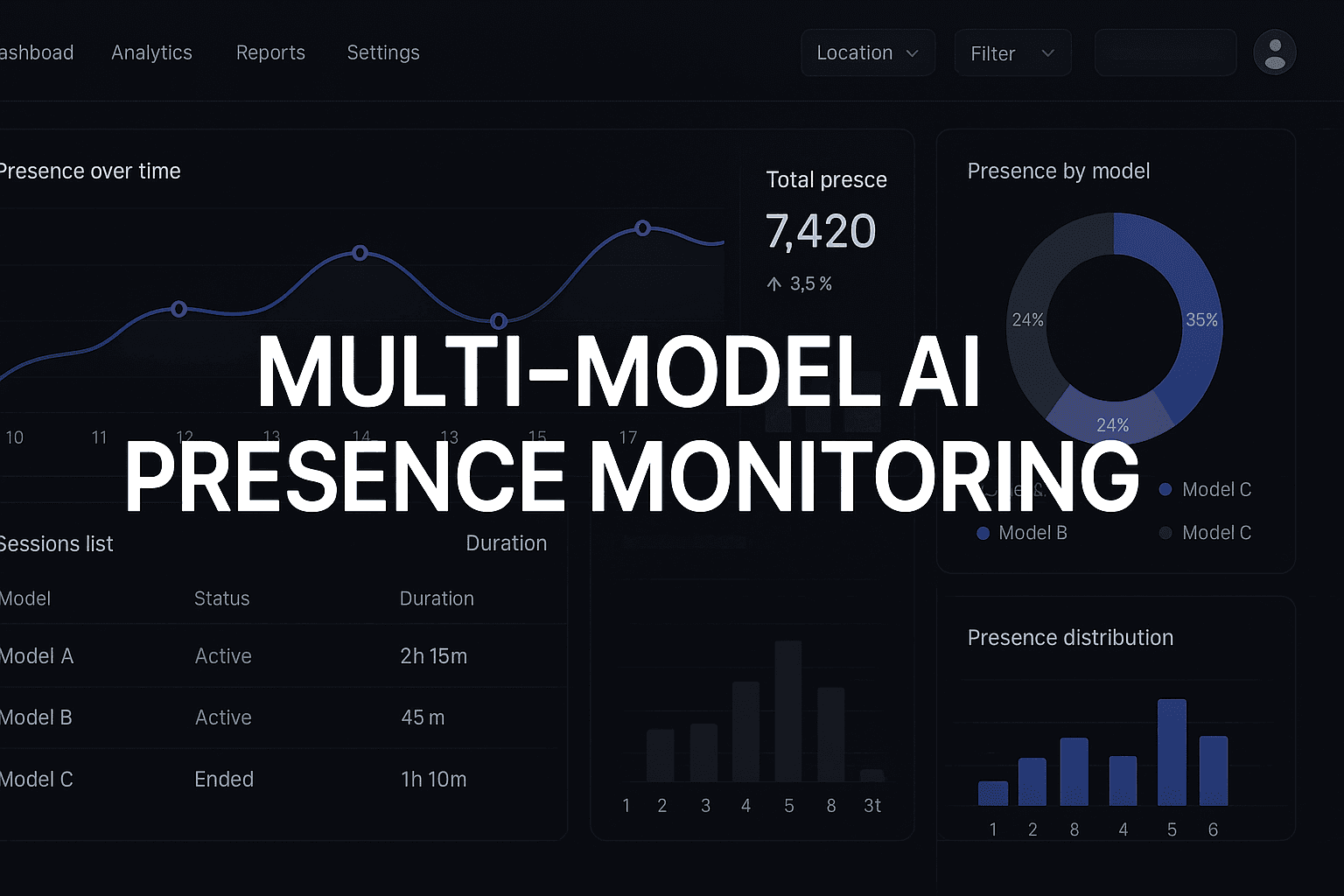
Multi-model AI presence monitoring solves this visibility crisis by tracking how your brand appears across multiple AI platforms simultaneously. It reveals not just whether you're mentioned, but how you're positioned relative to competitors, what contexts trigger recommendations, and which AI models favor your brand versus alternatives. This comprehensive intelligence enables proactive brand management in the AI-first discovery era.
Here's everything you need to know about multi-model AI presence monitoring—from understanding why it matters to implementing a systematic monitoring strategy that protects your brand visibility across the AI ecosystem. You'll discover how different AI models make recommendation decisions, what monitoring infrastructure you need, and how to translate visibility insights into actionable content optimization strategies that ensure your brand remains part of the AI-driven conversation.
Decoding Multi-Model AI Presence Monitoring for Modern Brands
Multi-model AI presence monitoring tracks how your brand appears across multiple AI platforms—ChatGPT, Claude, Perplexity, and emerging models—analyzing not just whether you're mentioned, but how you're positioned, what contexts trigger recommendations, and how sentiment varies across different AI ecosystems. Think of it as brand visibility insurance for the AI age, where being absent from AI recommendations means being invisible to an entire channel of potential customers.
This represents a fundamental evolution beyond traditional ai brand monitoring, which tracks social media mentions, search rankings, and web traffic. Those conventional tools completely miss the growing channel of AI-generated recommendations that increasingly influence purchase decisions. When someone asks ChatGPT for software recommendations or queries Claude about industry best practices, traditional monitoring systems have no visibility into whether your brand appears in those responses.
Beyond Traditional Brand Monitoring
Traditional brand monitoring operates in a reactive mode, tracking what people say about your brand after they've already discovered you through search engines or social media. AI presence monitoring operates proactively, revealing whether potential customers even encounter your brand during their AI-assisted discovery process.
The distinction matters because AI interactions follow different patterns than search behavior. When someone searches Google, they expect to evaluate multiple sources across several pages of results. When they ask an AI model for recommendations, they often trust the first few suggestions provided. There's no "page 2" in an AI response—you're either part of the conversation or you're not.
Sentiment analysis also requires completely different approaches for AI responses versus social media posts. A negative tweet might use explicit criticism, while an AI model might subtly position your brand as a conditional recommendation ("Brand X works well for basic use cases, but consider Brand Y for advanced needs"). Understanding these nuanced positioning patterns requires specialized analysis calibrated for AI response structures.
The Multi-Model Imperative
Different AI models exhibit distinct recommendation patterns based on their unique training data, algorithms, and design philosophies. ChatGPT tends toward popular, well-documented solutions with broad market recognition. Claude shows preference for nuanced, context-specific recommendations with strong analytical depth. Perplexity emphasizes recent information and source credibility in its responses.
These differences create fragmented visibility landscapes where your brand might dominate recommendations in one AI platform while remaining completely absent from another. A B2B software company could rank highly in Claude's recommendations for technical implementation scenarios but rarely appear in ChatGPT responses for the same industry queries. Without multi-model monitoring, you'd never discover this disparity or the optimization opportunities it represents.
Consumer behavior also varies across AI platforms based on use case and demographics. Technical professionals might prefer Claude for detailed analysis, while general consumers default to ChatGPT for quick recommendations. Missing visibility in any single model means missing entire audience segments who rely on that platform for decision-making guidance.
Real-Time Visibility Intelligence
Advanced monitoring systems provide more than simple mention tracking. They deliver real-time intelligence on sentiment trends, context categorization, and competitive positioning across all monitored models simultaneously. Understanding real-time brand perception in ai responses enables proactive management of how AI models character
Beyond Traditional Brand Monitoring
Multi-model AI presence monitoring represents the evolution of traditional ai brand monitoring, extending visibility tracking beyond social media and search engines into the AI recommendation ecosystem. While traditional monitoring tools track mentions across social platforms and news sites, they completely miss AI-generated recommendations that increasingly influence purchase decisions.
The fundamental difference lies in how AI models function as recommendation engines rather than discovery platforms. When someone searches Google for "best project management software," they receive a list of results to evaluate. When they ask ChatGPT the same question, they receive curated recommendations with explanations—and they often trust that first response without further research.
Traditional brand monitoring tools weren't designed for this paradigm. They track sentiment in social media posts, count website mentions, and analyze review site ratings. But they can't tell you whether ChatGPT recommends your brand when someone asks for software solutions. They can't reveal that Claude consistently suggests your competitor instead of you for specific use cases. They miss the entire conversation happening inside AI chat interfaces.
This creates dangerous blind spots in your competitive intelligence. Your brand might have overwhelmingly positive sentiment on Twitter, strong search rankings, and excellent review site ratings—yet remain completely absent from AI recommendations that drive actual purchase decisions. A competitor with weaker traditional metrics could dominate AI visibility simply because their content better aligns with how AI models make recommendations.
The sentiment analysis challenge compounds this problem. Traditional tools analyze social media tone and review sentiment using straightforward positive/negative classification. AI responses require understanding nuanced context—whether your brand appears as a strong recommendation, a conditional suggestion, or a warning against certain use cases. The same brand mention can be positive in one AI response context and negative in another, depending on the specific query and competitive landscape.
Consider a cybersecurity software company with excellent social media sentiment and strong review site ratings. Traditional monitoring shows healthy brand perception. But when potential customers ask AI models about cybersecurity solutions for small businesses, the brand never appears—AI models consistently recommend enterprise-focused competitors instead. The company's content optimization focused on traditional SEO signals rather than the semantic relevance patterns that influence AI recommendations.
Multi-model monitoring closes these gaps by systematically tracking how your brand appears across AI platforms in response to relevant queries. It reveals not just whether you're mentioned, but how you're positioned relative to competitors, what contexts trigger recommendations, and which AI models favor your brand versus alternatives. This intelligence enables proactive optimization rather than reactive crisis management.
Understanding real-time brand perception in ai responses enables proactive management of how AI models characterize your brand across different contexts and use cases. This real-time intelligence allows you to detect perception shifts before they impact business outcomes, enabling rapid content optimization and competitive positioning adjustments.
The shift from traditional monitoring to multi-model AI presence monitoring isn't optional—it's essential for maintaining competitive visibility as consumer behavior evolves. Brands that continue relying solely on traditional monitoring tools are operating with incomplete intelligence, missing the growing channel where purchase decisions increasingly begin.
The Multi-Model Imperative
Here's the uncomfortable truth: ChatGPT might love your brand while Claude has never heard of you. And that's not a hypothetical—it's the reality of AI-driven brand visibility in 2026.
Different AI models operate like parallel universes, each with distinct recommendation patterns, training data biases, and content preferences. When you ask ChatGPT, Claude, and Perplexity the same product recommendation question, you'll often get three completely different brand lists. This isn't a bug—it's a fundamental characteristic of how these models were trained and how they process information.
ChatGPT tends to favor well-documented, popular solutions with extensive online presence. Its training data emphasizes breadth of coverage, which means established brands with significant digital footprints typically dominate recommendations. Claude, by contrast, shows preference for nuanced, context-specific recommendations and often surfaces innovative solutions that might have less market share but stronger technical merit. Perplexity emphasizes recent information and source credibility, making it particularly sensitive to current content quality and authoritative citations.
This creates a strategic challenge that single-model monitoring simply cannot address. A B2B software company might discover they rank highly in Claude's recommendations for technical implementation queries—their detailed documentation and nuanced use case explanations align perfectly with Claude's preferences. But those same strengths might not translate to ChatGPT visibility, where broader market recognition and simpler explanatory content perform better. Meanwhile, Perplexity might favor them for certain queries based on recent case studies and press coverage that the other models haven't incorporated.
The business implications extend beyond simple visibility metrics. Consumer behavior varies significantly across AI platforms based on use case and demographics. Technical buyers often prefer Claude for detailed product comparisons. General consumers default to ChatGPT for quick recommendations. Researchers and analysts gravitate toward Perplexity for sourced information. If your brand only appears in one model's recommendations, you're invisible to entire customer segments who prefer different AI platforms.
Model-specific training data creates unique visibility opportunities and risks that demand comprehensive monitoring. Each AI model's knowledge cutoff date, training corpus composition, and algorithmic preferences create distinct recommendation ecosystems. Your competitors might be dominating Claude recommendations while you focus exclusively on ChatGPT optimization—and you'd never know without multi-model monitoring coverage.
This fragmentation means single-model monitoring provides dangerously incomplete competitive intelligence. You might celebrate strong ChatGPT visibility while missing the fact that emerging competitors are capturing market share through Claude and Perplexity recommendations. You might optimize content for one model's preferences while inadvertently reducing visibility in others. Without comprehensive coverage, you're making strategic decisions based on partial data—and your competitors who monitor all models have a decisive information advantage.
The solution requires systematic monitoring across all major AI platforms, tracking not just whether your brand appears but how recommendation patterns differ between models. This reveals optimization opportunities specific to each platform's preferences and ensures you're not leaving entire market segments unaddressed. Multi-model monitoring transforms from nice-to-have to strategic necessity when you realize that AI recommendation fragmentation creates both competitive threats and untapped opportunities across every platform you're not tracking.
Real-Time Visibility Intelligence
The difference between reactive and proactive brand management comes down to one factor: how quickly you detect changes in your AI visibility landscape. Advanced monitoring systems don't just tell you where your brand appeared yesterday—they alert you the moment sentiment shifts, competitive positioning changes, or new recommendation patterns emerge across multiple AI models simultaneously.
This real-time intelligence transforms AI presence monitoring from a reporting exercise into a strategic advantage. When a competitor launches a content campaign that suddenly dominates Claude's recommendations in your category, you know within hours instead of weeks. When AI models begin associating your brand with outdated solutions or negative contexts, automated alerts trigger immediate response protocols before the perception solidifies across the broader AI ecosystem.
The technical foundation of real-time monitoring relies on three interconnected systems working in concert. First, automated sentiment analysis calibrated specifically for AI response patterns—not social media tone—evaluates whether your brand appears in positive, neutral, or cautionary contexts. Unlike traditional sentiment tools that analyze human-written content, AI-specific sentiment analysis must interpret the nuanced language patterns of AI-generated recommendations, distinguishing between enthusiastic endorsements and qualified suggestions.
Second, sophisticated context categorization systems classify each brand mention by type: strong recommendations, conditional suggestions, competitive comparisons, or warning scenarios. A healthcare technology company might discover their solution appears frequently in AI responses about regulatory compliance but rarely in product recommendation contexts—revealing a positioning problem that requires immediate content strategy adjustment. This granular categorization enables strategic response rather than generic optimization.
Third, prompt engineering intelligence tracks which query patterns trigger brand mentions versus competitor recommendations. When monitoring reveals that your brand dominates responses to technical implementation questions but disappears from high-level strategy discussions, you've identified a content gap that competitors are exploiting. This insight transforms from interesting data point to actionable intelligence when automated systems flag the pattern and suggest specific content opportunities.
The integration of these three systems creates a continuous feedback loop. Real-time dashboards surface visibility trends across models, automated alerts notify teams of significant changes, and historical analysis reveals long-term positioning shifts that inform strategic planning. Marketing teams receive instant notifications when brand sentiment drops across multiple models, enabling rapid response before perception issues compound. Product teams gain visibility into which features AI models emphasize in recommendations, informing roadmap prioritization based on AI-driven market perception.
This proactive intelligence enables crisis prevention and opportunity capture that passive monitoring simply cannot deliver. When AI models begin recommending competitors for use cases where your solution excels, immediate content optimization can recapture that recommendation territory before market share erodes. When emerging topics present thought leadership opportunities, real-time detection allows you to establish authority before competitors recognize the opening.
The strategic value extends beyond defensive brand protection to offensive competitive positioning. Real-time monitoring reveals when competitors experience visibility drops or negative sentiment shifts, creating windows for market share capture through targeted content campaigns. It identifies which AI models show preference for your brand versus alternatives, enabling resource allocation toward platforms where you have natural advantages while addressing weaknesses on others.
Why Multi-Model Monitoring Matters for Your Business
The shift from search engines to AI assistants as primary information sources represents the most significant change in consumer behavior since the rise of mobile. When potential customers ask ChatGPT for software recommendations, query Claude about service providers, or consult Perplexity for product comparisons, they're not browsing multiple options—they're trusting a curated recommendation. Your brand either appears in that response or it doesn't exist in that customer's consideration set.
This binary visibility creates a fundamental business risk that traditional marketing metrics completely miss. Your Google rankings might be strong. Your social media engagement might be healthy. Your brand sentiment might be positive across all monitored channels. But if AI models don't recommend your brand when asked, you're invisible to a rapidly growing segment of potential customers who never make it to your website.
The AI Recommendation Economy
AI-powered recommendations increasingly influence purchase decisions across both consumer and B2B markets. Unlike traditional search where users evaluate multiple sources, AI recommendations carry implicit endorsement—users trust the AI's judgment about which solutions best fit their needs. This creates a direct correlation between AI visibility and revenue that most brands haven't yet quantified.
The competitive advantage goes to brands that appear consistently across multiple AI models. When your brand shows up in ChatGPT recommendations but not Claude's, you're missing the segment of users who prefer Claude's nuanced, context-specific advice. When competitors dominate Perplexity's recommendations while you focus solely on ChatGPT optimization, you're ceding market share in the fastest-growing discovery channel.
AI models use sophisticated semantic relevance scoring systems to determine which brands get recommended, analyzing content quality, topical authority, and contextual fit rather than traditional SEO signals. This fundamental shift means brands must optimize for semantic relevance and contextual authority rather than just keyword density and backlinks.
Competitive Intelligence Revolution
Multi-model monitoring reveals competitor strategies and market positioning opportunities that remain invisible through traditional competitive analysis. When you track which competitors dominate specific AI model recommendations, you discover content gaps where they haven't optimized for AI visibility. These gaps represent immediate market share capture opportunities.
Different AI models exhibit distinct preferences based on their training data and algorithms. Your competitor might dominate ChatGPT recommendations for broad industry queries while you capture Claude's recommendations for technical, implementation-focused questions. Understanding these model-specific competitive dynamics enables targeted content strategies that maximize your visibility where it matters most for your ideal customer profile.
The intelligence extends beyond simple mention tracking. Advanced monitoring reveals how competitors are positioned within AI responses—whether they're recommended enthusiastically, conditionally, or with caveats. This nuanced competitive positioning data informs your messaging strategy and content optimization priorities in ways traditional competitor analysis never could.
Crisis Prevention and Opportunity Detection
Early warning systems prevent reputation crises while identifying content optimization opportunities before competitors discover them. When AI models begin associating your brand with outdated solutions, negative contexts, or competitive disadvantages, comprehensive monitoring detects these trends before they impact business outcomes.
The speed advantage matters enormously. Traditional brand monitoring might detect a reputation issue after it's already influenced thousands of purchase decisions. Multi-model AI monitoring catches sentiment shifts as they emerge across different AI platforms, enabling rapid response through targeted content optimization and strategic messaging adjustments.
Beyond crisis prevention, systematic monitoring identifies emerging topics where your brand could establish
Putting It All Together
Multi-model AI presence monitoring isn't optional anymore—it's the foundation of modern brand visibility. While your competitors scramble to understand why their traditional SEO efforts aren't translating to AI recommendations, you now have the framework to systematically track, analyze, and optimize your presence across every major AI platform.
The brands that win in the AI-first era won't be those with the biggest marketing budgets. They'll be the ones who understand that ChatGPT, Claude, and Perplexity each have distinct recommendation patterns that require targeted strategies. They'll implement comprehensive monitoring that reveals not just whether they're mentioned, but how they're positioned relative to competitors and what contexts trigger recommendations.
Start with baseline assessment across your priority models. Develop systematic prompt libraries that uncover your brand visibility across all relevant contexts. Implement automated sentiment analysis that goes beyond simple mention tracking to understand recommendation strength and competitive positioning. Most importantly, integrate monitoring insights directly into your content strategy—because visibility data without optimization action is just expensive noise.
The competitive advantage belongs to early adopters who recognize that AI visibility directly correlates with market share. Every day you delay implementing multi-model monitoring is another day your competitors could be dominating AI recommendations while you remain invisible to an entire channel of potential customers. Start tracking your AI visibility today and ensure your brand remains part of the AI-driven conversation that's reshaping how customers discover and evaluate solutions.