To write a blog post that actually ranks, you need to master three things: decode search intent, build a comprehensive outline, and write for both humans and algorithms. This isn't just about ticking boxes; it's a process that ensures your content fully answers a user's question while also hitting all of Google's technical ranking signals.
Your Blueprint for High-Ranking Content
Creating content that consistently hits the first page of Google isn't about luck—it's about having a repeatable framework. This guide is your roadmap for the entire content workflow, from the initial spark of an idea all the way to those final pre-publish checks. Think of it as your command center, setting you up for success before you even write a single word.
The whole process kicks off with a simple goal: understanding what your audience truly wants. Before you get lost in the weeds of tactics, it's essential to zoom out and start with understanding what a robust content marketing strategy entails. This big-picture view helps you create content that not only ranks but also serves a real business purpose, guiding people from discovery to conversion.
The Core of SEO Content Creation
The most critical piece of the puzzle is decoding search intent—the "why" behind every search. Nailing this is the foundation of any successful post because it dictates your outline, your tone, and how deep you need to go. If you misjudge the intent, even the most beautifully written article will fall flat because it doesn't solve the searcher's actual problem.
“Think of search intent as the unspoken question your audience is asking. Your job is to answer that question more thoroughly and clearly than anyone else on page one.”
Once you've got a firm grasp on the intent, you can start structuring the article. This isn't just about organizing your thoughts. It’s a strategic plan to present information in a way that satisfies both the reader and the search engine crawlers.
This simple flowchart shows the three-step blueprint you'll use for every single SEO-friendly post.
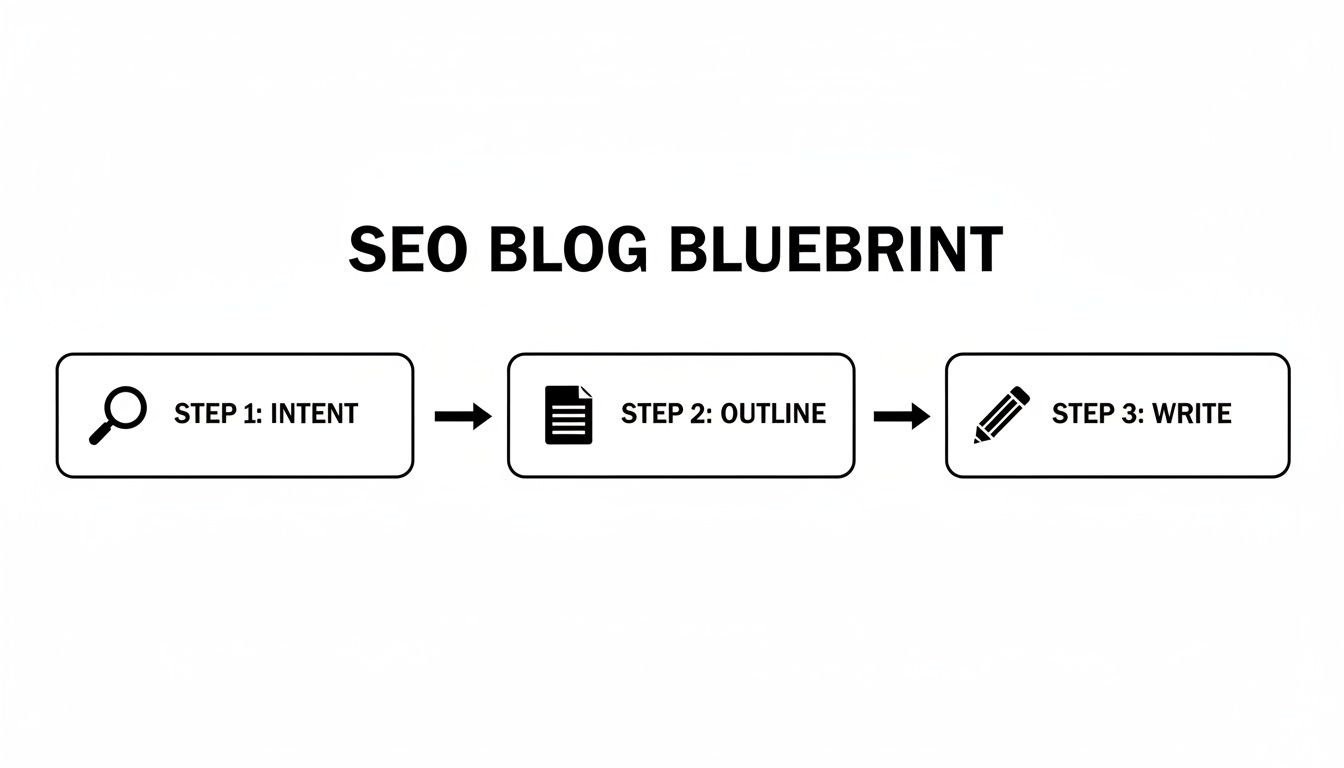
This workflow shows how each stage builds on the last, making sure your final piece is both valuable and perfectly optimized.
Balancing SEO With Genuine Value
The final piece is writing something that balances all the technical SEO requirements with being genuinely helpful. A post stuffed with keywords but lacking any real insight won't build trust or authority. On the flip side, a brilliant article that ignores on-page SEO will never get discovered in the first place.
Here's a quick look at the core components that make up an SEO-friendly blog post.
Core Components of an SEO-Friendly Blog Post
| Component | What It Is | Why It Matters |
|---|---|---|
| Keyword Optimization | Integrating target keywords naturally into your title, headings, and body copy. | Helps search engines understand your content's topic and relevance to a query. |
| User Engagement | Using short paragraphs, visuals, and clear formatting to keep readers on the page. | Signals to Google that your content is high-quality and satisfies user intent. |
| Topical Authority | Demonstrating deep expertise on a subject to build credibility with search engines. | Increases trust and makes it easier for all your related content to rank higher. |
Mastering these pillars is what separates content that gets buried from content that ranks. For a deeper dive into these fundamentals, reviewing these content SEO best practices will help build a much stronger foundation.
Ultimately, this approach ensures you create content that doesn’t just attract one-time visitors but builds a loyal audience over time.
Mastering Keyword Research and Search Intent

Before you even think about writing an intro, the real work of an SEO-friendly blog post has already begun. It all starts with getting inside your audience's head—understanding the exact words they use to search and, more critically, why they're searching in the first place.
This is the secret sauce. It's the difference between snagging a few random clicks and genuinely connecting with someone who needs what you have to say. Good keyword research isn't about chasing high search volumes; it's about uncovering the language your audience uses to describe their problems. When you nail this, your content feels like it’s reading their mind.
Decoding the Why Behind the Search
Every time someone types something into Google, there's a goal behind it. We call this search intent, and if you get it wrong, even the most beautifully written article will fall flat. Targeting a keyword is useless if your content doesn't give the searcher what they actually want.
Generally, search intent falls into one of four buckets:
- Informational: The user is looking for an answer or information. Think "how to write seo-friendly blog post."
- Navigational: The user wants to go to a specific site. For instance, "IndexPilot blog."
- Commercial: The user is in research mode, comparing products or services before a future purchase, like "best SEO content platforms."
- Transactional: The user is ready to pull out their wallet. A search like "IndexPilot pricing" signals they're ready to buy.
The best way to figure this out is to just Google your target keyword and look at the results. The Search Engine Results Page (SERP) is your cheat sheet, showing you exactly what kind of content Google thinks searchers want to see.
Finding Keywords You Can Actually Rank For
Okay, so you understand intent. Now it's time to find the right keywords. A smart strategy uses a mix of broad "head" terms and hyper-specific long-tail keywords. While a term like "SEO" gets tons of searches, it's nearly impossible to rank for.
Instead, focus on long-tail keywords—phrases of three or more words. Something like "how to write seo blog posts for beginners" is far less competitive and attracts a much more qualified reader. These are the organic search keywords that will bring you the right kind of traffic.
You don't need a boatload of expensive tools to get started. Google itself is a goldmine. Look at the "People Also Ask" boxes, the "Related searches" at the bottom of the page, and what pops up in autocomplete. These are real queries from real people.
Don't just take my word for it. Research shows that keyword optimization is the single biggest growth factor for bloggers—more important than how often you post or how many backlinks you build. And since roughly 8% of all searches are questions, matching that informational intent is a huge opportunity.
Building Keyword Clusters for Topical Authority
Here's where we move from good to great. Instead of targeting keywords one by one, think in terms of topic clusters. This is how you build real authority with Google.
The idea is simple: you create one massive "pillar" post on a broad topic. Then, you write several smaller "cluster" posts that go deep on specific subtopics, all linking back to the pillar.
Let's imagine you sell project management software. Your cluster might look like this:
- Pillar Post: "The Ultimate Guide to Agile Project Management"
- Cluster Posts:
- "What are scrum sprints"
- "Kanban vs Scrum comparison"
- "How to write effective user stories"
This structure proves to Google that you're an expert on the entire subject, not just a single keyword. This is what we call topical authority. By interlinking these articles, you create a powerful web that boosts the ranking potential of every single piece in the cluster, helping you dominate your niche.
Writing Content for People and Algorithms

Alright, your keyword research is done and you have a solid outline. Now for the fun part: turning all that planning into an article that people actually want to read and that Google wants to rank. This is where art meets science.
It’s a classic mistake to lean too far in one direction. Some people write for the algorithm, stuffing keywords into every other sentence until the content is robotic and unreadable. Others write a beautiful, flowing piece of prose that completely ignores SEO, dooming it to be buried on page ten of the search results.
The real magic happens when you find that sweet spot in the middle, creating content that is both discoverable and genuinely helpful.
Demonstrating E-E-A-T in Your Writing
Google's obsession with E-E-A-T (Experience, Expertise, Authoritativeness, and Trustworthiness) isn't just a passing trend. It's the foundation of their quality guidelines, and they’re getting smarter about spotting it. They want to promote content from credible sources who know their stuff.
So, how do you show you’re one of the good ones? You have to bake these signals directly into your writing.
- Share Firsthand Experience: Don't just report the facts. Show you've been in the trenches. Using simple phrases like "In my experience..." or "When our team tested this..." adds a layer of authenticity that generic, AI-generated content just can't match.
- Cite Credible Data: Back up your claims. Referencing studies, statistics, or reports from respected industry sources adds weight to your arguments and shows you've done your homework.
- Incorporate Expert Insights: Quote other recognized experts in your field. This shows you're engaged in the broader conversation and respect other authoritative voices.
When you actively showcase E-E-A-T, you’re telling both readers and search engines that you're a trustworthy source. That credibility is a powerful ranking factor.
Balancing Content Depth and Readability
"How long should my blog post be?" I get this question all the time. The data is pretty clear: longer, more comprehensive content tends to rank better. In fact, blog posts over 3,000 words are 2.5 times more likely to see strong results. Google rewards content that thoroughly covers a topic from every angle.
But here’s the catch: length means nothing if the article is a dense, unreadable wall of text. No one is going to stick around for that.
The secret to writing a long, successful post is to make it feel short. Break up complex ideas, use simple language, and guide the reader through the content with clear signposts and visual breaks.
This is all about readability. The easier your content is to skim and digest, the longer people will stay on your page—and that's a huge signal to Google.
A few simple tactics make a world of difference:
- Write Short Paragraphs: Keep paragraphs to 1-3 sentences, max. All that white space makes the page feel less intimidating and easier to scan.
- Use Simple Language: Ditch the jargon and overly academic sentences. Write like you're explaining it to a friend.
- Leverage Bullet Points and Numbered Lists: These are perfect for breaking down steps, listing examples, or highlighting key takeaways for scanners.
For more great tips on crafting engaging posts (even if you don't consider yourself a "writer"), check out this practical guide on how to create great web content.
Weaving Keywords in Naturally
Now, let's talk about putting those keywords to work. The keyword here is naturally. The old days of keyword stuffing are long gone, and doing it now is a great way to get your site penalized.
Think of your keywords as signposts that help Google understand what your content is about. Your primary keyword should show up in a few strategic spots:
| Placement Area | Best Practice |
|---|---|
| H1 Title Tag | Place it at or near the beginning of your main title. |
| Introduction | Include it within the first 100 words to confirm the topic for readers and crawlers. |
| Headings (H2s & H3s) | Use your primary keyword and relevant variations in your subheadings. |
| Body Content | Sprinkle the keyword and its synonyms throughout the text logically. |
The goal is seamless integration. If a sentence sounds clunky or forced just to fit a keyword in, rewrite it. Search engines are smart enough to understand synonyms and context, so you don't have to hammer the exact same phrase over and over.
Writing for both people and algorithms is a balancing act. Focus on E-E-A-T to earn Google's trust, and prioritize readability to keep your human audience engaged. Nailing this combination is a cornerstone of great SEO copywriting best practices. When you do it right, you create content that doesn't just rank—it resonates.
Fine-Tuning Your On-Page Elements for Maximum Visibility
Once your draft is written, it’s time to put on the finishing touches. This is where we sharpen the technical elements that search engines use to understand, categorize, and ultimately rank your page. Think of it as polishing the engine after you've built the car—it ensures all your hard work on the content actually gets seen.
These on-page elements are direct signals to Google about your content's topic and relevance. When you get them right, you don't just help your rankings; you also create a much better user experience, which encourages more people to click on your link in the first place.
Crafting Click-Worthy Meta Titles and Descriptions
Your meta title (also known as the title tag) is arguably the most important on-page SEO factor there is. It's the blue, clickable link that shows up in search results, and it's the first thing people see. The meta description is the little blurb underneath it, acting like a mini-advertisement for your article.
A killer title and description combo can seriously boost your click-through rate (CTR), even if you aren't sitting in the number one spot.
Here’s how to nail them:
- Lead with Your Keyword: Try to place your primary keyword near the beginning of the title. This immediately tells searchers they've found what they're looking for.
- Keep it Tight: Aim for titles under 60 characters and descriptions under 160 characters. Anything longer will likely get cut off in the search results.
- Throw in a Hook: Use numbers, questions, or power words to make your title pop. For example, "10 SEO Writing Tips That Actually Work" is way more enticing than just "SEO Writing Tips."
If you want to go deeper on this, our complete guide to writing an effective SEO page title breaks down the entire process with plenty of real-world examples.
Pro Tip: Your meta description doesn't directly impact your rankings, but a great one absolutely influences clicks. Treat it like ad copy. Focus on the benefit for the reader and include a clear call to action, like "Learn how to..." or "Discover the steps..."
Structuring Clean, Readable URLs
The URL might seem like a small detail, but it’s another important signal for both search engines and users. A clean, descriptive URL is easy to understand and share, and it reinforces what your page is all about.
Just look at the difference:
- Bad URL:
yoursite.com/blog/p?id=12987_post_final - Good URL:
yoursite.com/blog/how-to-write-seo-blog-post
The second one is instantly clear. It contains the keyword, it's easy to read, and it sets the right expectation for the user. As a rule of thumb, keep your URLs short, use hyphens to separate words, and always use lowercase letters.
Optimizing Images with Descriptive Alt Text
Every single image you add to your blog post is another opportunity to optimize. Search engines can’t "see" images the way we do, so they rely on alt text (alternative text) to understand what an image is showing.
Writing good alt text is a win-win:
- Accessibility: It allows screen readers to describe the image to visually impaired users, making your site more inclusive.
- Image SEO: It helps your images show up in Google Image Search, which can be another significant source of organic traffic.
Instead of lazy alt text like "chart," get descriptive. If you have an image showing a few keyword research tools on a screen, a much better alt text would be, "Laptop screen displaying keyword research tools like Ahrefs and Semrush." This gives context to everyone—users and search engines alike.
Building Authority with Smart Internal Linking
Internal linking—the simple act of linking to other relevant pages on your own website—is an absolute powerhouse SEO tactic. It's how you show search engines that you have a deep well of knowledge on a particular subject, which is critical for building topical authority.
When done right, internal links also keep readers on your site longer, guiding them from one helpful piece of content to the next. The key is to use descriptive anchor text that tells the reader what they'll find if they click. For example, linking out to "our guide on SEO copywriting" is infinitely more useful than just saying "click here."
Using Visuals and Advanced SEO Tactics

Look, great writing and solid on-page SEO are just the price of entry these days. If you really want to gain an edge in competitive search results, you have to go further. This means elevating your content with multimedia and some of the more advanced on-page strategies that most people either ignore or don't know about.
These are the pro-level adjustments that can make a real difference in your rankings.
Visual content does so much more than just make your post look pretty. Relevant images, custom infographics, and embedded videos break up those intimidating blocks of text, making your article far more engaging and easier to digest. This has a direct impact on user behavior metrics like time on page and dwell time—signals that tell Google your content is worth sticking around for.
Even better, these assets open up entirely new traffic channels. A well-optimized image can rank in Google Image Search, and a genuinely helpful video can pull in viewers from YouTube and video carousels. It's a powerful way to expand your digital footprint beyond the standard blue links.
Amplify Your Reach with Visual Content
Different types of visuals serve different purposes in your SEO strategy. Choosing the right format for the job is key to amplifying your message and keeping readers engaged.
Visuals aren't just filler; they're strategic assets. The table below breaks down how different visual types can specifically benefit your content and where they shine the brightest.
Visual Content Impact on SEO
| Visual Type | Primary SEO Benefit | Best Use Case |
|---|---|---|
| Custom Images | Enhances E-E-A-T (Experience) and provides image search ranking opportunities. | Showing step-by-step processes or illustrating concepts with real-world examples. |
| Infographics | Highly shareable and can attract backlinks from other sites. | Presenting data, statistics, or complex workflows in an easy-to-understand format. |
| Embedded Videos | Significantly increases time on page and satisfies users who prefer video content. | Providing tutorials, product demos, or expert interviews to add depth to your post. |
By mixing these elements into your posts, you're not just making them look better—you're catering to different learning styles and creating a much richer user experience. This helps prove to search engines that your content is a comprehensive, go-to resource.
Demystifying Schema Markup for Rich Results
Now, let's get into a more advanced tactic that can make your search result impossible to ignore: Schema markup.
In simple terms, Schema is a bit of code (structured data) that you add to your website. It doesn't change how your page looks to a user, but it gives search engines a crystal-clear understanding of what your content is all about.
And no, you don't need to be a developer to use it. Many SEO plugins and tools can generate this code for you automatically. By telling Google exactly what your content is—whether it's a "HowTo" guide, an "FAQPage," or a "Product"—you seriously increase your chances of earning those eye-catching rich snippets.
Rich snippets are those enhanced search results that show extra information, like star ratings, event dates, or a Q&A dropdown. They take up more real estate on the search page and can dramatically improve your click-through rate.
For a post like this one—"how to write an seo-friendly blog post"—you could use "HowTo" Schema to detail the steps or "FAQPage" Schema to mark up a common questions section. This gives Google the structured information it loves and gives you a competitive advantage before anyone even clicks on your page.
Common Questions About Writing SEO Content
As you start putting all these pieces together and refining your own SEO writing process, a few common questions are bound to pop up. It's totally normal. Things like how often you should be publishing or how long it really takes to see results can feel like a moving target.
Let's tackle some of the most frequent questions we get from fellow content marketers. My goal here is to give you direct, no-fluff answers to help you build a more confident and effective SEO content strategy.
How Often Should I Publish New Blog Posts for SEO?
This is a classic, but the answer is always the same: consistency trumps frequency.
Seriously, publishing one deeply researched, high-quality post per week is infinitely more valuable for SEO than churning out four shallow, rushed articles in the same amount of time. A regular publishing schedule sends a strong signal to Google that your site is active and a reliable source of fresh information.
If you're launching a brand-new blog, stepping up the frequency a bit can help build that initial authority faster, but never—ever—at the expense of quality.
For more established websites, you'll often get more mileage from strategically updating old content than from creating something new from scratch. Find a sustainable pace that ensures every single thing you publish is your absolute best work. That's the real secret.
How Long Does It Take for a Blog Post to Rank on Google?
Ah, the million-dollar question. The honest answer? It varies wildly. The time it takes for a new post to rank depends heavily on your website's overall authority, how competitive your target keyword is, and, of course, the quality of your content.
For a newer site with low domain authority, you might be looking at 6 to 12 months to see real traction for even moderately competitive terms. On the flip side, an established site with a ton of authority could see a new post start ranking in just a few days or weeks.
Remember, SEO is a long game. Building high-quality backlinks to your new post can definitely help speed up the indexing and ranking process. Use Google Search Console to keep an eye on your progress, but be patient. It’s a marathon, not a sprint.
What Is the Difference Between On-Page and Off-Page SEO?
Getting this distinction right is fundamental to building a solid strategy. You need both to rank effectively, but they cover different sides of the optimization coin.
- On-Page SEO: This is everything you do directly on your website. Think of it as what you have full control over. We're talking about optimizing your titles, writing great content, improving internal links, and adding image alt text.
- Off-Page SEO: This covers all the actions taken outside of your own website to boost its authority and reputation. The big one here is earning backlinks from other reputable sites. Other signals include things like brand mentions and social media engagement.
A winning strategy needs both. Your on-page efforts get your house in order, making sure it's perfectly optimized to capitalize on all the authority and trust you build through your off-page activities.
Should I Go Back and Optimize Old Blog Posts?
Yes! A thousand times, yes. This is one of the most powerful and underrated SEO tactics out there, often called "historical optimization." It’s all about squeezing more value out of the content you've already put the work into creating.
A great place to start is by finding posts that are already ranking on the second or third page of Google for their target keywords. These articles are goldmines because Google already sees them as relevant; they just need a little push to get to page one.
Here’s how you can breathe new life into them:
- Add More Depth: Go deeper. Expand on key sections, add new FAQs, and provide more comprehensive explanations.
- Update Information: Swap out old statistics, fix broken links, and refresh any information that's become dated.
- Improve Readability: Break up those chunky paragraphs. Add new subheadings, bullet points, or numbered lists to make the content easier to scan.
- Add New Visuals: Toss in some new images, create a simple infographic, or embed a relevant video to make the content more engaging.
Once you’ve made your improvements, republish the post with the current date. This tells Google that the content is fresh and relevant, and you can see some significant ranking improvements with way less effort than writing a new post from the ground up. For more hands-on advice, check out these other powerful SEO content writing tips to round out your strategy.