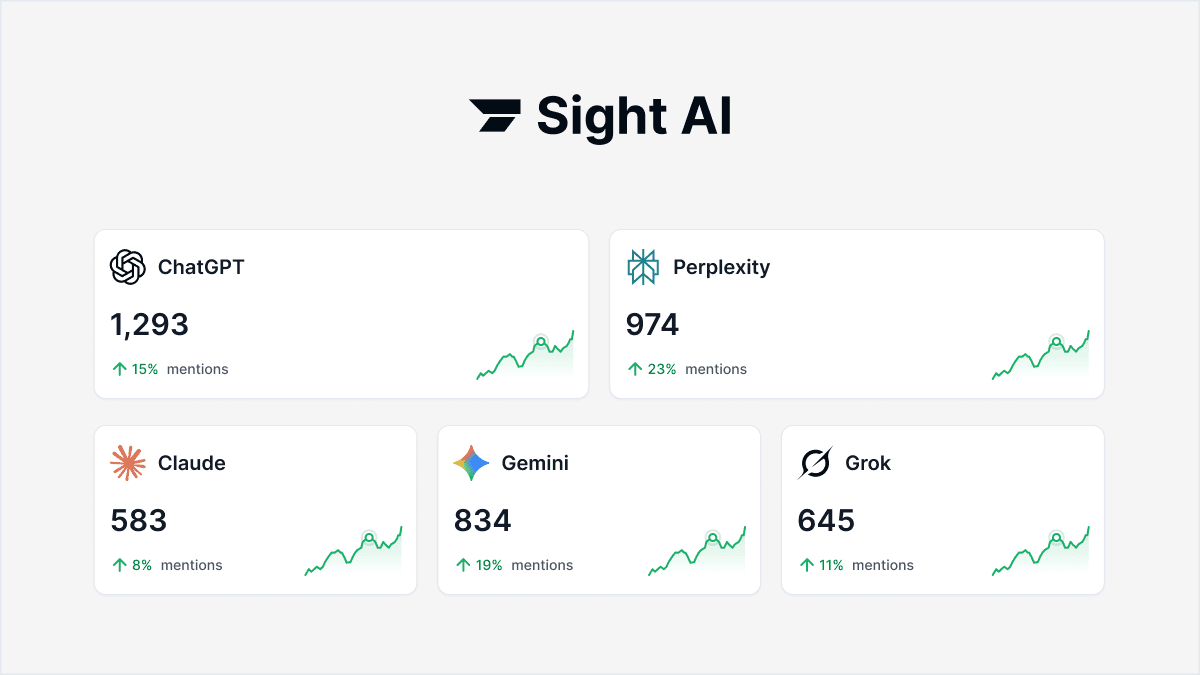
Traditional search rankings are becoming less relevant as millions of users turn to ChatGPT, Perplexity, and Google's AI Overviews for answers instead of clicking through blue links. When someone asks an AI model to recommend marketing tools or explain a complex topic, the brands that get mentioned win the visibility—and everyone else simply doesn't exist in that conversation.
This shift creates a fundamental challenge: you can't see your "ranking" because there are no position #1 through #10 results. AI models synthesize information from across the web and either mention your brand or they don't. They either understand what you do or they misrepresent it. They either recommend you as a solution or suggest your competitors instead.
The good news? You can influence these outcomes systematically. Generative Engine Optimization (GEO) is the practice of making your content more likely to be understood, cited, and recommended by AI models. This guide walks you through a proven 6-step framework that helps you establish AI visibility, build the authority signals that models trust, and track your progress as generative search continues reshaping how people discover information.
Whether you're watching organic traffic shift toward AI platforms or wondering why competitors keep appearing in ChatGPT responses while you're invisible, these steps will give you a systematic approach to claiming your space in the AI-powered search landscape.
Step 1: Audit Your Current AI Visibility Baseline
You can't improve what you don't measure. Before making any optimization changes, you need to understand exactly how AI models currently talk about your brand—or whether they mention you at all.
Start by opening ChatGPT, Claude, Perplexity, Google's AI Overviews, and Gemini. Query your brand name directly and document what each model says. Does it accurately describe what you do? Does it mention your key products or services? What tone does it use—positive, neutral, or critical?
Then move beyond vanity searches. Test the queries your potential customers actually ask. If you sell project management software, try "best project management tools for remote teams" or "how to improve team collaboration." See which brands get mentioned. Your competitors appearing consistently while you're absent reveals a significant visibility gap.
Pay special attention to factual accuracy. AI models sometimes hallucinate features you don't offer or confuse you with similar companies. Document these errors because correcting misinformation becomes part of your optimization strategy.
Record everything in a simple spreadsheet: the query, which AI platform you tested, what was said about your brand, whether competitors were mentioned, and the overall sentiment. This baseline documentation serves two critical purposes—it shows you where you currently stand, and it gives you concrete metrics to measure improvement against as you implement the remaining steps. Learning how to monitor AI search rankings systematically will save you hours of manual checking.
The most valuable insight often comes from competitor analysis. When AI models consistently recommend the same three competitors for queries where you should be relevant, that pattern reveals what authority signals you're missing. These companies have somehow convinced AI models they're the go-to solution in your space. Your job is to understand how they did it and build similar signals for your own brand.
Step 2: Structure Content for AI Model Consumption
AI models don't read content the way humans do. They parse information looking for clear, factual statements that can be synthesized with data from other sources. Your content structure either makes this easy or creates friction that causes models to skip over your information entirely.
Start by writing in a citation-friendly format. Instead of vague claims like "our platform helps teams work better," use explicit, quotable statements: "The platform reduces project handoff time by eliminating email threads and centralizing all task discussions in one interface." AI models can extract and cite the second version. The first version is too generic to be useful.
Implement schema markup across your site. Product schema, Organization schema, and Article schema help AI crawlers understand what information means, not just what it says. When you mark up your pricing page with Product schema, you're explicitly telling AI models "this is a product, this is its price, these are its features." That structured data gets weighted more heavily than unstructured text.
Create an llms.txt file in your site root—think of it as robots.txt for AI models. This emerging standard lets you specify which pages contain your most authoritative content about specific topics. While not all AI platforms respect it yet, early adoption positions you well as this becomes more standardized.
Organize information hierarchically with clear H2 and H3 headings that signal topic relationships. When your article about "email marketing automation" has clear sections for "segmentation strategies," "trigger-based campaigns," and "performance metrics," AI models can understand the topical structure and extract relevant sections for specific queries. Understanding how AI search engines rank content helps you structure information more effectively.
Write definitions explicitly. Don't assume AI models understand industry jargon or your proprietary terminology. Include clear explanations: "Behavioral triggers are automated email campaigns that send based on specific user actions, such as abandoning a shopping cart or downloading a resource." This definitional clarity makes your content more useful for AI synthesis.
The goal is making your content as frictionless as possible for AI consumption. Every structural improvement you make increases the likelihood that models will understand, extract, and cite your information when responding to relevant queries.
Step 3: Build Topical Authority Through Content Clusters
AI models recognize expertise through content depth and interconnection. Publishing one article about email marketing doesn't establish authority. Publishing twenty interconnected articles that comprehensively cover every aspect of email marketing signals that you're a legitimate expert in this domain.
Identify the three to five core topics where you want AI models to recognize your expertise. These should align with your business value proposition. If you sell project management software, your core topics might be project management methodologies, team collaboration, and productivity optimization.
For each core topic, create a comprehensive pillar page that serves as the definitive resource. This isn't a 500-word overview—it's a 3,000+ word guide that thoroughly covers the topic from multiple angles. Then surround that pillar with 10-15 supporting articles that dive deep into specific subtopics.
Your project management pillar might cover methodologies, tools, best practices, and common challenges. Supporting articles would explore "Agile vs. Waterfall for software teams," "how to run effective sprint planning meetings," "project management for remote teams," and "common project management mistakes and how to avoid them."
Interlink these articles strategically. Every supporting article should link back to the pillar page and to related supporting articles. This internal linking structure signals to AI crawlers that these pieces form a cohesive knowledge cluster about a specific topic. Models interpret this interconnection as depth of expertise. Reviewing the key AI search ranking factors will help you prioritize which signals matter most.
Update existing content regularly to maintain freshness signals. AI training data has recency biases—newer information often gets weighted more heavily than outdated content. Adding new sections to pillar pages, refreshing examples, and updating statistics (when you have real data to cite) keeps your content relevant in model training cycles.
The brands that dominate AI mentions in specific categories typically have this cluster structure in place. They've systematically built comprehensive content ecosystems that demonstrate unmistakable expertise. AI models reward this depth by citing them as authoritative sources.
Step 4: Earn Third-Party Mentions and Citations
Here's the hard truth about AI visibility: what you say about yourself matters far less than what others say about you. AI models heavily weight information that appears across multiple independent sources because corroboration signals credibility.
When three different industry publications mention your platform as a leading solution for remote team collaboration, AI models interpret that pattern as consensus. When only your own website makes that claim, it's treated as potentially biased self-promotion.
Focus on earning mentions in publications and platforms that likely feed AI training data. Industry blogs, major news sites, academic publications, and community platforms like Reddit and Stack Overflow all contribute to the corpus of information AI models learn from. A mention in TechCrunch or a detailed Reddit thread discussing your product creates training data that influences future AI responses.
Contribute original research or publish data that others will reference. When you release a comprehensive industry survey or publish unique findings, other content creators cite your work. Those citations create a web of references that AI models recognize as authority signals. The more your research gets cited across the web, the more likely AI models will reference you as a source of expertise.
Build genuine relationships with content creators, podcast hosts, and industry analysts. When you're featured on podcasts, quoted in articles, or included in expert roundups, you're creating third-party validation. Guest appearances and expert contributions put your name and expertise into content that AI models will encounter during training. If you're wondering why competitors rank in AI search while you don't, third-party mentions are often the differentiating factor.
Pursue Wikipedia inclusion if you're eligible. While Wikipedia has strict notability requirements, having a Wikipedia page creates an authoritative source that AI models frequently reference. Many AI responses pull directly from Wikipedia entries when providing background information about companies and concepts.
Think of third-party mentions as votes of confidence. Each independent source that discusses your brand, cites your content, or recommends your solution adds weight to AI models' understanding of your authority and relevance in your space.
Step 5: Optimize for Specific AI Platforms
Not all AI models work the same way. ChatGPT, Claude, Perplexity, and Google's AI Overviews pull from different data sources, have different update cycles, and use different crawling mechanisms. Effective GEO requires understanding these platform-specific differences.
Start by checking your robots.txt file to ensure you're not accidentally blocking AI crawlers. GPTBot (OpenAI's crawler), ClaudeBot (Anthropic's crawler), and PerplexityBot need access to index your content. Many sites inadvertently block these bots because they were configured before AI crawling became relevant. Review your robots.txt and explicitly allow AI-specific user agents.
Understand that Perplexity operates differently than ChatGPT. Perplexity crawls the web in real-time for many queries, meaning fresh content can appear in responses almost immediately. ChatGPT and Claude rely more heavily on training data with less frequent updates, so changes to your content may take longer to influence their responses. Our comprehensive generative search optimization guide covers these platform differences in detail.
Submit content to platforms with direct AI integrations. Wikipedia, as mentioned earlier, feeds directly into many AI models. Reddit discussions often appear in AI responses because models recognize Reddit as a source of real user experiences and opinions. Stack Overflow answers influence technical responses. Identifying which platforms your target AI models draw from helps you prioritize where to build presence.
Consider creating platform-specific content strategies. If your audience heavily uses ChatGPT for research, focus on building the comprehensive, well-structured content that performs well in training data. If they use Perplexity, prioritize fresh, timely content that benefits from real-time crawling.
Monitor how different AI platforms describe your brand and tailor your optimization accordingly. If Claude consistently misunderstands your product category while ChatGPT gets it right, that signals a need to improve the clarity of your positioning in sources Claude likely references.
The AI search landscape is fragmented, and each platform has its own quirks. Treating them as a monolithic entity leads to suboptimal results. Platform-specific optimization ensures you're visible across the full spectrum of generative search tools your audience uses.
Step 6: Track, Measure, and Iterate on Your AI Presence
AI visibility optimization isn't a one-time project. It's an ongoing process of monitoring, measuring, and refining based on what's actually working. Without systematic tracking, you're optimizing blind.
Set up a regular monitoring schedule to track brand mentions across AI platforms. Weekly or biweekly, run the same set of queries across ChatGPT, Claude, Perplexity, and other relevant platforms. Document what's mentioned, how you're described, and whether your visibility is improving. This longitudinal data reveals trends that single snapshots miss. Knowing how to track AI search rankings effectively is essential for measuring your progress.
Analyze which content pieces are getting cited by AI models. When you notice a particular article or resource page appearing in AI responses, reverse-engineer what made it citation-worthy. Was it the structured format? The explicit definitions? The comprehensive coverage? Understanding success patterns helps you replicate them across other content.
Identify gaps where competitors consistently appear but you're absent. These gaps represent your highest-priority optimization opportunities. If AI models mention three competitors when asked about solutions for remote team management but never mention you, that specific query becomes a target. Create content that directly addresses that use case with the structure and authority signals that models reward.
Track sentiment alongside visibility. Getting mentioned is good, but getting mentioned positively is the goal. If AI models cite your brand but frame it negatively or mention limitations, that signals a need to address those perceptions through better content or third-party validation.
Adjust your content strategy based on what's working. If how-to guides consistently get cited while opinion pieces don't, shift resources toward instructional content. If content with explicit product comparisons performs well, create more comparison content. Let the data guide your optimization priorities. Exploring generative search optimization software can help automate much of this tracking work.
The brands winning in generative search aren't guessing—they're measuring, learning, and iterating based on real data about how AI models talk about them. This systematic approach turns AI visibility from a mystery into a manageable optimization process.
Your Path to AI Visibility Starts Now
Ranking in generative search requires a fundamentally different mindset than traditional SEO. You're not optimizing for keyword positions—you're optimizing for AI comprehension, trust, and recommendation. Success comes from making your content maximally useful for AI synthesis, building the third-party validation that models recognize as authority, and systematically tracking how your visibility evolves across platforms.
Start with Step 1 today. Open ChatGPT, Claude, and Perplexity and audit your current AI visibility. Query your brand name, test competitor comparisons, and document exactly where you stand. This baseline gives you a clear starting point and reveals your biggest opportunities.
Then work through each subsequent step systematically. Restructure your content for AI consumption. Build comprehensive topic clusters that demonstrate expertise. Earn third-party mentions that validate your authority. Optimize for platform-specific differences. Track your progress and iterate based on what works.
The brands that establish AI visibility now will have a significant advantage as generative search continues capturing market share from traditional search engines. Every week you delay is another week your competitors build authority signals while you remain invisible in AI-generated responses.
Stop guessing how AI models like ChatGPT and Claude talk about your brand—get visibility into every mention, track content opportunities, and automate your path to organic traffic growth. Start tracking your AI visibility today and see exactly where your brand appears across top AI platforms.