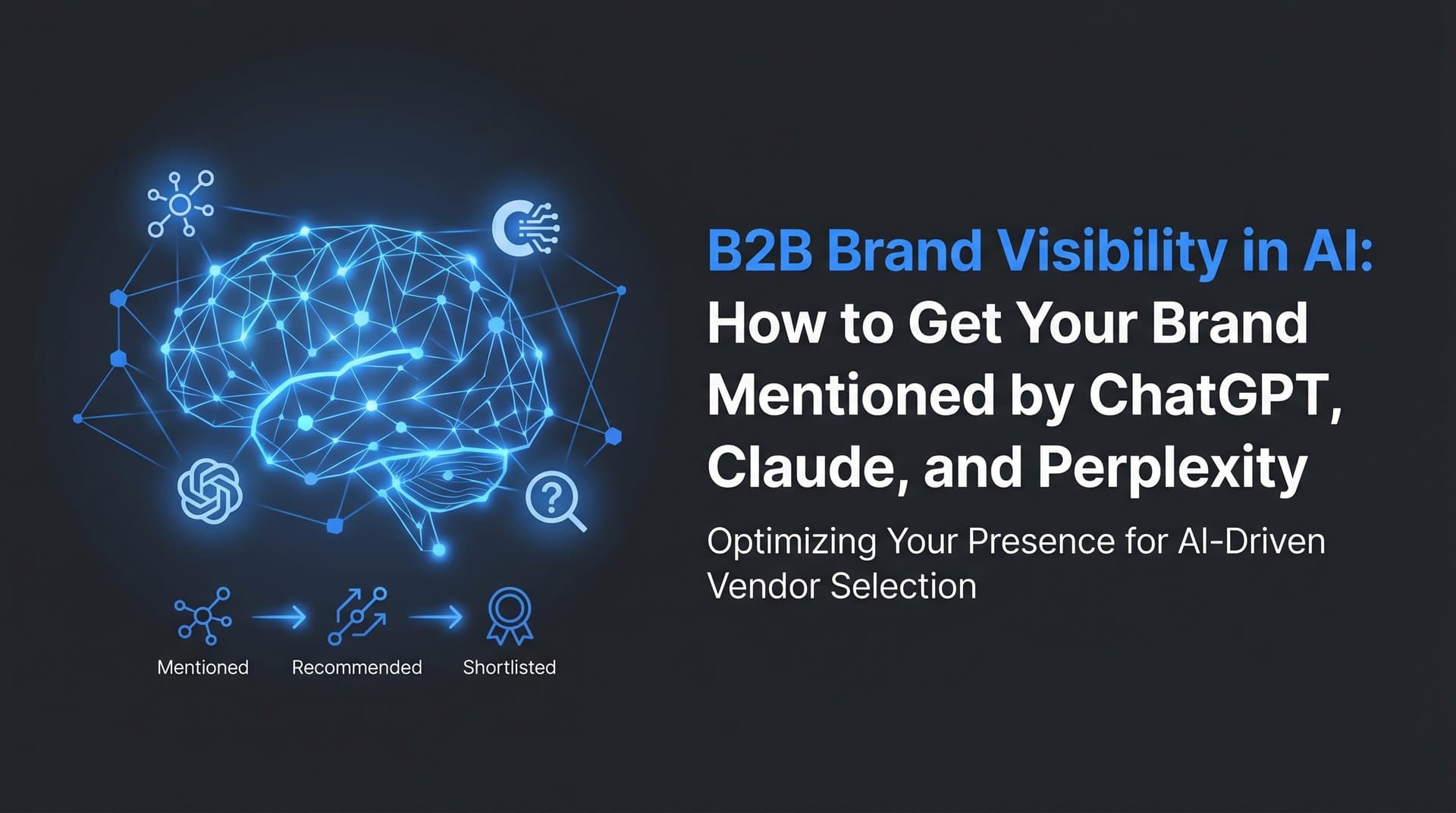
When potential customers ask ChatGPT for product recommendations in your industry, does your brand come up? For most businesses, the answer is no—and that's a massive missed opportunity. AI chatbots are rapidly becoming the new search engines, with millions of users asking them for buying advice, tool comparisons, and service recommendations daily.
Unlike traditional SEO where you optimize for Google's algorithm, AI chatbot visibility requires a fundamentally different approach: you need to optimize for how large language models understand, retrieve, and recommend brands. The challenge? These AI systems don't work like search engines. They rely on training data, real-time retrieval systems, and authority signals that differ dramatically from traditional ranking factors.
This guide walks you through six actionable steps to increase your brand's presence in AI-generated responses across ChatGPT, Claude, Perplexity, and other AI platforms. You'll learn how to audit your current visibility, structure your content for AI comprehension, build the authority signals that LLMs trust, and track your progress over time. Whether you're a marketer trying to capture this emerging channel or a founder looking to stay ahead of competitors, these steps will help you establish your brand in the AI conversation.
Step 1: Audit Your Current AI Chatbot Visibility Baseline
Before you can improve your AI visibility, you need to know where you stand right now. Think of this as your diagnostic phase—you're gathering intelligence about how AI models currently perceive and recommend your brand.
Start by opening ChatGPT, Claude, Perplexity, and Gemini. For each platform, test 10-15 prompts that potential customers might actually use. Don't just search for your brand name—that's not how discovery works. Instead, use queries like "best [product category] for [use case]" or "recommend a [service type] that helps with [problem]." These conversational queries mirror how real users interact with AI chatbots.
Document everything you find. Create a spreadsheet tracking: which AI platforms mention your brand, the exact prompts that trigger mentions, your position in the response (first recommendation vs. buried in a list), and the sentiment of each mention. Pay special attention to the context—is the AI recommending you enthusiastically, mentioning you neutrally, or omitting you entirely while listing competitors?
Here's where it gets interesting: analyze your competitors who do appear in these responses. What makes them mentionable? Often, you'll discover they have strong presence on review platforms, comprehensive Wikipedia entries, or they're frequently cited in industry publications. These are the authority signals that AI models trust.
Record specific baseline metrics: mention frequency (how often you appear across 50+ test prompts), average recommendation position (are you typically first, third, or not mentioned?), and sentiment score (positive recommendation, neutral mention, or negative context). Understanding how to measure AI visibility metrics becomes your benchmark for measuring improvement over the next three to six months.
The most valuable insight from this audit? Identifying the gaps. If competitors consistently appear for certain query types while you don't, you've just discovered your biggest optimization opportunities. Maybe they dominate "best tools for agencies" prompts because they have case studies on agency-focused sites. That's your roadmap.
Step 2: Structure Your Website Content for LLM Comprehension
AI models don't read your website the same way humans do. They parse content looking for clear, factual information presented in digestible formats. If your site is filled with marketing fluff and vague value propositions, LLMs will skip over you in favor of sources that provide concrete details.
Start by auditing your core pages—homepage, product pages, service descriptions, and about page. Ask yourself: could an AI model extract five specific, factual statements about what we do from each page? If the answer is no, you have work to do. Replace vague phrases like "innovative solutions" with specific capabilities: "tracks brand mentions across ChatGPT, Claude, and Perplexity with daily monitoring and sentiment analysis."
Build comprehensive product and service pages that answer the questions AI chatbots receive most frequently. Include specific features with clear descriptions, concrete use cases with measurable outcomes, and explicit differentiators that distinguish you from alternatives. When an AI model evaluates whether to recommend your product, it needs this factual foundation to make a confident citation.
Implement structured data markup using Schema.org vocabulary. Product schema, Organization schema, and FAQPage schema help AI systems quickly parse your most important information. While we don't know exactly how much LLMs rely on structured data, we do know that search engines connected to AI systems (like Bing powering Copilot) use it extensively.
Consider implementing an llms.txt file—an emerging protocol that guides AI crawlers to your most important content. This simple text file, placed in your site's root directory, lists your key pages and their purposes, helping AI systems understand your site structure. Think of it as a roadmap specifically designed for language models.
Format matters more than you might think. Use clear headings, short paragraphs, and bullet points for key information. Create FAQ sections that directly answer common questions in your industry. The easier you make it for an AI to extract and comprehend your information, the more likely it becomes that the model will confidently cite you in responses.
One often-overlooked element: consistency across pages. If your homepage says you offer "AI-powered analytics" but your product page calls it "machine learning insights," you're creating confusion. AI models look for consistent terminology and clear positioning across your entire site.
Step 3: Build Authority Signals That LLMs Trust
Here's the reality: AI models are trained to be cautious about recommendations. They preferentially cite sources they perceive as authoritative because making confident recommendations requires confidence in the underlying information. Your job is to build the external validation that creates that confidence.
Start with review platforms and industry directories that AI models frequently reference. Get your company listed on G2, Capterra, Product Hunt, and category-specific directories in your industry. These platforms carry weight because they aggregate user feedback and maintain editorial standards. When multiple trusted sources mention your brand, AI models begin to see you as a legitimate player.
Create original research and publish data that others will cite. Industry reports, survey results, and proprietary data become reference points that other publications link to. When your research gets cited by multiple sources, AI models notice the pattern—you become an information source rather than just another vendor. Even a simple annual industry survey can establish you as a data authority.
Pursue strategic mentions on high-authority domains in your vertical. A mention in TechCrunch, industry trade publications, or respected blogs carries more weight than hundreds of low-quality directory listings. Focus on earned media through newsworthy announcements, expert commentary, and thought leadership rather than paid placements that AI models might discount.
Wikipedia presence matters more than most marketers realize. While creating your own Wikipedia page is challenging and requires meeting notability guidelines, you can often get mentioned in relevant industry or category pages. These mentions become part of the knowledge base that AI models reference frequently.
Build genuine backlinks from authoritative sites in your industry vertical. Not for PageRank—for authority signals. When respected industry sources link to your content as a reference, AI models trained on web data learn to associate your brand with credible information. Quality beats quantity dramatically in this context.
The compounding effect is real: each authority signal makes the next one easier to earn. Your first industry publication mention might take months to secure, but once you have three or four, journalists and editors begin viewing you as an established source worth citing. Understanding how AI chatbots mention brands helps you prioritize which authority signals matter most.
Step 4: Optimize for AI-Specific Search Patterns
People talk to AI chatbots differently than they type into Google. They use complete sentences, ask follow-up questions, and phrase queries conversationally. Your content strategy needs to match these natural language patterns rather than just targeting traditional keywords.
Research the actual questions users ask AI about your product category. Join communities where your target audience hangs out and observe how they phrase questions. Look at Reddit threads, Quora discussions, and social media conversations. The language patterns you discover—"what's the best way to..." or "I'm trying to figure out how to..."—should directly inform your content creation.
Create content that addresses comparison queries head-on. Users frequently ask AI chatbots questions like "what's the difference between X and Y?" or "should I use X or Y for Z?" If you're not creating content that directly answers these comparisons, you're invisible in these conversations. Build dedicated comparison pages that objectively evaluate options, including competitors, rather than just promoting yourself.
Format content for conversational responses. When AI chatbots answer questions, they often pull specific facts or statements from sources. Create content with clear, quotable facts that AI can confidently cite. Instead of "Our platform helps businesses grow," write "Our platform tracks brand mentions across six AI models including ChatGPT, Claude, and Perplexity." The second statement is specific enough for an AI to cite with confidence.
Address the "best for" query pattern explicitly. Users constantly ask AI chatbots "what's the best [product] for [specific use case]?" Create content that directly targets these combinations: "best for agencies," "best for e-commerce," "best for small teams." Each piece should explain why your solution fits that specific use case with concrete examples. This approach directly supports your efforts to improve content recommendation rates across AI platforms.
Include specific, factual claims throughout your content. AI models are more likely to cite sources that make clear, verifiable statements rather than vague marketing claims. Replace "significantly improves" with "reduces time spent by an average of 40%" (only if you have real data to support it) or use general language like "helps teams work more efficiently" when specific numbers aren't available.
Step 5: Leverage Real-Time Content and Fresh Indexing
Not all AI chatbots work the same way. Understanding which platforms use real-time data versus training data fundamentally changes your optimization strategy. Perplexity and Bing Chat pull information from the web in real-time, meaning fresh content can appear in responses almost immediately. ChatGPT primarily relies on training data, though it has browsing capabilities for certain queries.
For real-time AI systems, speed matters. Implement IndexNow—a protocol that instantly notifies search engines when you publish or update content. Instead of waiting for traditional crawlers to discover your changes, IndexNow pushes updates to Bing, which powers several AI systems. Learning how to improve content indexing speed means your latest content can appear in AI responses within hours rather than days or weeks.
Maintain a consistent publishing cadence. AI systems connected to search engines interpret regular content updates as a signal of active authority. A site that publishes valuable content weekly appears more current and reliable than one that publishes sporadically. You're not just creating content for users—you're signaling to AI-connected crawlers that you're an active, maintained source of information.
Publish timely, newsworthy content that real-time AI systems will surface. When industry trends emerge or news breaks in your space, create content quickly. Real-time AI platforms like Perplexity excel at surfacing recent, relevant content for current events and trending topics. Being among the first to publish authoritative content on emerging topics gives you visibility advantages.
Update existing content strategically. When you improve a key page, use IndexNow to notify search engines immediately. This is particularly important for product pages, pricing information, and feature lists—content that AI chatbots frequently reference when making recommendations. Keep publication dates visible so both users and AI systems can assess content freshness.
Create a content calendar that balances evergreen resources with timely updates. Evergreen content builds long-term authority, while timely content captures real-time AI visibility. The combination ensures you're visible across both training-data-based AI systems and real-time retrieval platforms.
Step 6: Monitor, Measure, and Iterate Your AI Visibility Strategy
AI visibility optimization isn't a set-it-and-forget-it strategy. The landscape shifts constantly as AI models update, competitors optimize, and user behavior evolves. Systematic monitoring turns your initial audit into an ongoing intelligence operation.
Set up a monthly testing protocol. Return to the same prompts you used in Step 1 and document any changes. Has your mention frequency increased? Are you appearing in new contexts? Have competitors fallen off or new ones emerged? Using AI visibility tracking software helps you track these patterns systematically, noting the date of each test so you can correlate changes with your optimization efforts.
Analyze which specific actions correlate with visibility improvements. If you published three comparison articles in March and saw increased mentions in April, that's a signal to create more comparison content. If securing a mention on an industry publication preceded a jump in ChatGPT recommendations, prioritize earning more authoritative media placements. Let data guide your strategy refinement.
Monitor competitor movements closely. When a competitor suddenly appears in AI responses where they weren't before, investigate what changed. Did they launch new content? Earn a significant backlink? Get featured on a major platform? Competitive intelligence reveals optimization opportunities you might have missed.
Test new prompt variations regularly. User behavior with AI chatbots evolves as people become more sophisticated in how they query these systems. Expand your test prompt library monthly with new question patterns you observe in communities, customer conversations, and industry discussions.
Document sentiment shifts, not just mentions. A brand might appear frequently but in neutral or even negative contexts. Implementing AI chatbot brand mention tracking helps you monitor whether AI models recommend you enthusiastically, mention you as an option, or cite you with caveats. Sentiment quality often matters more than raw mention frequency.
Create feedback loops between your AI visibility data and your content strategy. If you're consistently mentioned for one use case but invisible for others, you've identified a content gap. If certain content formats (comparisons, guides, data-driven articles) correlate with better visibility, produce more of them.
Your Roadmap to AI Visibility Success
Improving your AI chatbot visibility isn't a one-time project—it's an ongoing strategy that compounds over time. The brands establishing themselves in AI recommendations today are building advantages that will be increasingly difficult for competitors to overcome as this channel matures.
Start with Step 1 today: open ChatGPT, Claude, and Perplexity, and test 10 relevant prompts in your industry. Document where you stand, where competitors appear, and identify your biggest gaps. This baseline audit takes less than an hour but provides the foundation for everything that follows.
Then work through each subsequent step systematically. Structure your key pages for LLM comprehension this week. Identify and pursue three authority-building opportunities this month. Create your first batch of conversational, AI-optimized content this quarter. Each step builds on the previous ones, creating cumulative visibility improvements.
Quick-start checklist to get moving immediately:
Week 1: Audit current visibility across ChatGPT, Claude, Perplexity, and Gemini using 10-15 industry-relevant prompts.
Week 2: Structure key pages for LLM comprehension with clear facts, consistent formatting, and structured data.
Month 1: Build 3-5 new authority signals through review platforms, industry directories, or earned media.
Month 2: Create content targeting conversational AI query patterns, especially comparison and "best for" formats.
Month 3: Implement rapid indexing with IndexNow for new content and establish consistent publishing cadence.
Ongoing: Set up monthly AI visibility tracking to measure progress and refine strategy based on results.
The brands that act now will establish themselves in AI recommendations before this channel becomes as competitive as traditional search. Every month you wait, competitors are building authority signals and optimizing content that AI models will reference for years to come.
Your next customer might be asking an AI chatbot for recommendations right now—make sure your brand is part of the answer. Start tracking your AI visibility today and see exactly where your brand appears across top AI platforms, uncover content opportunities that drive mentions, and automate your path to organic traffic growth through AI-optimized content.