When someone asks ChatGPT "What's the best project management tool for remote teams?" or queries Claude about "top email marketing platforms for e-commerce," the brands that get mentioned win attention at the exact moment of purchase intent. No ad spend. No bidding wars. Just pure, authoritative visibility when it matters most.
Here's what makes this opportunity so compelling: AI chatbots have fundamentally changed how people discover brands. They're not just answering questions—they're making recommendations, comparing products, and shaping purchasing decisions for millions of users daily.
But there's a catch.
AI models don't work like Google. They don't crawl the web in real-time, they don't prioritize the highest bidder, and they certainly don't care about your keyword density. They learn from training data, cite sources they trust, and prioritize content that demonstrates genuine expertise and authority.
Getting mentioned requires a completely different playbook than traditional SEO. You can't just optimize a page and hope for the best. You need to understand how AI models cite sources, what makes content citation-worthy, and how to build authority that transcends any single platform.
This guide breaks down the exact process—six concrete steps that position your brand for AI visibility. Whether you're a marketer expanding organic reach beyond Google, a founder building brand authority from scratch, or an agency managing multiple clients, these strategies will help you earn mentions where your audience is increasingly searching.
Let's start with the foundation: understanding where you stand today.
Step 1: Audit Your Current AI Visibility Baseline
You can't improve what you don't measure. Before building any strategy, you need to understand your current AI visibility—and that means actually querying the platforms your audience uses.
Start by identifying 10-15 prompts your target audience would realistically ask. Think about the questions that lead to purchasing decisions in your space. If you sell project management software, test prompts like "best project management tools for startups" or "how to choose project management software." If you're in email marketing, try "top email platforms for e-commerce" or "best email automation tools."
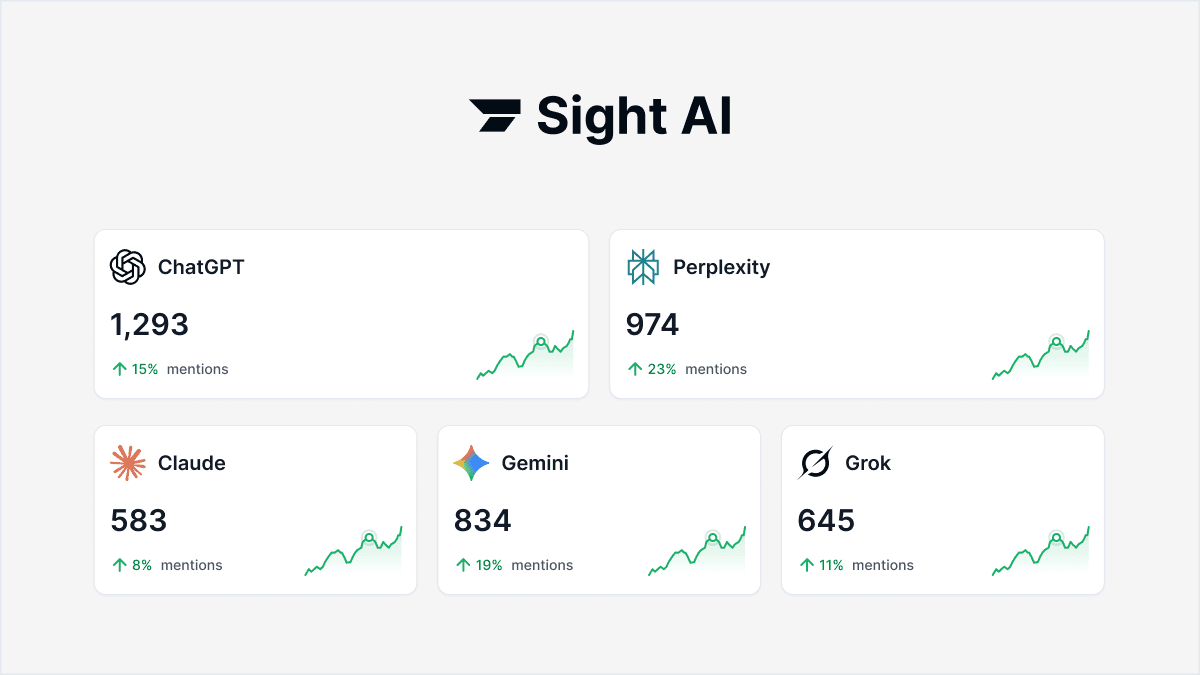
Query the major platforms systematically: Test your prompts across ChatGPT, Claude, Perplexity, and Gemini. Each AI model has different training data and citation patterns, so your visibility will vary across platforms. Take screenshots and document the exact responses—who gets mentioned, in what order, and with what context.
Pay close attention to your competitors. When they appear in AI responses, analyze why. Are they cited because of original research? Industry reports? Comprehensive comparison pages? Understanding the pattern of what gets cited reveals the playbook you need to follow. If you're finding that competitors are mentioned in AI but not you, this analysis becomes even more critical.
If your brand already appears in some responses, evaluate the sentiment and accuracy. Is the AI describing your product correctly? Is the tone positive, neutral, or negative? Are there factual errors that need addressing? These insights shape your content strategy moving forward.
Create a baseline tracking document: Record which prompts trigger mentions, which platforms cite you, and the context of each mention. This becomes your measurement framework. Learning how to track AI model mentions systematically will help you measure improvement over time.
This audit typically reveals an uncomfortable truth: most brands have minimal AI visibility, while a small number of competitors dominate the conversation. That's actually good news—it means the opportunity is wide open for brands willing to execute strategically.
Step 2: Build Authoritative, Citable Content Assets
AI models cite content that demonstrates genuine expertise and provides unique value. Generic blog posts won't cut it. You need content assets substantial enough that AI systems recognize them as authoritative sources worth referencing.
Original research and data studies sit at the top of the citation hierarchy. When you publish industry surveys, benchmark reports, or proprietary data analysis, you create something AI models can't find anywhere else. This doesn't require a massive research budget—even a well-executed survey of 200-300 industry professionals can generate citation-worthy insights.
Comprehensive resource pages that definitively answer specific questions: Think ultimate guides, detailed comparisons, or exhaustive how-to content that covers every angle of a topic. The key is depth and completeness. If someone asks an AI chatbot about your topic, your resource should be so thorough that the AI has no reason to look elsewhere.
Structure matters enormously for AI citation. Use clear definitions, include relevant statistics (with sources), break down complex concepts into digestible sections, and provide expert insights that demonstrate real-world experience. Understanding how AI models rank websites helps you create content that meets their evaluation criteria.
Focus your efforts on topics where you have genuine expertise and unique perspectives. If you're a SaaS company, create content about the specific problems your software solves. If you're an agency, publish insights from client work (anonymized appropriately). Authenticity and specificity beat generic advice every time.
Update existing high-performing content: Take your best content and make it citation-worthy. Add data, expand sections, include expert quotes, and ensure accuracy. A single exceptional resource page can generate more AI mentions than dozens of mediocre blog posts.
Consider creating content in formats AI models can easily process: detailed FAQ sections, comparison tables with clear criteria, step-by-step processes with specific outcomes, and case studies with measurable results. The easier you make it for AI to extract and cite your information, the more likely you'll appear in responses.
The goal isn't content volume—it's creating a portfolio of 5-10 exceptional resources that establish your brand as the authoritative voice in your niche. Quality and depth beat quantity every single time when it comes to AI citations.
Step 3: Optimize Technical Foundations for AI Discovery
Even the most authoritative content won't get cited if AI systems can't properly discover and understand it. Technical optimization for AI differs from traditional SEO, but it's equally critical for visibility.
Structured data markup using Schema.org vocabulary helps AI models understand exactly what your content represents. Implement Article schema for blog posts, Product schema for offerings, Organization schema for company information, and FAQ schema for question-answer content. This structured approach makes it exponentially easier for AI to extract accurate information about your brand.
The llms.txt file is emerging as a standard for communicating with AI crawlers: Similar to robots.txt for search engines, this file tells AI systems which content on your site is most important and authoritative. Create an llms.txt file in your site root that points to your best resources, key pages, and citation-worthy content. While not all AI systems currently use this standard, early adoption positions you advantageously as the practice becomes widespread.
Fast indexing matters because AI training data gets updated periodically. Learning how to use IndexNow protocol can help notify search engines and AI systems immediately when you publish or update content. Keep your XML sitemap current and ensure it's properly submitted to major platforms. The faster your content gets indexed, the sooner it can influence AI model responses.
Verify that your most important content is fully accessible and crawlable. Check for JavaScript rendering issues that might hide content from crawlers. Ensure your robots.txt file isn't accidentally blocking important pages. Test your site's mobile responsiveness and loading speed—technical excellence signals quality to both search engines and AI training systems.
Create a clear site architecture: Organize content logically with intuitive navigation and internal linking. When AI systems crawl your site, they should easily understand your content hierarchy and how different pages relate to each other. This contextual understanding improves the accuracy of AI citations.
Don't overlook basic technical SEO fundamentals—they matter for AI discovery too. Use descriptive URLs, write clear meta descriptions, optimize image alt text, and ensure your site has proper HTTPS security. If you're struggling with discovery issues, understanding how to speed up content indexing can make a significant difference.
Step 4: Expand Your Digital Footprint Across Trusted Sources
AI models don't just learn from your website—they synthesize information from across the entire web. The more authoritative third-party sources mention your brand, the more likely AI systems will recognize and cite you.
Wikipedia represents the gold standard of AI training data. If your brand qualifies for a Wikipedia page (meeting notability guidelines through significant coverage in independent reliable sources), create or improve it. Even if you don't qualify for a dedicated page, getting mentioned on relevant industry pages increases your authority signal significantly.
Industry publications and trade media carry enormous weight: Contribute expert commentary to journalists covering your space. Respond to media requests through platforms like HARO (Help a Reporter Out). When established publications quote you or feature your insights, AI models take notice. These citations compound over time, building a web of authority around your brand.
Build presence on platforms that AI models frequently cite during training. Reddit's community discussions, Stack Overflow's technical Q&A, and Quora's expert answers all feed into AI knowledge bases. Participate authentically—answer questions genuinely, share expertise without overt self-promotion, and establish yourself as a helpful voice in your industry.
Pursue backlinks from high-authority domains, particularly .edu and .gov sources when relevant. Guest post on established industry blogs. Get featured in roundup articles and expert interviews. Each authoritative mention creates another data point for AI systems to recognize your expertise. This approach is one of the best ways to get mentioned by AI systems.
Directory listings and review platforms matter more than you might think: Ensure your brand appears accurately on G2, Capterra, Trustpilot, and industry-specific directories. AI models often pull information from these aggregated sources when answering product comparison queries.
The key is consistency across all these touchpoints. Your brand name, description, and key information should align everywhere. Conflicting information across sources confuses AI models and reduces citation confidence.
Think of this as building a web of authority—each trusted mention reinforces the others, creating a comprehensive picture of your brand's expertise that AI systems can't ignore.
Step 5: Create Content That Answers AI-Friendly Queries
Understanding how people actually query AI chatbots unlocks a massive content opportunity. The questions people ask AI differ from traditional search queries—they're more conversational, more specific, and more intent-driven.
Research the actual prompts users type into ChatGPT, Claude, and Perplexity about your industry. Look for patterns in online communities where people share AI prompts. Monitor social media for screenshots of AI conversations. These real-world queries reveal exactly what content you need to create.
Best-of and comparison queries dominate AI conversations: People ask "what's the best email marketing platform for small businesses" or "compare Slack vs Microsoft Teams for remote work." Create content that directly answers these queries with comprehensive, unbiased analysis. Include your brand naturally within the comparison—not as the only option, but as one authoritative choice among others.
How-to queries represent another major category. Users ask AI chatbots for step-by-step guidance on specific tasks. Create detailed how-to content that walks through processes completely. If your product solves a problem, create guides that show how to solve that problem—mentioning your solution naturally within the broader context.
Definition and explanation queries need clear, authoritative answers. When someone asks "what is marketing automation" or "how does SEO work," they want concise, accurate explanations. Create content that defines concepts clearly, explains them thoroughly, and positions your brand as the expert on that topic. Understanding how to optimize for answer engines can help you structure this content effectively.
Structure your content to match AI response patterns: Use clear headings, concise paragraphs, and direct answers to common questions. AI models often extract specific sections from content when generating responses. Make those sections easy to identify and cite.
Update your content regularly to maintain accuracy and relevance. While AI training data doesn't update in real-time, keeping your content current ensures that when models do refresh their training, your information remains authoritative and citation-worthy.
Include your brand naturally within helpful, comprehensive content. The goal isn't to manipulate AI into mentioning you—it's to create genuinely valuable resources that deserve citation when users ask relevant questions.
Step 6: Monitor, Measure, and Iterate Your Strategy
AI visibility isn't a set-it-and-forget-it strategy. The landscape evolves constantly as AI models update their training data, new platforms emerge, and competitor strategies shift. Continuous monitoring and iteration separate brands that maintain AI visibility from those that fade into obscurity.
Set up a systematic tracking process for brand mentions across AI platforms. Query your target prompts monthly using the same list you created in your initial audit. Document which platforms mention you, in what context, and with what sentiment. Track changes over time to identify what's working and what needs adjustment. Implementing a system to track ChatGPT brand mentions is essential for this process.
Analyze which content types and topics drive the most AI citations: If your original research gets cited frequently but your blog posts don't, that tells you where to focus resources. If certain topics consistently trigger mentions while others don't, double down on what works and reconsider underperforming areas.
Monitor competitor mention patterns religiously. When competitors appear in AI responses you don't, investigate why. What content do they have that you lack? What sources cite them? What topics do they cover more comprehensively? Use these insights to identify gaps in your own strategy.
Track broader trends in AI citation patterns. Notice which types of sources AI models favor—are they citing more recent content, or do they prefer established resources? Are certain platforms (like Perplexity with its source citations) becoming more important for brand visibility? Learning how to optimize for Perplexity AI specifically can give you an edge on this growing platform.
Refine your content strategy based on actual citation data: If how-to content generates more mentions than thought leadership pieces, adjust your content calendar accordingly. If certain formats (like comparison tables or FAQ sections) get cited more often, create more content in those formats.
Test new approaches regularly. Try different content structures, experiment with various technical optimizations, and explore emerging platforms. AI visibility strategies that work today might need adjustment as models evolve and user behavior shifts.
The brands winning AI visibility treat this as an ongoing program, not a one-time project. They invest in monitoring tools, allocate resources to content updates, and continuously refine their approach based on performance data.
Putting It All Together
Getting mentioned in AI chatbots isn't about gaming algorithms or finding shortcuts—it's about becoming the authoritative source that AI models naturally trust to cite. The brands appearing in ChatGPT responses, Claude conversations, and Perplexity results have earned that visibility through genuine expertise, comprehensive content, and strategic positioning.
Start with your baseline audit. Query the AI platforms your audience uses and document exactly where you stand today. This honest assessment reveals both the opportunity size and your starting point for measurement.
Build content assets that demonstrate real expertise. Create original research, develop comprehensive resources, and structure content that AI models can easily understand and cite. Focus on quality and depth over volume.
Optimize your technical foundations. Implement structured data, create an llms.txt file, ensure fast indexing, and make your content maximally accessible to AI crawlers. Technical excellence signals authority.
Expand your digital footprint across trusted sources. Earn mentions on authoritative third-party sites, contribute expert commentary to industry publications, and build presence on platforms AI models cite frequently.
Create content that directly answers the questions users ask AI chatbots. Research actual prompts, structure content around AI-friendly queries, and include your brand naturally within comprehensive, helpful responses.
Monitor your progress continuously and iterate based on what works. Track mentions across platforms, analyze citation patterns, study competitor strategies, and refine your approach based on real performance data.
The opportunity window is open right now. Most brands haven't yet adapted their strategies for AI visibility, which means early movers capture disproportionate attention. But this won't last forever—as more companies recognize the value of AI mentions, competition will intensify.
Use this checklist to track your progress: baseline audit complete, citable content assets published, technical foundations optimized, digital footprint expanded across trusted sources, AI-query content created, and monitoring system active. Each completed item moves you closer to consistent AI visibility.
The brands that win in this new landscape are the ones treating AI visibility as a strategic priority today. Start tracking your AI visibility today and see exactly where your brand appears across top AI platforms—because you can't optimize what you can't measure.