ChatGPT SEO optimization is all about creating and structuring your content so that AI models like ChatGPT not only discover it but also choose to cite and recommend it. This is a huge pivot from traditional SEO. We're now talking about AI visibility and getting your brand mentioned directly in conversational answers—a rapidly growing source of traffic.
The New SEO Playbook for AI Discovery
The way people find information is in the middle of a massive shake-up. For years, the SEO playbook was simple: rank on Google's search engine results page (SERP). Success was all about keyword positions, click-through rates, and organic traffic.
Today, that playbook is missing a critical chapter. A powerful new player has entered the game as a primary discovery tool: conversational AI.
Millions of users now turn to platforms like ChatGPT for complex, informational, and creative questions, completely bypassing traditional search. This evolution from a search engine to an answer engine means that ranking #1 on Google just isn't enough anymore. Your brand has to show up inside the AI's generated response. This is the heart of AI visibility—a new kind of ranking where a mention, citation, or recommendation in a ChatGPT response is what truly matters.
From SERPs to Conversational Answers
The customer journey is no longer a straight line from a Google search to your website. Instead, it's becoming a dialogue where the AI acts as a trusted middleman, synthesizing information from all over the web and presenting a single, consolidated answer.
This diagram perfectly illustrates this fundamental shift in how people get information online.
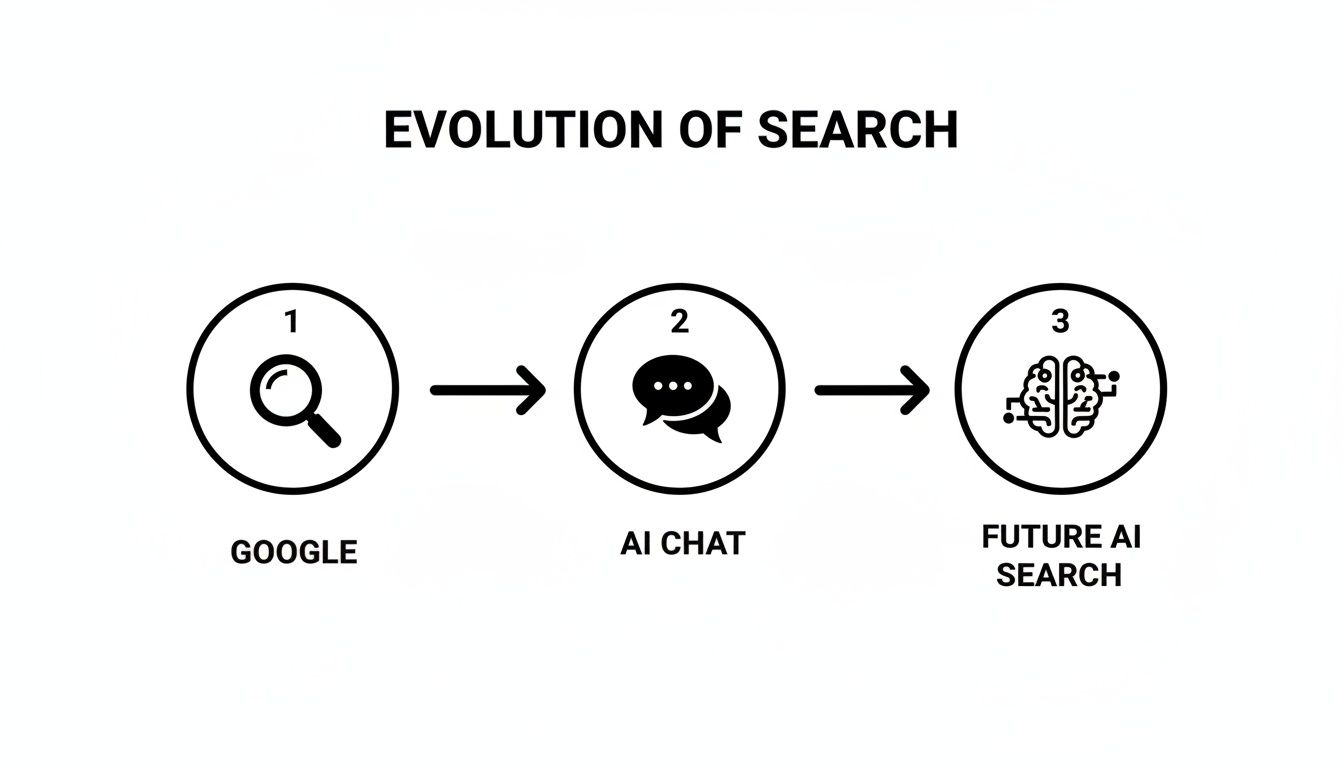
As you can see, while Google is still a dominant force, AI chat is carving out a huge role as the primary interface for discovery, completely changing the SEO landscape.
This isn't some far-off concept; it's a measurable reality impacting traffic right now. By late 2025, ChatGPT has already shifted from a simple content ideation tool to a real discovery layer, making "ChatGPT SEO optimization" a trackable channel.
The data is telling. ChatGPT now accounts for 17.1% of all digital queries globally and has captured a massive 23% of informational intent searches. For SEO leaders, that means nearly one in four information-seeking searches now happens in an LLM where a single answer block decides which brands get seen.
The new goal isn’t just to be a blue link on a results page. It's to become an authoritative source embedded directly within the AI's knowledge base. Your content must be so clear, comprehensive, and well-structured that AI models have to cite it.
Why AI Visibility Is the New Ranking Factor
The first step is to start treating AI platforms as another search engine you need to win. Your brand's presence—or absence—in these answers directly shapes perception, authority, and, ultimately, revenue. You can't afford to ignore this emerging channel.
To really grasp the change, it helps to see the old and new playbooks side-by-side.
Traditional SEO vs. AI Discovery Optimization
| Focus Area | Traditional SEO (Google) | AI Discovery Optimization (ChatGPT) |
|---|---|---|
| User Intent | Focuses on short, transactional keywords (e.g., "best running shoes") | Handles complex, conversational, multi-step queries (e.g., "what are the best running shoes for a beginner with flat feet training for a half-marathon?") |
| Content Strategy | Targets keyword density, backlinks, and on-page technical SEO. | Prioritizes comprehensive, factual, and well-structured content that directly answers complex questions. |
| Success Metrics | Measures keyword rankings, organic traffic, click-through rates (CTR), and domain authority. | Tracks brand mentions, citation frequency, sentiment in AI responses, and referral traffic from citations. |
| User Experience | Optimizes for a list of blue links, aiming for the top position. | Aims to become the definitive source cited within a single, synthesized answer block. |
This table makes it clear: adapting requires a new mindset and new tools.
Platforms like Sight AI were built for this new reality, giving you the ability to track how your brand appears across all the major AI models. This allows marketers to treat AI responses just like another SERP to dominate.
For a practical guide on applying AI to boost your site's performance, these 8 steps to boost your site with AI Search Engine Optimization are a great starting point. Mastering this new form of AI search engine optimization is no longer a choice for brands that want to grow.
Mastering Prompts for High-Impact SEO Tasks
If you’re only giving ChatGPT generic prompts, you’re going to get generic, forgettable content back. It's that simple. Asking it to "write a blog post about X" is a surefire way to get a low-value article that neither your audience nor Google will care about.
The real magic happens when you stop thinking like a writer and start thinking like an engineer. You need to craft detailed, multi-layered prompts that guide the AI toward a specific strategic goal. Think of it as directing an actor—your prompt is the script. The more context, constraints, and examples you provide, the better the performance you'll get.

Uncovering Deeper Keyword Opportunities
Keyword research is the bedrock of any solid SEO strategy. Used correctly, ChatGPT can be an incredible brainstorming partner, but you have to push it beyond the obvious. Instead of just asking for a list of keywords, frame your requests around user intent and semantic relationships. This is how you uncover the long-tail queries and topic clusters that signal real authority to search engines.
Here’s a practical prompt that goes way beyond a basic keyword request:
"Act as an expert SEO strategist. My primary keyword is 'sustainable home gardening.' My target audience is urban millennials living in apartments with limited space. Generate a topic cluster model with one pillar page topic and five supporting cluster content ideas. For each idea, provide three long-tail keyword variations that address specific user problems, such as 'indoor vegetable garden no sunlight' or 'balcony herb garden for beginners'."
See the difference? This prompt works because it’s layered with context: a specific role, a target keyword, a detailed audience persona, and a precise output format (the pillar/cluster model). The result isn't just a boring list of keywords; it's a strategic content map ready for execution.
Building Strategic Content Briefs with AI
A well-structured content brief is the blueprint for a high-ranking article. It’s what keeps your content focused on search intent and ensures every angle of a topic is covered comprehensively. Using ChatGPT to accelerate this process can dramatically boost your team's output without letting quality slip.
A powerful prompt for generating a content brief needs to include a few key ingredients:
- Primary and Secondary Keywords: Clearly define your main keyword and a handful of related terms to target.
- Target Audience and Search Intent: Explain who the article is for and what problem they're trying to solve (is it informational, commercial, or something else?).
- Competitor Analysis: Give it the URLs of top-ranking articles and ask the AI to identify common themes, heading structures, and—most importantly—content gaps you can exploit.
- Desired Structure: Request a specific outline with H2s and H3s, and maybe even ask for a "People Also Ask" section to be included.
This structured approach turns the AI from a simple writer into a research assistant. It automates the tedious parts of competitor analysis and outlining, freeing up your human experts to add the unique insights and data that make content truly stand out. If you want to perfect this workflow, starting with a battle-tested SEO content brief template can give you a solid framework to build upon.
Generating Optimized On-Page Elements
Beyond full articles, ChatGPT is a beast at crafting the small but critical on-page SEO elements that drive click-through rates and improve rankings. With the right prompts, you can generate optimized titles, meta descriptions, and header structures in a matter of seconds.
Example Prompt for SEO Titles
"Generate five SEO-optimized blog titles for an article about 'AI for small business marketing.' The titles must be under 60 characters, include the primary keyword, and create a sense of urgency or curiosity for a non-technical audience."
This prompt is effective because it’s packed with constraints: character limits, keyword requirements, and tonal guidance. The outputs are almost always immediately usable.
You can also use it to quickly optimize existing content. For instance, grab a dense paragraph and ask ChatGPT to "rewrite this paragraph into a scannable format using H3 subheadings, short sentences, and a bulleted list to highlight the key benefits." It’s a fast and easy way to improve user experience—a factor that both Google and your readers will thank you for.
Scaling High-Quality Content Production with AI
In a world drowning in generic, low-effort AI text, the value of truly deep, authoritative content has never been higher. The real challenge for modern SEOs isn't just about creating content anymore. It's about producing comprehensive, high-quality articles at a speed that actually keeps pace with the search landscape.
This is exactly where a smart ChatGPT SEO optimization workflow gives you a serious edge.
The goal here is to move past short, superficial posts. We're talking about scaling the production of long-form articles—the kind that answer a user's main question and every single related question they might have. It's a game of quality and quantity, and AI is how you win at both.

Find Competitor Gaps with AI
A killer starting point is to use ChatGPT as your own high-speed research analyst. Forget manually sifting through the top-ranking articles for a keyword. You can automate that whole process to quickly pinpoint crucial content gaps.
Just feed the AI the URLs of the top five competitors for your keyword. Then, give it a specific analysis prompt:
"Analyze these five articles on 'AI for e-commerce personalization.' Identify the common subtopics they all cover, and then list at least three unique subtopics or unanswered questions that are missing from their collective coverage. Frame these gaps as potential H3 headings for a new, more comprehensive article."
This little trick instantly shows you where the opportunities are. You’re not just copying what competitors did; you're strategically building on their weaknesses to create something that's objectively better.
Generate Comprehensive First Drafts
Once you've identified those content gaps, you're ready to generate a structured draft. This is where a detailed prompt is absolutely critical. Don't just give it a simple request. Hand the AI a complete blueprint, including your target audience, tone of voice, primary and secondary keywords, and the full outline you just developed.
This process turns ChatGPT from a simple writer into a production powerhouse, delivering a well-organized draft that a human expert can then take to the next level. The AI does the heavy lifting of structuring all the information. This frees up your team to focus on adding unique insights, proprietary data, and real-world examples—the stuff that builds true authority. This strategic approach is also essential for effective content creation with AI that actually connects with readers.
This blend of speed and quality is completely changing the economics of ChatGPT SEO. As of 2025, surveys show that 57% of content marketers now use AI for drafting, with 71% of them leaning on ChatGPT. This has led to real results, as 65% of businesses using AI report better SEO performance. The flip side? This has also flooded the web with generic text, forcing Google to reward authority, freshness, and comprehensiveness.
For SEO managers, this means scaling 2,500–4,500 word resources is far more valuable than churning out hundreds of thin, 500-word posts.
The winning formula is no longer just about speed. It’s about using AI to accelerate the creation of content that is so comprehensive and well-structured that it becomes the definitive resource on a topic.
Prioritize Key Ranking Signals
As you scale up production, you have to stay laser-focused on the signals that Google and other AI models now prioritize. Generic, keyword-stuffed text just doesn't work anymore because it lacks the nuance and authority that build trust.
- Content Freshness: Make a habit of updating articles with new data, examples, and stats to signal ongoing relevance.
- Clarity and Structure: Use short paragraphs, clear headings, bullet points, and tables. Make complex information easy to scan and digest.
- Authoritative Signals: Weave in expert quotes, link out to credible sources, and include unique data or case studies that no one else has.
By building these elements into your AI-assisted workflow, you ensure that the content you're producing at scale not only meets but crushes the quality benchmarks for today's search environment. The result is a library of high-value assets that drive sustained organic growth.
The Irreplaceable Role of Human Expertise
Let's make one thing crystal clear: using ChatGPT for SEO is like having a brilliant, incredibly fast junior strategist on your team. It can generate drafts, analyze data, and build outlines at a stunning speed. But it is not the final decision-maker.
The most successful SEO strategies are a fusion of AI's raw efficiency and the irreplaceable judgment of a human expert.
Thinking of AI output as a finished product is the single biggest mistake you can make. It’s a highly polished first draft, sure, but it lacks the nuanced understanding, lived experience, and strategic oversight that turn good content into great, authoritative content. The final mile of the content creation journey is where human expertise truly shines.
The Human-Led Quality Assurance Checklist
Before any AI-assisted content gets near your CMS, it has to pass a rigorous human quality assurance process. This isn't just a quick proofread; it's a strategic review designed to catch common AI pitfalls and elevate the content beyond what an algorithm can produce on its own.
Your QA process needs to be methodical. Create a checklist and use it every single time to ensure nothing slips through the cracks. This step is what separates high-value content from the sea of generic AI text flooding the web.
Here are the non-negotiable checks your team must perform:
- Fact-Checking and Verification: AI models are notorious for "hallucinating"—confidently stating incorrect facts or citing non-existent sources. Every statistic, date, and claim must be manually verified against a primary source. A single inaccurate data point can destroy your credibility.
- Tone of Voice Alignment: Does the content sound like your brand? AI often defaults to a generic, slightly formal tone. Your editor's job is to inject your brand's unique personality, humor, and perspective.
- Injecting Unique Insights (E-E-A-T): This is where you add value that AI simply cannot replicate. Weave in personal anecdotes, customer stories, proprietary data, or expert opinions. This is crucial for demonstrating Experience, Expertise, Authoritativeness, and Trustworthiness (E-E-A-T).
- Eliminating Repetitive Phrasing: AI drafts often overuse certain transitional phrases or sentence structures. A human editor needs to smooth out the language, ensuring the prose flows naturally and doesn't sound robotic.
For a deeper dive into why this human touch is so vital, exploring the differences between AI content writing vs. traditional methods provides some excellent context.
From Final Draft to Published Post
Once the content is polished and verified, the human-led process continues. Integrating the article into your CMS isn't just a copy-paste job. It’s another opportunity to apply SEO best practices that an AI tool might overlook.
This final stage involves meticulous on-page optimization. Your team should be focused on the small details that collectively make a huge impact on performance.
The ultimate goal is to blend AI's speed with human creativity and judgment. AI handles the 80% of grunt work, freeing up your experts to focus on the final 20% that drives real results.
This includes:
- Strategic Internal Linking: Manually add internal links to relevant pillar pages, supporting articles, and service pages. This distributes link equity and guides users through your site in a way an algorithm can't intuit.
- Image Optimization: Select compelling images, write descriptive alt text that includes keywords, and compress files to ensure fast page load speeds. A recent study noted that 78% of SEO issues can be image-related, making this a critical step you can't afford to skip.
- Schema Markup Implementation: Add relevant schema markup (like Article, FAQ, or HowTo) to help search engines better understand your content and improve its appearance in the SERPs.
- Final Readability Check: Review the final post on the front-end. Make sure the formatting is clean, scannable, and user-friendly on both desktop and mobile devices.
Only after these human-centric steps are complete is the content truly ready for publishing and submission for indexing. This meticulous final review ensures that every piece of content you produce is a powerful asset for your brand.
How to Measure and Win AI Visibility
If you can't measure it, you can't improve it. This old business adage is more relevant than ever. After you've dialed in your prompts and started scaling up your content, the work isn't over. The next question is always: is it working?
In traditional SEO, we have a clear set of metrics—keyword rankings, organic traffic, backlink velocity. We know what to look for. But how do you track performance when the "search engine" is a conversational AI like ChatGPT?
This is where the idea of AI visibility stops being a concept and becomes a concrete, measurable goal.
Think of AI visibility as your brand's presence, authority, and reputation inside the answers generated by large language models. It's the new frontier of search ranking, and it demands a fresh set of tools and a completely new mindset. You have to start treating these AI platforms as a parallel search engine with its own unique signals of success.
Defining Your Key Performance Indicators
To really get a handle on your ChatGPT SEO strategy, you need to look beyond the familiar world of Google Analytics. Your new dashboard needs to reflect how the AI sees and talks about your brand.
Here are the core metrics you absolutely need to track:
- Brand Mentions and Citations: How often does ChatGPT mention your brand, products, or content as a source in relevant answers? Simple, but powerful.
- Share of Voice: For a specific topic or query, what percentage of the AI's answers mention your brand versus your competitors? This is your market share in the AI space.
- Sentiment Analysis: How is your brand mentioned? Is the context positive, neutral, or negative? A positive mention from an AI is a massive digital endorsement.
- Positional Tracking: When you are mentioned, where do you appear? Are you the first brand the AI names, the third, or just buried in a list? The top-mentioned brand almost always captures the most mindshare.
Tracking these KPIs paints a clear picture of your performance. If you want to see how this approach stacks up against older methods, our guide on what is rank tracking provides some great context on how this practice has evolved.
Finding and Filling High-Value Content Gaps
The real magic of measuring AI visibility is using the data to uncover strategic opportunities. Once you start monitoring competitor mentions, you'll inevitably find high-value gaps where their brand is getting recommended and you're nowhere to be found.
These gaps are your roadmap. They tell you exactly what content to create next.
Imagine a user asks ChatGPT, "What are the best CRMs for small businesses?" If the AI consistently names three of your competitors but not you, that’s a critical visibility gap. That single insight is more valuable than a dozen keyword reports because it shows you precisely what content you need to build or improve to earn a spot in that conversation.
The goal is no longer just to rank #1 on a SERP. It’s to become one of the top brands ChatGPT consistently names when answering category-defining questions. This is the new definition of winning in search.
This is exactly why platforms like Sight AI exist. They were built for this new reality, monitoring prompts, positions, and sentiment across major LLMs. You can see exactly where competitors are winning and where your brand is invisible, allowing you to prioritize filling those gaps before your rivals lock in that authority for good.
Analyzing the Sources AI Trusts
Another crucial piece of the puzzle is analyzing the sources that AI models trust and cite. These are the digital breadcrumbs that lead back to authority. AI search is acting like a parallel search engine, and just like traditional rankings, its visibility is becoming trackable.
In fact, ChatGPT is on track to surpass a 1% share of the search market, which translates to billions of queries. Its models frequently cite sources like Reddit, LinkedIn, and YouTube, amplifying content that already has a strong signal of authority. You can see more data on this trend in these ChatGPT statistics on seoprofy.com.
What does this mean for your strategy? It means your content and authority-building efforts need to focus on getting mentioned on these high-trust platforms. If an AI consistently cites a specific industry blog, forum, or community, that’s a massive signal that you need to be active and visible in that space.
Securing mentions, guest posts, or positive reviews on these trusted sources indirectly boosts your AI visibility, creating a powerful feedback loop that reinforces your brand’s authority within the model.
Common Questions About ChatGPT for SEO
Whenever you mix a new tool like AI into a tried-and-true process like SEO, questions are going to pop up. As more teams start using ChatGPT in their day-to-day work, a few key concerns keep surfacing. Let's clear the air on those so you can move forward with confidence.
By far, the biggest question on everyone's mind is about search engine penalties. Let's tackle that one head-on.
Can Google Detect AI Content and Will It Hurt My Rankings?
Google’s official stance is actually pretty straightforward: they reward helpful, high-quality content that’s made for people. How you make it doesn't matter nearly as much as the value it provides.
If you’re just trying to game the system by pumping out low-effort, spammy AI content, you're violating their guidelines. That's a fast track to getting penalized. But that’s not what we’re talking about here.
Using ChatGPT as a creative partner to brainstorm ideas, kickstart research, or draft an article is a totally different story. When you take that draft and have a human expert meticulously fact-check it, edit it for a unique voice, and add their own expertise, you're in the clear.
As long as the final piece is accurate, original, and genuinely helps the user, it’s exactly what Google wants to see. The risk isn't using AI; it's publishing raw, unedited AI output that feels robotic and lacks real authority.
The golden rule here is "people-first content." If AI helps you create something better for your audience, Google is all for it. If you're using it to create content for search bots, you've missed the point.
This also brings up a related concern for many: Can Turnitin Detect ChatGPT and other AI content? Getting a handle on what detection tools can and can't do is key to using AI ethically and effectively in any content workflow.
How Is ChatGPT SEO Optimization Different?
While the core principles of SEO—like focusing on user intent—are still front and center, the strategic game has shifted. Traditional SEO has always been about targeting keywords to climb up a SERP, optimizing technicals, and building backlinks to own one of those ten blue links.
ChatGPT SEO optimization, on the other hand, is about something else entirely. The new goal is to make your content so authoritative and citable that it gets featured directly within a conversational AI answer.
This means your content needs to be exceptionally clear, incredibly comprehensive, and structured perfectly to answer complex questions directly. It also puts a much higher premium on being mentioned in sources that LLMs already trust, like respected industry blogs, in-depth reports, and high-quality forums. You're not just trying to rank; you're trying to become an embedded, trusted source in the AI's brain.
What Are the Biggest Mistakes to Avoid?
The single most damaging mistake is the "prompt and publish" approach. Just taking the first thing the AI spits out and hitting publish without any human oversight is a recipe for disaster. It's this lazy workflow that's flooding the internet with generic, and often flat-out wrong, content.
Here are the top errors you need to sidestep:
- Blindly Trusting Facts: LLMs are notorious for "hallucinating" or just making things up. Every single statistic, date, or factual claim must be verified with a credible, primary source before it ever sees the light of day.
- Using Simplistic Prompts: A vague, one-line prompt will get you a superficial, generic article. Real chatgpt seo optimization comes from detailed, context-rich prompts that steer the AI toward a specific, strategic goal.
- Forgetting SEO Fundamentals: AI is a powerful tool, but it doesn't replace the basics. If you forget to add strategic internal links, optimize your images with alt text, or implement the right schema markup, you're leaving a ton of performance on the table.
Ready to stop guessing and start measuring your AI visibility? Sight AI shows you exactly how AI models see your brand, uncovers high-value content gaps, and automates the creation of SEO-optimized articles to win the new era of search. Learn more and get started at https://www.trysight.ai.