When someone opens ChatGPT and asks "What's the best project management tool for remote teams?" your brand is either in that answer—or it isn't. The same goes for Claude, Perplexity, Gemini, and every other AI model that millions of people now consult before making purchasing decisions. This shift represents one of the most significant changes in how brands gain visibility since the rise of Google search itself.
The difference? You can't see these conversations happening. There's no analytics dashboard showing you when AI recommended your competitor instead of you. There's no alert when sentiment shifts in how models describe your product category. Traditional monitoring tools—built for scanning published web content and social media—completely miss this new frontier of brand visibility.
This creates a genuine blind spot in marketing intelligence. While you're tracking website traffic and social mentions, entire conversations about your industry are happening inside AI platforms, shaping perceptions and driving decisions without leaving a trace you can monitor. The brands that figure out how to track and influence these AI-generated responses will gain a compounding advantage as AI-assisted search continues its rapid growth.
The New Visibility Frontier: Why AI Responses Matter for Your Brand
LLM outputs operate fundamentally differently than traditional search results. When Google displays results, it retrieves and ranks existing web pages based on relevance and authority signals. When ChatGPT answers a question, it generates a response by synthesizing patterns from its training data, creating something new in that moment.
This distinction matters enormously for brand visibility. A well-optimized webpage can rank consistently in Google for months or years. But AI responses vary by session, prompt phrasing, model version, and even subtle contextual factors. Ask the same question twice, and you might get different brand mentions each time.
AI mentions fall into several distinct categories, each with different strategic implications. Direct recommendations occur when AI explicitly suggests your brand as a solution: "For enterprise project management, consider Asana or Monday.com." Comparative mentions place you alongside competitors in feature discussions or pricing breakdowns. Sentiment-loaded references include qualitative assessments—describing your product as "user-friendly" versus "complex" shapes perception before prospects ever visit your website.
Then there are the notable absences. When AI answers a category question without mentioning your brand at all, you've lost a visibility opportunity. If someone asks "What are the top CRM platforms?" and gets five recommendations that don't include yours, you weren't just outranked—you were invisible in that conversation. Understanding why your brand is not visible in LLM responses is the first step toward fixing it.
Traditional monitoring tools miss this entirely because they're designed to scan published content. Social listening platforms track mentions across Twitter, Reddit, and news sites. Media monitoring services alert you to press coverage and blog posts. But none of these tools can see what happens inside a ChatGPT conversation or a Claude session.
The visibility gap becomes especially critical when you consider user intent. Someone asking AI for product recommendations is often further along in their buying journey than someone casually browsing social media. They're actively seeking solutions, comparing options, and forming preferences. Being present in those AI-generated answers directly influences purchase decisions.
This creates a new category of competitive intelligence. You need to know not just whether AI mentions your brand, but how it positions you relative to competitors, what attributes it associates with your product, and which use cases trigger your inclusion in responses. Without systematic monitoring, you're operating blind in an increasingly important channel.
How Brand Monitoring in LLM Outputs Actually Works
Monitoring brand mentions in AI outputs requires a fundamentally different approach than traditional web monitoring. Instead of passively scraping published content, you actively query AI models with strategically designed prompts and analyze the responses.
The technical process starts with systematic querying across multiple AI platforms. This means submitting relevant questions to ChatGPT, Claude, Perplexity, Gemini, and other major models, then capturing and storing the complete responses. The goal isn't to query once—it's to build a longitudinal dataset that reveals patterns over time.
Prompt engineering becomes critical here. The questions you ask AI determine what insights you uncover. A prompt like "What are project management tools?" yields different results than "What's the best project management software for marketing teams?" or "Which project management platform has the strongest API?" Each variation tests different aspects of your brand's AI visibility.
Effective monitoring strategies use diverse prompt categories. Product comparison prompts directly pit your brand against competitors. Problem-solution prompts test whether AI connects your product to specific pain points. Industry expertise prompts reveal if AI associates your brand with thought leadership. Feature-specific prompts uncover which capabilities AI attributes to your product. Learning how to track brand mentions in LLMs starts with mastering these prompt variations.
The challenge of consistency complicates this process significantly. AI responses aren't deterministic—the same prompt can generate different answers across sessions. Model updates change how AI synthesizes information. Even subtle phrasing variations produce different brand mentions. This variability means single queries provide incomplete pictures.
Systematic tracking over time solves this problem. By querying the same prompts regularly—daily or weekly—you build a dataset large enough to identify genuine trends versus random variation. You can track whether your brand's mention frequency is increasing, whether sentiment is shifting, and how competitive positioning evolves.
The monitoring infrastructure needs to handle multiple dimensions simultaneously. You're tracking across different AI platforms, different prompt categories, different competitors, and different time periods. The raw data—thousands of AI-generated responses—requires structured analysis to extract actionable insights.
This is where specialized monitoring tools become valuable. Manual querying quickly becomes impractical at scale. Imagine systematically testing 50 different prompts across 6 AI platforms daily—that's 300 queries per day, over 9,000 per month. Automation handles the querying, response capture, and initial analysis, surfacing the patterns that matter.
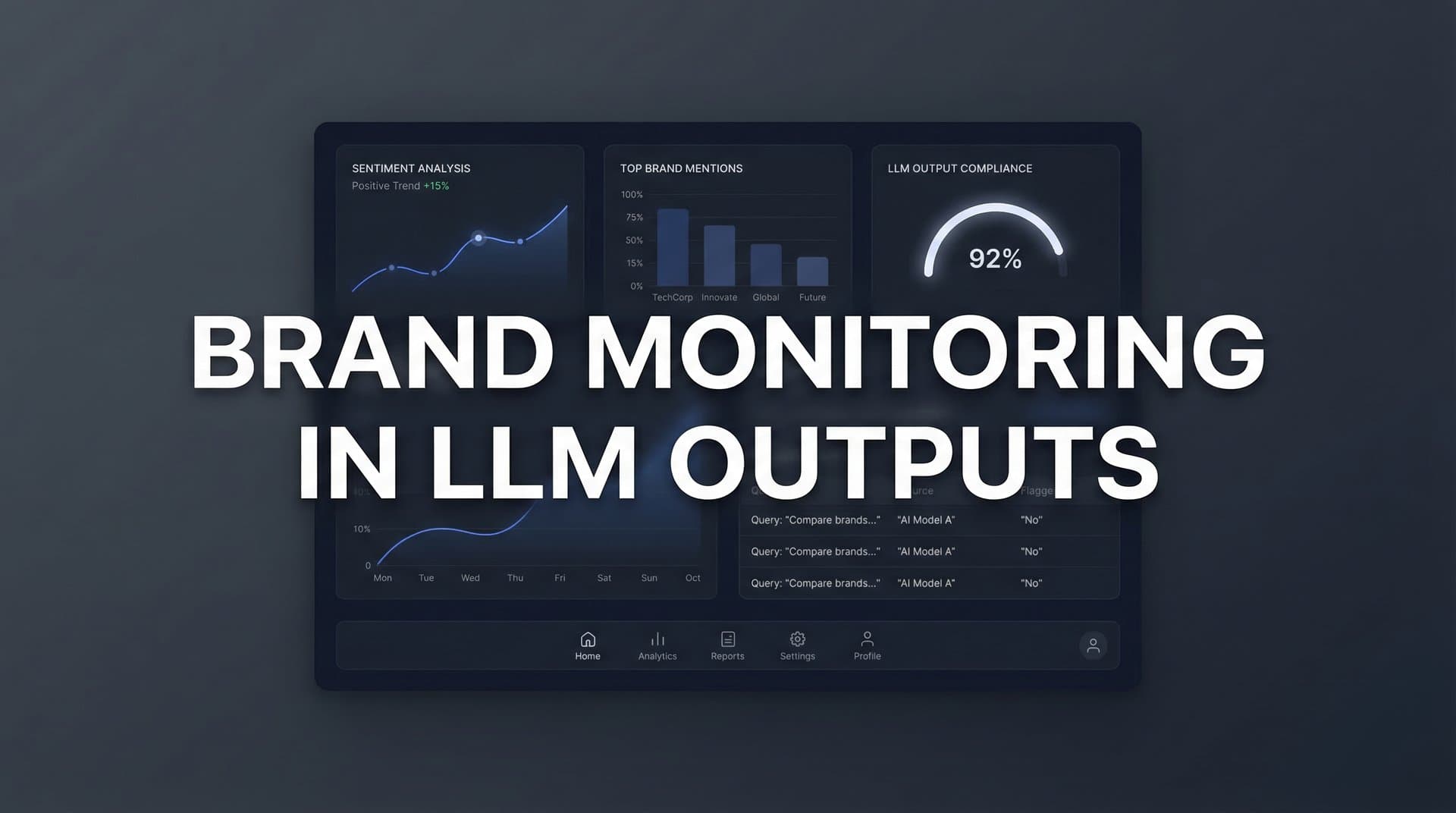
The analysis layer identifies brand mentions within responses, classifies mention types, extracts sentiment indicators, and tracks competitive dynamics. Advanced systems calculate composite metrics like AI Visibility Score, which aggregates mention frequency, sentiment, and positioning into a single trackable number.
Think of it like this: traditional SEO tools show you where you rank in search results. AI visibility monitoring shows you where you appear in AI-generated answers. Both measure discoverability, but in fundamentally different information ecosystems. Understanding LLM monitoring vs traditional SEO helps clarify why both approaches matter.
Key Metrics That Reveal Your AI Visibility Health
Measuring brand visibility in LLM outputs requires metrics designed specifically for AI-generated content. Traditional metrics like share of voice or sentiment scores need adaptation to work effectively in this new context.
AI Visibility Score serves as the primary composite metric. This measurement aggregates multiple factors: how frequently your brand appears across AI platforms, the sentiment of those mentions, the prominence of your positioning (first mention versus buried in a list), and the breadth of prompt categories where you appear. A high AI Visibility Score indicates strong, positive presence across diverse AI responses.
The score typically normalizes to a 0-100 scale for easy interpretation. A brand with a score of 75 appears frequently, receives positive framing, and shows up across multiple question types. A score of 30 suggests limited visibility, inconsistent mentions, or unfavorable positioning. Tracking this metric over time reveals whether your AI presence is strengthening or weakening. Dedicated LLM brand visibility monitoring makes this tracking systematic and actionable.
Sentiment analysis in LLM context differs from traditional sentiment scoring. You're not analyzing user-generated content—you're evaluating how AI models characterize your brand. Positive sentiment means AI describes your product with favorable language, recommends it for specific use cases, or highlights strengths. Neutral sentiment indicates factual mentions without qualitative assessment. Negative sentiment includes critical language, problem associations, or unfavorable comparisons.
The nuance matters because AI-generated sentiment shapes first impressions. When someone asks Claude about email marketing platforms and it describes yours as "powerful but complex," that framing influences perception before the prospect researches further. Monitoring sentiment trends helps you understand how AI positions your brand narratively. Tools for tracking brand sentiment in LLMs provide this critical insight.
Competitive share of voice measures your visibility relative to competitors when AI answers category-level questions. If AI mentions your brand in 60% of project management tool queries but mentions your main competitor in 85%, you're losing share of voice in that category. This metric reveals competitive positioning gaps.
Mention frequency by prompt category shows where your visibility is strong versus weak. You might appear frequently in feature comparison prompts but rarely in "best for small business" queries. This granularity identifies specific visibility gaps to address through targeted content strategies.
Platform-specific performance reveals which AI models favor your brand and which overlook it. Strong presence in ChatGPT but weak visibility in Perplexity suggests different training data or response patterns. Understanding these variations helps prioritize improvement efforts.
Tracking these metrics longitudinally creates a visibility health dashboard. You can see whether recent content efforts are improving AI mentions, whether competitive positioning is shifting, and which prompt categories need attention. The data transforms from abstract curiosity into actionable intelligence.
Building a Systematic LLM Monitoring Strategy
Effective AI visibility monitoring requires strategic planning rather than ad hoc querying. The goal is creating a repeatable system that generates consistent, actionable insights over time.
Start by defining prompt categories that matter for your business. Product comparison prompts test direct competitive positioning: "Compare [Your Product] with [Competitor]" or "What's better, [Your Product] or [Alternative]?" These reveal how AI frames competitive differentiation.
Best-of queries assess category leadership: "What are the best [product category] tools?" or "Top [product type] platforms for [use case]." Your presence or absence in these responses directly impacts discoverability for high-intent prospects. Understanding how LLMs choose brands to recommend helps you optimize for these critical queries.
Problem-solution prompts test whether AI connects your product to specific pain points: "How do I solve [specific problem]?" or "What tool helps with [particular challenge]?" If AI doesn't mention your brand when describing solutions to problems you solve, you're missing visibility opportunities.
Industry expertise prompts reveal thought leadership associations: "Who are the experts in [your industry]?" or "What companies lead in [your category]?" These mentions build authority and credibility beyond direct product recommendations.
Feature-specific prompts uncover capability awareness: "Which [product category] has the best [specific feature]?" or "What tool offers [particular functionality]?" These responses show whether AI accurately understands your product's capabilities.
Monitoring frequency determines how quickly you detect changes. Daily tracking provides the most granular trend data but requires more resources. Weekly monitoring balances insight quality with practical sustainability for most teams. Monthly tracking works for slower-moving categories but risks missing important shifts. Real-time brand monitoring across LLMs offers the fastest detection of visibility changes.
The key insight: AI responses change over time as models update, training data evolves, and new content gets published. Single snapshots tell you where you stand today but miss the trajectory. Regular monitoring reveals whether you're gaining or losing ground.
Platform prioritization should reflect your audience's actual AI usage patterns. If your target customers primarily use ChatGPT and Perplexity, focus monitoring efforts there rather than spreading resources across every available AI model. Quality of insights matters more than quantity of platforms tracked.
That said, monitoring multiple platforms reveals important variations. Different AI models sometimes position brands quite differently based on their training data and response patterns. These discrepancies highlight opportunities to improve visibility where you're currently weak.
Build a monitoring calendar that balances consistency with adaptability. Core prompts should run on a regular schedule to enable trend analysis. Supplemental prompts can rotate monthly to explore different aspects of your visibility. This approach maintains comparable data while allowing strategic exploration.
From Insights to Action: Improving Your Brand's AI Presence
Monitoring reveals where your AI visibility stands—but the real value comes from using those insights to improve your presence in future AI responses.
The connection between monitoring data and content strategy is direct. When you discover that AI rarely mentions your brand for specific use cases or problem categories, you've identified a content gap. Creating comprehensive, authoritative content that addresses those topics helps influence how AI models understand and represent your brand.
This is where GEO-optimized content creation becomes strategic. Generative Engine Optimization focuses on creating content that AI models are likely to reference when generating responses. Unlike traditional SEO that optimizes for search engine rankings, GEO optimizes for becoming part of the knowledge base that AI draws from.
Effective GEO content demonstrates clear expertise, provides comprehensive coverage of topics, and establishes authoritative connections between your brand and specific solutions. When AI models train on or reference this content, they're more likely to include your brand in relevant responses. Strategic efforts to improve brand visibility in LLM responses start with this content foundation.
The feedback loop works like this: monitor to identify visibility gaps, create targeted content addressing those gaps, index that content quickly so it becomes discoverable, then measure changes in AI mentions over time. This cycle transforms monitoring from passive observation into active visibility improvement.
Quick indexing matters more in the AI context than traditional SEO. Tools like IndexNow help search engines discover new content faster, which can accelerate how quickly that content influences AI training datasets and real-time retrieval systems. The faster your content becomes part of the discoverable web, the sooner it can impact AI responses.
Content types that particularly influence AI visibility include comprehensive guides that establish topical authority, comparison articles that frame competitive positioning, case studies that demonstrate real-world applications, and thought leadership pieces that build expertise associations.
The strategic approach isn't about gaming AI models—it's about ensuring accurate, comprehensive representation. If your product genuinely solves specific problems or serves particular use cases, creating authoritative content about those topics helps AI models make accurate connections.
Track the impact of content initiatives on AI visibility metrics. After publishing a comprehensive guide on a topic where you previously had weak AI mentions, monitor whether your brand starts appearing more frequently in related AI responses. This measurement closes the loop between effort and outcome.
The compounding effect becomes powerful over time. Each piece of authoritative content potentially influences multiple AI responses. As your content library grows and your AI visibility improves, you build momentum that becomes increasingly difficult for competitors to overcome.
The Competitive Advantage of Early Adoption
Brand monitoring in LLM outputs represents a fundamental shift in competitive intelligence. While traditional monitoring tools track published mentions and social conversations, AI visibility monitoring reveals how your brand appears in the generated responses that increasingly shape purchase decisions.
The core workflow is systematic tracking across AI platforms, meaningful metrics analysis, and content strategies that improve visibility where it matters. This isn't about occasional curiosity—it's about building a repeatable system that generates actionable insights consistently.
The brands that establish strong AI visibility now will gain compounding advantages as AI-assisted search continues growing. Early adopters can identify and close visibility gaps before competitors even recognize the opportunity. They can build content libraries optimized for AI reference. They can establish thought leadership associations that become embedded in how AI models understand their category.
Think of it as the modern equivalent of early SEO adoption. Companies that invested in search optimization when Google was emerging built advantages that persisted for years. The same dynamic is playing out with AI visibility—except the timeline is compressed and the stakes are arguably higher given how rapidly AI adoption is accelerating.
The visibility gap won't remain invisible forever. As more marketers recognize that AI responses influence purchase decisions, competition for AI mentions will intensify. The brands monitoring and optimizing their AI presence today are building moats that will be harder to cross tomorrow.
Stop guessing how AI models like ChatGPT and Claude talk about your brand—get visibility into every mention, track content opportunities, and automate your path to organic traffic growth. Start tracking your AI visibility today and see exactly where your brand appears across top AI platforms.