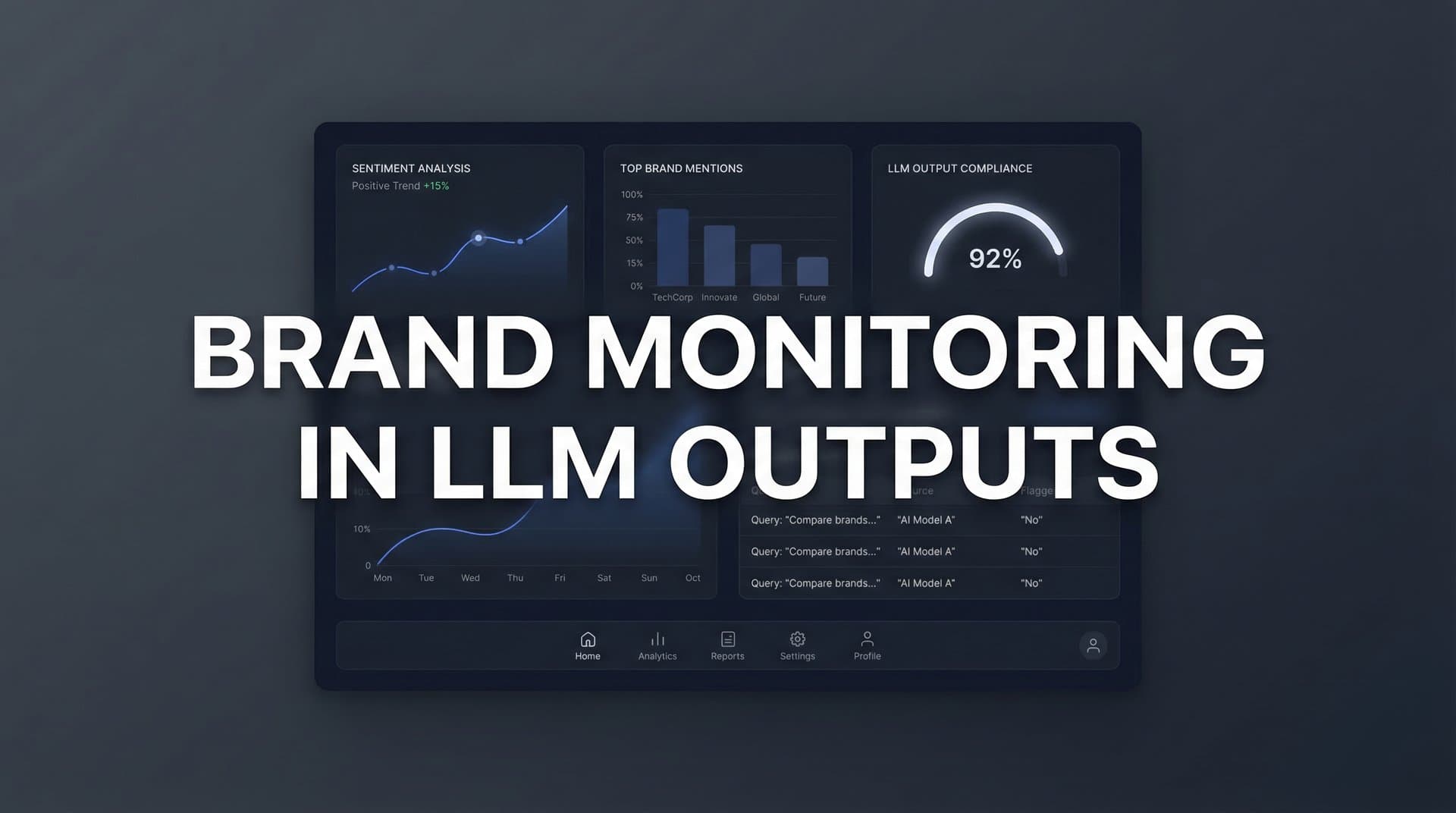
When someone opens ChatGPT and asks "what's the best CRM for small businesses," does your brand appear in the response? What about when a potential customer asks Claude for "top project management tools" or queries Perplexity about "reliable email marketing platforms"? These aren't hypothetical scenarios anymore. Millions of professionals now bypass Google entirely, turning instead to AI models for recommendations, research, and decision-making support.
This shift represents more than just a new interface for search. It's a fundamental change in how brands gain visibility and earn customer consideration. Traditional SEO taught us to optimize for search engine crawlers and ranking algorithms. But AI models don't work like search engines. They don't rank pages or display blue links. Instead, they synthesize knowledge from vast training datasets and generate conversational responses that either mention your brand or don't.
Brand awareness in LLM outputs has become the new frontier of digital visibility. It's distinct from SEO, operates on different principles, and requires its own strategies and measurement frameworks. The question is no longer just "where do we rank?" but "when AI models discuss our industry, do we exist in their knowledge base at all?"
How AI Models Form Brand Knowledge
Understanding brand awareness in LLM outputs starts with understanding how these models learn about brands in the first place. Large language models like GPT-4, Claude, and others don't browse the internet in real-time during most interactions. Instead, they build their knowledge during training, processing billions of text documents to form associations, patterns, and understanding.
Think of it like this: when an LLM encounters your brand name mentioned alongside certain keywords, contexts, and topics thousands of times across its training data, it forms what researchers call parametric knowledge. The model learns that "Salesforce" frequently appears in discussions about CRM systems, that "HubSpot" connects to inbound marketing conversations, and that "Slack" emerges in workplace communication contexts. These associations become embedded in the model's parameters, essentially its learned understanding of the world.
The strength of these associations matters enormously. A brand mentioned occasionally in passing creates weak signals. A brand that appears consistently in authoritative contexts, discussed in detailed technical documentation, featured in industry analysis, and referenced in educational content creates strong, multi-dimensional associations. The model doesn't just learn that your brand exists but understands the specific contexts where it's relevant, the problems it solves, and how it compares to alternatives. Understanding how LLMs choose brands to recommend reveals the mechanics behind these selection processes.
But here's where it gets interesting. Many modern AI systems supplement their parametric knowledge with retrieval-augmented generation, or RAG. Platforms like Perplexity and certain ChatGPT modes actively search the web during your conversation, pulling in fresh information to ground their responses. This creates a dual pathway for brand visibility: the foundational knowledge baked into the model during training, plus the real-time content the system retrieves when answering specific queries.
This explains why some brands appear consistently across AI responses while others remain invisible. Strong parametric knowledge means your brand surfaces even in base model responses without real-time retrieval. Combine that with fresh, well-indexed content that RAG systems can find, and you've created multiple pathways for AI visibility. Brands that neglect either pathway leave significant visibility on the table.
The knowledge graph effect amplifies this further. When your brand appears in connection with specific use cases, industries, features, and comparisons across diverse sources, AI models build richer contextual understanding. They learn not just that you exist, but when to recommend you, what problems you solve, and how you fit into broader industry landscapes.
Where Traditional Metrics Fall Short
If you've spent years mastering SEO, you might assume that high Google rankings automatically translate to strong AI visibility. Unfortunately, the relationship isn't that straightforward. AI models and search engines evaluate content authority through fundamentally different lenses.
Google's ranking algorithm weighs hundreds of factors: backlinks, domain authority, page speed, user engagement signals, and countless others. A page can rank number one for a competitive keyword while contributing little to how AI models understand your brand. Why? Because search engines optimize for relevance to specific queries and user satisfaction signals, while LLMs optimize for coherent, accurate knowledge synthesis across their entire training corpus.
Consider this scenario: your product page ranks first for "enterprise analytics software." Great for SEO. But if that page uses heavy marketing language, lacks technical depth, and doesn't appear in the broader ecosystem of industry discussions, tutorials, and comparative analyses, an LLM might have weak associations with your brand despite your strong search rankings. This is precisely why brand awareness is important in the AI era.
AI models prioritize different signals when forming brand understanding. They value comprehensive technical documentation that explains how things work. They weight educational content that demonstrates expertise across a domain. They incorporate third-party discussions, reviews, and analyses that validate claims and provide independent perspective. A single high-ranking page matters less than the cumulative pattern of how your brand appears across thousands of documents.
This has given rise to Generative Engine Optimization, or GEO, as a complement to traditional SEO. While SEO focuses on ranking for keywords and driving clicks, GEO focuses on ensuring AI models can understand, trust, and accurately reference your brand in generated responses. The two disciplines overlap but require distinct strategies.
GEO prioritizes structured, parseable content over keyword density. It values topical authority over individual page optimization. It emphasizes building the broader content ecosystem around your brand rather than optimizing isolated landing pages. Where SEO asks "how do we rank for this keyword," GEO asks "how do we become the authoritative reference AI models cite when discussing this topic?"
The measurement frameworks differ too. SEO tracks rankings, organic traffic, and click-through rates. GEO requires tracking brand mention frequency across AI platforms, analyzing the sentiment and context of those mentions, and monitoring which prompts trigger your brand's inclusion in responses. You can dominate traditional search while remaining invisible in AI conversations, or vice versa.
The Context Quality Problem
Even when brands achieve AI mentions, the context matters enormously. An AI model might mention your brand frequently but primarily in negative contexts, comparisons where competitors appear superior, or outdated information that no longer reflects your current offerings. Traditional SEO metrics won't capture these nuances. You need AI-specific visibility tracking to understand not just if you're mentioned, but how you're being represented.
Tracking Brand Presence Across AI Platforms
You can't improve what you don't measure. Building brand awareness in LLM outputs requires systematic tracking across the AI platforms where your potential customers actually interact with these models. This means moving beyond assumptions and establishing concrete baselines for your current AI visibility.
The foundational metric is mention frequency. When users ask questions in your industry, how often does your brand appear in responses? This isn't a single number but a spectrum across different prompt types. Your brand might surface frequently for technical implementation questions but rarely for high-level strategic queries. It might appear in ChatGPT responses but remain absent from Claude or Perplexity results. Learning how to track LLM brand mentions systematically is essential for establishing these baselines.
Sentiment analysis adds critical context to raw mention counts. A brand mentioned frequently in negative contexts or primarily in comparison to "better alternatives" has a visibility problem, not a visibility success. You need to track whether AI models present your brand positively, neutrally, or negatively across different conversation types.
Prompt category mapping reveals where your brand has established authority and where gaps exist. Test systematic variations: feature-specific questions, use case queries, industry vertical prompts, comparison requests, and implementation guidance. A comprehensive brand presence means appearing across this entire spectrum, not just in narrow contexts.
Competitive benchmarking provides essential perspective. How does your mention frequency compare to direct competitors? When AI models generate comparison lists or recommend alternatives, where does your brand appear in that hierarchy? Are you the primary recommendation, a secondary option, or absent entirely?
Platform-specific tracking matters because different AI systems have different knowledge bases and retrieval behaviors. ChatGPT, Claude, Perplexity, Gemini, and other platforms may represent your brand differently based on their training data, RAG implementations, and update cycles. A brand invisible in ChatGPT might appear prominently in Perplexity results if you've optimized for real-time retrieval. Implementing brand monitoring across LLMs ensures comprehensive coverage.
Establishing baselines creates the foundation for improvement. Run systematic tests across key prompts monthly or quarterly. Document which questions trigger brand mentions, what context surrounds those mentions, and how responses evolve over time. This longitudinal data reveals whether your content strategies actually move the needle on AI visibility.
Change tracking becomes crucial as you implement optimization strategies. When you publish comprehensive guides, update technical documentation, or earn mentions in industry publications, do those efforts correlate with improved AI visibility? Without systematic before-and-after measurement, you're flying blind.
Content That Earns AI Citations
Creating content that AI models reference requires rethinking traditional content marketing approaches. The goal shifts from optimizing for search crawlers to creating the kind of authoritative, structured content that becomes embedded in AI knowledge bases and surfaces in RAG retrieval.
Comprehensive Technical Documentation: AI models heavily weight detailed technical content that explains how systems work, not just what they do. When your documentation thoroughly covers implementation details, API references, architecture decisions, and technical specifications, it signals deep expertise. This content often gets incorporated into training data and retrieved when users ask implementation questions.
Educational Depth Over Marketing Fluff: Marketing pages optimized for conversion often lack the informational depth that AI models value. Long-form educational content that teaches concepts, explains trade-offs, and provides genuine insight builds stronger brand associations than promotional copy. Think tutorials, technical guides, and thought leadership that demonstrates expertise rather than pitches products. Discovering how to improve brand mentions in AI starts with this content-first approach.
Topical Authority Through Comprehensive Coverage: AI models recognize patterns of expertise. A brand that publishes extensively across every aspect of their domain builds stronger associations than one with scattered, shallow content. If you're in the analytics space, comprehensive coverage means content spanning data collection, processing, visualization, statistical methods, integration patterns, and use case implementations. This breadth signals authority.
Structured, Parseable Formats: AI models excel at extracting information from well-structured content. Clear headings, logical organization, bulleted lists for key points, and consistent formatting make your content easier to process and reference. Think about how an AI would extract the core information from your page and structure accordingly.
Third-Party Validation: Your own content establishes claims, but third-party mentions validate them. Reviews on industry platforms, mentions in technical publications, citations in educational resources, and discussions in community forums create independent signals that reinforce your brand's authority. AI models weight these external validations heavily when forming brand understanding.
Comparative Context: Don't shy away from honest comparisons with alternatives. Content that acknowledges the competitive landscape, explains when your solution fits best, and provides balanced perspective often gets referenced more than purely promotional material. AI models value this balanced approach when synthesizing recommendations.
The cumulative effect matters more than individual pieces. A single comprehensive guide helps, but a library of interconnected, authoritative content across your domain creates the dense signal pattern that embeds your brand deeply in AI knowledge bases.
Technical Infrastructure for AI Discovery
Beyond content quality, technical implementation determines whether AI systems can discover, access, and incorporate your content into their knowledge bases and retrieval systems. This is where the infrastructure layer of AI visibility comes into play.
The llms.txt Standard: Emerging standards like llms.txt files provide a structured way to communicate with AI crawlers. Similar to how robots.txt guides search engine crawlers, llms.txt helps AI systems understand your site structure, locate key resources, and identify authoritative content. While still evolving, implementing these standards positions your content for better AI discoverability as the ecosystem matures.
Rapid Indexing for RAG Systems: Retrieval-augmented generation systems pull real-time information during conversations. The faster your content gets indexed and discoverable, the sooner it can appear in AI responses. IndexNow integration enables immediate notification to search engines and discovery systems when you publish or update content, dramatically reducing the lag between publication and discoverability.
Structured Data Implementation: Schema markup and structured data help both search engines and AI systems understand your content's meaning and relationships. Product schema, article schema, organization schema, and other structured data types provide explicit signals about content type, authorship, relationships, and context that AI systems can leverage. Comprehensive LLM optimization for brands requires attention to these technical details.
Site Architecture for Clarity: Clear information architecture helps AI systems understand your content relationships and domain coverage. Logical URL structures, comprehensive internal linking, topic clusters, and clear navigation signals create a coherent knowledge graph that AI models can map and reference effectively.
Performance and Accessibility: While AI crawlers may be more forgiving than human users about page speed, accessible, clean HTML that loads reliably ensures your content can be crawled and processed effectively. Technical issues that block access or make content difficult to parse directly impact AI discoverability.
Sitemap Optimization: Comprehensive, frequently updated XML sitemaps help discovery systems identify all your content and understand update frequency. For sites publishing regularly, automated sitemap updates ensure new content gets discovered quickly rather than waiting for eventual crawling.
The technical foundation works in concert with content quality. Excellent content that's technically difficult to discover and access won't achieve its full AI visibility potential. Conversely, perfectly optimized technical infrastructure can't compensate for thin, low-authority content. Both layers must work together.
Your AI Visibility Implementation Roadmap
Phase 1: Audit and Baseline Start by understanding your current state. Test how AI models respond to key prompts in your industry. When someone asks for tool recommendations, implementation guidance, or industry insights, does your brand appear? Document these baseline results across multiple platforms and prompt types. This reveals both your strengths and your most critical gaps.
Phase 2: Quick Technical Wins Implement the technical foundations that improve discoverability. Set up IndexNow integration for rapid content indexing. Ensure your sitemap is comprehensive and automatically updated. Add structured data to key pages. These technical improvements create immediate benefits for both traditional search and AI discoverability.
Phase 3: Content Gap Analysis Map your existing content against the comprehensive coverage needed for topical authority. Where do you have strong educational resources? Where are the gaps? Prioritize creating authoritative content for high-value topics where you currently lack depth. Focus on educational value over promotional messaging. Using LLM brand visibility monitoring helps identify exactly where these gaps exist.
Phase 4: Third-Party Presence Develop strategies for earning mentions beyond your own properties. This might include contributing to industry publications, participating in technical communities, encouraging detailed customer reviews, and building relationships with analysts and journalists. These external signals validate your expertise and create diverse pathways for AI models to learn about your brand.
Phase 5: Systematic Measurement Integrate AI visibility tracking into your regular marketing workflow. Monthly or quarterly testing across key prompts reveals whether your efforts translate to improved visibility. Track not just mention frequency but sentiment, context quality, and competitive positioning. Dedicated LLM brand tracking software makes this process manageable and consistent.
Long-Term Strategic Development Building sustained AI visibility requires ongoing commitment to comprehensive domain coverage, technical excellence, and third-party validation. This isn't a one-time project but an evolving discipline that grows alongside your brand. As AI systems update their knowledge bases and new platforms emerge, maintaining visibility requires continuous adaptation.
The brands that will dominate AI-assisted search in the coming years are those building these foundations now. Early movers who establish strong AI visibility before their competitors will capture significant mindshare as more customers shift from traditional search to AI-powered discovery.
Moving Forward with AI Visibility
Brand awareness in LLM outputs has evolved from an interesting curiosity to a measurable, improvable metric that directly impacts how potential customers discover and evaluate your company. When millions of professionals turn to ChatGPT, Claude, and Perplexity for recommendations and research, your presence or absence in those conversations shapes your market position.
The paradigm shift is clear: visibility is no longer just about ranking on search engine results pages. It's about becoming embedded in the knowledge bases that power AI-assisted decision-making. It's about ensuring that when someone asks an AI model about solutions in your space, your brand appears as a credible, authoritative option.
This requires new measurement frameworks that track mention frequency, sentiment, and context across AI platforms. It demands content strategies focused on comprehensive domain coverage and educational depth rather than keyword optimization alone. It needs technical infrastructure that ensures rapid discoverability by both search engines and AI retrieval systems.
The opportunity window for early movers remains open but won't stay that way indefinitely. As more brands recognize the importance of AI visibility and optimize accordingly, the competitive landscape will intensify. The brands investing in comprehensive AI visibility strategies today will establish the strong associations and authoritative presence that become increasingly difficult to displace over time.
The question isn't whether AI-assisted search will become mainstream—it already is for millions of users. The question is whether your brand will be part of those conversations or remain invisible while competitors capture mindshare and market position.
Stop guessing how AI models like ChatGPT and Claude talk about your brand—get visibility into every mention, track content opportunities, and automate your path to organic traffic growth. Start tracking your AI visibility today and see exactly where your brand appears across top AI platforms.