Manual content creation bottlenecks are killing organic growth for marketing teams. Between keyword research, writing, optimization, publishing, and indexing, a single article can consume 8-15 hours of human effort. For teams targeting aggressive content goals, this simply doesn't scale.
An automated SEO content pipeline transforms this fragmented workflow into a systematic, repeatable process—where content moves from ideation to indexed and ranking with minimal manual intervention. This guide breaks down seven battle-tested strategies for building a content pipeline that produces optimized articles consistently, indexes them rapidly, and frees your team to focus on strategy rather than execution.
Whether you're a solo founder or managing an agency with dozens of clients, these approaches will help you scale content output without sacrificing quality.
1. Map Your Content Workflow Before Automating Anything
The Challenge It Solves
Teams often rush into automation tools without understanding their actual workflow, creating new bottlenecks instead of eliminating them. You end up with disconnected tools that require manual handoffs between each stage—the exact problem automation should solve. Without a clear workflow map, you can't identify which steps genuinely need automation versus which benefit from human judgment.
The Strategy Explained
Start by documenting every step in your current content production process, from initial keyword research to final publication. Track the time spent on each activity and identify where work gets stuck or duplicated. Look for patterns: Are writers waiting for keyword research? Does content sit in review limbo for days? Are formatting and publishing eating hours of time?
The goal is to create a visual workflow diagram that shows decision points, handoffs, and time investments. This becomes your automation blueprint—revealing which tasks are repetitive and rule-based (prime automation candidates) versus which require strategic thinking (keep human-driven). Understanding your automated SEO content workflow requirements upfront prevents costly tool mismatches later.
Implementation Steps
1. Shadow your team through one complete content cycle, documenting every action from keyword selection to hitting "publish" with timestamps for each stage.
2. Create a workflow diagram showing all steps, decision points, and handoffs between team members or tools, marking which steps are manual versus automated currently.
3. Calculate time investment per step and identify bottlenecks where work consistently gets delayed or requires back-and-forth communication.
4. Categorize each step as "automate fully," "automate with approval gates," or "keep manual" based on whether it requires creative judgment or follows consistent rules.
Pro Tips
Don't automate steps that work well manually. The biggest workflow gains come from eliminating the transitions between steps, not necessarily the steps themselves. If your writers produce great content but waste hours formatting for your CMS, automate formatting—not writing.
2. Build a Dynamic Keyword Opportunity Engine
The Challenge It Solves
Static keyword lists become outdated within weeks, forcing teams to manually research new opportunities or miss trending topics entirely. By the time you identify a keyword gap, competitors have already published content targeting it. Manual keyword research also creates feast-or-famine cycles—you batch research keywords quarterly, then run out mid-cycle and scramble for new topics.
The Strategy Explained
Replace one-time keyword research with continuous discovery systems that automatically identify and prioritize content opportunities. This means connecting data sources—your existing rankings, competitor analysis tools, search console data, and AI search queries—into a unified feed that surfaces high-value topics as they emerge.
The system should score opportunities based on your specific criteria: search volume, ranking difficulty, relevance to your product, and current content gaps. New opportunities automatically populate your content queue, sorted by priority, so your team always knows what to write next without manual research sessions. A well-designed automated SEO content strategy ensures your keyword engine feeds directly into production.
Implementation Steps
1. Connect your Google Search Console data to identify queries where you rank positions 5-15 (the "striking distance" zone where new content can quickly capture traffic).
2. Set up automated competitor content monitoring to flag when competitors publish new articles in your topic space, triggering gap analysis for related keywords you haven't covered.
3. Create a scoring algorithm that weights keywords by search volume, difficulty, topical relevance, and business value, then automatically adds high-scoring opportunities to your content calendar.
4. Build a feedback loop where published content performance data flows back into your scoring algorithm, improving prioritization over time based on what actually drives results.
Pro Tips
Include AI search query data in your opportunity engine. Track what questions users ask ChatGPT and Claude about your industry—these represent content gaps that traditional keyword tools miss entirely. The teams winning in 2026 are those optimizing for both traditional search and AI model recommendations.
3. Deploy AI Writing Agents with Specialized Roles
The Challenge It Solves
Single-prompt AI content generation produces generic articles that require extensive editing, defeating the purpose of automation. When you ask one AI model to handle research, structure, writing, and optimization simultaneously, quality suffers across all dimensions. The result is content that technically covers a topic but lacks depth, originality, and strategic optimization.
The Strategy Explained
Instead of treating AI as a single content generator, deploy multiple specialized agents that each handle a distinct function in your pipeline. Think of it like a newsroom: one agent researches and gathers information, another structures the outline, a third writes the content, and a fourth optimizes for SEO and readability.
Each agent operates with specific instructions tailored to its role. Your research agent focuses on gathering accurate data and identifying content angles. Your writing agent focuses on tone, clarity, and engagement. Your optimization agent handles keyword placement, internal linking, and meta descriptions. This division of labor produces content that's both comprehensive and strategically sound. Learn more about implementing automated SEO content generation tools that support multi-agent workflows.
Implementation Steps
1. Design your agent workflow by mapping which specialized functions your content needs: typically research, outline creation, section writing, optimization, and fact-checking as minimum roles.
2. Create detailed prompt templates for each agent with specific instructions, output formats, and quality criteria relevant to that agent's function.
3. Set up sequential processing where each agent's output becomes the next agent's input, with automated handoffs between stages and quality checks at each transition.
4. Implement an orchestration layer that manages the agent workflow, handles errors, and allows human intervention at key checkpoints before content moves to the next stage.
Pro Tips
Add a dedicated fact-checking agent to your pipeline that validates claims, verifies sources, and flags unsubstantiated statistics before publication. This prevents the biggest quality issue with AI content: plausible-sounding but inaccurate information. Your fact-checker agent should specifically look for percentages, company names, and "according to" statements that lack proper citations.
4. Implement Real-Time SEO Optimization Loops
The Challenge It Solves
Traditional workflows treat optimization as a post-writing step, requiring editors to manually add internal links, adjust keyword density, and restructure content for readability. This creates a bottleneck where well-written content sits in an optimization queue for days. When optimization happens after writing, fixing issues often means rewriting entire sections—wasting the time you saved with AI generation.
The Strategy Explained
Embed optimization directly into your content generation process so articles emerge already optimized rather than requiring post-production work. This means your AI writing agents receive real-time feedback on keyword usage, readability scores, and internal linking opportunities as they generate content, adjusting on the fly to meet your quality thresholds.
Your system should automatically identify relevant internal linking opportunities by analyzing your existing content, suggest optimal keyword placement based on competitor analysis, and score content against predefined quality criteria before it moves to publication. Effective AI content optimization for SEO happens during generation, not after. Content that doesn't meet thresholds triggers automatic revision rather than human editing.
Implementation Steps
1. Build an internal content database that your AI agents can query in real-time to identify relevant internal linking opportunities as they write each section.
2. Create optimization scoring criteria covering keyword usage, readability metrics, content structure, and internal linking density that content must achieve before advancing in your pipeline.
3. Implement automated revision loops where content scoring below thresholds triggers specific improvement instructions to your writing agents rather than moving to human review.
4. Set up quality gates at key workflow stages that automatically check optimization criteria and either advance content to the next stage or route it back for targeted improvements.
Pro Tips
Include AI model optimization in your real-time loops alongside traditional SEO. As your agents write, have them check whether the content naturally answers questions users might ask ChatGPT or Claude about your topic. Content optimized for AI visibility tends to perform better in traditional search too, since both prioritize comprehensive, well-structured answers.
5. Create a Frictionless CMS Publishing Workflow
The Challenge It Solves
Even with AI-generated content, teams waste hours copying text into their CMS, formatting paragraphs, adding images, configuring SEO fields, and clicking through publishing interfaces. This manual publishing step creates a bottleneck that limits how much content you can actually push live, regardless of how fast you generate it. Content sits in "ready to publish" limbo while someone finds time to handle the tedious CMS work.
The Strategy Explained
Eliminate manual CMS work by connecting your content pipeline directly to your publishing platform through API integrations. Your optimized content should flow automatically from your writing agents into your CMS with proper formatting, populated meta fields, and scheduled publication—requiring human intervention only for final approval or strategic decisions.
This doesn't mean publishing everything automatically without review. Instead, set up approval gates where content lands in a "ready for review" queue in your CMS, fully formatted and configured, requiring only a quick quality check and approval click to go live. The formatting, field population, and technical setup happen automatically. Teams using automated SEO content creation software can reduce publishing time from hours to minutes.
Implementation Steps
1. Connect your content pipeline to your CMS via API, mapping your content structure to CMS fields so articles automatically populate with title, body, meta description, categories, and tags.
2. Create formatting templates that automatically apply your site's styling, heading hierarchy, and paragraph spacing without manual intervention in the CMS editor.
3. Set up approval workflows where completed content lands in a review queue with a simple approve/reject interface, allowing quick quality checks without reformatting or field population.
4. Implement scheduled publishing rules that automatically publish approved content at optimal times based on your audience activity patterns, spreading content distribution strategically throughout the week.
Pro Tips
Build in automatic rollback capabilities for your auto-publishing system. If published content triggers quality alerts—like broken internal links, missing images, or formatting errors—your system should automatically unpublish and flag for human review. This safety net lets you publish confidently at scale without manual pre-checks for every article.
6. Accelerate Indexing with Automated Submission Protocols
The Challenge It Solves
Content that takes days or weeks to get indexed loses competitive timing for trending topics and delays the traffic impact of your content investment. Traditional crawl-and-discover indexing is passive—you publish content and hope search engines eventually find it. For teams publishing multiple articles daily, this creates a growing backlog of unindexed content that's invisible to searchers despite being live on your site.
The Strategy Explained
Implement active indexing protocols that notify search engines immediately when you publish new content, rather than waiting for crawlers to discover it organically. IndexNow protocol, supported by Microsoft Bing and Yandex, enables near-instant indexing notification. Combined with automated sitemap updates and strategic internal linking from high-authority pages, you can get content indexed in hours instead of weeks.
Your automated pipeline should trigger IndexNow submissions the moment content goes live, update your XML sitemap automatically, and create internal links from recently published high-traffic articles to new content. This multi-channel approach maximizes discovery speed across all search engines. Understanding how to automate SEO content creation includes mastering these indexing acceleration techniques.
Implementation Steps
1. Implement IndexNow protocol integration that automatically submits new and updated URLs to supported search engines within minutes of publication, using your API key and validated endpoint.
2. Set up automatic XML sitemap regeneration that triggers whenever content publishes, ensuring your sitemap always reflects your latest content structure for crawler efficiency.
3. Create an automated internal linking system that adds links to new articles from your 5-10 most recently published posts, giving crawlers multiple discovery paths to fresh content.
4. Build monitoring dashboards that track indexing speed by measuring time from publication to first appearance in search results, identifying content that needs manual indexing intervention.
Pro Tips
Don't just submit URLs—submit with context. When using IndexNow, include the key entities and topics in your submission metadata to help search engines understand content relevance immediately. For Google (which doesn't support IndexNow), combine automatic sitemap updates with strategic social sharing and internal linking from high-authority pages to accelerate discovery through multiple channels.
7. Track AI Visibility to Close the Content Feedback Loop
The Challenge It Solves
Traditional SEO metrics show how you rank in Google but miss entirely how AI models like ChatGPT, Claude, and Perplexity reference your brand when users ask for recommendations. As more searches shift to AI-powered platforms, you're flying blind if you only track traditional rankings. You might be producing optimized content that ranks well but never gets mentioned when AI models answer product questions in your category.
The Strategy Explained
Close your content feedback loop by monitoring how AI models reference your brand, products, and content across different query types. This visibility data reveals which content topics and formats earn AI mentions, informing your future content strategy. When you see that certain article types consistently get cited by AI models while others get ignored, you can adjust your content pipeline to produce more of what works.
Track not just whether AI models mention your brand, but in what context, with what sentiment, and for which types of queries. This creates a new optimization dimension: you're not just targeting keywords for traditional search, you're creating content that AI models find valuable enough to recommend to users. Combining content generation with SEO optimization now means optimizing for both traditional and AI-powered discovery.
Implementation Steps
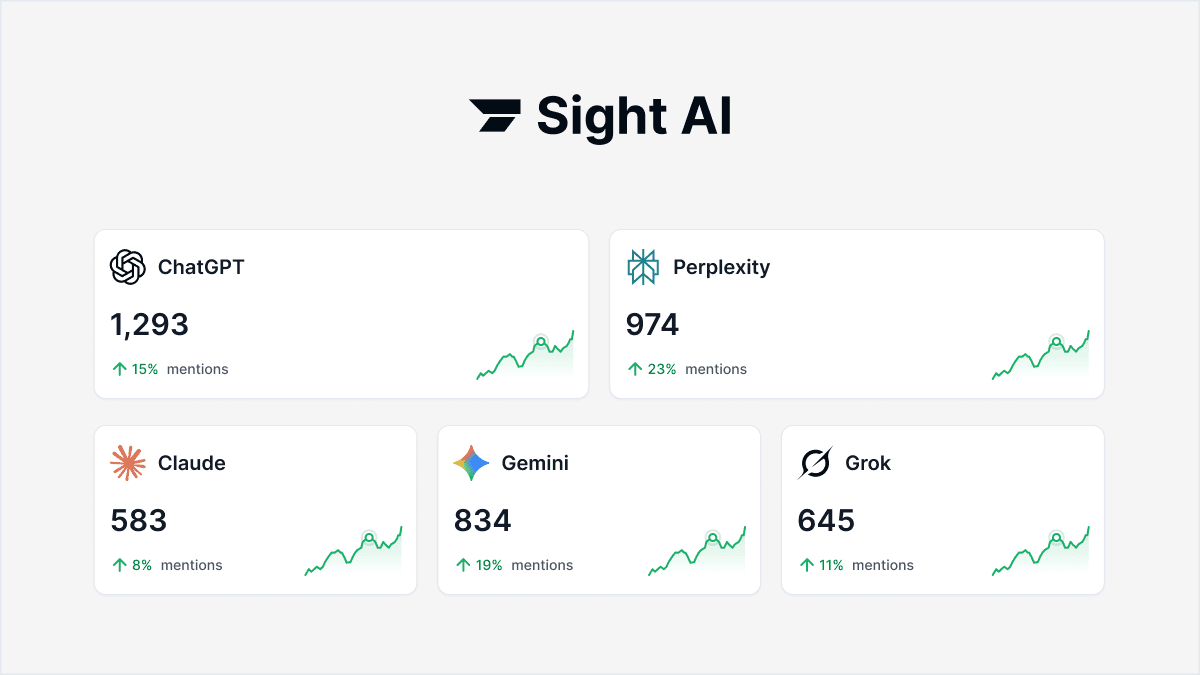
1. Implement AI visibility tracking across major platforms including ChatGPT, Claude, Perplexity, and Gemini to monitor when and how your brand appears in AI-generated responses.
2. Create test query sets representing how your target audience asks questions about your product category, running these queries regularly to track mention frequency and context changes over time.
3. Analyze which content types and topics earn the most AI mentions, identifying patterns in article structure, depth, and formatting that correlate with higher AI visibility.
4. Feed AI visibility insights back into your keyword opportunity engine, prioritizing content topics where you currently lack AI mentions but competitors appear frequently.
Pro Tips
Pay attention to the prompts that trigger your brand mentions. AI models respond differently to "What's the best X?" versus "Compare X solutions" versus "How do I solve Y problem?" Understanding which query patterns include your brand helps you create content that aligns with how users actually interact with AI search, not just how they use traditional search engines.
Putting It All Together
Building an automated SEO content pipeline isn't about removing humans from the process—it's about removing friction. The teams seeing the biggest gains are those who approach automation systematically rather than trying to automate everything at once.
Start with strategy one: map your current workflow before touching any automation tools. This foundation prevents you from automating broken processes. Then layer in keyword discovery systems that continuously feed your pipeline with prioritized opportunities. Deploy specialized AI writing agents that handle distinct functions rather than trying to do everything in a single prompt.
Embed optimization into your generation process so content emerges ready to publish, not ready to edit. Connect directly to your CMS to eliminate manual publishing work. Implement active indexing protocols to get content discovered in hours instead of weeks.
Finally, close the feedback loop by tracking not just traditional rankings, but how AI models reference your content. This new visibility dimension reveals what's actually working in the age of AI-powered search.
Your implementation priority: workflow mapping first, then content generation automation, then indexing acceleration, and finally AI visibility tracking. Each layer compounds the efficiency of the previous one. Teams that rush to AI writing without workflow clarity end up with fast content production but slow publishing. Teams that automate publishing without indexing acceleration watch content sit invisible for weeks.
The complete pipeline—from opportunity discovery through AI visibility tracking—creates a self-improving system where performance data informs future content strategy automatically.
Stop guessing how AI models like ChatGPT and Claude talk about your brand—get visibility into every mention, track content opportunities, and automate your path to organic traffic growth. Start tracking your AI visibility today and see exactly where your brand appears across top AI platforms.