Your content team just finished writing twenty articles this month. They're well-researched, keyword-optimized, and ready to drive organic traffic. But there's a problem: half of them are still sitting in a Google Doc, waiting for someone to manually copy them into WordPress, format the headings, add the featured images, configure the SEO fields, update the sitemap, and finally hit publish.
By the time those articles go live, your competitors have already published similar content. Search engines have already started ranking their pages. And you've lost precious weeks in the race for visibility.
This is the publishing bottleneck that quietly kills content strategies. Teams invest heavily in content creation—hiring writers, building editorial calendars, conducting keyword research—only to watch their work languish in the final mile between "finished" and "live." The gap between content creation speed and publishing capacity has become one of the most overlooked obstacles to organic growth.
Automated content publishing solves this fundamental mismatch. It's the infrastructure that transforms content production from a manual, error-prone process into a streamlined system where finished content flows directly to your website without human intervention. Think of it as the difference between hand-delivering letters and having a postal system—the content still needs to be created, but the distribution becomes instant and reliable.
This guide breaks down exactly how automated publishing works, why manual workflows create hidden costs, and how modern teams are using automation to publish faster, index quicker, and scale their organic traffic without scaling their headcount.
The Mechanics Behind Publish-on-Demand Workflows
Automated content publishing isn't magic—it's a series of connected systems working together to move content from creation tools to live websites. Understanding these mechanics helps you evaluate solutions and build workflows that actually work.
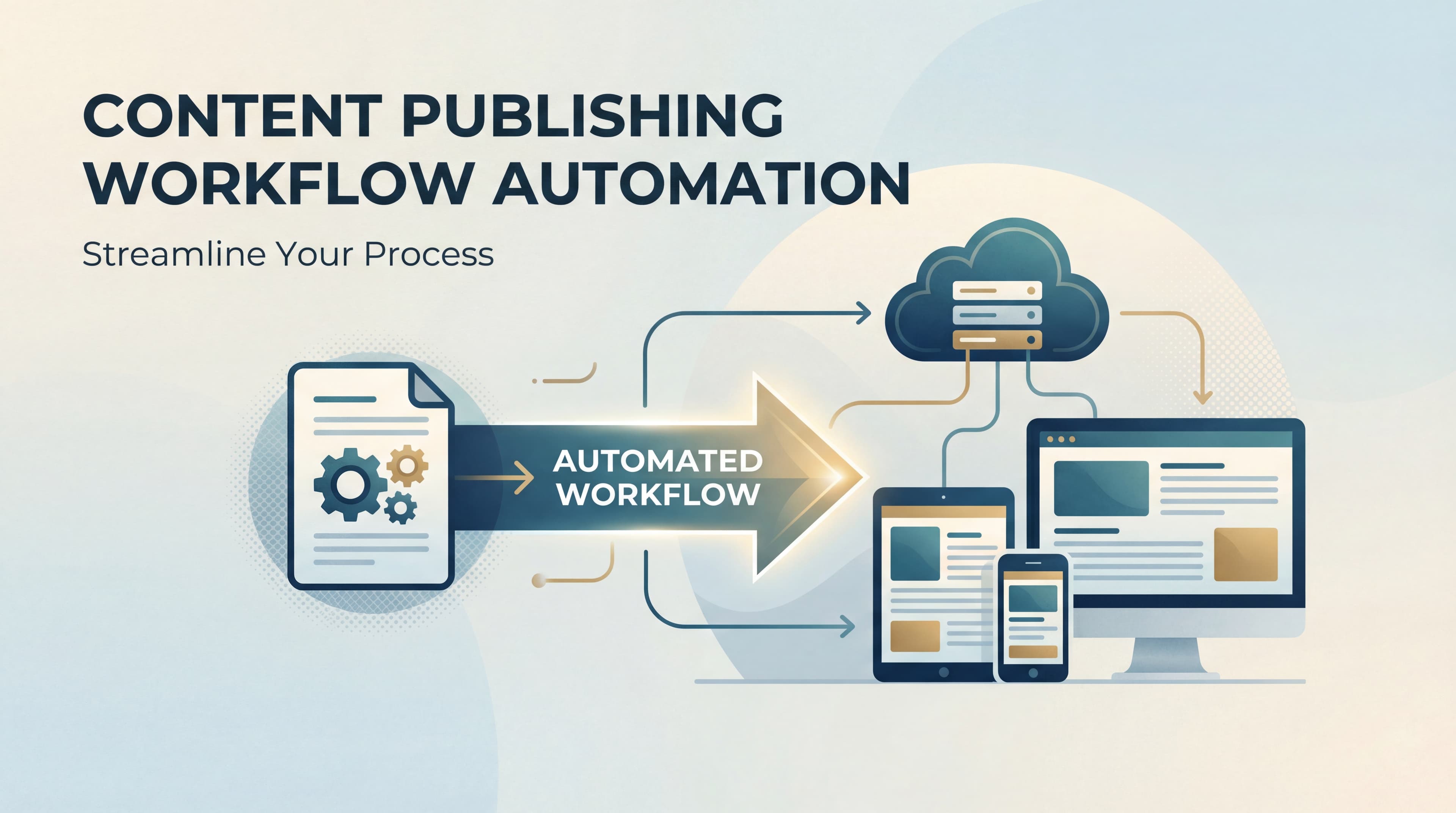
At the foundation sits the API connection between your content source and your CMS. When you finish an article in your content creation tool, that tool sends a structured data package to your website's content management system through an API (Application Programming Interface). This package contains everything: the article text, headings, metadata, images, categories, and publishing instructions.
Think of APIs as translators that speak both languages—they understand your content tool's format and your CMS's requirements, converting one to the other automatically. A well-designed API integration doesn't just dump raw text into your CMS; it maps each element to the correct field, applies your site's formatting rules, and ensures the published version matches your brand standards. Teams looking to streamline this process often explore automated content publishing to CMS solutions that handle these translations seamlessly.
Webhooks add real-time responsiveness to this system. While APIs handle the data transfer, webhooks act as notification systems that trigger actions based on specific events. When you mark an article as "ready to publish" in your content tool, a webhook fires immediately, alerting your CMS to pull the content and initiate the publishing sequence. This creates the "publish-on-demand" experience where content goes live within seconds of approval.
The scheduling engine provides temporal control over this process. Modern automation platforms include sophisticated scheduling systems that let you queue content for future publication, distribute articles across optimal time slots, and coordinate multi-platform releases. You might generate ten articles on Monday but schedule them to publish throughout the week, maintaining a consistent content cadence without manual intervention.
Content queue management becomes critical when you're publishing at scale. The system needs to track which articles are awaiting publication, which are scheduled, which are live, and which encountered errors. Good automation platforms provide dashboards showing your entire content pipeline, letting you monitor flow and identify bottlenecks before they impact your publishing schedule.
Formatting rules ensure consistency across all published content. You define once how headings should be styled, where images should be positioned, how internal links should be formatted, and what metadata fields are required. The automation system then applies these rules to every piece of content, eliminating the formatting variations that creep in with manual publishing.
Platform-specific optimization handles the technical requirements of different CMS platforms. Publishing to WordPress requires different API calls than publishing to Webflow or a headless CMS. Effective automation systems abstract away these differences, letting you work with a single interface while the platform handles the technical translation for each destination.
Why Manual Publishing Creates Hidden Bottlenecks
The true cost of manual publishing extends far beyond the obvious time spent copying and pasting. It's a compounding drag on your entire content operation that most teams dramatically underestimate.
Consider the actual time investment for manual publishing. For each article, someone needs to copy the content from your writing tool, paste it into your CMS, reformat all the headings because the styling didn't transfer, upload and position images, fill in the SEO title and meta description fields, select categories and tags, add internal links, configure the URL slug, set the featured image, and finally review everything before publishing. This process typically takes 15-30 minutes per article for experienced publishers.
That might not sound catastrophic until you multiply it across volume. A team publishing 100 articles per month spends 25-50 hours just on the mechanical act of publishing—that's more than a full-time employee dedicated solely to copying and pasting. Those hours could be spent on strategy, content optimization, or creating additional content. Understanding why manual content publishing is too slow helps teams recognize the urgency of automation.
Human error compounds these time costs with quality issues. Manual processes introduce inconsistencies: forgotten meta descriptions, miscategorized articles, broken internal links, missing schema markup, and formatting variations between articles. Each error diminishes the content's SEO potential and creates technical debt that requires later cleanup.
The metadata problem deserves special attention. Search engines rely heavily on properly configured metadata—titles, descriptions, structured data, canonical tags—to understand and rank your content. Manual publishing makes it easy to skip these fields when you're rushing or to fill them inconsistently across articles. Automated systems enforce metadata requirements, ensuring every published article includes complete, properly formatted technical elements.
Internal linking suffers particularly under manual workflows. Effective internal linking requires understanding your entire content library and identifying relevant connection points for each new article. Manual publishers often skip this step or add only the most obvious links, missing opportunities to build topical authority and distribute page authority across your site. Automation can analyze content semantically and suggest or implement internal links based on topical relevance.
The delay effect on SEO performance is where manual publishing really hurts. Search engines reward content freshness and consistent publishing velocity. When articles sit for days or weeks between completion and publication, you're giving competitors a head start in ranking for those topics. The time gap between content creation and indexing directly impacts how quickly you can capture search traffic for trending topics or seasonal keywords.
This delay becomes even more critical in the context of AI visibility. Large language models and AI search platforms continuously update their knowledge bases. The faster your content gets published and indexed, the sooner it can be incorporated into AI training data and retrieval systems. Manual publishing delays mean your brand misses opportunities to be mentioned in AI-generated responses during crucial windows when topics are trending.
Core Features That Define Effective Automation Systems
Not all automated publishing solutions are created equal. The difference between basic automation and a system that genuinely scales your content operations comes down to specific capabilities that address real publishing challenges.
CMS integration depth determines what the system can actually automate. Surface-level integrations might handle basic text publishing but leave you manually configuring everything else. Comprehensive integrations control the full publishing stack: content, images, metadata, categories, tags, custom fields, and platform-specific features like WordPress's Yoast SEO fields or Webflow's CMS collection properties.
WordPress remains the most common publishing destination, so robust WordPress integration is table stakes. Look for systems that can publish to custom post types, populate Advanced Custom Fields, configure Yoast or Rank Math SEO settings, and handle featured images with proper alt text. For teams using WordPress, exploring automated content publishing to WordPress reveals the specific capabilities needed for seamless integration.
Webflow integration requires different capabilities because Webflow uses a visual CMS with collection-based content. Effective automation maps content fields to Webflow CMS collections, handles rich text formatting in Webflow's specific syntax, and manages the relationship between collection items and page templates. This lets design-focused teams maintain their visual workflows while automating content population.
Headless CMS platforms like Contentful, Sanity, or Strapi represent the future of content management, separating content storage from presentation. Automation systems built for headless architectures use GraphQL or REST APIs to push content into the CMS, then trigger build processes that regenerate static sites. This enables the performance and security benefits of headless architecture without sacrificing publishing speed.
IndexNow integration accelerates search engine discovery of your published content. IndexNow is a protocol that lets websites notify search engines immediately when content is published or updated, rather than waiting for traditional crawling. Automated publishing systems with IndexNow support ping search engines the moment an article goes live, potentially cutting indexing time from days to hours. Teams serious about speed should explore automated content indexing solutions that incorporate these protocols.
Sitemap automation ensures search engines always have an up-to-date map of your content. Every time the system publishes new content, it should automatically regenerate your XML sitemap and ping search engines about the update. This creates a continuous feedback loop where new content is discovered and indexed as quickly as possible.
Scheduling flexibility separates basic automation from systems built for strategic content operations. You need the ability to schedule individual articles for specific dates and times, queue batches of content for staggered release, and configure publishing rules based on content type or category. A team might want thought leadership pieces published on Tuesday mornings, product updates on Thursdays, and SEO-focused articles distributed evenly throughout the week.
Bulk publishing capabilities matter when you're working with AI-generated content or seasonal campaigns. The system should handle publishing dozens or hundreds of articles with a single action, applying consistent formatting and metadata rules across the entire batch while respecting your desired publishing schedule.
Timezone optimization ensures content goes live at optimal times for your target audience. If your readers are primarily in Eastern Time but your content team works in Pacific Time, the automation should handle the timezone translation, publishing content when your audience is most active rather than when your team happens to be working.
From Content Creation to Live Publication: A Workflow Breakdown
Understanding the end-to-end workflow helps you identify where automation adds the most value and how different components work together to create a seamless publishing experience.
The workflow typically begins with AI content generation or human writing in your content creation tool. Modern platforms that combine content generation with automated publishing create particularly tight integration—the AI generates the article, applies your formatting preferences, and prepares it for publication in a single workflow. This eliminates the context switching between separate tools that slows manual processes. Teams building these systems benefit from understanding the full automated content creation workflow from ideation to publication.
The review stage provides the quality gate between creation and publication. Even in highly automated workflows, human review remains valuable for ensuring content accuracy, brand alignment, and strategic fit. Effective automation systems include approval workflows where designated team members can review content, request revisions, or approve for publication. The key difference from manual publishing is that approval triggers automated publication rather than requiring additional manual steps.
Automated formatting transformation happens during the handoff from creation to CMS. The system takes your content—whether it's in Markdown, HTML, or a proprietary format—and converts it to your CMS's required structure. Headings get wrapped in the correct HTML tags, paragraphs are properly formatted, and any special formatting like bold or italics is preserved. This transformation follows the formatting rules you've defined, ensuring consistency across all published content.
Image handling represents one of the more complex automation challenges. Modern platforms can automatically upload images to your CMS's media library, optimize file sizes for web performance, generate responsive image variants, insert images at appropriate positions in the content, and populate alt text for accessibility and SEO. Some advanced systems can even generate or select featured images based on article content.
Schema markup injection adds structured data that helps search engines understand your content's context and purpose. The automation system can apply article schema with properties like headline, author, publish date, and article body. For specific content types, it might add FAQ schema, how-to schema, or product schema. This structured data appears in your page's HTML automatically, without requiring manual coding or plugin configuration.
Internal linking automation analyzes your new content against your existing content library to identify relevant connection points. The system might look for keyword matches, topical similarity, or semantic relationships between articles. It then inserts contextual internal links that help search engines understand your site's topical structure while improving user navigation. This creates a self-reinforcing content network that grows more valuable with each published article.
The CMS push executes the actual publication through API calls to your content management system. The automation platform authenticates with your CMS, creates a new post or page, populates all fields with the prepared content and metadata, sets the publish status (draft, scheduled, or live), and confirms successful publication. This entire sequence typically completes in seconds.
Post-publication tasks complete the workflow. The system updates your sitemap to include the new content, sends IndexNow notifications to search engines, and may trigger social media sharing or email notifications to subscribers. These automated follow-up actions ensure your new content gets maximum visibility immediately after publication.
Measuring the Impact on Organic Growth
Automation's value becomes clear when you measure its impact on the metrics that actually drive organic traffic growth. The right measurements help you quantify ROI and identify optimization opportunities.
Time-to-publish measures the duration between content completion and live publication. Manual workflows typically show time-to-publish ranging from several hours to several days, depending on team capacity and process bottlenecks. Automated publishing can reduce this to minutes or seconds, fundamentally changing how quickly you can respond to trending topics or capitalize on keyword opportunities.
Indexing speed tracks how quickly search engines discover and index your new content. This metric combines publishing speed with technical SEO factors like sitemap updates and IndexNow notifications. Teams using automated publishing with proper indexing protocols often see new content appearing in search results within hours rather than days, accelerating the timeline to organic traffic. Developing a comprehensive automated content indexing strategy maximizes these speed advantages.
Content velocity quantifies your publishing throughput—how many articles you can publish per week or month. Automation directly increases content velocity by removing publishing bottlenecks. A team that previously published 20 articles per month with manual processes might scale to 100+ articles with the same headcount once automation eliminates the publishing workload.
This velocity increase matters because consistent publishing signals to search engines that your site is actively maintained and regularly updated. Search algorithms tend to favor sites that publish fresh content regularly over those with sporadic publishing patterns. Higher content velocity, when paired with quality content, typically correlates with improved organic visibility.
The relationship between publishing speed and AI model mentions deserves special attention. Large language models and AI search platforms like ChatGPT, Claude, and Perplexity continuously update their knowledge bases with recently published content. The faster your content gets published and indexed, the sooner it becomes available for inclusion in AI training data and retrieval systems.
This creates a competitive advantage in AI visibility. When someone asks ChatGPT about topics you cover, the AI draws from its knowledge base to formulate responses. Content that's been indexed longer and appears more frequently in search results has a higher probability of being referenced in AI-generated answers. Automated publishing accelerates your entry into this visibility window.
Tracking content performance across traditional search and generative AI platforms requires integrated analytics. You need visibility into how quickly new content ranks in Google, how it performs in AI-powered search engines like Perplexity, and whether AI models mention your brand when discussing relevant topics. Platforms that combine automated publishing with AI visibility tracking provide this unified view, letting you measure the full impact of your content operations.
Error rate reduction is another measurable benefit of automation. Track the frequency of publishing errors—missing metadata, broken links, formatting issues—before and after implementing automation. Most teams see error rates drop dramatically because automated systems consistently apply the same rules, eliminating the human mistakes that creep into manual processes.
Building Your Automation Stack: A Practical Implementation Guide
Moving from manual publishing to automation requires thoughtful planning and staged implementation. The goal is to build a system that integrates smoothly with your existing tools while delivering immediate value.
Start by mapping your current publishing workflow in detail. Document every step from content completion to live publication: who handles each task, how long each step takes, where delays typically occur, and what tools are involved. This audit reveals your biggest bottlenecks and highest-value automation opportunities. You might discover that 60% of publishing time goes to formatting and image handling, suggesting those should be your first automation targets.
Evaluate your existing content tools for automation readiness. Your CMS needs API access or native integrations with automation platforms. WordPress, Webflow, and most modern headless CMS platforms offer robust APIs, but some older or proprietary systems may have limitations. Similarly, your content creation tools should support export formats or integrations that feed into automation systems.
Integration considerations extend beyond technical compatibility to workflow fit. The best automation platform integrates seamlessly with tools your team already uses rather than requiring wholesale replacement of your content stack. Look for solutions that offer pre-built integrations with your specific CMS, support your preferred content formats, and can adapt to your existing approval workflows. Reviewing the best automated content platforms helps teams identify solutions that match their technical requirements.
Starting small reduces implementation risk and builds team confidence. Rather than automating your entire content operation at once, pilot automation with a specific content type that publishes frequently and follows predictable patterns. Many teams start with automated publishing for SEO-focused blog posts or news updates—high-volume content where consistency matters more than creative formatting.
This pilot approach lets you test the automation, refine your formatting rules, train your team, and demonstrate ROI before expanding to more complex content types. Once the pilot proves successful, you can progressively automate additional content categories, eventually covering your entire publishing operation.
Team training ensures everyone understands how automation changes their workflows. Content creators need to know how their work feeds into the automated system. Editors need to understand the review and approval process. And someone needs to own the automation configuration, monitoring published content to ensure quality standards are maintained. A detailed automated content publishing tutorial can accelerate team onboarding and reduce implementation friction.
Consider platforms that combine multiple automation capabilities in a single system. A platform that handles AI content generation, automated publishing, and website indexing eliminates integration complexity and provides a unified workflow. Your team works in one interface from content creation through publication and indexing, rather than juggling multiple disconnected tools.
The New Standard for Content Operations
Automated content publishing has shifted from competitive advantage to operational necessity. Teams serious about scaling organic traffic can't afford the delays, inconsistencies, and resource drain of manual publishing workflows.
The connection between publishing speed, search engine indexing, and AI visibility creates a compounding effect. Content that publishes faster gets indexed sooner, starts ranking earlier, and becomes available for AI model references more quickly. This acceleration in the content lifecycle translates directly to faster organic growth and broader visibility across both traditional search and emerging AI platforms.
The technology has matured to the point where automation is accessible to teams of any size. You don't need enterprise budgets or technical expertise to implement effective automated publishing. Modern platforms provide user-friendly interfaces, pre-built integrations, and support that makes automation practical for small teams and large organizations alike.
What matters now is recognizing that manual publishing is a choice—a choice to operate slower, publish less consistently, and give competitors a head start in the race for organic visibility. Automation frees your team to focus on what humans do best: strategy, creativity, and building relationships with your audience. The systems handle the mechanical work of distribution, ensuring your content reaches your website and search engines as quickly and reliably as possible.
The teams winning at organic growth in 2026 aren't necessarily creating better content than their competitors. They're creating good content and publishing it faster, more consistently, and with better technical optimization. Automation makes this possible without scaling headcount proportionally with content volume.
As AI continues to reshape how people discover information, the importance of publishing speed will only increase. AI models update their knowledge bases continuously, and early publication creates more opportunities for your content to be included in those updates. The gap between content creation and publication represents missed opportunities for AI visibility that compounds over time.
Stop guessing how AI models like ChatGPT and Claude talk about your brand—get visibility into every mention, track content opportunities, and automate your path to organic traffic growth. Start tracking your AI visibility today and see exactly where your brand appears across top AI platforms.