AI search engine optimization is all about tweaking your website and content so it gets found, understood, and—most importantly—cited by AI models like ChatGPT, Perplexity, and Google's AI Overviews.
This isn't about throwing out your traditional SEO playbook. It's about expanding it. The game has changed because people are no longer just looking for links; they're asking for direct answers, and they're getting them from AI. This is a fundamental shift in how information gets discovered online.
The New Frontier of Search Is Here

Welcome to the next evolution of search. For years, the goal was to land on the first page of Google. Now, with AI-driven answers taking center stage, the goalposts have moved entirely. This guide will show you what ai search engine optimization really means for your brand's future.
Here's an analogy. Think of traditional SEO as a library's card catalog—it’s an incredibly organized system for pointing people to the right book (or webpage). It works, and it's reliable.
AI SEO, on the other hand, is like having a personal research librarian. This expert doesn't just point you to a shelf; they grasp the nuance of your question, pull insights from a dozen different books, synthesize the information, and hand you a single, comprehensive answer.
Why AI SEO Is No Longer Optional
Conversational AI platforms have opened up a brand new channel for discovery. People are turning to models like ChatGPT, Gemini, and Claude for everything from quick facts to in-depth product research.
When these models generate an answer, they're pulling that information from sources they deem credible and authoritative. Your mission is to become one of those primary sources.
Brands that get this right, and get it right first, have a massive opportunity. By optimizing your content for AI, you can:
- Secure visibility right inside AI-generated answers and summaries.
- Build brand authority by being cited as the go-to source.
- Capture a whole new stream of traffic from users who find you through an AI conversation.
Ignoring this shift is like making your brand invisible to a huge, and rapidly growing, part of the internet.
AI search is a behavioral shift from "searching for links" to "asking for answers." Brands that provide the clearest, most authoritative answers will win the new discovery race and secure a powerful competitive advantage.
The Core Difference From Traditional SEO
While traditional SEO often zeroes in on ranking individual pages for specific keywords, AI search engine optimization is all about establishing topical authority across your entire domain.
The AI isn't just looking for one perfect blog post. It's scanning your entire website to figure out if you're a true expert on a subject.
This means your content needs to be exceptionally clear, well-structured, and comprehensive. The goal is to turn your website into a knowledge base that's easy for an AI to digest and trust. As we'll get into, this requires a dual focus: world-class content backed by solid technical signals. It's how you prepare for what's next in search.
How AI Is Fundamentally Changing Search

The very mechanics of search are in the middle of a seismic shift. We're moving away from the old model of simple keyword matching and into an era of deep, contextual understanding. For decades, a search engine’s job was to act as a retriever—it fetched a list of documents it thought were relevant to your query. Your goal was simple: be the most relevant document on that list.
That game is over. Today, AI models are synthesizers. They don’t just find information; they consume it, interpret it, and then reassemble it into a single, cohesive answer. This changes everything for ai search engine optimization. You're no longer just competing for a click. You're competing to become a trusted source for the AI itself.
Think of it this way: traditional SEO was like booking a direct flight. A user types a query and gets flown straight to one webpage. AI search, on the other hand, is like a guided tour. The AI is the tour guide, cherry-picking the best information from multiple sources to create a complete story for the user. Your job is to make sure your content is one of those can't-miss destinations on the tour.
The New Pillars Of Optimization
With AI acting as the interpreter, a whole new set of ranking factors has become critical. The focus isn't just on keywords anymore; it's about the quality, clarity, and authority of the information itself. Concepts that once felt advanced are now the absolute fundamentals.
Three pillars really stand out in this new world:
- Semantic Relevance: This goes way beyond matching keywords. It's about understanding the meaning and intent behind a search. To compete, you need to create content that covers a topic from all angles and answers the user's next question before they even ask it. To really nail this, you can learn more about what https://www.trysight.ai/blog/what-is-semantic-seo is and how it's reshaping modern strategy.
- Structured Data: Clean, organized data using Schema markup is like giving an AI a clear set of instructions. It helps the model instantly understand what your content is about—a product, a person, a how-to guide, an event—which makes it far more likely to cite your page correctly.
- E-E-A-T (Experience, Expertise, Authoritativeness, Trustworthiness): These signals are no longer optional. AI models are explicitly designed to find and surface information from sources that ooze credibility. Your content must scream, "We are the experts, and you can trust us."
The core change is from optimizing for retrieval to optimizing for synthesis. The goal is to make your content so clear, authoritative, and well-structured that an AI not only understands it but trusts it enough to use it as a source for its own answers.
How LLMs Process And Cite Information
Large Language Models (LLMs) are the engines driving this transformation. When a user asks a question, an LLM doesn't just "Google" it like we do. It first accesses its massive training data—a snapshot of the internet—to start building an answer. Then, modern AI search systems cross-reference that information with live web data to check for accuracy and provide citations.
If you want your content featured in those AI-generated answers, it has to be incredibly easy for a machine to parse. LLMs have a clear preference for information that is:
- Clearly Articulated: Keep it simple. Short sentences, straightforward language, and a logical flow are your best friends.
- Well-Structured: Proper use of headings (H1, H2, H3), lists, and tables helps the AI zero in on the key takeaways.
- Factually Accurate and Supported: Citing your own sources and backing up claims with data is non-negotiable. This is how you build the credibility an LLM needs to trust your content.
This shift has profound consequences for how we build and maintain an online presence. To get the full picture, it's worth digging into the implications of ChatGPT and artificial intelligence for online presence. Ultimately, the brands that adapt to this new reality of information synthesis will be the ones that stay visible and influential.
Actionable Frameworks For AI Visibility
Having a solid grasp of the theory is one thing, but actually winning in AI search requires a concrete plan. You need to move from thinking about it to doing it, and that means having a repeatable strategy that connects what you learn to what you create. This is how you stop reacting to changes and start proactively building a presence inside the AI models your audience uses every day.
The most effective approach is a clear, three-part cycle. It kicks off with monitoring, flows into analysis, and finishes with targeted content production. This loop ensures your work is always guided by data and laser-focused on capturing that valuable AI-driven traffic.
The Three Pillars Of AI Visibility
Success in this new world means adopting a new workflow. The best ai search engine optimization strategies are built on a continuous cycle of monitoring, analyzing, and creating. This isn’t a set-it-and-forget-it task; it's an ongoing process.
- AI Visibility Monitoring: You can't improve what you don't measure. The first step is to actively track how different AI models talk about your brand, your products, and your competitors. It's all about knowing where you stand right now.
- Conversational Gap Analysis: Once you have a baseline, you can start hunting for opportunities. This is where you find the valuable questions, prompts, and topics where your competitors are getting cited, but you're nowhere to be seen.
- High-Authority Content Production: Finally, you close those gaps. This means creating comprehensive, expert-led content specifically designed to answer those conversational queries you've identified, positioning your brand as the definitive source.
This framework shifts your SEO from a defensive game of protecting rankings to an offensive one of capturing new territory within AI conversations.
Step 1: Master AI Visibility Monitoring
Every good strategy starts with good data. In the old days, this meant obsessively tracking keyword rankings. Today, it means monitoring your brand’s presence inside the answers generated by models like ChatGPT, Gemini, Claude, and Perplexity.
You need solid answers to some critical questions:
- Which AI models are even talking about our brand?
- What specific prompts trigger these mentions?
- Is the sentiment positive, negative, or just neutral?
- How often are we cited compared to our top three competitors?
This is where platforms designed specifically for AI visibility become essential. Instead of spending hours manually typing prompts, these tools automate the tracking process, giving you a unified dashboard of your brand's performance across the most important AI platforms. Using the best AI SEO tools is the only way to gather this intelligence efficiently. Think of this proactive monitoring as your early warning system, showing you exactly where you’re winning and where you’re completely invisible.
Step 2: Conduct A Conversational Gap Analysis
With monitoring data in hand, you can move to the most critical part of the process: finding your content gaps. A conversational gap analysis is the practice of identifying the high-value prompts your audience is using where your competitors are getting cited, but you aren’t.
This is the AI-era equivalent of traditional keyword gap analysis. You're not just looking for keywords; you're looking for entire conversations where your brand is absent, revealing exactly what content you need to create next.
For example, a SaaS company specializing in project management might discover through monitoring that a competitor is consistently cited for the prompt, “best project management software for remote teams.” This is a crystal-clear, actionable insight. It’s a bright, flashing sign pointing to a specific content gap that needs to be filled to intercept that AI-driven discovery.
The graphic below shows how you can map out and prioritize these content opportunities by looking at search volume and competitive weakness.
This kind of visual approach helps teams decide which gaps to tackle first, focusing their efforts on topics with the highest potential return.
Step 3: Produce High-Authority Content
The final piece of the framework is all about execution. Once you’ve identified a critical conversational gap, the goal is to create the single best piece of content on the internet for that topic. This isn't just about writing another blog post; it's about building a pillar of authority that AI models can trust without a second thought.
This content needs to be comprehensive, factually accurate, and highly structured. It should directly answer the target prompt while also addressing the logical follow-up questions someone might have. The need for this is more urgent than ever. The 2025 Previsible AI Traffic Report found that sessions from large language models surged by a staggering 527% year-over-year. On top of that, separate data shows 68.94% of websites are already receiving AI traffic. As traffic from AI search continues its rapid climb, having optimized content is no longer a choice—it's a necessity.
Optimizing Content And Technical SEO For LLMs

Alright, with our strategic framework in place, it’s time to roll up our sleeves and get tactical. Winning at AI search engine optimization comes down to a two-pronged attack: creating content that AI models are eager to consume and setting up the technical signals that help them make sense of it all.
The goal here is to evolve your website from a simple collection of pages into a structured, interconnected knowledge base that an AI can trust.
Think of it this way: your content is the collection of high-quality, verifiable facts, and your technical SEO is the perfectly organized library card catalog that makes those facts easy to find and understand. LLMs are looking for sources they can lean on without a second thought, and that trust is built both by what you say and how you structure it.
This means meticulously building out articles to answer questions from top to bottom and using technical markup to remove any guesswork for the machines. Let's dig into the specific tactics for both.
Crafting AI-Friendly Content
The content you’re creating needs to be built from the ground up to serve as a primary source for an LLM. This is a step beyond just making things readable for humans; it’s about absolute clarity, structure, and exhaustive detail. You want your content to be the most logical and trustworthy source an AI can find on a given topic.
To make that happen, every article should be a self-contained hub of information. It needs to nail the user's main question right away and then anticipate and answer their next three. For a deep dive on how to produce this kind of content at scale, check out our guide on using AI content for SEO.
Here's your checklist for creating AI-optimized content:
- Answer Questions Directly: Get straight to the point. Provide a clear, concise answer to the core question right at the top, usually within the first couple of paragraphs.
- Use a Logical Structure: Break your topic into logical chunks with clear, descriptive headings (H2s, H3s, etc.). This gives LLMs a quick roadmap to your article’s structure and main ideas.
- Back Up Your Claims: Every assertion should be supported by hard data, statistics, and citations. This isn't just good practice—it’s how you build the authority an AI needs to see before it will cite you.
- Keep Language Simple: Ditch the jargon and overly complex sentences. The easier your content is for a machine to parse, the better it will understand its context and meaning.
Implementing Robust Technical SEO
While incredible content lays the foundation, technical SEO is the scaffolding that LLMs need to navigate your site accurately. Your technical setup essentially provides a clear set of instructions, telling AI models exactly what your content is about and how it connects to everything else.
In the world of AI search, two technical elements are completely non-negotiable: comprehensive Schema markup and a smart internal linking strategy. They work in tandem to build topical authority and turn your website into a clean, organized data source that machines can process without a hitch. If you're interested in how this applies to performance marketing, this LLMSEO guide to performance marketing is a great resource.
Schema markup is like putting detailed, machine-readable labels on your content. It transforms a simple block of text into a clearly defined entity—like an 'Article,' 'FAQPage,' or 'HowTo'—that an AI can instantly recognize, categorize, and trust.
A Practical Technical SEO Checklist
To get your site technically ready for AI visibility, you need to audit your setup against these critical points. This is about more than just satisfying old-school search crawlers; it's about feeding LLMs the clean, structured data they crave.
- Implement Comprehensive Schema Markup: Don't stop at the basic
Articleschema. Use more specific types likeFAQPagefor Q&A sections,HowTofor step-by-step guides, andPersonto connect content to authors and bolster your E-E-A-T signals. - Build a Strong Internal Linking Strategy: Make every link count. Use descriptive anchor text to connect related articles, creating a dense web of context around your core topics. This is how you demonstrate the depth of your expertise to AI models.
- Ensure a Clean Site Architecture: Your site needs a logical flow, with clear categories and a shallow click depth. A confusing or messy structure makes it incredibly difficult for an AI to map the relationships between your content.
- Optimize for Core Web Vitals: Yes, page speed and mobile-friendliness still matter—a lot. AIs are far less likely to process and cite content from slow or clunky pages, which are often a sign of a poor user experience.
By marrying expertly crafted content with a meticulous technical foundation, you position your website to become the definitive source in your niche—one that AI models will turn to again and again.
Measuring Success in AI Search Engine Optimization
You can't improve what you don't measure. In traditional SEO, success was a pretty straightforward numbers game—keyword rankings and organic traffic told you most of what you needed to know. But in the world of AI search engine optimization, where your brand can be mentioned without a single click, those old metrics only tell part of the story.
To truly get a handle on your impact, you need a new playbook with Key Performance Indicators (KPIs) built for the age of AI-generated answers.
This means shifting your focus from just tracking your website's position on a results page to monitoring its presence within the AI models themselves. Success is no longer just about being a blue link; it's about being the cited source. It's about becoming a trusted part of the conversation happening on platforms like ChatGPT, Gemini, Perplexity, and Grok.
The old methods aren't obsolete, but they are incomplete. You can learn more about how foundational concepts are evolving by exploring our guide on what is rank tracking, which adds important context to this new measurement landscape.
Introducing the New KPIs for AI SEO
To measure success accurately, you have to track metrics that directly reflect your brand’s influence and visibility inside these AI-driven conversations. These new KPIs give you a much clearer picture of your performance and the true ROI of your optimization efforts. They move beyond traffic to measure authority and trust.
The three most critical metrics to start tracking are:
- AI Visibility Score: This is an aggregate score that quantifies your brand’s overall presence across multiple AI models for a specific set of prompts. Think of it as the AI-era equivalent of Share of Voice, showing you how often you appear in relevant answers compared to your competitors.
- Citation Frequency: This metric tracks the raw number of times your domain is cited as a source in AI-generated responses. A high citation frequency is a direct signal that AI models see your content as authoritative and trustworthy for a given topic.
- Mention Sentiment: This goes beyond simple mentions to analyze the context in which your brand is discussed. It classifies mentions as positive, negative, or neutral, giving you crucial insight into how AI models—and by extension, your audience—perceive your brand.
Tracking these KPIs is the only way to get a real-time pulse on your AI visibility.
Simply put, if you aren't tracking citations and sentiment, you're flying blind. You have no way of knowing if your content is actually influencing the AI models or if your competitors are quietly dominating the conversations that matter most to your customers.
Tracking Performance Across Different LLMs
Not all Large Language Models are created equal. An answer from Gemini might be completely different from one generated by Claude or Perplexity, even for the exact same prompt. This happens because each model has its own unique training data, algorithms, and real-time data sources.
What gets you cited in one might not work in another.
This variability makes it absolutely essential to track your performance across each major platform individually. A brand might discover it has strong visibility on ChatGPT for a certain topic but is completely invisible on Perplexity. This kind of granular insight is a goldmine, revealing platform-specific weaknesses and opportunities you can act on.
A unified dashboard is the key to managing this complexity. Trying to manually check prompts across a half-dozen different AI tools isn't just inefficient; it's unsustainable. A centralized platform allows you to see the complete picture, compare performance side-by-side, and spot trends you would otherwise miss.
A Real-World Example Visualizing Success
Let's make this tangible. Imagine a B2B software company that sells CRM solutions. After running a conversational gap analysis, they discover they have zero visibility for the prompt, “best CRM for small businesses with remote teams.” They decide to create a comprehensive, data-backed article targeting this exact query.
Before publishing, their AI Visibility Score for this prompt is 0%. Two weeks after publishing and promoting the new article, they use an AI monitoring tool to check again. They find their article is now being cited by ChatGPT and Perplexity.
Their dashboard now shows:
- An AI Visibility Score of 25% for that target prompt.
- A Citation Frequency of 8 new citations this month.
- A Mention Sentiment that is 100% positive, as the AI highlights their software’s key features.
This isn’t an abstract concept; it’s a measurable win. They can now see exactly how their targeted content directly translated into increased visibility, proving a clear and undeniable return on their investment in AI search engine optimization.
Your AI SEO Workflow From Start To Finish
Let’s pull all these ideas together into a practical, step-by-step workflow. To keep things grounded, we'll follow a content marketer as they run through a complete AI search engine optimization cycle. This isn't just theory; it's a blueprint for turning raw insights into real action and measurable results.
It all starts with listening, not guessing. Using a platform like Sight AI, our marketer monitors conversations happening across the major AI models. They quickly find a high-value content gap: competitors keep getting cited for the prompt, “what is the best way to track employee productivity without invading privacy?” Their brand, however, is nowhere to be found.
From Insight To Creation
With a clear target in sight, the next move is research and creation. The mission is to build the single most comprehensive, authoritative answer to that specific question. This means drafting an article that hits the user's primary question head-on while also covering all the related subtopics, like legal considerations and the best tools for the job.
To make sure the content is perfectly tuned for both AI models and human readers, our marketer relies on a detailed brief. If you're looking to tighten up your own process, using a solid SEO content brief template is a fantastic way to ensure every piece of content is built to perform from the ground up.
Success in AI SEO isn't just about traffic; it's about tracking your visibility, citations, and the sentiment around your brand within the AI models themselves.
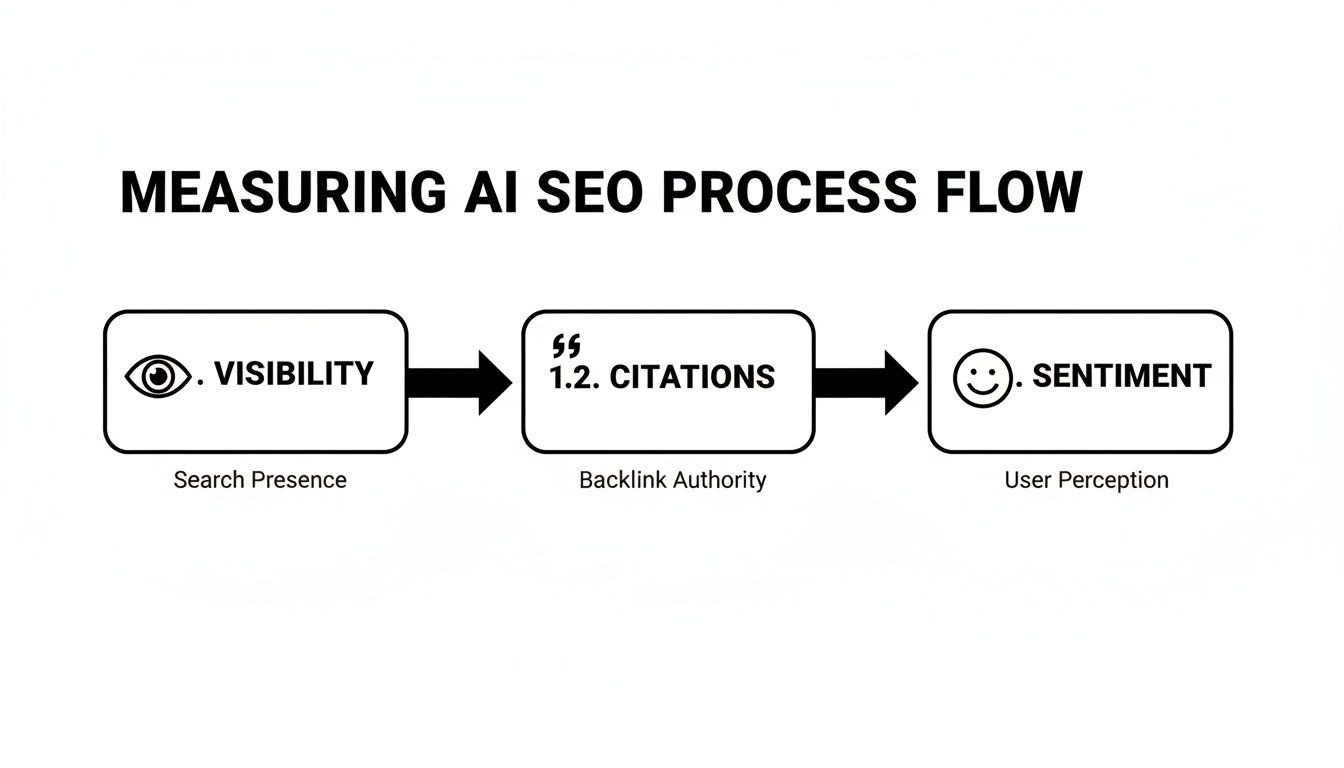
As the visual shows, effective measurement goes way beyond old-school rankings. You need to know how often—and how positively—your brand is showing up in AI-generated answers.
Optimization And Publishing
Before hitting "publish," the article gets a final optimization pass. This is a critical last check that includes:
- On-Page SEO: Making sure headings (H2s, H3s) are clear, the introduction gives a direct answer, and keywords are placed naturally.
- Structured Data: Implementing
FAQPageorArticleSchema markup is a huge help for AI models, as it tells them exactly what your content is about and how it's structured. - Internal Linking: Weaving in links to and from other relevant posts on the site builds a strong web of topical authority.
Finally, the marketer publishes the article straight to their CMS. An integrated platform can then automatically update the sitemap and ping search engines through IndexNow, which seriously speeds up the discovery process.
This workflow—Monitor, Analyze, Create, Optimize, Publish—is the engine of modern AI search engine optimization. It’s a repeatable process that transforms AI-driven insights into high-authority content that compounds organic traffic over time.
By running this cycle, the marketer hasn't just plugged a content gap. They've strategically positioned their brand to be the go-to source for a valuable conversational search. Now, they can head back to their monitoring dashboard to watch their visibility score and citation frequency start to climb. This is exactly how you win in the new era of search.
Frequently Asked Questions About AI SEO
Jumping into the world of AI search engine optimization is bound to bring up some questions. It's new territory for most of us. Let's tackle a few of the most common ones head-on so you can start adapting your strategy with confidence.
Is Traditional SEO Still Relevant?
Absolutely. The best way to think about it is like building a house. Your traditional SEO—things like technical health, mobile-friendliness, and solid backlinks—is the foundation. You simply can't build anything lasting without it.
AI SEO is the brand-new, high-tech second story you build on top. It doesn't replace the foundation; it expands on it. In fact, the core principles of creating genuinely valuable, user-focused content have never been more critical.
How Long Does It Take to See Results?
This definitely isn't an overnight fix. Earning authority and trust with AI models is a game of time and consistency. While you might see your content get cited in an AI answer in as little as a few weeks after publishing a great, targeted article, building a strong, consistent presence usually takes around three to six months.
A few things can speed up or slow down that timeline:
- How competitive your industry is.
- The authority your domain already has.
- How often you're publishing high-quality, expert content.
The key is consistency. Unlike chasing a single keyword ranking, AI visibility is built by creating a comprehensive library of trusted content over time. This is how you establish your site as a go-to, reliable source for the models.
Can I Stop Tracking Keyword Rankings?
Nope, you really shouldn't. Keyword rankings are still a vital health metric for your website. They give you a clear window into how you're performing on traditional search engines like Google, which are still a massive source of traffic for almost everyone.
The smartest approach is to track both. Keep an eye on your keyword positions to understand your traditional search footprint. At the same time, you need to be tracking your AI Visibility Score and how often you're cited to measure your influence in this new conversational search world. They're just two sides of the same visibility coin.
Ready to stop guessing and start measuring your AI visibility? Sight AI gives you the complete picture, from tracking brand mentions across models like ChatGPT and Gemini to producing expert-level content that gets you cited. See how our platform turns AI insights into measurable growth. Discover your AI visibility today.