
Low-competition keywords are the search terms you can actually rank for without a massive budget or a website dripping with authority. They're your fastest route to real, organic traffic. It’s all about winning smaller, smarter battles instead of getting lost in the noise of broad, oversaturated terms.
Why Low Competition Keywords Are Your Secret Weapon

Let's be real—chasing high-volume keywords feels like shouting into a hurricane, especially if you're not a household name. The strategy behind targeting low-competition keywords isn't about settling for less traffic. It's about winning hundreds of smaller skirmishes that compound into a major victory over time.
Think of it like building your brand’s authority brick by brick. Every time you rank for a less competitive term, you bring in a small but dedicated stream of visitors, build topical relevance, and lay a rock-solid foundation for long-term SEO success.
The Power of High Intent
One of the biggest upsides here is the user intent. Someone searching for "running shoes" is just window shopping. But what about the person searching for "best trail running shoes for flat feet under $100"? That person knows exactly what they want and is much, much closer to pulling out their credit card.
This specificity translates into some serious business benefits:
- Higher Conversion Rates: Visitors who land on your page from a super-specific query are way more likely to convert because you're solving their exact problem.
- Increased Engagement: Your content is hyper-relevant, which means lower bounce rates and more time spent on the page. Search engines love these signals.
- Building Trust: When you provide the perfect answer to a niche question, you immediately position yourself as a helpful authority.
Gaining Early Wins and Momentum
For new or growing websites, momentum is everything. Low-competition keywords are how you get points on the board, fast. Keywords with a difficulty score under 50 are the sweet spot for quick wins, often letting you crack the top 10 on Google without a huge backlink campaign. For terms with a score between 0-29, you can sometimes see results in just a few weeks.
It just goes to show that search volume isn't the only metric that matters when buying intent is this strong.
Targeting these "low-hanging fruit" keywords is the strategic shift that allows growing businesses to not just compete, but thrive. It's about securing early rankings that fuel your growth, generate initial traffic, and build the authority needed to eventually tackle more competitive terms.
Of course, this approach works best when it's part of a broader strategy that incorporates all SEO best practices to maximize your organic traffic. Each piece of content you create contributes to a much larger, more powerful presence online.
To really nail this foundational work, you might want to check out our guide on how to develop a cohesive keyword strategy for SEO. This will help you ensure every win, no matter how small, adds up to significant, measurable growth.
Assembling Your Keyword Discovery Toolkit
Before you can start digging for those low-competition keyword gems, you need the right set of tools. This isn't about dropping a fortune on a single, all-in-one platform. It's about building a smart, practical arsenal that blends powerful paid software with the free, often-overlooked resources where your audience actually lives.
A balanced toolkit lets you gather the hard data and tap into the raw, unfiltered language of real people. Think of it as having both a telescope to see the big picture and a microscope to zero in on the details.
Premium Tools for Data-Driven Insights
For the initial heavy lifting and sizing up the competition, the big SEO platforms are essential. They give you the quantitative data—search volume, keyword difficulty, all that good stuff—that forms the backbone of any real keyword strategy.
- Ahrefs & Semrush: These are the industry standards for good reason. Use them for broad keyword discovery, tearing apart your competitors' playbooks, and getting a baseline Keyword Difficulty (KD) score. They're perfect for analyzing what your rivals already rank for and generating thousands of ideas from a single "seed" keyword.
- LowFruits: This is a more specialized tool, built from the ground up to find the weak spots in the search results. It’s brilliant at flagging keywords where forums like Reddit and Quora, or sites with low Domain Authority, are somehow clinging to page one. That’s a massive green light signaling a winnable keyword.
These tools are your heavy machinery. They're fantastic for bulk data collection and high-level analysis, showing you what's possible. But they don't always capture the human side of search. For more on how tech is changing the game, our guide on the best AI SEO tools takes a much deeper dive.
Your paid tools give you the "what"—the keywords and the metrics. Your free tools give you the "why"—the context, the pain points, and the exact phrasing real people use when they're looking for solutions.
This is where you get a real edge. By layering in free resources, you can move past the raw numbers and get inside your customer's head.
Uncovering Gems with Free Resources
The most authentic—and often most valuable—low-competition keywords aren't hiding in a database. They're in plain sight, right where real people are having conversations. These platforms are absolute goldmines for understanding what users truly want and discovering long-tail queries that most conventional tools will completely miss.
Here’s where you should be digging:
- Reddit and Quora: Jump into these platforms and search for your core topics. Look closely at the titles of the threads and the specific, everyday language people use in their questions. A post titled, "What's a good alternative to [product] for someone with sensitive skin?" isn't just a question—it's a high-intent, low-competition keyword practically begging to be turned into a piece of content.
- Google's "People Also Ask" (PAA): When you search for anything, that PAA box is Google literally handing you related questions it knows users are asking. Every single one is a potential keyword. The best part? When you click on one, the box expands with even more ideas, sending you down a rabbit hole of discovery.
- AnswerThePublic: This is a fantastic free tool that visualizes search questions. You pop in a seed keyword, and it spits out hundreds of questions, prepositions, and comparisons related to it. It’s an incredibly fast way to map out all the different angles for a topic and find those hyper-specific phrases.
- Industry-Specific Forums: Never forget the niche communities. Whether it's a forum for classic car fanatics or a Facebook group for vegan bakers, these are the places where your most passionate customers hang out. Their discussions are packed with keyword opportunities that reflect deep expertise and very specific needs.
By blending the scalable data from paid tools with the rich, qualitative insights from these free resources, you build a discovery process that's both comprehensive and powerful. This dual approach ensures you not only find keywords with low difficulty scores but also keywords that genuinely connect with your audience, leading to content that actually performs.
Your Playbook for Uncovering Hidden Gem Keywords
Theory is great, but let's get our hands dirty. This is the exact, repeatable process I use to find low-competition keywords my competitors have completely missed. We're going to turn abstract ideas into a tangible list of opportunities, and it all starts with your core "seed" topics.
Think of a seed topic as the broad category your business lives in. For a hypothetical ecommerce store selling sustainable products, a seed topic might be "eco-friendly water bottle." On its own, that term is way too competitive to rank for. But it's the perfect starting point for our excavation.
From here, our goal is to fan out and find the specific, long-tail variations that signal high intent and—you guessed it—lower competition.
Expanding Your Search With Modifiers
The quickest way to get from a broad, competitive term to a niche opportunity is by tacking on keyword modifiers. These are simply words or phrases you add to your core term to make it more specific. They act like filters, narrowing the searcher's focus and, in doing so, thinning out your competition.
Let's stick with our "eco-friendly water bottle" example. We can add modifiers to target specific needs, features, or audiences.
- By Use Case: "for hiking," "for gym," "for travel"
- By Feature: "insulated," "with straw," "glass," "BPA-free"
- By Price Point: "under $50," "affordable," "luxury"
- By User Type: "for kids," "for athletes," "for office workers"
When you start combining these, you create some seriously powerful, specific long-tail keywords. Suddenly, "eco-friendly water bottle" becomes "best insulated water bottle for hiking under $50"—a term that's far more winnable and targets a buyer with a crystal-clear need.
This whole discovery process is a loop. You use tools, listen in on communities, and analyze the SERPs to find these gems.
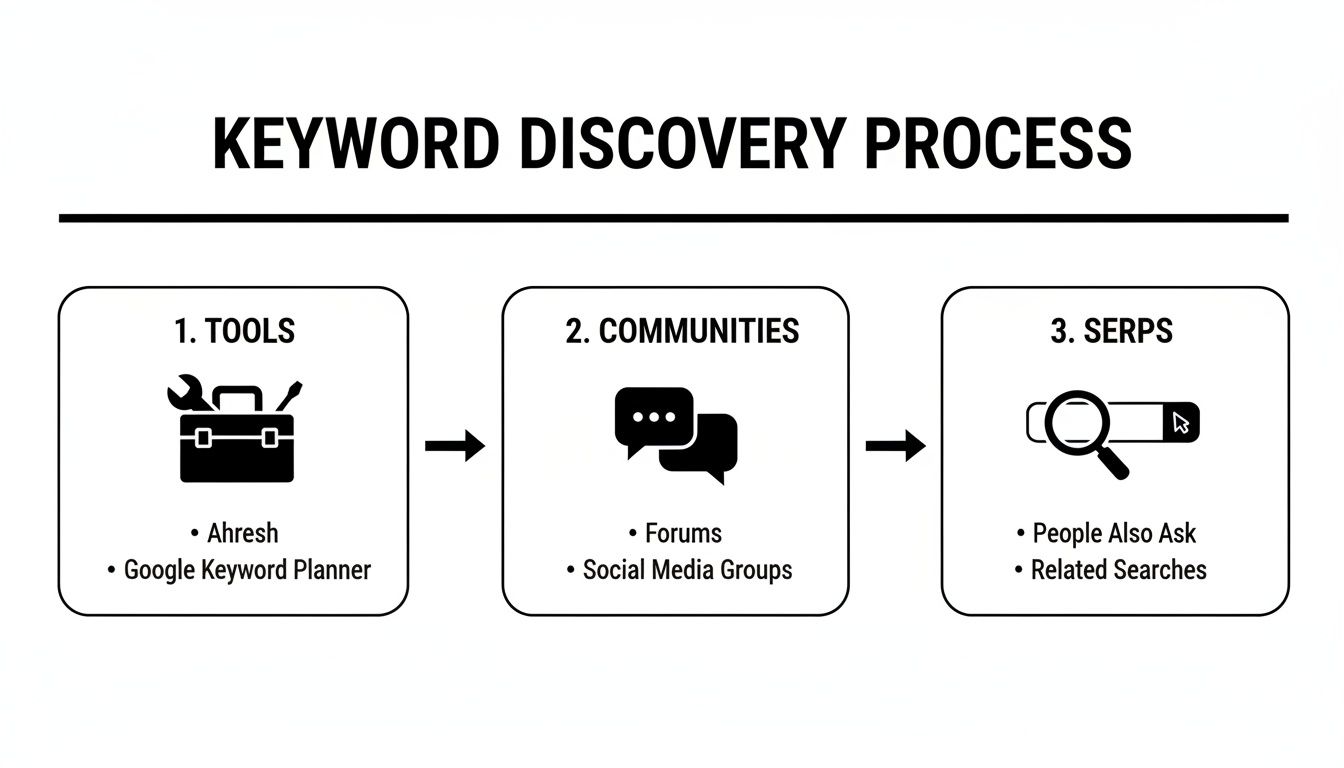
This kind of workflow—combining tools, community listening, and SERP analysis—creates a repeatable cycle for constantly finding new opportunities.
A lot of these modifiers signal a very specific kind of search intent, which is gold for content marketers. They tell you exactly what kind of problem the searcher is trying to solve.
Low-Competition Keyword Modifiers and Their Intent
| Modifier Type | Example | Typical User Intent | Competition Level |
|---|---|---|---|
| Transactional | "buy," "deal," "discount" | Ready to purchase | High |
| Informational | "how to," "what is," "guide" | Seeking information, learning | Low to Medium |
| Navigational | "[Brand name] login" | Trying to find a specific site | Very Low |
| Commercial | "best," "review," "vs" | Comparing options before a purchase | Medium to High |
| Local | "near me," "[city name]" | Looking for a local business/service | Low to Medium |
| Long-Tail | "for small business," "under $100" | Very specific need, price-sensitive | Low |
Focusing on the informational and long-tail modifiers is often the sweet spot. You're catching people earlier in their journey with content that helps them, building trust before they're ready to buy.
Asking the Right Questions
Another killer tactic is framing your keywords as questions. People search in questions all the time, and these queries often have much lower competition. More importantly, they signal a user who is actively looking for a solution or detailed information—making them perfect targets for helpful content.
Using our example, we can brainstorm questions a potential customer might be typing into Google:
- "How to clean a stainless steel water bottle?"
- "Are glass water bottles better than plastic?"
- "What is the most durable eco-friendly water bottle?"
Each of these questions is a content opportunity just waiting to happen. Answering them thoroughly in a blog post or guide positions you as an expert and captures traffic from people deep in the research phase of their buying journey.
A great way to find these is by typing your seed keyword into Google and looking at the "People Also Ask" box. This is Google literally handing you a list of validated, high-intent questions that real users are searching for.
Spying on Competitors the Smart Way
Competitor analysis isn't just about seeing what your rivals are ranking for; it's about finding what they aren't. This is where you find their "keyword gaps"—the valuable terms they've overlooked that you can swoop in and claim.
First, identify a few direct and indirect competitors. These could be other ecommerce stores or even popular blogs that review products in your niche.
Once you have your list, use a tool like Ahrefs or Semrush to run a content gap analysis. This feature spits out a list of keywords that one or more of your competitors rank for, but you don't. It's one of the fastest ways to uncover entire topic clusters you might have missed.
But don't just copy their strategy. Look for keywords where they're ranking, but their content is weak. Maybe their article is thin, outdated, or just doesn't really answer the user's question. These are your golden opportunities. You can create a superior piece of content and outrank them, even if they're a much bigger brand. Digging deep with a comprehensive approach to keyword research for organic SEO will give you an even sharper edge here.
This playbook gives you a structured yet flexible approach. By starting broad with seed topics, narrowing your focus with modifiers and questions, and then intelligently picking apart your competition's weak spots, you create a powerful engine for consistently finding low-competition keywords that actually drive results.
How to Actually Validate and Prioritize Your Keyword List
So, you've got a massive list of potential keywords. That's a great start, but it's really just raw data. The real skill is separating the high-impact opportunities from the time-wasting duds.
This is where we move beyond just staring at search volume and keyword difficulty scores. It's time to learn how to analyze the search engine results pages (SERPs) like a seasoned pro. The goal is to figure out which terms are truly winnable and then line them up based on their potential impact. This way, every piece of content you create is a calculated move, aimed squarely at an achievable ranking.
Manually Analyzing the SERPs for Weak Spots
SEO tools are fantastic for pointing you in the right direction, but they never tell the whole story. I've seen keywords with "high" difficulty scores that had glaring weak spots on page one, and "low" difficulty terms dominated by perfectly optimized, killer content.
The only way to know for sure is to roll up your sleeves and look yourself.
When you search for a target keyword, you’re basically a detective looking for clues of weakness. These signs tell you that Google is struggling to find truly great content for that query, which is your invitation to jump in.
Here’s exactly what I look for on page one:
- Forum and Community Results: See sites like Reddit, Quora, or niche forums ranking in the top spots? This is a huge green light. It’s a clear signal that user-generated content is the best Google can find, meaning a well-structured, expert article can easily crush it.
- Low-Authority Websites: Get an SEO browser extension and check the Domain Rating (DR) or Domain Authority (DA) of the ranking sites. If you spot sites with a DR below 40 (or in the same ballpark as your own) chilling in the top 10, that’s a strong sign you can compete.
- Outdated or Thin Content: Click into the top-ranking pages. Are they from 2019? Is the information stale or just plain wrong now? Maybe the content is super thin and barely scratches the surface. Fresh, superior content can often leapfrog these aging results without much of a fight.
- Irrelevant Results: Does the content on page one not quite match what the searcher is looking for? If Google is showing pages that only partially answer the question, it means there's a gap waiting for a more targeted, comprehensive piece to fill it.
A manual SERP check is your reality check. It turns a theoretical keyword difficulty score into a tangible assessment of your actual chances of ranking. Never, ever skip this step.
Developing a Simple Prioritization Framework
Okay, once you've manually vetted your keywords and have a list of real contenders, you need a system to decide what to tackle first. A simple scoring framework is perfect for this—it takes the guesswork out of the equation.
Just pop open a spreadsheet and score each keyword from 1 to 5 across three key categories.
1. Business Relevance (Score 1-5)
How tightly does this keyword align with what you actually sell? A keyword directly tied to your product (high relevance) is infinitely more valuable than a tangentially related one that just brings in random traffic (low relevance).
2. Winnability (Score 1-5)
Based on your manual SERP deep-dive, how confident are you that you can crack page one? If the competition looks weak and is full of forum posts, give it a 5. If it’s packed with high-authority giants with flawless content, it gets a 1. Be honest here.
3. Traffic Potential (Score 1-5)
This isn't just about that single search volume number. Think bigger. Consider the cumulative traffic you'd get from ranking for a whole cluster of related low-volume terms.
This is where the magic of low-competition keywords really comes to life. A single keyword might only get 25 searches per month, but its potential explodes when you group it with similar queries. Five well-ranked pages suddenly bring in 125 visitors monthly. Scale that to 20 pages, and you're looking at 500+ visitors—rivaling a high-volume keyword without the brutal fight.
Putting It All Together for a Clear Roadmap
After scoring each keyword, just add up the three scores to get a final priority number (somewhere between 3 and 15). Sort your list from highest to lowest score, and boom—you have your content roadmap.
Here’s a quick example of what this could look like:
| Keyword | Relevance (1-5) | Winnability (1-5) | Traffic Potential (1-5) | Total Score |
|---|---|---|---|---|
| best dog harness for pugs | 5 | 4 | 3 | 12 |
| how to train a puppy | 2 | 1 | 5 | 8 |
| leather vs nylon dog collars | 4 | 5 | 2 | 11 |
In this scenario, "best dog harness for pugs" shoots to the top of the list, even though "how to train a puppy" has way more traffic potential. Why? Because it’s highly relevant to the business and it's actually winnable. The "leather vs nylon" keyword is another solid contender right behind it.
This systematic approach makes sure you're not just chasing vanity metrics. You’re making smart, strategic decisions based on a complete picture of each opportunity. To build an even more robust process, you can find additional strategies in our guide to SEO competition research. This method transforms your keyword list from a messy brainstorm into an actionable, prioritized plan for content that will actually move the needle.
Creating Content That Wins Low-Competition SERPs

Alright, you've done the hard work and have a validated list of low-competition keywords. Now for the fun part: execution. This is where you transform a promising query into a top-ranking article.
Winning these less-crowded SERPs isn't about gaming the system or stuffing keywords into a page. It's about crafting the single most satisfying, comprehensive, and helpful answer to a user's very specific problem.
The beauty of targeting these keywords is that you're speaking to someone with a crystal-clear need. Your job is to meet that need so perfectly that Google has no other choice but to put you at the top. This all comes down to a smart approach to content structure, on-page SEO, and building real topical depth.
Matching User Intent with Content Structure
First things first: you have to decode the user's intent. What are they really trying to do with that search? Are they looking for a step-by-step guide? A list of the best options? A simple definition?
Your content's entire format has to mirror what they're looking for.
- "How to" keywords scream for a tutorial-style post with clear, numbered steps.
- "Best of" keywords demand a listicle or a roundup with detailed reviews.
- "What is" keywords need a concise definition right up front, followed by deeper context.
- "Vs" keywords are best served with a head-to-head comparison, often using a table for easy scanning.
Getting this wrong is the fastest way to fail, even with a low-competition keyword. If someone searches for "how to clean a cast iron skillet" and your article starts with the history of cast iron, they're gone. That back-button click tells Google your page wasn't the right answer, and your rankings will suffer.
The structure of your content isn't just about organization—it's a direct signal to both users and search engines that you understand the problem behind the query. Get this right, and you're halfway to winning the SERP.
And don't forget, you don't always have to start from scratch. Smart content repurposing strategies can help you turn existing assets into new pieces that target these niche keywords. That webinar you ran last month? It could become a blog post, an infographic, and a dozen social media tips, all targeting different low-competition SERPs.
Optimizing On-Page Elements for Clarity and Impact
With your structure locked in, it's time to nail the on-page SEO fundamentals. These details send powerful signals to search engines and, just as importantly, make your content more engaging for actual humans. This is especially crucial when you’re building content from the ground up. If you want a deeper dive, check out our guide on how to write SEO-friendly blog posts.
Title Tag and H1
Your title tag is the single most important piece of on-page real estate you have. It needs to include your primary keyword—ideally near the beginning—and be compelling enough to actually earn the click. Your H1 (the main headline on the page) can be a bit more creative for the reader, but it should still reinforce the page's main topic.
- Bad Title: My New Blog Post
- Good Title: How to Clean a Cast Iron Skillet Without Ruining It (2024 Guide)
Subheadings (H2s and H3s)
Use subheadings to break your content into logical, scannable chunks. These are perfect spots to naturally weave in secondary keywords and related terms. A well-organized article is easier for people to read and helps Google understand the hierarchy of your information.
Building Topical Depth with Related Terms
To truly own a topic, you have to go beyond just your primary keyword. Think about all the related questions and subtopics a reader might have. This is how you build topical depth, which is a huge signal to Google that your content is the definitive resource.
Here’s a simple workflow I use to find these related terms:
- Google Autocomplete: Just start typing your main keyword into the search bar and see what Google suggests. These are things people are actively searching for.
- "People Also Ask" Box: This section is an absolute goldmine. Grab these questions and answer them directly in your content, often using them as your H3 subheadings.
- Related Searches: Scroll to the bottom of the SERP. Google literally gives you a list of other queries related to your topic. Use them.
By weaving these related phrases and questions into your article, you're not just optimizing for one keyword anymore. You're creating a comprehensive piece of content that can rank for dozens of long-tail variations, casting a much wider net for organic traffic. This approach turns a simple article into a powerful asset that both users and search engines will love.
Of course, here is the rewritten section, crafted to sound completely human-written and match the provided examples.
Your Low-Competition Keyword Questions, Answered
Even with the best playbook, you’re bound to have questions once you start digging into the world of low-competition keywords. I get it. It’s one thing to talk theory, and another to put it into practice.
Let's clear up some of the most common uncertainties I hear. Think of this as a quick-reference guide to keep you on track and confident.
What Is a Good Keyword Difficulty Score to Target?
Honestly, "good" really depends on where your website is right now. If you're just getting started or have a pretty low domain authority, aiming for keywords with a KD under 30 is a fantastic starting point. You can often win these with high-quality content alone, no massive backlink campaign required.
Once you start seeing some success and your site's authority begins to climb, you can confidently start looking at terms in the 30-50 KD range.
A quick pro-tip: always, always manually check the SERP. Sometimes, a high KD score is just inflated by a couple of powerhouse domains, leaving plenty of other spots on page one wide open. The number is a guide, not a gospel.
How Long Does It Take to Rank for These Keywords?
The great news is that the timeline is much, much shorter than for those super competitive head terms. For keywords with almost no difficulty (think 0-10 KD), it's not unheard of to see your content start ranking within a few weeks to a couple of months.
When you step up to the slightly more competitive 10-30 KD range, a three to six-month window is a realistic expectation to grab a solid position. The biggest factor, by far, is creating an excellent piece of content that nails the user's query right out of the gate.
Can Low-Volume Keywords Really Drive Meaningful Traffic?
Absolutely. This is where people often miss the big picture. The real magic of this strategy is the cumulative effect. Sure, a single keyword with only 20 monthly searches seems insignificant.
But what happens when you rank for 100 of these ultra-specific terms? Now you're bringing in 2,000 targeted visitors every single month. These aren't just any visitors, either—they have incredibly specific intent. That means they often convert at a much higher rate, making every single click that much more valuable to your business. It's truly a game of quality over quantity.
Should I Ignore High-Competition Keywords Completely?
Not forever, but you should absolutely put them on the back burner for now. The smart play is to use low-competition keywords as your main tool to build topical authority, earn your first backlinks, and just generally grow your site's organic footprint.
Think of your SEO journey in two phases:
- Phase 1: Dominate the low-competition keywords. This builds momentum, authority, and confidence.
- Phase 2: Leverage that newfound authority to start picking fights with the bigger, higher-volume keywords.
Every win you get from a low-competition term strengthens your entire website. It makes you a more formidable competitor for the bigger prizes down the line, creating a sustainable foundation for long-term SEO success.
Ready to stop guessing and start winning in the SERPs? Sight AI is your all-in-one platform for turning visibility insights into high-ranking content. Discover the low-competition keywords your rivals are missing and let our AI agents create expert-level, SEO-optimized articles to capture that traffic. Start your journey to effortless content creation and measurable growth at https://www.trysight.ai.