
Doing competitor analysis in SEO is about more than just peeking at what your rivals are up to. It’s a deep dive into their keyword strategy, their content quality, and their backlink profile to figure out not just what they’re doing right, but why it works.
The real goal isn't to just mimic their success. It's to find the strategic gaps they've missed and claim that territory for yourself.
Your Secret Weapon for Winning at SEO
Let’s be honest—SEO can feel like a guessing game sometimes. You write content, you build some links, and you cross your fingers, hoping it moves the needle. But what if you had a clear map of what’s already working in your niche?
That's exactly what a solid competitor analysis gives you. It’s all about reverse-engineering success to build a strategy grounded in data, not guesswork.
Understanding your rivals' digital footprint is crucial for sustainable growth. It helps you pinpoint your true SEO competitors, who aren't always your direct business rivals. A local bakery’s direct competitor is the shop down the street, but their SEO competitor might be a national food blog that’s ranking for "best sourdough recipe."
Ultimately, this process is about turning insights into action. By dissecting what your competitors are doing, you can:
- Discover Untapped Keywords: Find valuable terms they rank for that you've completely overlooked.
- Identify Content Gaps: Pinpoint topics your audience is searching for that your competition is either ignoring or covering poorly.
- Find Link Building Opportunities: See which authoritative sites are linking to them, which basically hands you a ready-made outreach list for your own campaigns.
- Set Realistic Benchmarks: Get a clear picture of the level of effort it’s going to take to actually rank in your specific market.
To give you a better sense of how this all fits together, here’s a high-level look at the workflow.
The SEO Competitor Analysis Workflow at a Glance
This table breaks down the core stages of the process, showing you what you're trying to achieve at each step and the key action to get it done.
| Stage | Primary Goal | Key Action |
|---|---|---|
| Identification | To define your true digital competitors. | Find domains that consistently rank for your target keywords. |
| Data Collection | To gather intel on their SEO tactics. | Use SEO tools to audit keywords, content, backlinks, and tech SEO. |
| Analysis | To find strategic gaps and weaknesses. | Compare their performance against your own to spot opportunities. |
| Action & Reporting | To create a data-driven SEO strategy. | Prioritize opportunities and build a content and link-building plan. |
Each stage builds on the last, turning raw data into a clear, actionable roadmap for outranking the competition.
The entire process boils down to a simple, repeatable loop: identify, analyze, and act. This simple framework is the engine behind any effective SEO strategy.
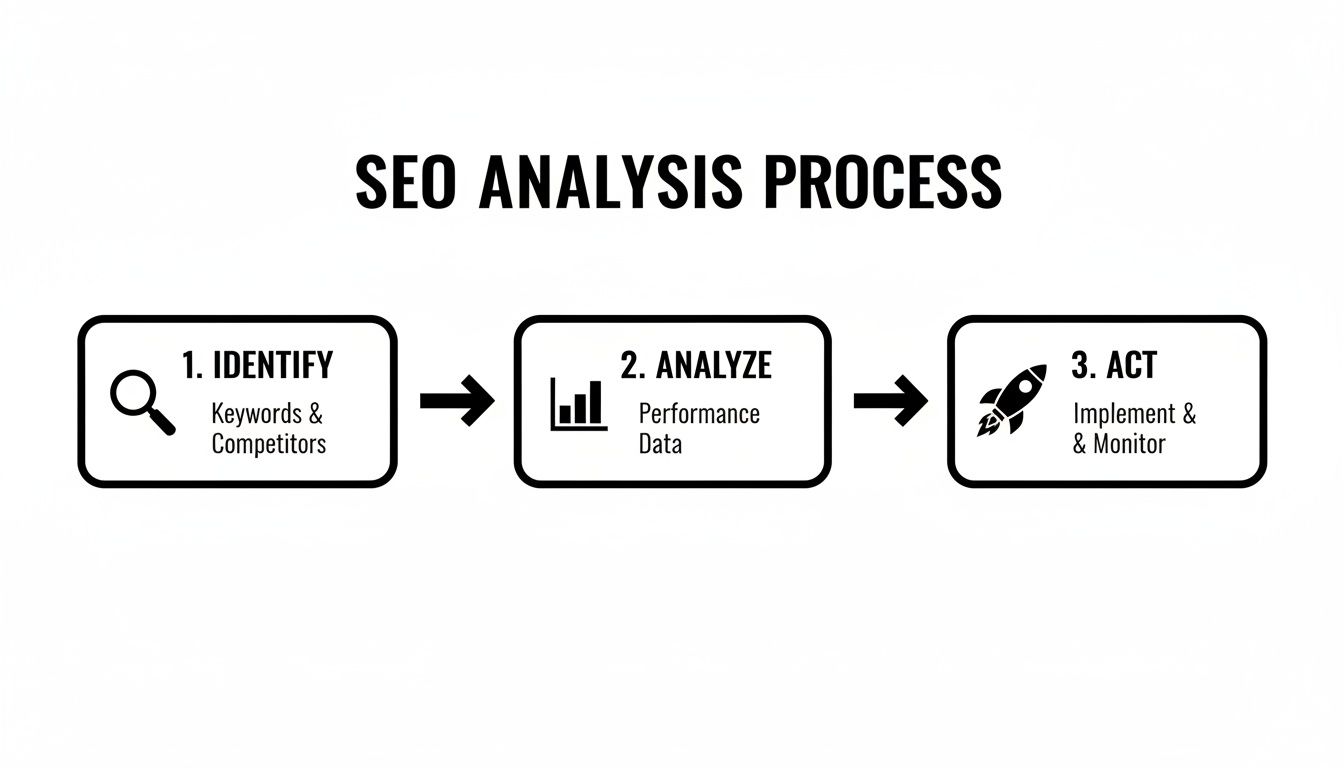
This visual really hammers it home: every successful campaign starts with identifying opportunities, moves into deep analysis, and finishes with decisive action.
To truly leverage SEO as a secret weapon, you must understand the competitive landscape; learn more about how to conduct competitor analysis effectively.
The value here isn't just theoretical. Businesses that lean into competitive intelligence often see a significant 20% average increase in online visibility. It’s proof that a well-executed analysis pays off. And as you gather all this data, it's worth exploring the benefits of AI-driven SEO strategies to help you process these insights at scale and move even faster.
Building Your Competitor Intelligence Toolkit
To really dig into what your competitors are doing, you need the right set of tools. Let's be honest, trying to do this manually is a non-starter. The right software turns hours of painful data-sifting into a few strategic clicks, effectively handing you your competitors' SEO playbooks.
Your toolkit doesn’t need to break the bank, but it absolutely has to be effective. The foundation for any serious analysis is built on a couple of all-in-one SEO platforms. These are the heavy hitters that give you the raw data on keywords, backlinks, and content performance.
Core All-in-One SEO Platforms
Think of these as your command center for competitive intelligence. While there are plenty of options out there, two platforms consistently lead the pack because of their sheer data depth and powerful features.
- Semrush: This is my go-to for keyword gap analysis and deep organic research. Its ability to compare multiple domains side-by-side is a game-changer for spotting keywords your competitors rank for that you've completely missed.
- Ahrefs: Famous for its absolutely massive backlink index, Ahrefs is the undisputed king of dissecting a competitor's link profile. I especially love the "Link Intersect" tool—it spits out a ready-made outreach list of sites linking to your rivals but not to you.
Most teams will pick one of these to be their primary platform. The choice usually comes down to your immediate goals. If you're focused on content and keyword opportunities, Semrush often has the edge. If your priority is building authority through backlinks, Ahrefs is probably your best bet. If you're still weighing the options, it helps to know what to look for in SEO tools based on your specific needs and budget.
A classic mistake is paying for multiple tools that do the same thing. Start with one core platform and fill in the gaps with specialized free software. This approach keeps your analysis sharp and your costs down.
Of course, the tools are only half the battle. Knowing the top competitive analysis techniques is what separates the pros from the amateurs. Applying the data strategically is what actually drives results.
Essential Free and Specialized Tools
Beyond the big paid suites, a handful of free tools provide critical insights that round out your analysis. You'll want these in your back pocket, especially for on-page and technical SEO checks.
First up, Google Search Console (GSC) is completely non-negotiable. It only shows data for your site, but it's the ultimate source of truth for your own performance. You can then use this as a baseline to measure against the competitor data you pull from other tools.
For quick, on-the-fly analysis, browser extensions are your best friend. The Ahrefs SEO Toolbar, for instance, overlays SERP results with key metrics like Domain Rating and the number of referring domains for every single URL.
This little add-on lets you instantly see the authority of the top-ranking pages without ever leaving Google. It dramatically speeds up your initial assessment of who you're really up against.
Finally, for technical deep dives, tools like GTmetrix or Google's own PageSpeed Insights are fantastic. Just plug in a competitor’s URL, and you'll get a detailed report on their site speed and Core Web Vitals. It’s a simple way to uncover technical weaknesses you can exploit.
Finding Where Your Competitors Are Dropping the Ball
Alright, you've got your tools sharpened and your list of competitors locked in. Now for the fun part: finding the cracks in their armor. This is where we go from simply knowing who they are to pinpointing the exact keywords and content topics they own—and, more importantly, where they’re completely missing the mark.
This isn’t about drowning yourself in a spreadsheet with thousands of random keywords. Think of it more like a strategic hunt. We're looking for their vulnerabilities, figuring out why their top pages are working so well, and identifying the golden opportunities they've left wide open for you.
Uncovering Strategic Keyword Gaps
The classic first move here is a keyword gap analysis. Using a tool like Semrush or Ahrefs, you can pop in your domain alongside two or three of your biggest rivals. The tool then spits out all the keywords your competitors are ranking for that you aren’t.
But here’s a pro tip: don’t just focus on the keywords you’re missing entirely. The real low-hanging fruit is often hiding in the "Weak" filter. This shows you keywords where your competitors are outranking you, but you still have a page in the game. These are prime targets. You’ve already done some of the work; now you just need to do it better.
Imagine you sell project management software. You see a competitor sitting pretty on page one for "Gantt chart best practices," while your own, perfectly good article is collecting dust on page three. That’s not a content gap—it's a massive opportunity gap just waiting for you to close it with a smart content refresh.
How to Prioritize Your Opportunities
That initial analysis is probably going to give you a mountain of keywords. Don't get overwhelmed. The trick is to be ruthless with your prioritization. Filter everything through these three lenses:
- Search Volume: Is anyone actually looking for this? More searches mean more potential traffic.
- Keyword Difficulty (KD): How big of a fight will it be to rank? Start with keywords that have a difficulty score your site can realistically compete for.
- Business Relevance: Does this keyword attract someone who might actually buy from you, or just a window shopper? Always prioritize terms that align with what you sell.
The sweet spot is where these three circles overlap: keywords with solid search volume, a manageable difficulty score, and high relevance to your business. That’s where you’ll get the biggest bang for your buck.
And the prize for winning is huge. The click-through rate (CTR) for the #1 spot in the search results is a staggering 39.8%. It plummets to just 18.7% for the second position and 10.2% for the third. This steep drop-off is exactly why you need to pick apart what the top players are doing. For more on this, check out the SEO statistics on seranking.com.
Look Beyond Keywords: Analyze Content Formats and Intent
Once you have a tight, prioritized list of keywords, the real detective work begins. Stop looking at the keywords themselves and start analyzing the pages that are ranking for them. What type of content is Google actually rewarding?
Is it a massive, long-form guide? A free tool or calculator? A detailed case study? A video?
This tells you everything you need to know about search intent. If the top three results for "how to create a budget" are all interactive calculators, you’re probably wasting your time writing a 3,000-word blog post. Your competitors have already done the hard work of showing you the format that works.
Let’s say you’re in the fitness space and you’re targeting "beginner HIIT workout." You might notice the top-ranking content includes:
- A blog post with a follow-along video embedded at the top.
- A listicle of "10-Minute HIIT Workouts" with animated GIFs for each exercise.
- A downloadable PDF workout plan.
The signal here is crystal clear: users want visual, actionable content they can start using immediately. A plain-text article is doomed to fail. Your job isn’t just to match this intent, but to one-up it. Maybe you can create a post that has a video, the GIFs, and a printable plan.
Finally, as you start targeting these new opportunities, you need a way to know if your work is actually paying off. Our guide on how to track keyword rankings walks you through setting up a simple, effective system to measure your progress. This turns your analysis from a one-off project into a repeatable strategy with tangible results.
Right, so you've picked apart your competitors' content. Now it's time to dig into the real foundation of their authority: their backlink profile.
Think of backlinks as votes of confidence from other websites. They're a massive signal to Google about who's trustworthy and who isn't. Understanding not just how many links your competitors have, but where they're coming from and why, is how you build a strategy to actually unseat them.
This isn't about just glancing at a Domain Authority score. We're about to go full detective mode on their link-building patterns, find their crown-jewel links, and spot the weak points you can exploit.

From Raw Link Metrics to a Coherent Strategy
First things first, you need a bird's-eye view. Plug each competitor's domain into a tool like Ahrefs or Semrush and pull the top-level metrics. But don't just stare at the numbers. Look for the story they're telling.
A competitor with a ton of links from spammy, low-quality domains might look impressive on paper, but their authority could be a house of cards. On the flip side, a rival with fewer links but all from heavy-hitters in your industry? That's a much tougher opponent.
Start by asking a few key questions:
- What's their link velocity? Are they consistently earning new links every month, or did they have one big push years ago and have been coasting ever since? A stagnant profile is a vulnerable one.
- How does their anchor text look? Is it a natural mix of their brand name, naked URLs, and target keywords? A profile that's way too heavy on exact-match anchors is a huge red flag for risky tactics.
- What's the ratio of referring domains to total backlinks? A high number of total links but a low number of unique linking sites can mean they're just getting links from the same places over and over. That's far less powerful than getting single links from many different, relevant domains.
The tool you use matters here. A bigger link database means a more complete picture. For instance, Semrush boasts a 43 trillion link database, giving it a slight edge over Ahrefs' 35 trillion. This can make a real difference when you're trying to get precise comparisons. Want to see how the tools stack up? You can discover more insights about SEO competitor analysis tools to find the best fit for you.
To get a clearer picture, it helps to put the data side-by-side.
Competitor Backlink Profile Comparison
| Website | Domain Authority (DA) | Referring Domains | Total Backlinks | Common Link Types |
|---|---|---|---|---|
| Your Site | 45 | 500 | 2,500 | Blog comments, local directories |
| Competitor A | 72 | 3,200 | 15,000 | Guest posts, Digital PR |
| Competitor B | 65 | 2,100 | 11,000 | Podcast interviews, Resource pages |
| Competitor C | 58 | 4,000 | 20,000 | Niche forum links, Low-quality directories |
This simple comparison immediately tells a story. Competitor A and B are building high-quality, authoritative links. Competitor C has a lot of links, but the type suggests a lower-quality, volume-based approach. You'd want to emulate A and B, not C.
Pinpointing Their Most Powerful Links
With the big picture in place, it’s time to zoom in on the links that are really doing the heavy lifting.
Every major SEO tool lets you sort a competitor's backlinks by some authority metric (like Ahrefs' Domain Rating or Semrush's Authority Score). Filter their profile to see only the strongest links—say, from sites with a DR of 70 or higher.
This is where the patterns jump out. Are their best links coming from:
- Guest Posts: Look for author bios on well-known industry blogs.
- Digital PR: Are they getting quoted in news articles or major online magazines?
- Resource Pages: Did they get featured on a "best tools for X" or a curated list of resources?
- Podcast Appearances: Do you see links coming from podcast show notes pages?
You might notice, for example, that your top competitor is constantly getting links from high-authority marketing blogs. A quick look shows their CMO is a frequent guest author. Boom. You've just discovered their strategy is built on personal branding and thought leadership—a playbook you can potentially replicate.
One of the biggest mistakes people make is just trying to copy the exact links their competitors have. The real win is understanding the types of links that work in your niche so you can go find your own, unique opportunities.
While you're digging around, you might also find broken links pointing to your competitors. This is a classic opportunity. It's called broken link building, and it's gold. You reach out to the site with the dead link, give them a heads-up, and suggest they swap it out with a link to your own (very relevant) resource. Want to master this tactic? Check out our guide on how to fix broken links.
Uncovering Golden Opportunities with Link Intersect Analysis
This is probably the most actionable part of any backlink audit. A link intersect analysis shows you which websites are linking to two or more of your competitors, but not to you.
Think about that for a second. If a top-tier site has already linked to multiple players in your space, they've clearly shown they're interested in your topic. This makes them an incredibly warm prospect for your own outreach.
Tools like Ahrefs and Semrush call this a "Link Gap" or "Link Intersect" feature. You just pop in your domain and a few of your top competitors. The tool then spits out a pre-qualified list of outreach targets. This isn't just a random list of websites—it's a strategic roadmap for your link-building campaigns that can save you dozens of hours of prospecting.
By decoding your competitors' backlink strategies, you stop guessing and start knowing. You can build a link acquisition plan based on proven tactics, target domains that are already interested in your industry, and focus your energy on what will actually move the needle for your site's authority.
Analyzing Technical and On-Page Performance

While everyone obsesses over content and backlinks, I've seen technical and on-page SEO act as the ultimate tiebreaker in tight SERP battles. These foundational elements are what make or break the user's experience and determine how easily search engines can actually crawl and understand a site.
Finding a competitor's technical weakness is like discovering a secret backdoor to the top of the rankings.
This part of the analysis goes deeper than just keywords. We're looking at the very architecture and speed of your competitor’s website. If you find a top-ranking site that’s a mess on mobile or has sloppy internal linking, you've found a vulnerability. Your mission is to pinpoint these performance gaps and make sure your own site offers a much smoother experience, giving Google a pretty compelling reason to rank you higher.
Auditing Core Web Vitals and Site Speed
Site speed isn't some minor ranking signal anymore; it's a huge piece of the user satisfaction puzzle. Google's Core Web Vitals (CWV) are the specific metrics they use to judge a page's loading performance, interactivity, and visual stability. A competitor failing their CWV assessment is basically handing you an opportunity on a silver platter.
You don't need fancy tools for a quick check. Just grab a competitor's high-ranking URL and pop it into Google's PageSpeed Insights. Keep an eye on:
- Largest Contentful Paint (LCP): How fast does the main content load? Anything over 2.5 seconds is a problem for them.
- First Input Delay (FID): How quickly does the page react when a user clicks or taps something?
- Cumulative Layout Shift (CLS): Does the page layout jump all over the place while loading? It's a classic user frustration.
If their best pages are sluggish, especially on mobile, you have a clear opening. A faster, more stable site isn't just an SEO win; it keeps people from bouncing and makes them stick around longer.
Examining Mobile Experience and Usability
With more than 60% of all searches now happening on mobile, a clunky mobile experience is an unforgivable SEO sin. Your analysis has to go beyond a simple "mobile-friendly" check. You need to actually see how usable the site is on a small screen.
Pull up their key pages on your phone. Can you easily tap the buttons? Can you read the text without pinching and zooming? Is the navigation a nightmare? A competitor with a brilliant desktop site but a terrible mobile version is frustrating a huge chunk of their audience—and leaving them vulnerable to a better option (you).
Technical SEO wins are often the fastest to implement and can provide an immediate ranking boost. While your competitors are busy with long-term content plays, you can gain ground by simply offering a better, faster user experience.
Uncovering On-Page Optimization Gaps
On-page SEO is all about optimizing individual pages to rank higher and pull in more relevant traffic. This is where you dig into how competitors are using fundamental HTML elements and structured data.
Run a competitor's URL through a site audit tool or even a browser extension and look for these common gaps:
- Schema Markup: Are they using structured data to get those fancy rich snippets in the SERPs (like FAQs, reviews, or event info)? If not, that's a huge missed opportunity for them to stand out.
- Internal Linking: How are they connecting their own pages? A weak internal linking strategy often leaves important pages "orphaned" and makes it harder for Google to find and value them.
- Header Tag Usage: Is their content structured logically with H1, H2, and H3 tags, or is it just a disorganized wall of text?
For a really deep dive, running a full website crawl test can expose all sorts of hidden problems like broken links, redirect chains, or thin content pages that are dragging down their site's overall performance. By finding these mistakes, you can make sure to avoid them on your own site, building a rock-solid technical foundation that bolsters all your other SEO efforts.
Turning Your Analysis Into an Actionable SEO Roadmap
Let's be honest: insight without action is just trivia. All the data you've just spent hours gathering is completely useless until you shape it into a prioritized strategy that actually gets results. This final step is all about creating a living document that will guide your SEO efforts for months to come.
The biggest mistake I see people make here is getting buried under a massive, unorganized to-do list. To avoid that, use a simple but powerful framework: sort every single opportunity into one of three buckets. This one move immediately brings clarity to the chaos.
Prioritizing Your SEO Opportunities
Start by organizing everything you've found based on its potential impact and the effort required to get it done. This sorting exercise is the key to building momentum. You'll be able to show some early results while you chip away at the bigger, more ambitious goals.
Here’s how to break it down:
- Quick Wins (High Impact, Low Effort): These are your immediate priorities. Think about optimizing a page title for a keyword where a competitor ranks with super thin content. Or maybe it's fixing a critical technical error that’s been holding you back. Jump on these first.
- Medium-Term Projects (High Impact, Medium Effort): These require a bit more planning. This bucket might include creating a new pillar page to fill a major content gap you discovered, or launching a small-scale outreach campaign to snag links from sites that are already linking to your rivals.
- Long-Term Initiatives (High Impact, High Effort): These are the big-picture plays that build lasting authority. An example would be building out an entire content hub to challenge a competitor on a core topic, or executing a large-scale digital PR campaign to earn top-tier links.
This approach ensures you’re constantly balancing immediate gains with the foundational work that builds a real competitive moat.
Your SEO roadmap shouldn't be a static report that gathers dust. Treat it as a dynamic plan. Review and adjust it quarterly as the competitive landscape shifts and your own performance data comes in.
Creating a Clear Reporting Structure
To keep your team (and your boss) aligned, your final analysis needs to be presented with absolute clarity. A good report doesn't just dump data on someone's desk; it tells a story and provides clear, unambiguous next steps.
Your report should briefly summarize the key findings from each stage of the analysis—keywords, content, backlinks, and technical SEO. Then, immediately pivot to the prioritized action plan.
I’ve found the best way to do this is with a simple table. Outline each task, assign an owner, set a firm deadline, and define what success looks like (KPIs). This is what turns your analysis from a simple research project into a powerful, actionable SEO roadmap.
Got Questions? We've Got Answers
Diving into a full-blown competitor analysis can definitely bring up a few questions. Let's tackle some of the most common ones we hear so you can sharpen your approach and get the most out of your work.
How Often Should I Perform a Competitor Analysis?
This is probably the number one question I get asked, and the answer isn't a vague "it depends." It’s all about establishing a rhythm. A full, deep-dive analysis like the one we've walked through here? You should block that out on your calendar at least once per year. This is what sets your big-picture strategy and benchmarks.
But you can't just set it and forget it. The real magic happens with more frequent, lighter check-ins. A quarterly review to see how keywords have shifted and what new content your rivals are publishing is a fantastic habit. Even better? A quick monthly peek at the SERPs for your most valuable keywords. This keeps you nimble enough to react to changes without getting bogged down in a massive project every few weeks.
A common mistake is treating competitor analysis as a one-and-done project. Your rivals are always evolving, and so are search engine algorithms. Regular, scheduled check-ins are non-negotiable for staying ahead.
What If My Website Is Brand New?
Starting from scratch might feel like you're at a disadvantage, but it's actually a huge plus. You have a clean slate. There's no old data or past decisions clouding your judgment, so you can build a strategy based entirely on what's already proven to work in your niche.
For a new site, your approach will look a little different:
- Look to 'Aspirational' Competitors: Don't worry about the small fish. Pinpoint the top 3-5 leaders in your space—the sites you aspire to be.
- Dig into Their Foundational Content: Forget their latest blog post. Your job is to dissect their core, evergreen content that's been pulling in links and traffic for years. This is their strategic foundation.
- Reverse-Engineer Their "First Year": Fire up your favorite SEO tool and travel back in time. Look at the content they published and the links they built in their first 12-18 months. This gives you a realistic, battle-tested roadmap for gaining that initial traction.
The goal isn't to go head-to-head with their current authority today. It's to follow the exact footsteps they took to build that authority from the ground up.
How Many Competitors Should I Analyze?
The sweet spot is somewhere between three and five competitors. It's tempting to go broad, but it's a trap.
Analyzing just one competitor gives you a warped, incomplete view of the landscape. But trying to track ten or more is a fast track to "analysis paralysis"—you’ll be swimming in so much data that you can't make a single clear decision.
Sticking to 3-5 gives you a perfectly balanced perspective. It's enough to spot overlapping strategies and patterns that signal what truly moves the needle in your industry. This focused approach is the key to ensuring your insights on how to do competitor analysis in SEO are both comprehensive and, more importantly, actionable.
Ready to turn these insights into a scalable SEO strategy? IndexPilot uses trainable AI Agents to automate your entire content workflow, from keyword research to publishing optimized articles directly to your CMS. Stop the manual busywork and start compounding your organic traffic.