How many SEO keywords should you really use on a single page? Let's cut to the chase.
The best approach is to focus on one primary keyword and then build a rich cluster of related secondary and semantic terms around it. Forget trying to hit some magic number; the goal is to cover a topic so thoroughly that you become the undeniable authority, not just repeat a phrase over and over.
The Real Answer to an Old SEO Question

The question of how many keywords to target per page is a classic in the SEO world, but the answer has changed dramatically. Years ago, the game was all about "keyword density"—stuffing a specific phrase into your page a certain percentage of times. That tactic is now officially dead.
Search engines like Google got much, much smarter.
Today, modern SEO is less about counting keywords and more about understanding topics. Think of it like this: your primary keyword is the main character of a story. Your secondary and semantic keywords are the supporting cast, providing depth, context, and a much richer narrative. Without them, the story just falls flat.
The mission isn't to hit a specific keyword count. It's to create a comprehensive resource that completely answers a user's question and proves your topical authority to search engines. It's a shift from arbitrary metrics to genuine user intent.
The Myth of Keyword Density
Back in the early 2010s, aiming for a keyword density of 1-2% was the gold standard. That advice is now completely obsolete. In fact, modern studies show the average keyword density for top-ranking pages is a tiny 0.04%. This proves how much the game has shifted toward semantic search, where context and relevance crush simple repetition. Learn more about these keyword density findings.
The evolution from keyword-stuffing to topic modeling is one of the most significant shifts in SEO history. Here's a quick look at how things have changed:
Keyword Targeting Then vs Now
Old-school SEO was a numbers game, focused on hitting specific keyword counts. The modern approach, however, is all about creating a comprehensive resource that satisfies the user's entire query.
| SEO Practice | Old Approach (Pre-Semantic Search) | Modern Approach (User Intent Focused) |
|---|---|---|
| Primary Goal | Achieve a target keyword density (e.g., 1-2%). | Fully cover a topic to satisfy user intent. |
| Keyword Use | Repeat the exact-match keyword frequently. | Use a primary keyword, synonyms, and related terms. |
| Focus | How many times a keyword appears. | How well the content answers the user's question. |
| Content Structure | Optimized for a single phrase. | Structured around a core topic and its subtopics. |
This table makes it clear: the conversation has moved on. The focus is no longer on repetition but on creating deep, valuable content that search engines recognize as the best answer.
The conversation has moved from "How many times did I say this phrase?" to "How well did I cover this entire topic?" A page that answers all related questions naturally will always outperform one that simply repeats the main keyword.
A Smarter, Topic-Focused Strategy
Instead of obsessing over a magic number, your energy is better spent building a rich content experience. A well-optimized page today has a clear structure that serves both the person reading it and the search engine crawling it.
This topic-first mindset is the foundation of an effective and sustainable SEO strategy. By understanding the different types of organic search keywords and the roles they play, you can create content that doesn't just rank—it genuinely helps your audience. The rest of this guide will show you exactly how to do that.
Choosing Your Primary and Secondary Keywords
Alright, now that you're thinking in terms of topics instead of just a list of keywords, it's time to get specific. This is where we pick the exact phrases that will act as the blueprint for your page, giving distinct jobs to your primary and secondary keywords.

Think of your primary keyword as the north star for your content. It's the one, single query you want to rank for above all others. It defines the core user intent, and every single thing on the page—from the title to the images—should point back to it.
Secondary keywords, on the other hand, are the supporting cast. They add the necessary depth, context, and richness that makes your page a truly comprehensive resource. They help you answer all the little follow-up questions your reader might have, making your content the definitive guide on the subject.
Defining Your Keyword Hierarchy
To build a page that search engines love, you need a crystal-clear hierarchy. The game plan is simple: pick one powerhouse primary keyword, then surround it with a small group of closely related secondary keywords.
This structure forces you to stay focused. It stops you from trying to be everything to everyone on a single page, which is a classic SEO mistake that almost always ends with you ranking for nothing at all. A tight, focused keyword group is always more powerful.
A huge piece of this puzzle is seeing what's already working for others. A good place to start is by mastering keyword analysis competitor strategy to uncover the terms your rivals are winning with.
A Practical Example: Coffee Brewing
Let's make this real. Imagine you're building a guide for people who want to start making better coffee at home. After digging into what people are searching for, you land on a solid keyword structure.
Primary Keyword:
home coffee brewing methods- This is your main target. It nails a specific user intent ("I want to learn how to make coffee at home") but is broad enough to let you explore the topic in detail.
Secondary Keywords:
pour-over coffee guidebest coffee beans for french presscold brew at home stepshow to use an aeropress
See how that works? These secondary keywords become natural subheadings or entire sections within your main guide. They tackle the specific, related questions someone interested in "home coffee brewing" would likely have. You're not just answering one question; you're satisfying their entire curiosity on the topic.
It's also worth exploring different keywords match types to see how search engines might interpret variations of these phrases.
The Rule of Thumb: For most pages, aim for one primary keyword and 3-5 highly relevant secondary keywords. This creates a focused yet comprehensive structure that signals deep topical expertise to search engines without watering down your core message.
When you adopt this model, the question changes. You stop asking "How many keywords can I stuff onto a page?" and start asking, "How can I best structure my keywords to own this topic?" That shift in mindset is the secret to creating content that doesn't just rank, but dominates.
Unlocking Your Rank Potential with Semantic Keywords
So you’ve got your primary and secondary keywords. What's next? Well, beyond that initial layer lies something much deeper—the key to signaling true topical expertise to search engines. Welcome to the world of semantic keywords. These are the related concepts, synonyms, and phrases that naturally orbit a topic. They’re the conversational glue that makes your content feel complete and, more importantly, authoritative.
Think about it this way: if your main keyword is "baking bread," your article would feel hollow and frankly, a bit weird, without mentioning words like 'yeast,' 'flour,' 'kneading,' and 'proofing.' Those are your semantic keywords. They aren't just extra terms to sprinkle in for flair; they are the essential building blocks that prove you actually know your stuff.
Building True Topical Authority
Search engines have gotten incredibly smart. They're designed to understand language the way a person does, looking for the conceptual relationships between words to figure out the depth and quality of a page. This is exactly why a page rich with semantic terms will almost always crush one that just hammers the same primary keyword over and over again.
You’re not just showing keyword knowledge; you’re demonstrating genuine expertise. This approach helps you rank for a much wider net of queries because you naturally start covering the nuances and related questions real people are searching for. It shifts the entire focus from "how many keywords can I fit on this page?" to "how thoroughly can I cover this topic?"
Instead of obsessing over how many times you should use a keyword, ask yourself this: "Have I covered this topic so completely that all the related concepts are naturally included?" This simple shift in perspective is the secret to creating content that search engines love to reward.
Finding Semantic Keywords in Plain Sight
The good news is you don't need a bunch of expensive tools to start digging up these valuable terms. Google itself hands you a goldmine of semantic keyword ideas right there in the search results.
- "People Also Ask" (PAA) Box: These questions are a direct line into your audience's mind. They show you the immediate follow-up queries people have, giving you perfect subtopics and related phrases to weave into your content.
- "Related Searches" Section: Scroll to the bottom of the search results page. That list isn't random; it shows other common searches directly related to your original query. Pure gold.
- Autocomplete Suggestions: Start typing in the search bar. Google's suggestions are popular long-tail queries, and they're packed with the very semantic phrases you're looking for.
Don't just take my word for it. Recent research that analyzed over 1 million search results backs this up completely. It found that top-ranking pages don’t fixate on a single keyword. Instead, they feature a huge variety of related phrases and synonyms. On average, these top pages included 30-50 unique keyword variations for every 1,000 words. The takeaway is clear: diversity and relevance matter far more than repetition. You can dive deeper into the data in the full ranking factors study.
By weaving these naturally related terms into your headings, body copy, and lists, you create a far more comprehensive and helpful resource. This approach doesn't just satisfy what your reader is looking for—it aligns perfectly with modern search engine algorithms, which are built to reward high-quality, in-depth content. For more tips on this, check out our guide on content SEO best practices.
How to Structure Your Content for Keyword Success
Knowing which keywords to target is only half the battle. Now comes the fun part: strategically weaving them into your content so it makes sense to both people and search engines. This isn't about awkwardly stuffing keywords where they don't belong. It's about building a clear, logical hierarchy that guides your reader through the topic.
Think of your page like a well-organized blueprint. Your primary keyword is the foundation—it's what the whole structure rests on. Your secondary and semantic keywords are the support beams and framework, adding strength and context. Each piece has a specific job and a specific place.
The High-Impact Placement Checklist
Your primary keyword needs to be in the most prominent spots on the page. These are the non-negotiable placements that send the strongest signal to Google about your content's main focus. Get these right, and you're off to a great start.
Here’s your checklist for placing your primary keyword:
- Title Tag: This is the headline that shows up in the search results and at the top of the browser tab. It's arguably the most important real estate you have.
- H1 Heading: The H1 is the main title on the page itself. It should contain your primary keyword and feel like a natural extension of the title tag.
- Opening Paragraph: Mention your primary keyword somewhere in the first 100-150 words. This immediately confirms the topic for readers and search engines, telling them they're in the right place.
- URL: A clean, keyword-focused URL (like
yourdomain.com/primary-keyword-here) is another crystal-clear signal about the page's topic.
These placements are like big, bright signposts for Google. Once they're in place, you can start building out the rest of your content with all the supporting terms. To really make your content work for you, it's crucial to understand how to implement search engine optimization effectively from the ground up.
Integrating Secondary and Semantic Keywords
With your primary keyword anchored, it's time to bring in your secondary and semantic keywords to add depth and context. These are the terms that will flesh out the body of your content, making it comprehensive and genuinely helpful.
Don’t think of this as a checklist you have to frantically tick off. Instead, see these keywords as organizational tools. If a secondary keyword makes a perfect subheading, use it. If a semantic term fits naturally into a sentence, drop it in. The goal is always a smooth, valuable reading experience.
Here’s how to integrate them seamlessly:
- Subheadings (H2s and H3s): Your secondary keywords often make for perfect subheadings. For example, if your primary keyword is "home coffee brewing methods," an H2 could easily be "A Beginner's Guide to Pour-Over Coffee."
- Body Content: Sprinkle your secondary and semantic keywords throughout your paragraphs where they make sense. You're aiming for a conversational flow, not robotic repetition.
- Image Alt Text: Describe your images accurately for accessibility, and use relevant keywords when it feels natural. For an image of a French press, alt text like "brewing dark roast coffee with a French press" is perfect.
- Internal Links: Use secondary or semantic keywords as the anchor text when you link to other relevant pages on your site. This builds topical authority and guides users to more of your great content. For a deeper dive on this, check out our SEO content writing tips.
Seeing Effective Keyword Targeting in Action
Theory is one thing, but seeing it work in the real world is where it all clicks. The best way to understand how to balance your keywords is to peek under the hood of a high-ranking page and see exactly how they do it.
Let's deconstruct the on-page SEO of a successful article. By reverse-engineering their content structure, you'll see the direct line between a smart keyword strategy, satisfying user intent, and making Google happy.
This simple hierarchy shows where your most important keywords should live for maximum impact. Think of it as a roadmap for your on-page elements.
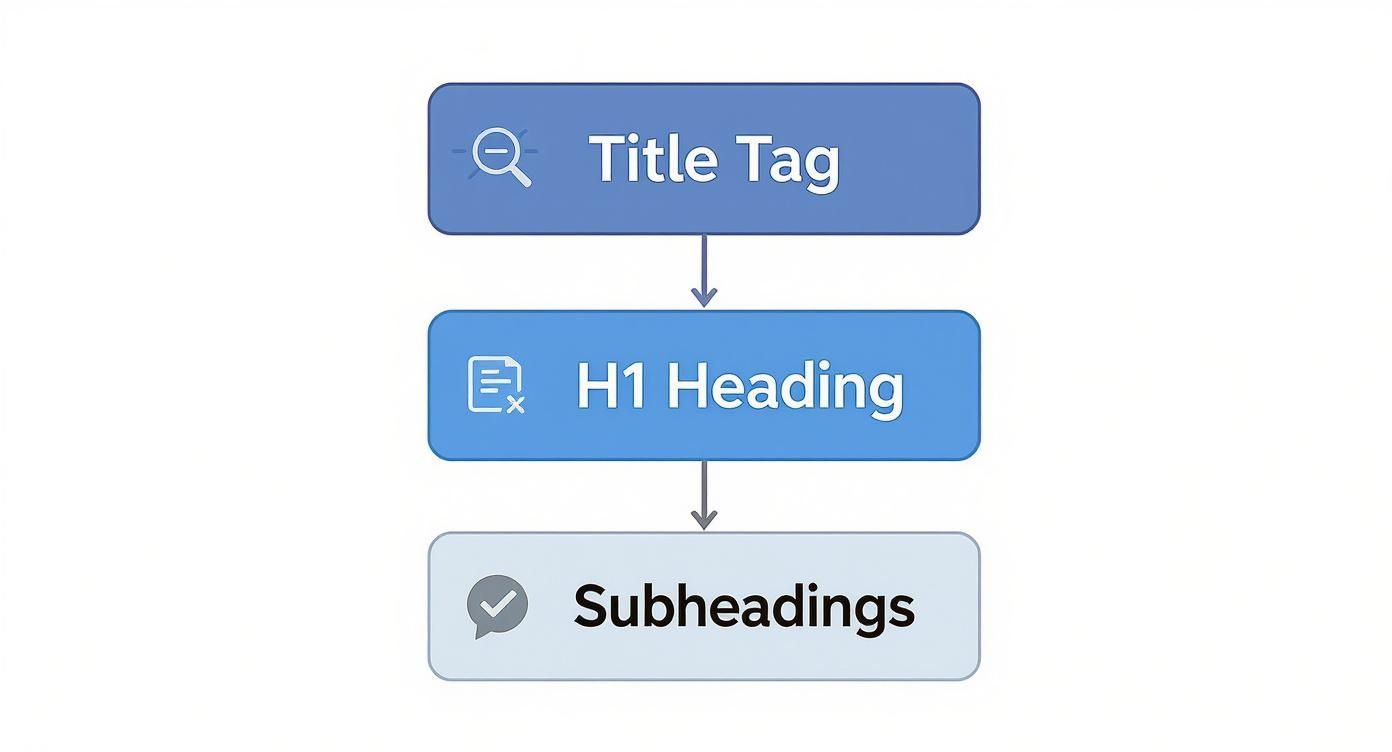
As you can see, your primary keyword gets the prime real estate—the Title Tag and the H1 Heading. Your secondary keywords then come in to support the main topic within the subheadings, fleshing out the article.
Case Study: NerdWallet's Travel Credit Cards Page
Let’s look at a page from NerdWallet, an absolute master of SEO in the brutally competitive finance space. Their page on the "best travel credit cards" is a perfect example of this strategy executed flawlessly.
This isn't just about stuffing keywords; it’s about creating a logical flow that guides the reader while signaling relevance to search engines.
Here's a quick breakdown of their brilliant keyword strategy:
- Primary Keyword: Their laser focus is on "best travel credit cards." You’ll find this exact phrase in the title tag, the main H1 heading, and right in the opening paragraph. There's no ambiguity here.
- Secondary Keywords: The H2 subheadings are used to target related, high-intent searches. Think "best airline credit cards," "best hotel credit cards," and "cards with no foreign transaction fees." Each one is a potential search query on its own.
- Semantic Keywords: Sprinkled throughout the copy, you'll find terms like "annual fee," "rewards points," "sign-up bonus," and "lounge access." These words build topical depth and prove to Google that NerdWallet knows this subject inside and out.
NerdWallet’s approach is backed by hard data. Top-ranking pages often target 3-5 primary keyword variations and support them with up to 20 secondary and semantic terms. Pages that strike this balance are 40-50% more likely to rank well compared to those that obsess over a single keyword. You can dig into more SEO statistics to see just how powerful this layered method is, especially in tough markets.
By targeting a core topic with a primary keyword and using secondary keywords to answer all the related follow-up questions, NerdWallet creates an unbeatable resource. It perfectly satisfies what the user wants to know and what search engines need to see. This is exactly how you should structure keywords for a successful page.
Measuring Performance and Refining Your Strategy
So, you’ve hit “publish.” Is the job done? Not even close. A truly effective keyword strategy isn’t a one-and-done task. It’s a living, breathing process that demands constant attention, measurement, and fine-tuning to build real momentum over time.
Thinking your page is perfectly optimized is one thing, but seeing how Google actually sees it is a whole different ballgame. This is where you swap theory for hard data and start turning a good piece of content into a genuine traffic-generating machine.
Your first stop on this journey should always be Google Search Console (GSC). It's a free, powerhouse tool that gives you a direct look at how your pages are performing out in the wild.
Using Data to Guide Your Next Steps
Once you're inside Google Search Console, you can see every single query that's earning your page impressions and clicks. Don't just fixate on your primary keyword. You need to look at the entire constellation of terms that are leading users to your content.
This data is your roadmap. It tells you exactly what’s working, what’s falling flat, and where your hidden opportunities are just waiting to be discovered.
You'll often be surprised to find your page ranking for secondary or long-tail keywords you never even intentionally targeted. These are your "keyword gaps"—golden opportunities where a small content update could reel in a significant amount of new traffic. For example, if you see a ton of impressions for a specific term but a painfully low click-through rate (CTR), that's a huge signal that it's time to test a more compelling title tag.
SEO is not a "set it and forget it" activity. The most successful strategies involve a continuous cycle of publishing, measuring, and refining. Your data in Google Search Console is the feedback loop that drives this growth.
A Framework for Continuous Improvement
After you've pinpointed these opportunities, you can start making strategic updates. This iterative process is the absolute key to long-term SEO success and is a central part of understanding how to measure SEO success.
Here's a simple, repeatable framework you can follow:
- Analyze Performance: Dive into GSC and review the queries your page is ranking for. Hunt for keywords with high impressions but low clicks, or terms that are stuck on the second page of Google.
- Identify Gaps: Pinpoint related subtopics or user questions you haven't fully covered. Could adding a new section for a secondary keyword give your page the boost it needs to climb higher?
- Update and Enhance: Go back into your content and revise it to better target these keyword gaps. This might mean expanding an existing section, adding a new H3 with more detailed information, or completely rewriting your meta description to be more enticing.
- Test and Measure: Run A/B tests on different page titles to see which one gets a better CTR. After you make an update, keep a close eye on your average position for your target keywords to confirm your changes are actually moving the needle.
Got Questions About Keyword Targeting? We've Got Answers
Let's clear up some of the most common questions that pop up when figuring out how many keywords to target on a single page.
How Many Times Should My Main Keyword Show Up?
Forget about "keyword density." That's old-school SEO thinking. There’s no magic number here.
Instead, think about strategic placement. Make sure your primary keyword shows up naturally in a few key places:
- Your page's title tag
- The main H1 heading
- The URL itself
- Somewhere in the opening paragraph
After hitting those spots, just write for your reader. If the keyword fits, use it. If it doesn't, don't force it. A smooth, helpful reading experience will always beat hitting some arbitrary keyword count.
Can One Page Rank for Multiple Primary Keywords?
It’s possible, but it's rarely a winning strategy. When you try to make one page the champion for two different primary keywords, you usually just dilute its focus. The result? It ranks poorly for both.
A much better approach is to create a separate, laser-focused page for each primary keyword. This lets you go deep on each topic, creating content that perfectly matches what someone is looking for with that specific search.
Is It Bad to Target the Same Keyword on Multiple Pages?
Yes, absolutely. This is a classic SEO mistake called keyword cannibalization, and it’s a great way to confuse search engines.
When you have multiple pages all fighting for the same keyword, Google doesn't know which one is the "right" one to show in the search results. This can drag down the performance of all the competing pages. The rule is simple: give every important keyword its own dedicated home.
How Do I Update Keywords on an Old Blog Post?
This is a great way to get more traffic from content you already have. Start by jumping into your Google Search Console account to see what search terms the post is already getting impressions for.
Look for what we call "striking distance" keywords—these are terms where you're ranking on the second or third page of Google. Then, go back and refresh the content. You can expand sections to better cover those topics, add new subheadings, and update any old information to make the whole piece more relevant and in-depth.
Ready to stop guessing and start scaling your SEO? IndexPilot uses trainable AI Agents to automate your entire content workflow—from keyword research and writing to optimization and publishing. Transform your SEO into a reliable growth engine that compounds traffic while you focus on your business. Discover how IndexPilot can automate your content strategy.