Enterprise SEO content operations demand more than basic keyword tools. At scale, you're managing hundreds of writers, thousands of pages, and content workflows that span multiple teams, regions, and product lines. The right enterprise SEO content software unifies these moving parts—automating production, ensuring brand consistency, and, increasingly, optimizing for AI search visibility.
This guide evaluates top platforms built for enterprise complexity, from AI-powered content generation to workflow orchestration and performance analytics. We've prioritized tools that handle the unique challenges large organizations face: governance controls, team collaboration at scale, and integration with existing tech stacks. Because traditional SEO suites excel at tracking Google rankings but can't tell you how AI assistants describe your brand or which prompts trigger a mention, we've also weighed each platform's readiness for AI search.
Enterprise SEO Software Compared at a Glance
| Platform | Primary Strength | Standout Enterprise Capability | Starting Price |
|---|---|---|---|
| Sight AI | AI search visibility + content generation | Prompt tracking across ChatGPT, Claude, Perplexity | Custom |
| Conductor | Organic marketing intelligence | Granular permissions, intent-based keyword mapping | Custom |
| Clearscope | Content optimization quality | A++ to F grading in Google Docs/WordPress | $350/month |
| MarketMuse | Content strategy and inventory analysis | Personalized difficulty scores | $399/month |
| Surfer SEO | Real-time NLP optimization | Team workspaces with permissions | $219/month |
| Semrush | All-in-one suite | Multi-domain management, enterprise API | $499.95/month |
| BrightEdge | SEO intelligence at Fortune 500 scale | DataMind AI, Adobe/Salesforce integrations | Custom (annual) |
| Contently | Content operations and freelancers | Talent network with brand governance | Custom |
| Frase | Research and brief automation | SERP-based brief generation | $114.99/month |
1. Sight AI
Best for: Enterprises prioritizing AI search visibility alongside traditional SEO content production
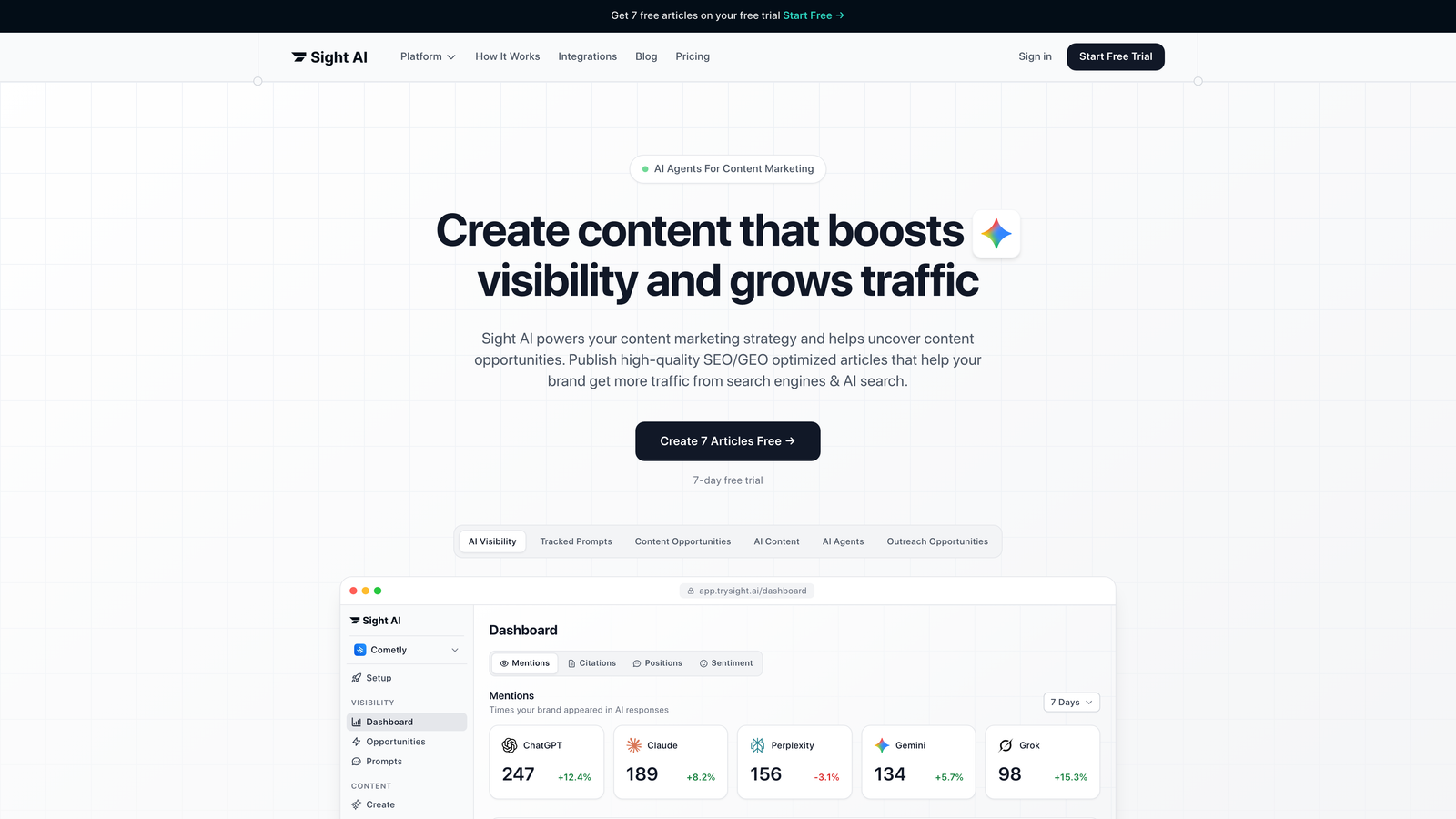
Sight AI is an AI visibility tracking and content generation platform that monitors brand mentions across AI models while producing SEO/GEO-optimized content at scale.
Where This Tool Shines
Sight AI addresses a critical gap in enterprise content strategy: understanding how AI models like ChatGPT, Claude, and Perplexity discuss your brand. As generative AI search becomes a primary discovery channel, traditional SERP tracking alone no longer tells the complete story.
The platform combines visibility monitoring with content production capabilities. You can track sentiment and positioning across AI responses, identify content gaps where competitors appear but you don't, and generate optimized articles designed to improve both traditional SEO rankings and AI model citations.
Key Features
AI Visibility Score: Tracks brand mentions across ChatGPT, Claude, Perplexity, and 6+ AI platforms with sentiment analysis.
13+ Specialized AI Agents: Generates SEO/GEO-optimized articles including listicles, guides, and explainers with autopilot mode.
IndexNow Integration: Automatically notifies search engines of new content for faster discovery and indexing.
Prompt Tracking: Monitors which user queries trigger brand mentions in AI responses.
CMS Auto-Publishing: Publishes content directly to your website without manual intervention.
Best For
Large enterprises managing complex content operations who need to understand their presence in AI-generated responses. Particularly valuable for organizations in competitive markets where AI search visibility directly impacts brand awareness and customer acquisition.
Pricing
Contact for enterprise pricing based on content volume and team size.
2. Conductor
Best for: Enterprise teams needing comprehensive organic marketing intelligence and cross-team collaboration
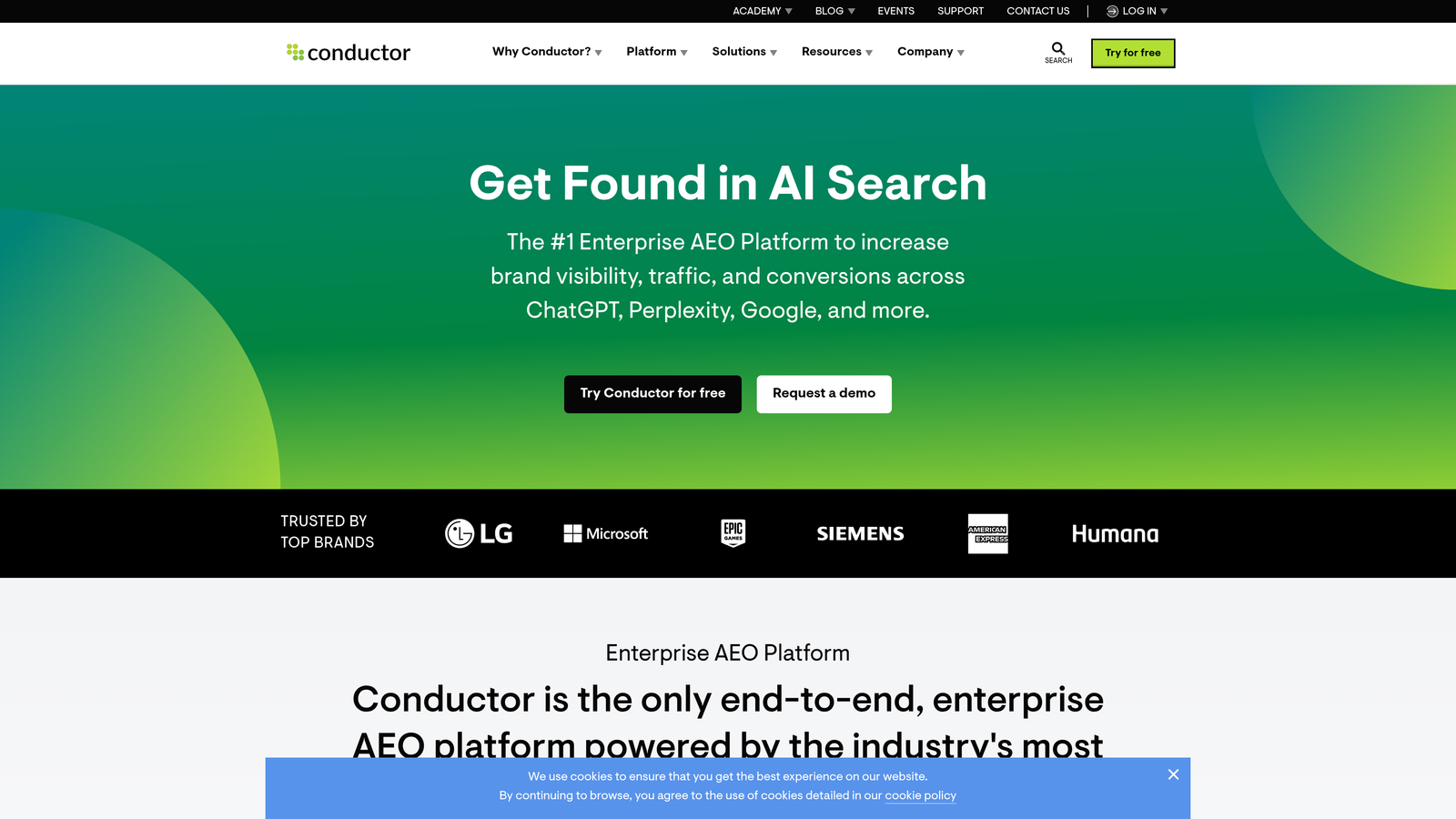
Conductor is an enterprise SEO and content marketing platform focused on organic marketing intelligence and cross-team collaboration.
Where This Tool Shines
Conductor excels at breaking down silos between SEO, content, and product teams. The platform provides a unified view of organic performance that helps enterprises coordinate strategy across departments. Think of it as a command center for your entire organic marketing operation.
What sets Conductor apart is its emphasis on governance and permissions. Large organizations need granular control over who can access sensitive competitive data or make strategic recommendations. Conductor's enterprise permission structure ensures the right stakeholders see relevant insights without overwhelming teams with unnecessary information.
Conductor also classifies keywords by customer journey stage, so teams can see whether they're producing awareness, consideration, or decision-stage content. That turns keyword research from a volume game into a planning exercise tied to marketing objectives—especially useful for B2B companies with long sales cycles. Built-in workflow management coordinates creation, review, and publishing without a separate project management tool.
Key Features
Keyword and Content Gap Analysis: Identifies opportunities where competitors rank but your content doesn't exist.
Intent-Based Keyword Intelligence: Maps keywords to customer journey stages and buyer intent signals.
Real-Time SEO Health Monitoring: Tracks technical issues and content performance across your entire domain.
Enterprise Permission Controls: Granular access management for distributed teams and agency partners.
CMS Integration: Native connections to Adobe Experience Manager, Drupal, Sitecore, WordPress, and other major enterprise platforms.
Competitive Intelligence: Market share tracking and competitor content strategy analysis.
Best For
Fortune 500 companies and large enterprises with complex organizational structures requiring sophisticated permission controls and deep integration with existing martech stacks. Ideal for organizations where multiple teams need coordinated access to SEO intelligence.
Pricing
Custom enterprise pricing based on domain size, user count, and feature requirements.
3. Clearscope
Best for: Content teams focused on optimization quality and real-time writing assistance
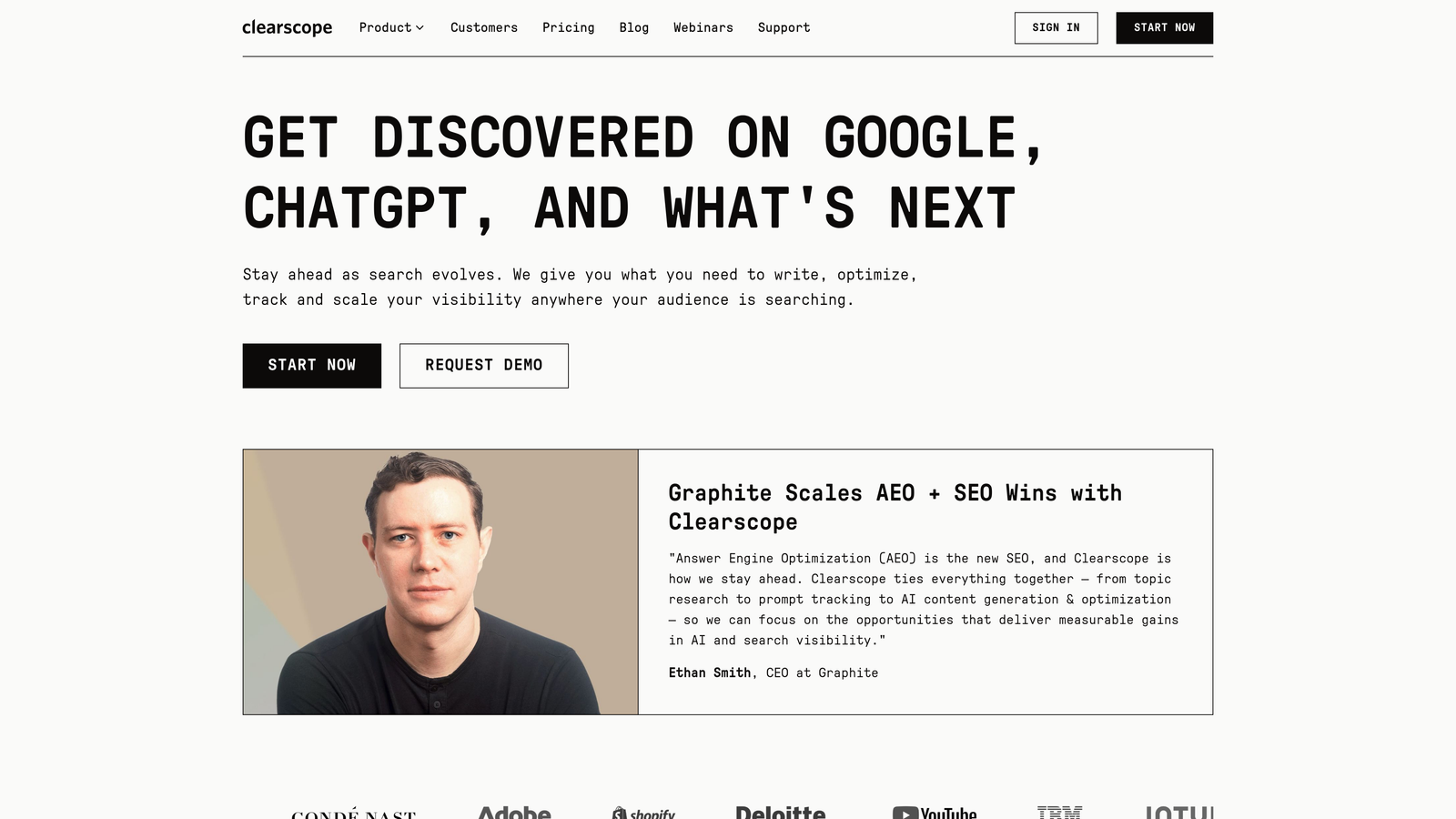
Clearscope is an AI-powered content optimization platform that helps enterprise teams create high-ranking content through data-driven recommendations.
Where This Tool Shines
Clearscope simplifies content optimization with an intuitive grading system that writers actually understand. Instead of drowning teams in technical SEO metrics, it provides a straightforward A++ to F score that makes optimization actionable. Writers know exactly what good looks like.
The real-time optimization during writing sets Clearscope apart. As your team drafts content in Google Docs or WordPress, they receive immediate feedback on keyword coverage, readability, and content depth. This eliminates the back-and-forth revision cycles that slow down enterprise content production.
Key Features
Content Grading System: A++ to F scoring that translates complex SEO factors into clear quality metrics.
Real-Time Optimization: Live suggestions as writers create content in Google Docs or WordPress.
Shared Reports: Team collaboration features for editors and stakeholders to review optimization recommendations.
Competitor Analysis: Side-by-side comparison of your content against top-ranking pages.
CMS Integration: Direct connections to WordPress and other major content management systems.
Best For
Content teams prioritizing quality over quantity, especially organizations with distributed writers who need consistent optimization guidance. Works well for enterprises where content passes through multiple reviewers before publication.
Pricing
Business plans start at $350/month; Enterprise custom pricing available for larger teams.
4. MarketMuse
Best for: Strategic content planning with AI-powered inventory analysis and opportunity identification
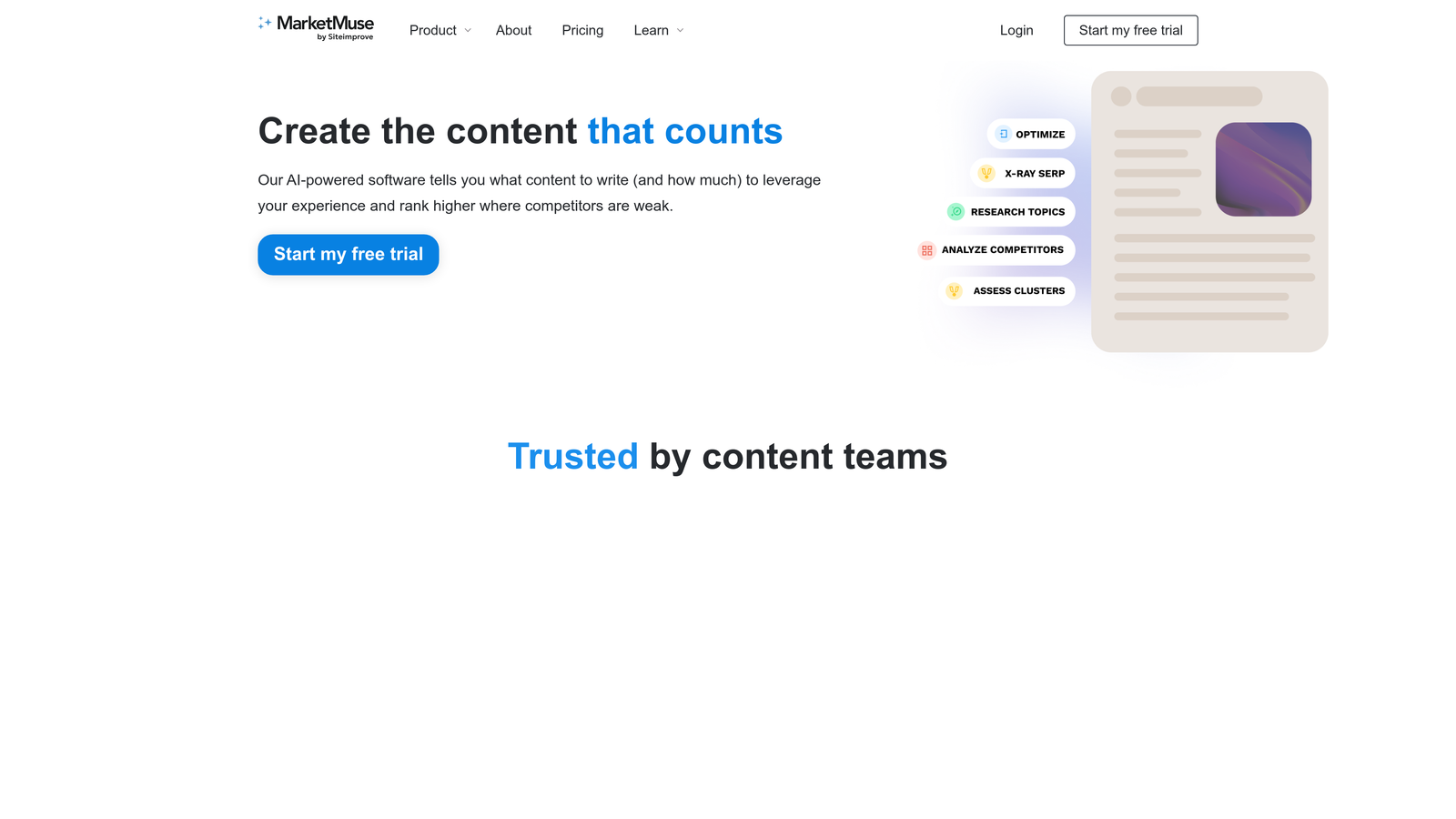
MarketMuse is an AI content strategy platform that analyzes your entire content inventory to identify gaps and prioritize high-impact opportunities.
Where This Tool Shines
MarketMuse takes a portfolio approach to content strategy. Rather than optimizing individual articles in isolation, it evaluates your entire content library to identify systemic gaps and prioritize investments. Its topic modeling maps semantic relationships between concepts, showing where your coverage is comprehensive and where it's superficial. Inventory scoring also helps teams decide which pages to update and which to retire—preventing the common enterprise problem of hundreds of mediocre pages diluting site authority.
The personalized difficulty scores are particularly valuable for large organizations. MarketMuse doesn't just tell you keyword difficulty in general—it calculates how difficult ranking would be for your specific domain based on your existing authority. This prevents teams from chasing impossible keywords or ignoring winnable opportunities.
Key Features
Personalized Difficulty Scores: Ranking difficulty calculations based on your domain's specific authority and content.
Content Inventory Analysis: Comprehensive audit of existing content with optimization recommendations.
AI-Generated Briefs and First Drafts: Detailed content outlines with competitive insights, plus AI-written initial drafts.
Topic Cluster Planning: Strategic mapping of pillar pages and supporting content architecture.
ROI Forecasting: Estimated traffic and business impact for proposed content investments.
Best For
Enterprise content strategists managing large content libraries who need to justify content investments with data-driven ROI projections. Particularly valuable for organizations transitioning from ad-hoc content creation to strategic portfolio management.
Pricing
Team plans start at $399/month; Enterprise custom pricing for larger content operations.
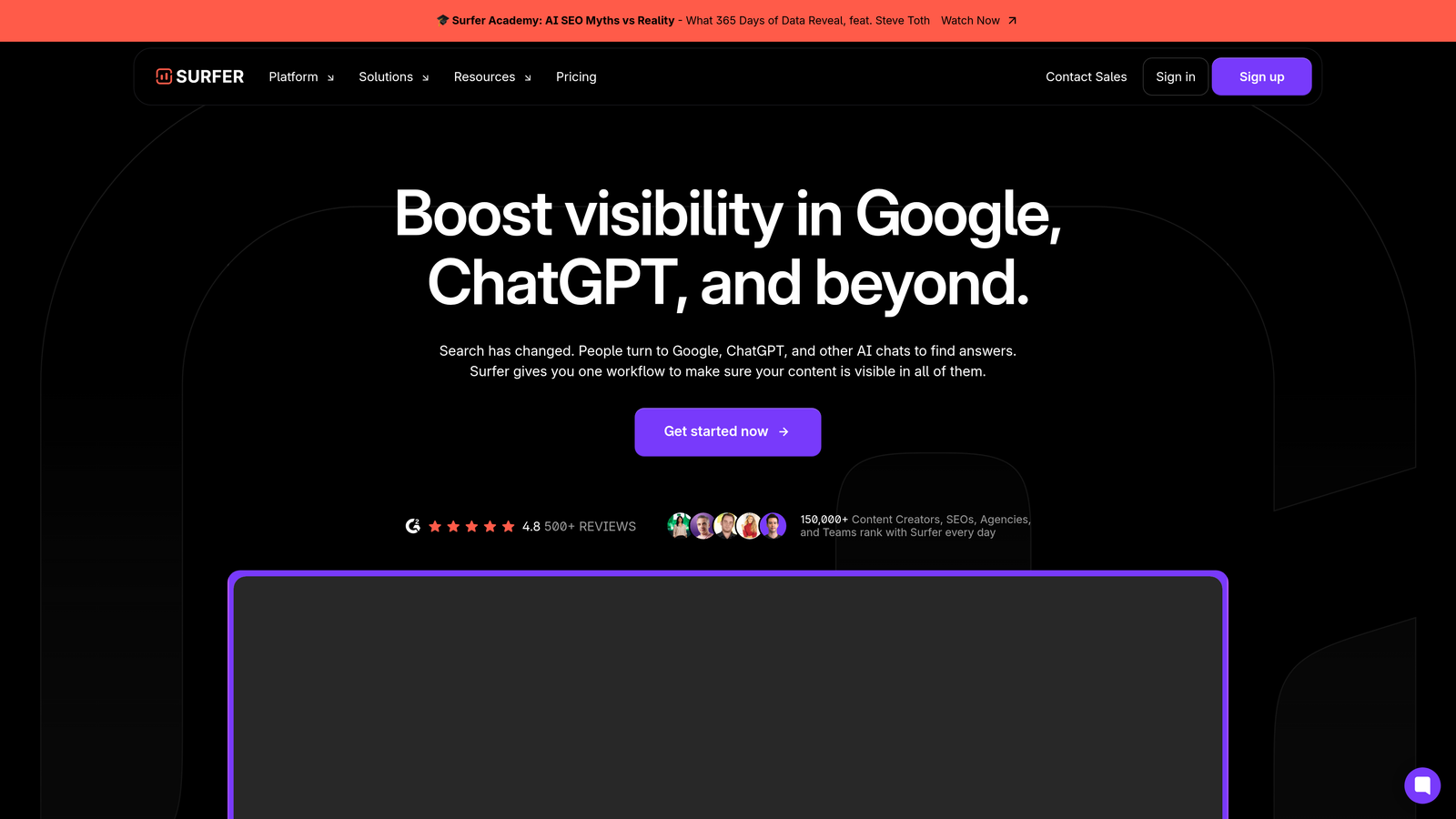
5. Surfer SEO
Best for: Data-driven content optimization with real-time editing suggestions
Surfer SEO is a content optimization tool with real-time editing suggestions based on top-ranking pages analysis.
Where This Tool Shines
Surfer SEO excels at demystifying what makes content rank. The platform analyzes top-performing pages and translates that analysis into specific, actionable recommendations. Writers don't need to guess what "comprehensive coverage" means—Surfer shows them exactly which topics and terms to include.
The Content Editor provides a real-time optimization experience that feels more like having an SEO expert looking over your shoulder than using software. As you write, the tool adjusts recommendations based on your content's evolving structure, ensuring suggestions remain relevant throughout the drafting process. For enterprises working with freelancers and agencies, shared briefs keep every contributor optimizing toward the same targets, while workspace permissions protect sensitive data.
Key Features
Content Editor: NLP-powered suggestions for keyword placement, content structure, and topic coverage.
SERP Analyzer: Competitive benchmarking against top-ranking pages for target keywords.
Audit Tool: Existing content optimization recommendations with before-and-after tracking.
Shared Workspaces: Team collaboration with granular permissions and content assignment for distributed teams.
Surfer AI Integration: AI writing capabilities combined with optimization guidance.
Best For
Content teams that want prescriptive optimization guidance without needing deep SEO expertise. Works well for enterprises scaling content production with freelancers or junior writers who need structured direction.
Pricing
Scale plan at $219/month; Enterprise custom pricing available for larger teams.
6. Semrush Content Marketing Platform
Best for: Organizations already using Semrush who want integrated content workflow capabilities
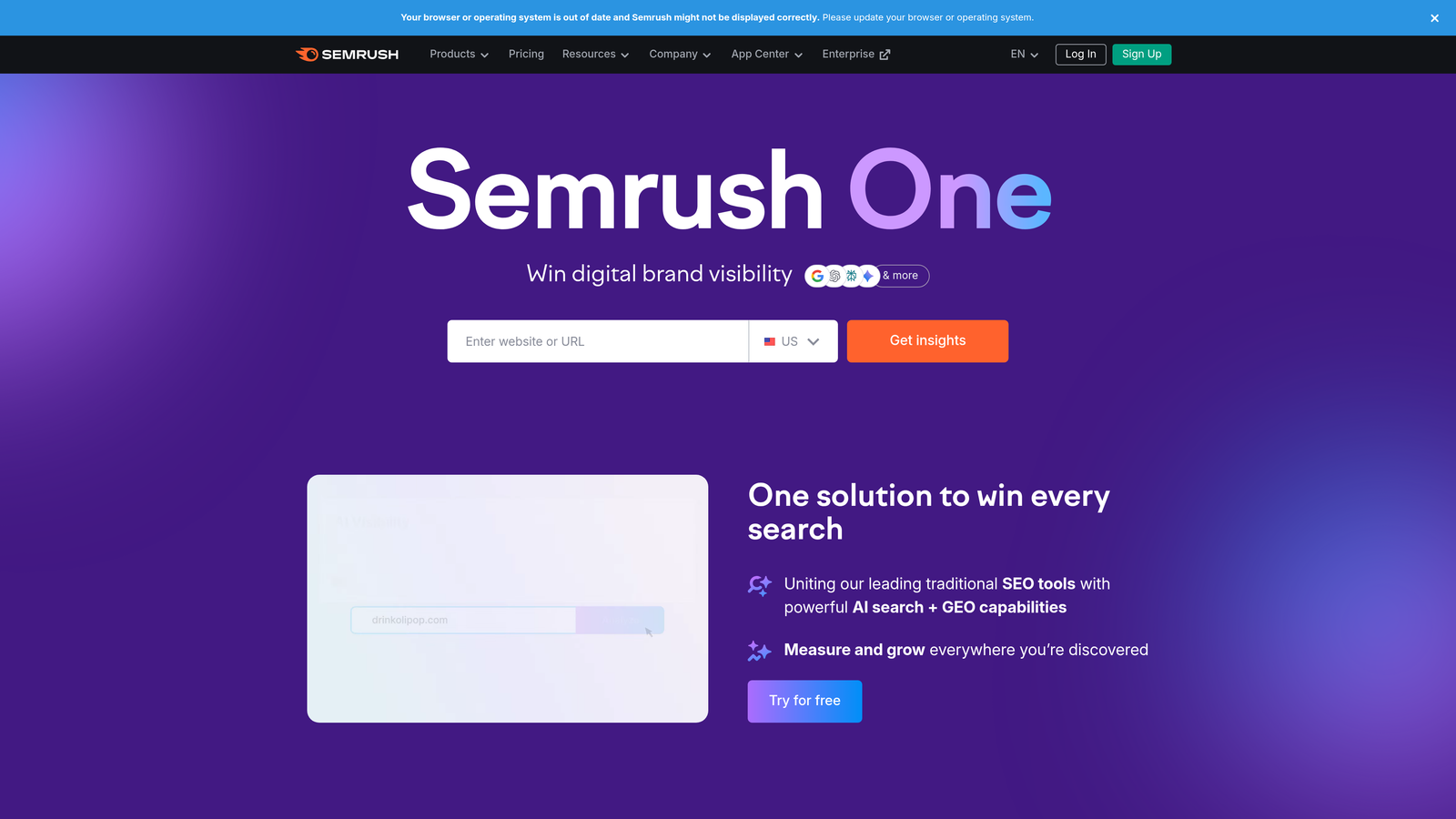
Semrush Content Marketing Platform is an integrated content marketing toolkit within the broader Semrush SEO suite, offering end-to-end content workflow capabilities.
Where This Tool Shines
Semrush's content platform benefits from deep integration with its broader SEO toolkit. You're not jumping between separate tools for keyword research, content creation, and performance tracking—everything lives in one ecosystem that also spans PPC and social. This unified approach reduces friction in enterprise workflows where context-switching slows down production.
The SEO Writing Assistant provides real-time optimization that draws from Semrush's massive keyword database. When you're writing about a topic, the tool suggests related terms and questions based on actual search data, not just algorithmic guesses. For enterprises and agencies running multiple brands or regional sites, multi-domain management, multi-location rank tracking, and white-label reporting consolidate work that would otherwise require several tools.
Key Features
Topic Research: Content ideation based on search volume, difficulty, and competitive analysis.
SEO Writing Assistant: Real-time optimization suggestions integrated with Google Docs and WordPress.
Brand Monitoring: Track mentions and content performance across the web.
Content Audit: Performance analytics for existing content with optimization recommendations.
Marketing Calendar: Content planning and scheduling across teams and channels.
Enterprise API Access: Pipes Semrush data into custom dashboards, CRMs, or BI tools.
Best For
Enterprises already invested in the Semrush ecosystem who want to consolidate content operations within their existing platform. Ideal for organizations prioritizing tool consolidation over best-of-breed point solutions.
Pricing
Business plan at $499.95/month; Enterprise custom pricing for larger organizations.
7. BrightEdge
Best for: Fortune 500 companies requiring enterprise-grade SEO intelligence at massive scale
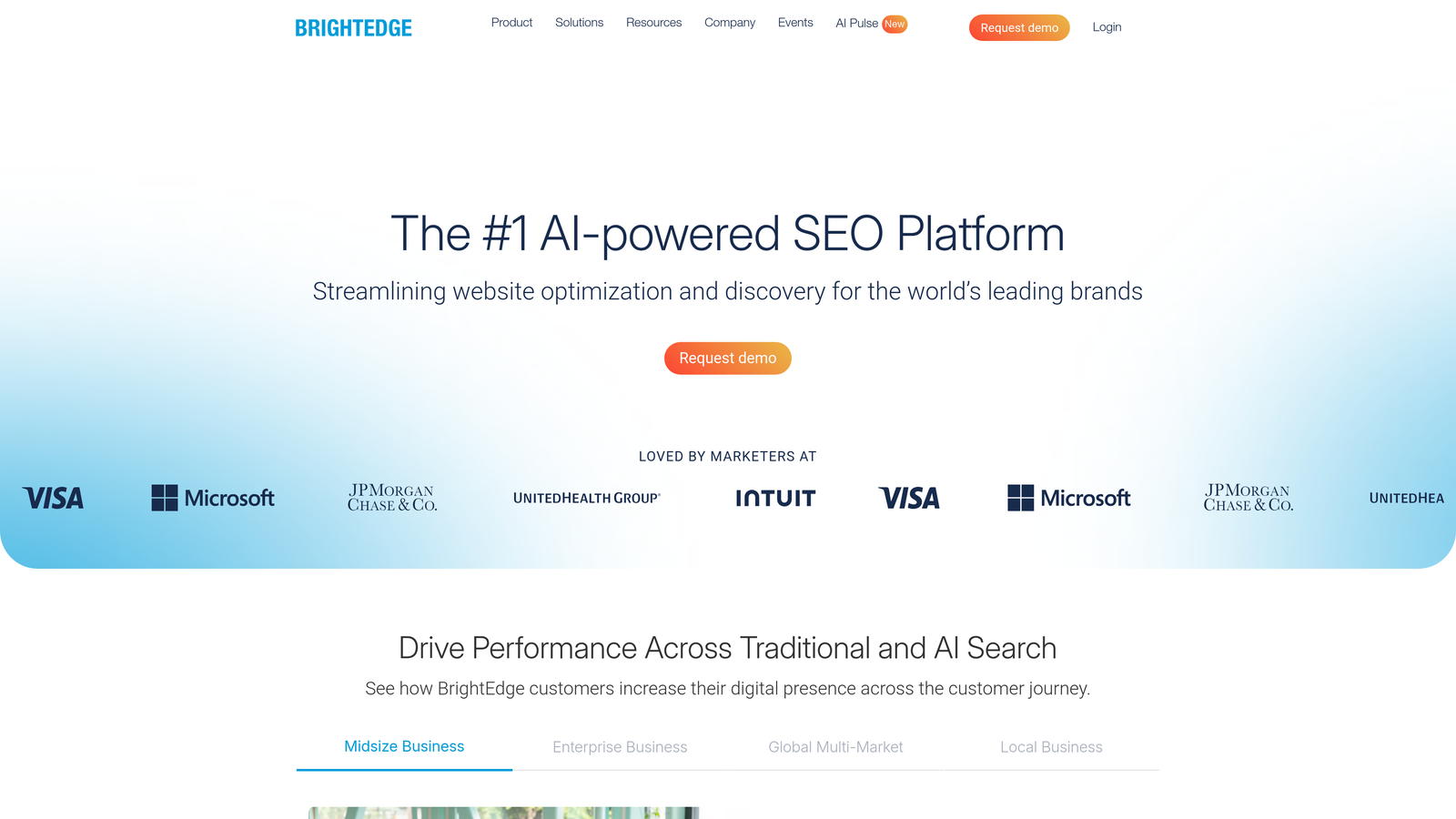
BrightEdge is an enterprise SEO platform with AI-powered recommendations designed for Fortune 500 companies and large-scale content operations.
Where This Tool Shines
BrightEdge operates at a scale few competitors can match. The platform handles enterprise complexity that would overwhelm simpler tools—thousands of pages, hundreds of markets, multiple brands under one corporate umbrella. This makes it the go-to choice for organizations where "enterprise" means truly massive operations.
DataMind AI automates insights that would require a team of analysts to produce manually. Rather than only reporting that a page underperforms, it predicts which content changes are likely to improve it, prioritized by business impact. Deep Adobe and Salesforce integrations push SEO data into the same dashboards executives use for other channels, making organic search a first-class line item in performance reviews.
Key Features
DataMind AI: Automated, predictive SEO insights and prioritized recommendations based on business impact.
ContentIQ: Technical content audits identifying issues at scale across massive site architectures.
StoryBuilder: Executive-level reporting that ties SEO performance to business outcomes and revenue.
Share of Voice Tracking: Competitive visibility analysis across keywords and topics.
Hyperlocal SEO: Multi-location optimization for enterprises with distributed physical presence.
Analytics Integration: Native connections to Adobe Analytics, Adobe Experience Cloud, Salesforce Marketing Cloud, and Google Analytics 4.
Best For
Fortune 500 companies and global enterprises managing multiple brands, markets, or product lines. Particularly valuable for organizations with complex technical requirements, regulatory compliance needs, or existing investment in Adobe or Salesforce.
Pricing
Custom enterprise pricing based on scale, domains, and integration requirements; typically requires an annual contract.
8. Contently
Best for: Managing freelance content operations and enforcing brand consistency at scale
Contently is an enterprise content operations platform combining content strategy, creation, and performance measurement with freelancer network management.
Where This Tool Shines
Contently solves a problem many enterprises face: scaling content production without sacrificing quality. The platform provides access to a vetted network of freelance writers while maintaining the workflow controls and brand governance large organizations require. Think of it as an in-house content team that scales on demand.
The brand voice enforcement features ensure consistency across hundreds of freelancers. Style guides become actionable rather than PDF documents writers ignore. The platform checks content against your brand standards before it reaches editors, reducing revision cycles and maintaining quality at scale.
Key Features
Talent Network: Access to vetted freelance writers across industries and content types.
Workflow Automation: Assignment management, approvals, and revision tracking for distributed teams.
Performance Analytics: Engagement metrics and ROI tracking for content investments.
Brand Voice Enforcement: Automated style guide checking and consistency monitoring.
Editorial Calendar: Content planning and scheduling across teams and channels.
Best For
Enterprises producing high volumes of content who need to scale production through freelancers while maintaining brand consistency. Particularly valuable for organizations in regulated industries requiring strict content governance.
Pricing
Custom enterprise pricing based on content volume and talent network access.
9. Frase
Best for: AI-assisted content creation with automated SERP research
Frase is an AI-powered content research and writing platform that generates SERP-based briefs and assists with content creation.
Where This Tool Shines
Frase accelerates the research phase that typically bogs down content production. Instead of manually analyzing top-ranking pages, the platform generates comprehensive briefs automatically by extracting key topics, questions, and structure from SERP results. This reduces research time from hours to minutes.
The AI writing assistant helps teams overcome blank page syndrome. While it won't replace skilled writers, it generates solid first drafts that writers can refine rather than starting from scratch. For enterprises producing hundreds of articles monthly, this efficiency gain compounds significantly.
Key Features
Automated Brief Generation: SERP analysis transformed into structured content outlines.
AI Writing Assistant: Draft creation based on brief parameters and optimization requirements.
Content Optimization Scoring: Real-time grading as you write and refine content.
Question Research: Extraction of People Also Ask questions and related queries.
Team Collaboration: Shared documents and workflow management for distributed teams.
Best For
Content teams prioritizing production speed and research automation. Works well for organizations creating high volumes of informational content where AI assistance can accelerate initial drafting.
Pricing
Team plan at $114.99/month; Enterprise custom pricing for larger operations.
Other Enterprise SEO Suites Worth Considering
The nine platforms above center on content. Many enterprise SEO stacks also include a dedicated backlink or technical SEO suite alongside them. Three are worth shortlisting if those are your bottlenecks.
Ahrefs Enterprise
Ahrefs is built on one of the largest backlink indexes in the industry, crawling billions of pages daily so new linking opportunities surface within days. Content Explorer turns that link data into strategy, showing which topics and formats earn the most links in your niche. Enterprise plans remove rank tracking limits and include high-limit API access and scheduled site audits. Best for publishers, large e-commerce sites, and agencies running link-building at scale; enterprise plans start at around $999/month.
seoClarity
Where most enterprise SEO software prices by tracked keywords, seoClarity offers unlimited rank tracking, so large sites can monitor every relevant term without overage fees. Clarity Grid AI surfaces optimization opportunities across entire site sections at once rather than page by page, and role-specific custom dashboards keep stakeholders focused on their own metrics. Enterprise plans typically start around $3,000/month.
Botify
Botify focuses on technical foundations for sites with millions of pages or heavy JavaScript. Enterprise-scale log file analysis shows how search engines actually crawl your site, exposing crawl budget wasted on low-value URLs, while SpeedWorkers and PageWorkers handle rendering so dynamic content gets indexed. Pricing is custom, based on pages crawled, and usually requires an annual commitment.
Choosing the Right Platform for Your Enterprise
The best enterprise SEO content software depends on your specific operational bottleneck. For organizations prioritizing AI search visibility alongside traditional SEO, Sight AI offers a forward-looking approach that tracks how AI models discuss your brand while generating optimized content. This becomes increasingly critical as generative AI search reshapes content discovery.
If comprehensive SEO intelligence is your primary need, Conductor and BrightEdge deliver depth of competitive analysis and cross-team collaboration capabilities. These platforms excel at breaking down organizational silos and providing unified visibility across complex content operations. For backlink-driven competitive research, Ahrefs or Semrush go deepest; for technical complexity on very large sites, Botify and seoClarity lead.
Teams focused on content quality optimization should consider Clearscope and MarketMuse for their AI-powered grading systems and strategic planning capabilities. Both platforms help enterprises move beyond ad-hoc content creation toward data-driven portfolio management.
For organizations needing end-to-end content operations including freelancer management, Contently provides robust workflow capabilities with built-in talent networks. This becomes valuable when internal teams can't keep pace with content demands.
In practice, most enterprises run two or three tools from this list—typically a core SEO suite, a content optimization layer, and an AI visibility tracker—because no single platform solves every challenge equally well. Choose the anchor platform for your biggest bottleneck, then fill gaps deliberately rather than buying overlapping suites.
The enterprise software landscape continues evolving rapidly. Traditional SERP rankings now compete with AI-generated responses that may or may not mention specific brands. Organizations that track only traditional metrics miss critical visibility opportunities in AI search.
Start tracking your AI visibility today and see exactly where your brand appears across top AI platforms. Understanding how ChatGPT, Claude, and Perplexity discuss your organization provides competitive intelligence that traditional SEO tools can't capture. As AI search becomes a primary discovery channel, this visibility transforms from nice-to-have to strategic necessity.
How to Choose Enterprise Software for SEO: A Buyer's Framework
Selecting enterprise software for SEO is fundamentally different from choosing a tool for a small team. The stakes are higher, the decision involves more stakeholders, and the cost of a poor fit—both financially and operationally—is significant. Use this framework to guide your evaluation.
1. Define Your Primary SEO Bottleneck
Enterprise SEO pain points cluster into five categories. Identify which describes your organization most accurately before evaluating vendors:
- Content production at scale: You need to create and optimize hundreds or thousands of pages efficiently. Prioritize platforms with AI content generation, automated brief creation, and CMS publishing integrations—like Sight AI or Frase.
- Visibility and intelligence: You need comprehensive ranking data, competitive analysis, and share-of-voice tracking across a large domain. Prioritize BrightEdge or Conductor.
- Quality and optimization: Your content exists but underperforms. You need systematic optimization guidance for existing pages. Prioritize Clearscope or MarketMuse.
- Technical scale: Millions of URLs, JavaScript rendering, or crawl budget problems. Prioritize Botify or seoClarity.
- AI search visibility: Your brand needs to appear in AI-generated responses from ChatGPT, Claude, and Perplexity—not just traditional SERPs. This emerging bottleneck requires platforms like Sight AI that track and optimize for generative engine results.
2. Evaluate Integration Depth
Enterprise SEO software doesn't operate in isolation. Your chosen platform must connect with existing infrastructure: Adobe Experience Manager or Drupal for CMS, Adobe Analytics or GA4 for measurement, Salesforce or HubSpot for revenue attribution. Assess not just whether integrations exist, but how deep they go. Native integrations that push data bidirectionally are worth significantly more than one-way exports, and API rate limits matter if you plan to feed SEO data into internal BI tools.
3. Assess Governance and Permissions
Large organizations have distributed teams—SEO specialists, content writers, brand managers, legal reviewers—each needing different levels of access. Your enterprise SEO software should support role-based permissions that match your org structure. Conductor and BrightEdge lead here with granular access controls designed specifically for complex organizational hierarchies. Agencies managing enterprise clients should also check for white-label reporting and multi-domain workspaces.
4. Demand a Proof-of-Concept Period
Enterprise software contracts are rarely cheap or easy to exit. Before signing, negotiate a structured proof-of-concept (POC) period—typically 30–90 days—against defined success criteria. Run the platform against a real project: a content audit, a keyword analysis, or a content generation sprint. Measure outputs against your baseline metrics, not vendor promises.
5. Factor in Total Cost of Ownership
Published pricing rarely reflects true cost. Factor in implementation fees, training and onboarding time, API usage overages, keyword-tracking caps, annual commitment terms, and the internal headcount required to manage the platform. Some enterprise SEO tools require dedicated administrators; others are genuinely self-service. Platforms with strong automation—like Sight AI's Autopilot Mode for content generation—reduce ongoing operational overhead and lower effective total cost.
6. Plan for AI Search's Growing Role
Traditional enterprise SEO software was built for Google's ten blue links. That world is changing. As AI-generated answers increasingly intercept search intent before users reach organic results, enterprise software for SEO must now address both SERP rankings and AI model visibility. Platforms that track how ChatGPT, Claude, and Perplexity represent your brand are transitioning from optional to essential for enterprise content strategies.