Picture this: A potential customer asks ChatGPT to recommend the best marketing automation platform for their startup. The AI responds with five detailed suggestions—and your brand isn't one of them. You just lost a sale to a competitor, and you didn't even know the conversation happened.
This scenario plays out thousands of times daily across ChatGPT, Claude, Perplexity, and other large language models. Unlike traditional search where you can track rankings and impressions, LLM recommendations happen in a black box. You can't see the queries. You can't monitor your position. And you definitely can't optimize what you can't measure.
Until now.
This guide walks you through building a complete brand tracking system across major LLMs. You'll learn which platforms matter most for your industry, how to structure queries that mirror real customer questions, and how to turn visibility data into content that gets your brand mentioned. By the end, you'll have a systematic approach to understanding—and improving—how AI models talk about your brand.
The shift is already happening. Your potential customers are asking AI for recommendations instead of scrolling through search results. The brands that win are the ones tracking their visibility and optimizing for it.
Let's build your tracking system.
Step 1: Identify Which LLMs Matter for Your Industry
Not all LLMs carry equal weight for your brand. Your first step is mapping which platforms actually influence your target audience's buying decisions.
Start with the major players: ChatGPT dominates consumer usage, Claude attracts technical and professional users, Perplexity focuses on research-oriented queries, Google Gemini integrates with the broader Google ecosystem, Microsoft Copilot serves enterprise users, and Meta AI reaches social media audiences. Each platform has distinct user demographics and use cases.
But here's the thing—you need to go beyond market share statistics. The question isn't which LLM is most popular overall. It's which platforms your specific audience uses when they're looking for solutions like yours.
Research your audience's AI habits. Survey existing customers about which AI tools they use. Monitor industry forums and communities to see which platforms people mention when discussing product research. Check your competitor mentions across different LLMs to identify where conversations about your category are happening.
B2B and B2C brands see different patterns. Enterprise software buyers often lean toward Claude and Copilot for their professional contexts. E-commerce shoppers might default to ChatGPT or Perplexity for product comparisons. SaaS tools targeting developers see heavy usage on Claude due to its technical capabilities. Understanding brand tracking across AI platforms helps you prioritize where to focus your monitoring efforts.
Think of it like choosing which social media platforms to focus on—you wouldn't invest equally in every platform. You'd prioritize based on where your audience actually spends time.
Create a prioritized list of three to six LLMs to monitor. Rank them by relevance to your industry, audience overlap, and the types of queries they handle well. This focused approach ensures you're tracking where it matters rather than spreading resources thin across every available platform.
Success indicator: You have a documented list of priority LLMs with clear reasoning for why each platform matters to your brand's visibility strategy.
Step 2: Define Your Brand Tracking Parameters
Effective tracking starts with knowing exactly what to look for. You need a comprehensive list of every way your brand might appear in LLM responses.
Begin with your core brand name, but don't stop there. Document every variation: official company name, shortened versions, common misspellings, product names, service names, and any abbreviations your industry uses. If you're "TechFlow Solutions" but customers call you "TechFlow," both variations need tracking.
Here's what many marketers miss: LLMs don't always use your preferred brand name. They might reference your product name instead of your company name, or use an industry abbreviation you didn't expect. Cast a wide net initially—you can narrow down later based on what actually appears.
Next, identify your key competitors. You're not tracking them to obsess over rankings—you're creating benchmarks. When an LLM mentions three competitors but not you, that's a content gap. When you appear alongside premium competitors, that's validation of your positioning. Effective brand tracking for competitive analysis reveals exactly where you stand in your category.
List five to ten direct competitors whose visibility you'll monitor. Include both established leaders and emerging alternatives in your space. This competitive context reveals where you stand in the AI-powered conversation about your category.
Now define your category terms and use cases. These are the queries where you want to appear even when someone doesn't know your brand name yet. For a project management tool, this might include "best project management software for remote teams," "Asana alternatives," or "how to track team productivity."
Think about the problems you solve, not just what you sell. Customers ask LLMs about their challenges before they ask about specific solutions. If you solve email deliverability issues, track queries about "improving email open rates" and "avoiding spam filters," not just "email marketing platforms."
Organize your tracking parameters into three tiers. Tier one: your exact brand and product names. Tier two: category terms and use cases where you're a strong fit. Tier three: adjacent topics where you could provide value. This hierarchy helps you prioritize monitoring efforts and content creation.
Success indicator: A comprehensive tracking document covering your brand variations, competitor list, and 15-20 category terms representing how customers discover solutions in your space.
Step 3: Build Your Query Library for Consistent Monitoring
Random queries produce random insights. You need a standardized query library that mirrors how real customers actually ask AI for recommendations.
Start by collecting authentic customer questions. Review support tickets, sales call transcripts, and community forum discussions. Pay attention to the exact phrasing people use when they're exploring solutions. "What's the best CRM for a five-person startup?" is more valuable than "CRM software" because it reflects real search intent.
Structure your queries across the buyer journey. Awareness-stage queries focus on problems: "How do I improve team collaboration?" Consideration-stage queries explore options: "What are the top project management tools for agencies?" Decision-stage queries compare specific solutions: "Asana vs Monday.com for marketing teams."
Each stage reveals different visibility opportunities. If you only appear in decision-stage comparisons, you're missing customers earlier in their journey. If you show up for problem-focused queries, you're building awareness before competitors enter the conversation. A solid prompt tracking for brands guide can help you structure these queries effectively.
Include comparison queries explicitly. LLMs love these, and they're incredibly valuable for tracking. "Best alternatives to [Competitor]" queries show whether you're positioned as a viable option. "Tools like [Your Brand]" queries reveal if you're becoming a category reference point.
Don't forget "best of" formats. These are LLM favorites: "best email marketing tools for small businesses," "top 10 accounting software for freelancers," "most affordable CRM options." Track the specific variations relevant to your positioning—if you're the affordable option, monitor budget-focused queries.
Create problem-solution query pairs. For every feature you offer, write a query about the problem it solves. If you offer automated reporting, track "how to create marketing reports faster" alongside "marketing analytics tools." This reveals whether you're visible for the pain points you address.
Aim for 15-25 queries that represent your category comprehensively. Too few and you miss important visibility patterns. Too many and tracking becomes unwieldy. The sweet spot captures awareness, consideration, and decision queries across your key use cases.
Document everything in a shared spreadsheet. Include the exact query text, which buyer journey stage it represents, why it matters to your business, and expected tracking frequency. This documentation ensures consistency—critical when you're comparing results over time.
Test your queries across your priority LLMs before finalizing. Some queries work better on certain platforms. Perplexity handles research-oriented questions differently than ChatGPT handles conversational queries. Adjust phrasing if needed to ensure queries feel natural on each platform.
Success indicator: A documented query library of 15-25 standardized prompts covering awareness, consideration, and decision stages, with clear documentation of why each query matters.
Step 4: Establish Your Baseline Visibility Score
You can't improve what you don't measure. Before you start optimizing, you need to know where you stand right now.
Run your complete query library across all priority LLMs. This is your baseline audit—the snapshot that shows your current visibility before any optimization efforts. Execute each query exactly as documented, and record the results systematically.
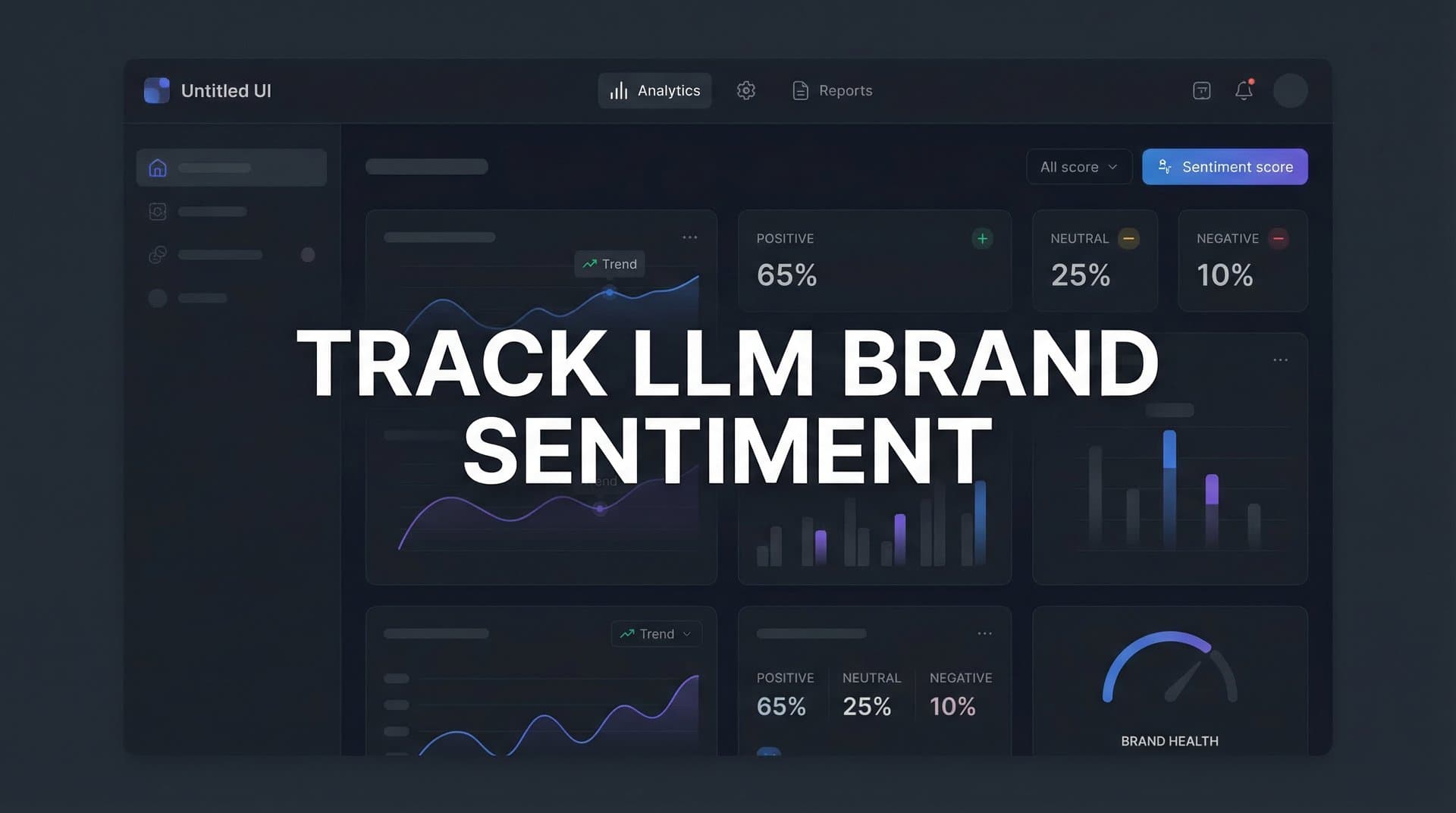
For each query response, track four key metrics. First, mention frequency: Does your brand appear at all? Second, position: Are you first, third, or buried at the bottom? Third, sentiment: Is the mention positive, neutral, or cautionary? Fourth, context: Are you positioned as a leader, an alternative, or a budget option? Understanding brand sentiment tracking in LLMs helps you interpret these nuances accurately.
Here's what this looks like in practice. You ask ChatGPT for "best email marketing platforms for e-commerce." The response lists five tools. Your brand appears third with a positive description highlighting your automation features. That's a mention, mid-position, positive sentiment, and positioned as a strong contender. Document all of it.
Calculate your visibility percentage for each platform. If your brand appears in 12 out of 20 queries on ChatGPT, that's 60% visibility. Do this for each LLM you're tracking. These percentages become your baseline scores—the numbers you'll work to improve.
Track competitor visibility alongside yours. When you run "best project management tools," note which competitors appear and how they're described. This competitive context reveals opportunities. If a competitor appears in every response while you appear in none, that's a clear signal about content gaps.
Pay special attention to the queries where you don't appear. These absences are more valuable than the mentions. They show exactly where you need to focus content creation. If you're invisible in awareness-stage queries but present in decision-stage comparisons, you need more educational content about the problems you solve.
Notice patterns in how you're described when you do appear. Do LLMs consistently mention the same features? Do they position you similarly across platforms? This reveals how AI models have learned to categorize your brand based on available training data and web content.
Create a baseline report that summarizes everything. Include overall visibility percentages per platform, mention patterns across buyer journey stages, competitive positioning insights, and priority gaps to address. This document becomes your roadmap for improvement.
Success indicator: A comprehensive baseline report showing current visibility scores across all tracked LLMs, with documented mention patterns, competitive context, and identified content gaps.
Step 5: Set Up Automated Monitoring and Alerts
Manual tracking works for establishing your baseline, but ongoing monitoring requires automation. You need a system that runs consistently without eating up your entire week.
Decide on your tracking frequency first. Weekly monitoring works for most brands—it catches trends without overwhelming you with data. Daily tracking makes sense if you're in a fast-moving market or running active campaigns that should impact visibility. Monthly tracking is too slow—you'll miss important shifts and lose the ability to connect changes to specific actions.
If you're tracking manually, create a structured schedule. Assign specific queries to specific days. Monday might be awareness-stage queries, Wednesday could be decision-stage comparisons, Friday covers competitor tracking. Consistency matters more than perfection—running the same queries on the same schedule reveals trends.
The reality is that manual tracking becomes unsustainable quickly. Running 20 queries across five LLMs weekly means 100 individual checks. Each check requires opening the platform, entering the query, reviewing the response, and documenting results. That's hours of repetitive work every week.
This is where automated AI visibility platforms become valuable. Exploring AI brand tracking tools comparison helps you identify solutions that run your query library across multiple LLMs simultaneously, track mentions automatically, calculate visibility scores, and alert you to significant changes. What takes hours manually happens in minutes with automation.
Configure alerts for changes that actually matter. You don't need notifications every time a response varies slightly—LLMs generate different responses naturally. Set alerts for meaningful shifts: new mentions where you were previously invisible, lost visibility on high-priority queries, significant sentiment changes, or competitor mentions in contexts where you should appear.
Integrate tracking data with your existing marketing dashboard. Visibility metrics should sit alongside traffic, conversions, and other performance indicators. This integration helps you connect AI visibility changes to business outcomes. When visibility increases and organic traffic follows, you've validated the connection.
Build a data retention strategy. Store historical tracking data so you can analyze trends over time. Month-over-month comparisons reveal whether your optimization efforts are working. Quarter-over-quarter trends show seasonal patterns or longer-term shifts in how LLMs discuss your category.
Test your monitoring system thoroughly before relying on it. Run a full cycle manually alongside your automated system to verify accuracy. Check that alerts trigger appropriately. Ensure data flows into your dashboard correctly. A monitoring system you don't trust is worse than no system at all.
Success indicator: A functioning monitoring system—manual or automated—that tracks your query library consistently, alerts you to significant changes, and integrates with your marketing reporting.
Step 6: Analyze Results and Identify Content Opportunities
Tracking data is worthless without analysis. This step transforms visibility metrics into actionable content strategy.
Start with the gaps—queries where you're completely absent. These represent your highest-value opportunities. When an LLM recommends five competitors but never mentions you, there's a content problem. Either you lack authoritative content on that topic, or your existing content isn't optimized for AI visibility.
Analyze the context of your mentions carefully. Are you positioned as a category leader or just another alternative? Do LLMs highlight your unique strengths or describe you generically? The way AI models talk about you reflects the content ecosystem around your brand. Monitoring AI model brand perception tracking reveals these positioning nuances.
Let's say you appear in responses about "affordable CRM software" but never in "best CRM for enterprise teams." That's not random—it reflects how your content, reviews, and third-party mentions position you. If you want enterprise visibility, you need content that demonstrates enterprise capabilities.
Cross-reference visibility data with your content inventory. For each gap, ask whether you have comprehensive content on that topic. If you're invisible for "how to improve email deliverability" but that's a core feature, you likely need better educational content explaining how you solve that problem.
Look for partial visibility opportunities. These are queries where you appear sometimes but not consistently, or where you're mentioned but positioned poorly. These situations are easier to improve than complete invisibility—you have some foundation to build on.
Identify competitor content advantages. When competitors appear consistently where you don't, investigate their content strategy. What topics do they cover that you ignore? How do they structure their content? What external sources cite them as authorities? You're not copying—you're identifying content gaps in your own strategy.
Prioritize content creation based on business impact. Not all visibility gaps matter equally. Focus on queries that represent high-intent buyers, align with your product strengths, and target audiences you're actively pursuing. A gap in awareness-stage queries might matter more than decision-stage visibility if you're building brand recognition.
Create a content roadmap that addresses your top visibility gaps. For each priority gap, define the content type needed: comprehensive guide, comparison article, case study, or problem-focused explainer. Map content to specific queries you're tracking so you can measure impact after publishing.
Success indicator: An actionable content roadmap prioritizing topics based on visibility gaps, business value, and your ability to create authoritative content that improves AI visibility.
Step 7: Create a Feedback Loop for Continuous Improvement
Brand tracking across LLMs isn't a one-time project—it's an ongoing practice. The final step is building a sustainable feedback loop that keeps improving your visibility over time.
Schedule monthly visibility reviews as a standing meeting. Bring together stakeholders from content, product marketing, and SEO teams. Review visibility changes, discuss what's working, and adjust strategy based on data. These regular check-ins prevent tracking from becoming a forgotten dashboard no one acts on.
Connect content publishing directly to visibility measurement. When you publish a comprehensive guide addressing a visibility gap, track whether it moves the needle. Did mentions increase? Did positioning improve? Did you start appearing in related queries? This connection validates your content strategy and helps you double down on what works.
Here's the pattern that successful brands follow: identify gap, create content, measure impact, refine approach. If a detailed comparison article improved visibility for decision-stage queries, create more comparison content. If thought leadership pieces didn't change awareness-stage mentions, try different formats or topics. Implementing real-time brand monitoring across LLMs accelerates this feedback cycle.
Adjust your query library as markets evolve. New use cases emerge, customer language shifts, and competitive landscapes change. Quarterly, review whether your queries still represent how customers discover solutions. Add new queries that reflect emerging trends. Retire queries that no longer align with your business priorities.
Share visibility reports beyond the marketing team. Product teams benefit from understanding how AI positions your features. Sales teams need to know which use cases generate the strongest AI recommendations. Customer success can identify gaps between how you're described and actual product capabilities.
Document what you learn in a shared knowledge base. When you discover that case study content improves visibility more than feature lists, write it down. When you find that certain query formats work better on Claude than ChatGPT, document it. Institutional knowledge prevents you from relearning the same lessons.
Build experimentation into your process. Test different content approaches, track results, and iterate. Try publishing content optimized specifically for AI visibility and measure whether it performs differently than traditional SEO content. Experiment with different content depths, formats, and structures.
Set visibility goals that align with business objectives. If you're launching a new product, set a goal for visibility in relevant category queries within 90 days. If you're expanding into a new market segment, track visibility improvements for that audience specifically. Goals create accountability and focus optimization efforts.
Success indicator: A documented review process with monthly visibility analysis, clear connections between content and visibility changes, and a culture of continuous optimization based on tracking data.
Putting It All Together
You now have a complete system for tracking your brand across LLMs—from identifying priority platforms to building a feedback loop that drives continuous improvement.
The brands winning in AI-powered search aren't guessing. They're tracking systematically, measuring visibility, identifying gaps, and creating content that gets them mentioned. They know which LLMs matter for their audience, they monitor the queries that represent real buyer intent, and they optimize based on data rather than assumptions.
Start with your baseline. Identify your priority LLMs, build your query library, and document where you stand today. That baseline becomes your benchmark for measuring every optimization effort going forward.
Then set up consistent monitoring. Whether manual or automated, you need a system that tracks visibility without consuming all your time. The insights come from trends over time, not individual data points.
Finally, close the loop between tracking and action. Use visibility gaps to guide content creation, measure the impact of your efforts, and refine your approach based on what actually works. This feedback loop is what separates brands that track from brands that improve.
Here's your quick-start checklist to ensure nothing falls through the cracks: Priority LLMs identified and documented, brand tracking parameters defined including variations and competitors, query library built with 15-25 standardized prompts, baseline visibility report completed across all platforms, monitoring system configured with appropriate alerts, content opportunities mapped and prioritized, monthly review schedule established and calendared.
The shift to AI-powered discovery is happening now. Every day you're not tracking is another day of invisible conversations about your category where your brand doesn't appear. Start tracking your AI visibility today and see exactly where your brand appears across top AI platforms.
Your competitors are already there. The question is whether you'll track your visibility systematically or keep guessing while they optimize.