Search is dead. Well, not dead exactly, but fundamentally transformed. Right now, millions of professionals are skipping Google entirely and asking ChatGPT, "What's the best project management tool for remote teams?" or turning to Claude for "Which CRM should a startup use?" These aren't casual queries. They're high-intent questions asked at the exact moment someone is ready to evaluate solutions.
Here's the uncomfortable reality: you have absolutely no idea what these AI assistants are saying about your brand.
While you've spent years optimizing for Google's first page, a parallel recommendation engine has emerged. AI models have become trusted advisors, and they're influencing purchasing decisions in ways that never show up in your Google Analytics. When someone asks Perplexity for SaaS recommendations in your category, does your brand get mentioned? When ChatGPT suggests solutions to your prospect's exact problem, are you in that conversation?
This is where an AI visibility monitoring system enters the picture. It's not just another analytics dashboard. It's your window into the black box of AI recommendations—a systematic way to track when, how, and why AI models mention your brand across conversational queries. For marketers and founders navigating 2026's landscape, understanding this technology isn't optional anymore. It's the difference between being part of the conversation and being completely invisible to an entire channel of discovery.
The New Discovery Layer: Why AI Recommendations Matter for Your Brand
Think about the last time you needed a recommendation for software, a service, or a solution to a business problem. Did you scroll through ten blue links on Google, or did you ask an AI assistant to explain your options?
AI models like ChatGPT, Claude, and Perplexity have evolved beyond simple question-answering tools. They've become trusted recommendation engines that people consult during the research phase of buying decisions. The shift is profound because these interactions happen in natural language, feel conversational, and deliver synthesized answers rather than lists of links to evaluate.
Traditional SEO visibility meant ranking on search engine results pages. You optimized content, built backlinks, and fought for position one because that's where the clicks lived. But AI visibility operates on entirely different mechanics. It's not about ranking first in a list; it's about being mentioned at all in a conversational response. When an AI model answers "What are the best email marketing platforms?" it might mention three brands, or seven, or none that match your category.
The business impact of these mentions is significant. Brands that appear in AI recommendations gain immediate trust signals. The AI assistant has effectively vouched for them by including them in its response. This happens at the precise moment of intent, when the user is actively seeking solutions. Unlike a banner ad or a cold email, this recommendation arrives when someone has explicitly asked for it.
What makes this particularly powerful is the nature of the interaction. Users often have follow-up questions: "Tell me more about that first option" or "How does it compare to this other tool?" The conversation continues, and brands mentioned early in the dialogue maintain presence throughout the decision-making process. Companies invisible in that initial response never get the chance to be part of the conversation.
Many businesses are capturing significant demand through this channel without even knowing it exists. Others are losing opportunities they can't measure because traditional analytics don't track AI-assisted discovery. The question isn't whether AI recommendations matter for your brand. It's whether you're willing to compete in a discovery channel you can't currently see.
Core Components of an AI Visibility Monitoring System
An AI visibility monitoring system does something deceptively simple: it asks AI models questions about your industry and tracks whether your brand gets mentioned in the answers. But underneath that simplicity lies sophisticated technology designed to solve a genuinely novel problem.
The first essential function is prompt tracking. These systems maintain libraries of relevant queries—questions your potential customers actually ask AI assistants. For a CRM company, that might include "best CRM for small businesses," "alternatives to Salesforce," or "how to choose customer management software." The system doesn't just track one or two queries. It monitors dozens or hundreds of variations because AI responses can vary significantly based on how questions are phrased.
Mention detection is where natural language processing enters the picture. When an AI model generates a response, the monitoring system needs to parse that conversational text and identify whether your brand appears. This isn't as straightforward as searching for exact name matches. AI models might reference your product with variations, abbreviations, or contextual descriptions. Advanced systems recognize these patterns and accurately capture mentions even when phrasing varies.
Sentiment analysis adds critical nuance to raw mention data. Being mentioned isn't always positive. An AI model might cite your brand as an example of what to avoid, or mention it neutrally alongside competitors without endorsement. Sentiment analysis categorizes each mention as positive, negative, or neutral, giving you qualitative context beyond simple frequency counts. This matters because a single negative mention in a high-visibility prompt can damage perception more than several neutral mentions help.
Competitive benchmarking transforms individual data points into strategic intelligence. The system doesn't just tell you when you're mentioned; it shows you when competitors appear instead. If ten different prompts about "marketing automation tools" consistently mention three competitors but never your product, you've identified a visibility gap that directly informs your content strategy. Effective LLM brand visibility monitoring makes this competitive analysis systematic rather than guesswork.
These systems query multiple AI platforms systematically because each model has different training data, different recommendation patterns, and different user bases. ChatGPT might favor certain brands based on its training data. Claude might emphasize different factors in its recommendations. Perplexity, with its real-time web access, might surface more recent entrants. Monitoring across platforms provides complete visibility rather than a partial picture from a single source.
The output of all this monitoring typically manifests as an AI Visibility Score—a quantifiable metric that aggregates mention frequency, sentiment quality, and competitive positioning. This score gives you a single number to track over time, similar to how domain authority functions in traditional SEO. It answers the question: "How visible is our brand in AI-assisted discovery compared to where we were last month or compared to our competitors?"
What makes this different from traditional brand monitoring tools is the focus on recommendation context. You're not tracking social media mentions or news coverage. You're measuring something more specific: whether AI models consider your brand relevant enough to recommend when users ask for solutions in your category.
How AI Visibility Monitoring Actually Works
The technical process behind AI visibility monitoring involves a continuous cycle of querying, parsing, and analysis that runs automatically in the background.
It starts with automated prompt submission. The system maintains a queue of target prompts—questions relevant to your industry and brand. At scheduled intervals, it submits these prompts to various AI platforms through their APIs or interfaces. For platforms without official APIs, systems use browser automation to interact with the AI models just as a human user would.
The key here is systematic coverage. A monitoring system might submit the same prompt multiple times over several days because AI responses aren't deterministic. Ask ChatGPT the same question twice, and you'll often get different answers. This variability means single snapshots aren't reliable. Continuous monitoring captures patterns across many responses, giving you statistically meaningful data about mention frequency.
Once the AI model generates a response, the system performs response parsing. This involves extracting the relevant text, identifying brand mentions, and cataloging the context around those mentions. Advanced systems use natural language processing to understand not just whether you were mentioned, but how you were positioned. Were you listed first among competitors? Were you recommended with qualifications ("good for small teams but not enterprises")? Was your mention part of a positive endorsement or a neutral list?
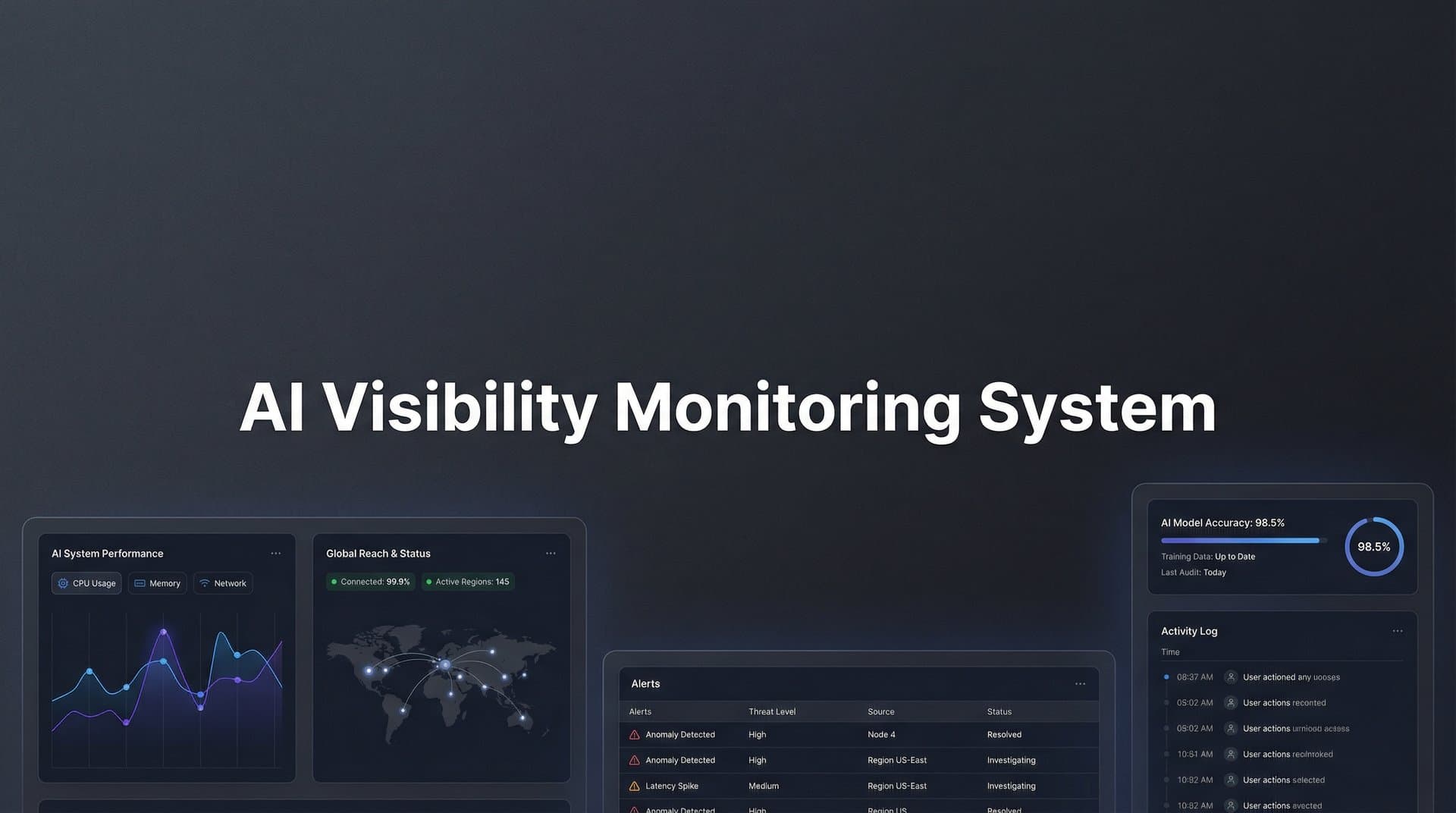
Data aggregation pulls all these individual query results into a unified dashboard. You might have hundreds of prompt submissions across multiple platforms generating thousands of data points weekly. The aggregation layer organizes this into actionable views: mention trends over time, platform-by-platform breakdowns, prompt performance analysis, and competitive comparison charts. A well-designed AI visibility monitoring dashboard makes this complexity manageable.
Multi-platform coverage is critical because AI recommendation behavior varies significantly across models. ChatGPT, trained on data up to a certain cutoff date, might favor established brands with extensive online presence. Claude might weight different factors in its recommendations. Perplexity, with its real-time search integration, can surface very recent content and newer market entrants.
Monitoring across all major platforms—ChatGPT, Claude, Perplexity, Gemini, and others—provides complete visibility into the AI recommendation landscape. You discover not just whether you're mentioned, but where you're strong and where you're invisible. Maybe you dominate ChatGPT mentions but don't appear at all in Perplexity responses. That gap represents a specific optimization opportunity. Multi-platform AI monitoring software addresses exactly this challenge.
The system also tracks which prompts trigger your brand mentions and identifies patterns in AI recommendation behavior. You might discover that prompts phrased as "best [category] for [use case]" consistently mention you, while "alternatives to [competitor]" prompts never do. This pattern recognition reveals exactly what types of content and positioning drive AI visibility.
Some advanced systems even track prompt evolution, monitoring how AI models' recommendations change over time as they're updated or as new training data influences their outputs. This temporal tracking is valuable because it shows whether your visibility is improving, declining, or holding steady as the AI landscape evolves.
Turning Monitoring Data Into Content Strategy
Raw visibility data becomes valuable when you transform it into content decisions. This is where AI visibility monitoring shifts from passive measurement to active strategy.
The most immediate insight comes from visibility gaps. These are prompts where competitors consistently get mentioned but your brand doesn't appear. Each gap represents a specific content opportunity. If "best analytics tools for SaaS companies" mentions three competitors but never your product, you've identified exactly what content to create and how to position it.
The strategic approach looks like this: analyze which competitor gets mentioned for that prompt, study the content they've published around that topic, identify what makes their content AI-citation-worthy, then create superior content that addresses the same query with greater depth, clearer structure, and more authoritative information.
This creates a feedback loop that's remarkably efficient. Monitoring identifies the gap. You create targeted content to fill it. Monitoring then validates whether that content improved your visibility for those specific prompts. Unlike traditional SEO where ranking improvements can take months, AI visibility changes can sometimes be detected within weeks as models access and incorporate new content.
GEO—Generative Engine Optimization—has emerged as the practice of creating content specifically designed to earn AI mentions. While traditional SEO optimizes for search engine crawlers and ranking algorithms, GEO optimizes for how AI models parse, understand, and cite information. Learning how to improve brand visibility in AI requires understanding these distinct optimization principles.
This means structuring content with clear definitions, authoritative statements, and well-organized information hierarchies. AI models favor content that directly answers questions, provides clear comparisons, and uses structured formats that are easy to parse. Lists, tables, and clearly labeled sections perform well because they're machine-readable in ways that narrative prose sometimes isn't.
The content strategy also extends to prompt coverage. Monitoring reveals which question variations drive the most valuable mentions. You might discover that prompts about specific use cases ("project management for creative agencies") generate better visibility than generic category queries ("best project management software"). This insight directly informs your content calendar—you prioritize creating use-case-specific content because that's where AI visibility opportunity exists.
Sentiment tracking influences messaging strategy. If you're getting mentioned but sentiment analysis shows neutral or qualified recommendations, you need content that builds stronger positive associations. Case studies, detailed feature comparisons, and authoritative guides help shift AI models toward more positive framing when they mention your brand.
Competitive intelligence from monitoring also reveals positioning opportunities. If competitors dominate mentions for certain categories, you might identify adjacent categories where visibility is more achievable. Rather than fighting for mentions in "email marketing platforms" where three established players dominate, you might find opportunity in "email marketing for e-commerce" where the field is less crowded.
Implementing Your First AI Visibility Monitoring Workflow
Starting with AI visibility monitoring doesn't require complex infrastructure. The goal is establishing baseline metrics and building systematic tracking before scaling to comprehensive coverage.
Begin by defining your target prompts. Start with 20-30 questions that represent how potential customers actually search for solutions in your category. Include category-defining queries ("best [product type]"), competitive comparison prompts ("alternatives to [major competitor]"), and use-case-specific questions ("how to solve [specific problem]"). Don't guess at these prompts—pull them from actual customer conversations, sales calls, and support tickets.
Next, select competitor benchmarks. Choose three to five direct competitors whose visibility you want to track alongside your own. This comparative context is essential because absolute mention counts mean little without competitive reference points. Being mentioned in 40% of prompts sounds good until you discover competitors appear in 75% of the same queries. Tools for brand mention monitoring across LLMs make this competitive tracking straightforward.
Establish your baseline metrics by running initial monitoring across all target prompts and platforms. This first sweep gives you your starting point: current mention frequency, sentiment distribution, platform-by-platform visibility, and competitive positioning. Document these numbers because they're what you'll measure progress against.
For monitoring frequency, weekly tracking provides sufficient data for most businesses without overwhelming you with noise. AI models don't change their recommendation patterns daily, but weekly monitoring captures meaningful trends while staying manageable. Some high-priority prompts might warrant daily tracking if they're particularly valuable to your business.
Prioritize metrics based on your specific business goals. If you're an established brand fighting for category leadership, mention frequency and competitive share of voice matter most. If you're a newer entrant, focus on sentiment quality and prompt coverage expansion—getting mentioned at all is the first goal before worrying about mention frequency. AI visibility monitoring for startups often requires different priorities than enterprise approaches.
Common implementation challenges usually center on data interpretation. Early monitoring often reveals lower visibility than founders expect, which can be discouraging. Remember that AI visibility is a new channel where most brands are starting from zero. The goal isn't perfection in month one; it's establishing baseline metrics and tracking directional improvement.
Another challenge is response variability. You might see your brand mentioned in a prompt one day and not mentioned the next day for the same query. This is normal AI behavior, not a monitoring error. Focus on trends across multiple queries over time rather than individual response fluctuations.
Set realistic expectations for how quickly visibility changes. Unlike paid advertising where you can see immediate results, AI visibility improvement typically follows a content publication and indexing timeline. Create targeted content, give AI models time to access and incorporate it, then measure visibility changes over weeks rather than days.
The practical workflow looks like this: run weekly monitoring, review new visibility gaps that emerge, prioritize content creation to address the highest-value gaps, publish that optimized content, then monitor whether those specific prompts show improved visibility in subsequent weeks. This cycle becomes your ongoing GEO strategy.
Building Your AI Visibility Foundation
AI visibility monitoring isn't just another analytics tool to add to your marketing stack. It's becoming essential infrastructure for brands competing in a landscape where discovery increasingly happens through conversational AI rather than traditional search.
The insight that matters most is this: you can't optimize for what you can't measure. For years, brands operated blind to how AI models talked about them, recommended them, or ignored them entirely. That blindness is no longer acceptable when millions of high-intent users are making decisions based on AI recommendations.
Establishing baseline visibility metrics is your actionable next step. Before you can improve AI visibility, you need to know where you stand today. Which prompts mention you? Where do competitors dominate? What's your current sentiment profile across platforms? These baseline numbers become the foundation for everything that follows.
Ongoing monitoring then transforms from passive measurement into active strategy. Each week's data reveals new content opportunities, validates what's working, and shows where competitive dynamics are shifting. This feedback loop—monitor, create, measure, refine—becomes the operational rhythm of effective GEO.
The brands that establish this foundation now are building competitive advantages that compound over time. AI models favor authoritative, well-structured content. As you publish more GEO-optimized material and monitor its impact, you create a growing library of content that drives visibility. Meanwhile, competitors who ignore this channel fall further behind in a discovery layer they don't even know exists.
Looking forward, AI recommendations will only become more influential in how buyers discover and evaluate solutions. The models are improving, adoption is accelerating, and the integration of AI assistants into daily workflows continues deepening. This isn't a temporary trend to wait out. It's a fundamental shift in how discovery works.
Stop guessing how AI models like ChatGPT and Claude talk about your brand—get visibility into every mention, track content opportunities, and automate your path to organic traffic growth. Start tracking your AI visibility today and see exactly where your brand appears across top AI platforms.