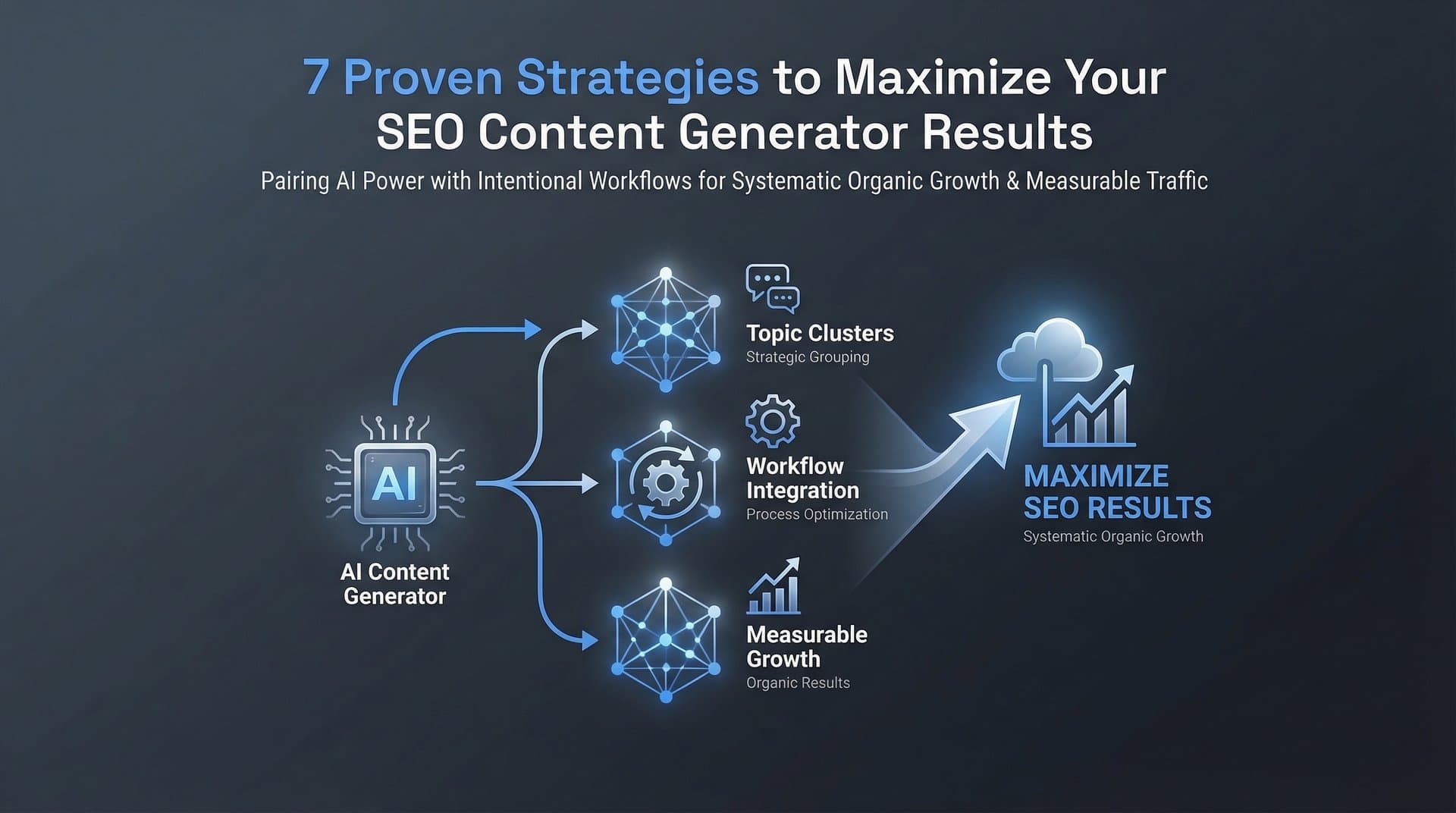
Your content team is drowning in production demands. Marketing leadership wants more articles, deeper coverage, faster turnaround—all while maintaining the quality and search visibility that drives organic traffic. You've explored SEO content generation APIs as the solution, but here's the challenge: simply plugging into an API and hitting "generate" rarely produces content that ranks, converts, or reflects your brand's expertise.
The gap between API capability and actual results comes down to implementation strategy. The most successful organizations treat content generation APIs not as magic content factories, but as sophisticated tools within carefully designed systems. They've built frameworks that transform raw API power into consistently high-performing content that satisfies both search engines and human readers.
The difference between mediocre API results and exceptional outcomes lies in seven strategic implementation approaches. These aren't theoretical concepts—they're battle-tested methods that separate organizations generating forgettable content from those building genuine search authority at scale. Whether you're processing hundreds of articles monthly or just starting to explore API-powered content, these strategies provide the roadmap for maximizing your investment while maintaining the quality standards your audience expects.
1. Architect Your Prompt Engineering Framework
The Challenge It Solves
Raw API calls without structured prompts produce generic, unfocused content that lacks brand voice and misses strategic SEO opportunities. When every content request starts from scratch, you get inconsistent quality, wasted tokens on revisions, and output that requires extensive manual editing. The result? Your API becomes a bottleneck rather than an accelerator.
The Strategy Explained
Think of prompt engineering like building content DNA—templates that encode your brand voice, audience expertise level, structural preferences, and SEO requirements into reusable frameworks. Instead of crafting individual prompts for each article, you create systematic templates that guide the API toward your quality standards automatically. These frameworks include voice guidelines, formatting rules, depth requirements, and keyword integration instructions that remain consistent across all content generation.
The most effective prompt frameworks separate universal brand elements from article-specific variables. Your template might specify tone, structure, and quality standards once, then accept topic, keywords, and audience parameters as inputs. This approach ensures brand consistency while maintaining flexibility for different content types and strategic goals.
Implementation Steps
1. Document your brand voice characteristics with specific examples of preferred and avoided language patterns, then translate these into prompt instructions that guide tone and style.
2. Create template structures for each content type you generate—listicles, how-to guides, comparison articles—with formatting rules, section requirements, and depth specifications built into the prompt framework.
3. Build keyword integration instructions that specify natural placement patterns, semantic variation requirements, and density guidelines to prevent over-optimization while ensuring search relevance.
4. Establish quality gates within your prompts: word count ranges, technical depth requirements, example inclusion rules, and citation standards that prevent surface-level content.
5. Version control your prompt templates and track which frameworks produce the best-performing content, refining based on actual ranking and engagement data.
Pro Tips
Start with one content type and perfect that prompt framework before expanding to others. Include negative instructions—what to avoid—alongside positive guidelines, as these often prevent common API pitfalls more effectively than aspirational instructions alone. Test prompt variations with identical inputs to identify which phrasing produces superior results.
2. Implement Semantic Keyword Clustering Before Generation
The Challenge It Solves
Feeding isolated keywords to your API produces shallow content that targets search terms without understanding the broader topic context. Search engines increasingly reward comprehensive topical coverage over keyword-focused articles, but APIs can't intuit these connections without structured input. The result is content that technically includes your keywords but fails to demonstrate the depth and authority that drives rankings.
The Strategy Explained
Semantic keyword clustering transforms your keyword research from a list of search terms into a structured knowledge map. Before any API call, you group related keywords into topical clusters that reveal the questions, subtopics, and related concepts your content should address. This pre-processing gives your API the contextual foundation to generate genuinely comprehensive content rather than keyword-stuffed articles.
Picture this like briefing a writer with a topic map instead of a keyword list. When your API receives "implement content marketing strategy" alongside a cluster including "content calendar planning," "distribution channels," "performance metrics," and "team workflows," it generates content that naturally addresses the full topic ecosystem. This approach aligns with how search engines evaluate topical authority while providing the depth human readers expect.
Implementation Steps
1. Use keyword research tools to identify primary targets, then export all related terms, questions, and "people also ask" queries into a comprehensive dataset for each topic area.
2. Apply clustering algorithms or manual grouping to organize keywords into semantic themes—each cluster represents a subtopic or question category within the broader subject.
3. Create cluster briefs that include the primary keyword, supporting terms, common questions, and topical boundaries, then feed these structured inputs to your API alongside your prompt framework.
4. Instruct your API to address multiple cluster elements within the content naturally, ensuring comprehensive coverage without forcing awkward keyword inclusion.
Pro Tips
Don't cluster by search volume alone—group by user intent and topic relationship. A well-structured cluster might include high-volume terms alongside long-tail questions that signal what comprehensive coverage requires. Review competitor content ranking for your target keywords to identify semantic gaps your clusters should address.
3. Build Quality Validation Pipelines
The Challenge It Solves
Publishing API-generated content directly to your site without validation creates quality control disasters. Some outputs nail your requirements while others contain factual errors, readability issues, or optimization problems that damage your search authority. Manual review of every article eliminates the efficiency gains that justified API adoption in the first place, leaving you stuck between speed and quality.
The Strategy Explained
Quality validation pipelines automate the editorial review process through systematic checks that catch common API output issues before publication. These pipelines evaluate multiple quality dimensions—readability scores, keyword optimization levels, structural completeness, factual consistency, and brand voice alignment—flagging content that requires human review while auto-approving pieces that meet your standards.
The key is building validation that matches your specific quality requirements rather than generic content scoring. Your pipeline might check for minimum word counts in each section, verify that examples include specific details rather than vague statements, confirm proper heading hierarchy, and ensure keyword variants appear naturally throughout the content. Failed validations trigger either automatic revision requests to the API or human editorial queues.
Implementation Steps
1. Define measurable quality criteria for each content type: readability grade levels, keyword density ranges, section word count minimums, and structural requirements that distinguish acceptable from problematic content.
2. Implement automated scoring for quantifiable metrics like Flesch reading ease, keyword frequency, heading structure, and content length using existing readability and SEO analysis tools.
3. Create validation rules that combine multiple metrics—content must pass readability AND keyword optimization AND structural requirements to proceed to publication without review.
4. Build human review workflows for content that fails validation, with specific feedback on which criteria weren't met to inform prompt framework improvements.
5. Track validation pass rates over time to identify whether prompt refinements are improving first-pass quality or if new issues are emerging.
Pro Tips
Start with conservative validation thresholds that catch obvious problems, then tighten criteria as your prompt engineering improves. Include positive validation checks—does the content include concrete examples, specific data points, actionable advice—not just negative filters for problems. Your validation pipeline should evolve as search engine quality expectations change.
4. Optimize for AI Search Visibility Alongside Traditional SEO
The Challenge It Solves
Content optimized exclusively for traditional search engines misses the growing volume of queries answered by AI models like ChatGPT, Claude, and Perplexity. These platforms evaluate and cite content differently than Google, prioritizing clear authority signals, structured information, and citation-worthy depth. Organizations generating content without considering generative engine optimization leave visibility opportunities on the table as user behavior shifts toward AI-assisted search.
The Strategy Explained
Generative engine optimization requires configuring your API outputs to satisfy both traditional ranking factors and the criteria AI models use when selecting sources to cite or reference. This means structuring content with clear expertise signals, authoritative tone, citation-worthy statistics, and information density that makes your content valuable for AI training and retrieval. The goal is becoming a trusted source that AI models reference when answering queries in your domain.
This dual optimization approach doesn't mean creating separate content versions. Instead, it means enhancing your existing SEO content with elements that signal authority to AI models: clear topic expertise, specific methodologies, transparent sourcing, and comprehensive coverage that makes your content citation-worthy. When AI models evaluate content for relevance and reliability, they look for signals similar to traditional E-E-A-T principles but applied through their own evaluation frameworks.
Implementation Steps
1. Modify your prompt frameworks to include authority signals: specific methodologies, clear expertise indicators, and transparent explanations that establish credibility beyond keyword optimization.
2. Instruct your API to structure information in formats AI models can easily extract and cite: clear definitions, step-by-step processes, specific statistics with context, and unambiguous statements of fact.
3. Generate content that addresses complete user intents rather than isolated keywords, as AI models prioritize comprehensive answers over keyword-focused fragments.
4. Include structured data markup in your publishing workflow to help AI models understand content relationships, author credentials, and topical authority.
5. Monitor how AI platforms reference your content using AI visibility tracking tools to understand which content types and topics generate citations across different models.
Pro Tips
AI models favor content that demonstrates clear reasoning and methodology over promotional language. Configure your API to explain "why" alongside "what" and "how" to increase citation-worthiness. Track which content formats—guides, comparisons, tutorials—generate the most AI model references to inform future generation priorities.
5. Design Modular Content Architectures
The Challenge It Solves
Generating complete articles as monolithic blocks limits your ability to update, repurpose, and maintain content efficiently at scale. When market conditions change, new data emerges, or strategic priorities shift, you face the choice between republishing entire articles or leaving outdated content live. Neither option is sustainable when managing hundreds of API-generated pieces, and both waste the efficiency gains that justified API adoption.
The Strategy Explained
Modular content architecture means generating content as reusable components—introductions, strategy sections, examples, conclusions—that can be assembled, updated, and repurposed independently. Instead of requesting complete articles, you generate building blocks that maintain consistency across content while enabling surgical updates to specific elements without regenerating entire pieces. This approach transforms your content library from static articles into a dynamic system of maintainable components.
Think of it like building with LEGO blocks instead of casting concrete sculptures. Your API generates a comprehensive explanation of a strategy once, then that component appears across multiple articles where relevant. When you need to update that explanation, you regenerate one component and the change propagates across all articles using it. This architecture dramatically reduces maintenance overhead while ensuring consistency across your content library.
Implementation Steps
1. Identify repeatable content components in your content strategy: common introductions for topic categories, standard strategy explanations, recurring examples, and conclusion frameworks that appear across multiple articles.
2. Create specialized prompt templates for generating each component type with consistent structure, depth, and formatting that enables seamless assembly into complete articles.
3. Build a component library that catalogs reusable elements by topic, content type, and update frequency, making it easy to identify which components need refreshing as information changes.
4. Develop assembly logic that combines components into complete articles while maintaining natural transitions and avoiding repetitive phrasing between sections.
5. Implement version control for components so you can track changes, roll back updates if needed, and understand how component evolution affects article performance.
Pro Tips
Start by modularizing evergreen content that requires periodic updates—industry statistics, tool comparisons, best practice frameworks. Components should be self-contained enough to stand alone but generic enough to fit multiple contexts. Track which components appear in your highest-performing content to prioritize quality improvements where they'll have the most impact.
6. Establish Feedback Loops with Performance Data
The Challenge It Solves
Generating content without connecting output to performance data means repeating unsuccessful patterns while missing opportunities to amplify what works. You might discover that certain prompt frameworks, keyword clustering approaches, or content structures consistently produce better rankings, but without systematic feedback loops, these insights remain anecdotal. The result is static content generation that doesn't improve over time despite accumulating performance data.
The Strategy Explained
Performance feedback loops systematically connect ranking data, traffic metrics, engagement signals, and AI visibility indicators back to your content generation parameters. This creates a continuous improvement system where successful content patterns inform future API configurations while underperforming approaches get refined or abandoned. The goal is transforming your API from a static tool into a learning system that gets better with every generation cycle.
This means tracking not just whether content ranks, but which specific generation parameters—prompt frameworks, keyword clusters, content structures, optimization approaches—correlate with performance outcomes. When you identify that articles generated with specific semantic clustering patterns consistently outrank those using different approaches, you encode that insight into your standard generation workflow. Over time, your system accumulates strategic advantages that compound with each content piece.
Implementation Steps
1. Tag generated content with metadata identifying which prompt framework, keyword cluster, and generation parameters produced each piece, enabling performance analysis by configuration type.
2. Establish regular performance reviews—monthly or quarterly—that analyze ranking, traffic, and engagement data segmented by generation parameters to identify patterns.
3. Create hypothesis-driven experiments where you deliberately vary specific parameters across content batches to test which approaches drive better outcomes.
4. Build dashboards that surface performance trends by generation method, making it easy to spot which configurations consistently outperform others.
5. Implement automatic prompt framework updates based on performance data, gradually shifting generation parameters toward proven successful patterns.
Pro Tips
Give content sufficient time to accumulate performance data before drawing conclusions—rankings can take weeks or months to stabilize. Focus feedback loops on controllable generation parameters rather than external factors like seasonal trends or algorithm updates. The most valuable insights often come from comparing similar content pieces where generation approach was the primary variable.
7. Accelerate Indexing with Automated Submission Workflows
The Challenge It Solves
Publishing API-generated content doesn't guarantee search engines will discover and index it quickly. Manual sitemap updates and submission workflows create bottlenecks that delay when your content becomes visible in search results, wasting the speed advantages that justified API adoption. Content sitting unindexed provides zero return on your generation investment, regardless of quality.
The Strategy Explained
Automated indexing workflows integrate submission processes directly into your content generation pipeline, ensuring search engines discover new content immediately after publication. This means automatically updating sitemaps, triggering IndexNow notifications, and submitting URLs to search console APIs as part of your standard publishing workflow. The goal is eliminating the gap between content creation and search visibility, transforming your API-powered content into ranking opportunities as quickly as possible.
Modern indexing automation goes beyond basic sitemap updates. IndexNow protocol enables real-time notifications to multiple search engines simultaneously, dramatically reducing discovery time compared to waiting for traditional crawling. When integrated with your content generation system, these protocols ensure that high-quality API output reaches search indexes at the same speed you can produce it, maximizing the competitive advantage of rapid content creation.
Implementation Steps
1. Implement automatic sitemap generation that updates immediately when new content publishes, ensuring search engines always have current crawl maps.
2. Integrate IndexNow API calls into your publishing workflow to notify search engines of new URLs in real-time rather than waiting for scheduled crawls.
3. Configure automatic submissions to Google Search Console and Bing Webmaster Tools APIs for priority indexing of strategic content.
4. Build monitoring dashboards that track indexing speed—time from publication to search engine discovery—to identify and resolve bottlenecks.
5. Prioritize indexing requests for high-value content targeting competitive keywords where faster visibility provides strategic advantages.
Pro Tips
Don't just automate submission—monitor indexing success rates to ensure search engines are actually processing your requests. Some content types or topics may face indexing challenges that automation alone can't solve. Combine automated submission with strategic internal linking from already-indexed pages to accelerate discovery of new content through multiple pathways.
Your Implementation Roadmap
These seven strategies work together as an integrated system, but trying to implement everything simultaneously creates complexity that undermines the efficiency gains you're pursuing. Start with the foundational elements that enable everything else: prompt engineering frameworks and quality validation pipelines. These two strategies ensure you're generating consistently high-quality content before you scale production volume.
Once your foundation is solid, layer in semantic keyword clustering to improve topical depth and search relevance. This enhancement transforms good content into comprehensive resources that demonstrate genuine expertise. From there, add GEO optimization to capture visibility across both traditional and AI-powered search platforms—a critical advantage as user behavior continues shifting toward AI-assisted discovery.
The final three strategies—modular architectures, performance feedback loops, and automated indexing—amplify the efficiency and effectiveness of your content system. Modular design makes your content library maintainable at scale. Feedback loops ensure continuous improvement based on real performance data. Automated indexing eliminates the final bottleneck between content creation and search visibility.
The crucial insight is that successful API-powered content generation requires treating your API as one component within a larger strategic system. The API handles generation, but your frameworks, validation processes, optimization approaches, and feedback mechanisms determine whether that generated content actually drives business results. Organizations that build comprehensive systems around their APIs achieve dramatically better outcomes than those expecting the API alone to solve their content challenges.
Ready to take your content strategy beyond generation? Start tracking your AI visibility today and see exactly where your brand appears across top AI platforms. Combine powerful content generation with visibility tracking and automated indexing to build a complete system that doesn't just create content—it drives measurable organic growth across traditional search and AI-powered discovery.