Choosing the right content optimization platform can make or break your SEO strategy. With MarketMuse positioning itself as a premium AI-powered content intelligence tool, marketers and agencies face a critical decision: is it the right fit, or would a competitor better serve their needs?
This guide provides actionable strategies for evaluating MarketMuse against alternatives like Clearscope, Surfer SEO, Frase, and emerging AI-native platforms. Rather than simply listing features, we'll walk you through a systematic evaluation framework that considers your specific workflow requirements, budget constraints, and growth objectives.
Whether you're a solo marketer evaluating your first content tool or an agency reassessing your tech stack, these strategies will help you make a data-driven decision that aligns with your content goals and AI visibility ambitions.
1. Map Your Content Workflow Before Comparing Features
The Challenge It Solves
Most teams approach tool evaluation backward—they start with feature lists and try to retrofit them into their process. This leads to paying for capabilities you'll never use or missing critical gaps in your actual workflow.
The disconnect happens because marketing tools showcase impressive features that sound valuable in isolation but may not address your specific bottlenecks. You need a clear picture of your current process before you can evaluate what will genuinely improve it.
The Strategy Explained
Document your entire content creation process from ideation through publication. Identify where time gets wasted, where quality suffers, and where team collaboration breaks down. This becomes your evaluation criteria—not the vendor's feature list.
Create a workflow map that includes every touchpoint: how topics get identified, who creates briefs, where research happens, how drafts get reviewed, and how content gets published and tracked. Be brutally honest about pain points. If your writers ignore optimization scores halfway through drafts, that's valuable information.
Now match each pain point to specific tool capabilities. If brief creation takes three hours per article, prioritize platforms with robust topic modeling. If your bottleneck is revision cycles, focus on real-time optimization feedback. This approach transforms feature evaluation from theoretical to practical.
Implementation Steps
1. Shadow your content team for one week and document every step in your actual process, including time spent at each stage and handoff points between team members.
2. Survey your team about their biggest frustrations—writers, editors, and SEO specialists will identify different pain points that all matter to your evaluation.
3. Create a prioritized list of must-have capabilities based on your documented gaps, then use this as your evaluation scorecard for each platform.
Pro Tips
Don't just map your ideal workflow—map what actually happens on deadline days when processes break down. Those edge cases reveal which tool features you'll truly depend on versus which ones are nice-to-have luxuries you'll abandon under pressure.
2. Evaluate Topic Research and Content Brief Capabilities
The Challenge It Solves
Topic research and brief creation often consume more time than the actual writing. Weak topic modeling leads to content that misses the mark, requiring extensive revisions or failing to rank altogether.
Different platforms take fundamentally different approaches to topic analysis. Some rely heavily on SERP data, others use proprietary semantic models, and some combine multiple data sources. Understanding these differences helps you predict which approach will serve your content strategy best.
The Strategy Explained
Test each platform's topic research capabilities using the same seed keyword across all tools. Compare the suggested subtopics, related questions, and semantic concepts each platform identifies. The variation will surprise you.
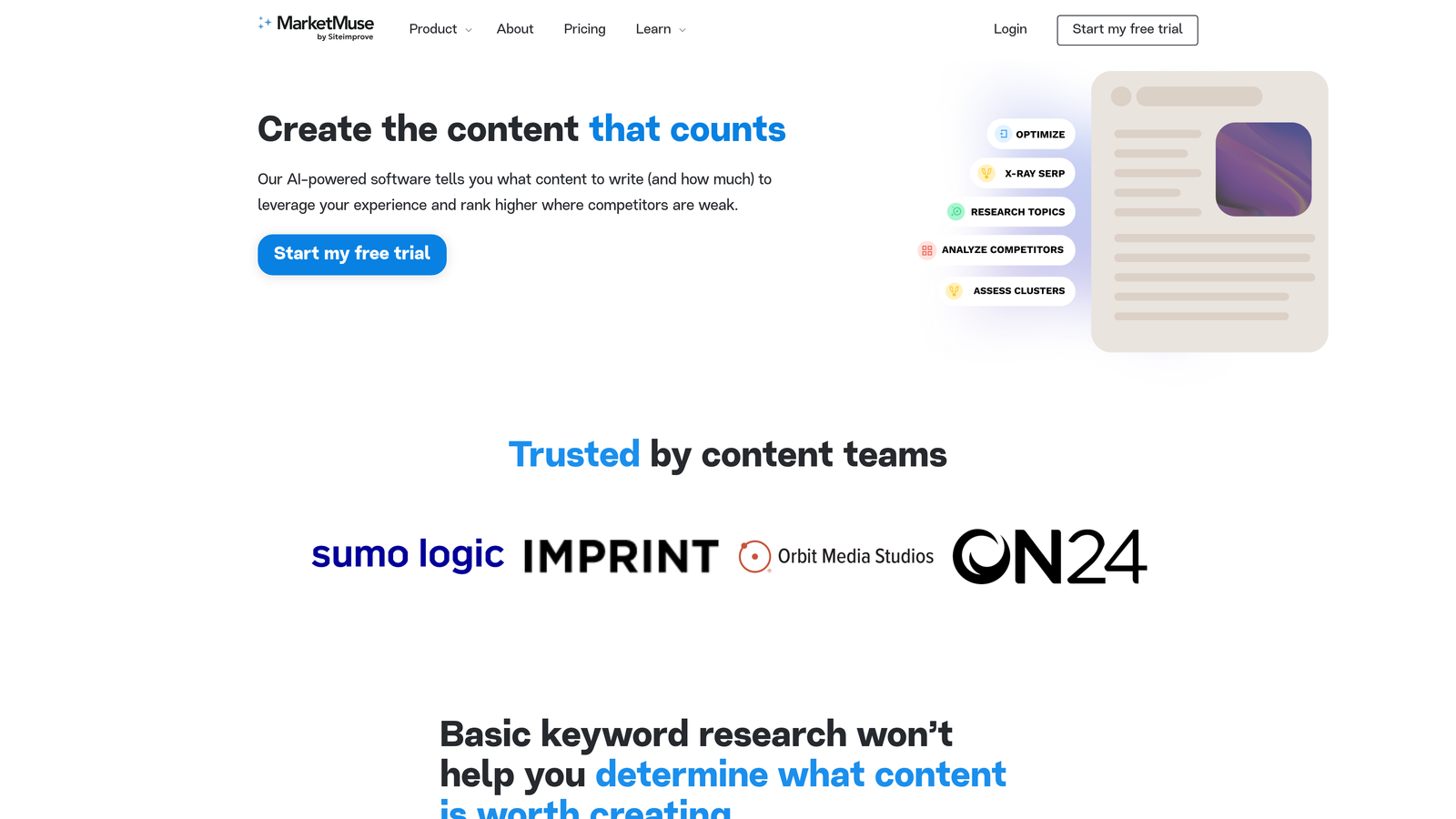
MarketMuse typically emphasizes topic authority and content inventory analysis—showing how your existing content covers a topic cluster.
Clearscope focuses on term frequency and relevance based on top-ranking content.

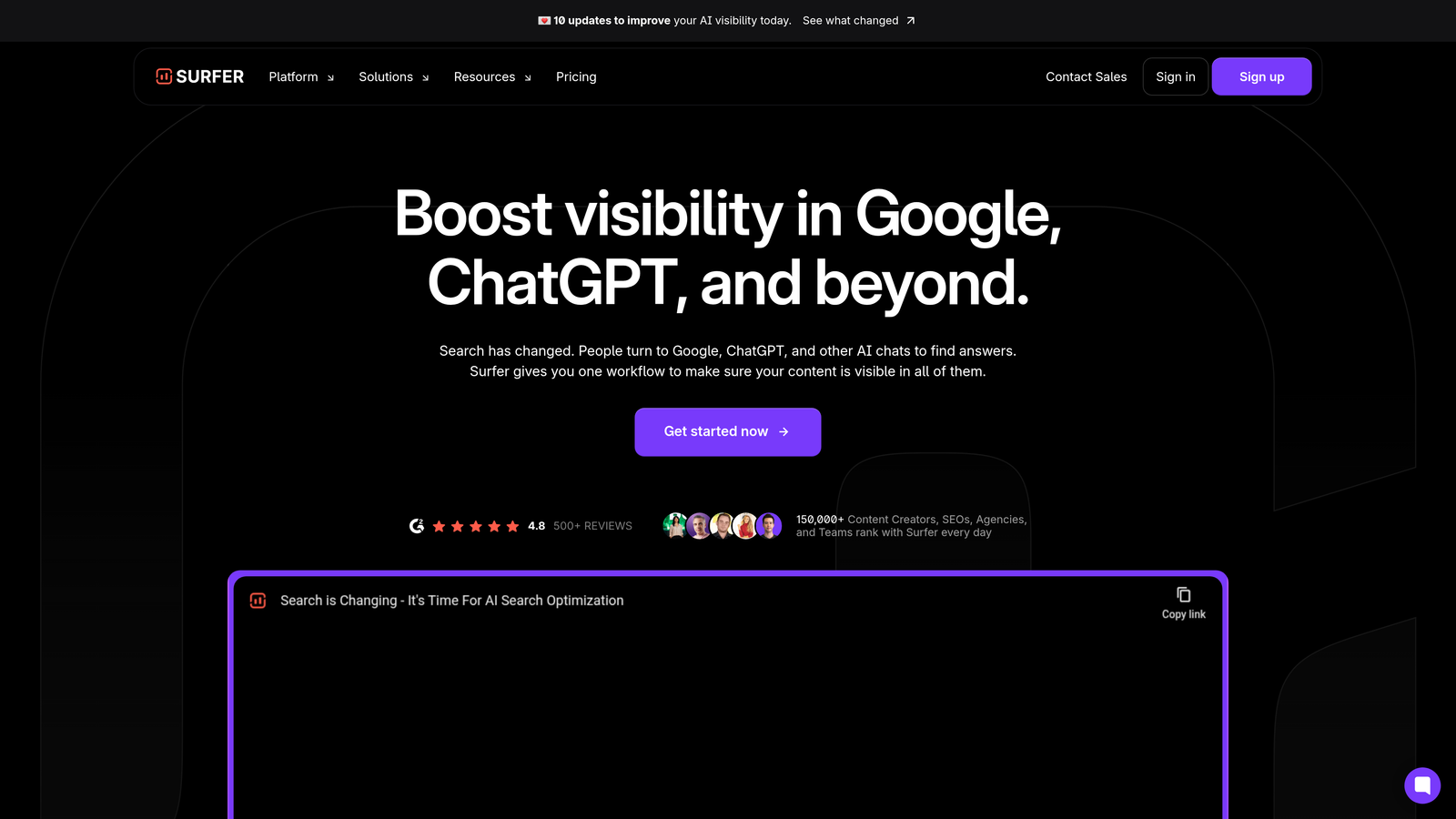
Surfer SEO leans heavily on SERP analysis and structured data.
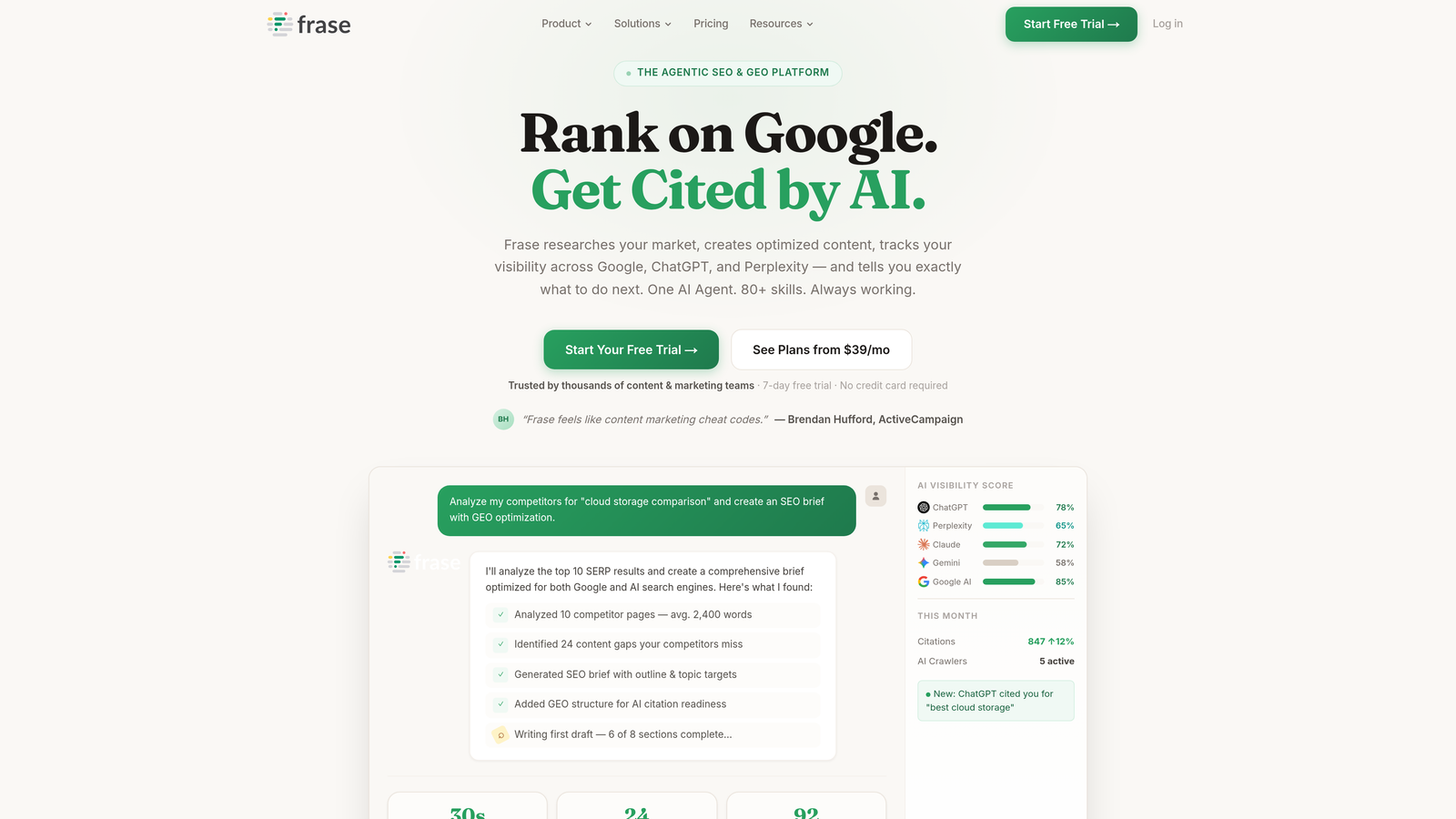
Frase combines SERP research with question extraction from sources like Reddit and Quora.
Pay attention to how each platform presents research findings. Can your writers actually use the brief, or does it require an SEO specialist to translate? The best topic research means nothing if your team can't execute on it efficiently.
Implementation Steps
1. Choose three representative keywords from your content calendar—one high-competition, one medium, and one long-tail—and run topic research in each platform you're evaluating.
2. Compare the subtopic suggestions side by side, noting which platform identifies angles your team wouldn't have considered and which ones simply regurgitate obvious points.
3. Have a writer who wasn't involved in the research attempt to create an outline from each platform's brief, then rate which one enabled the fastest, most comprehensive outline creation.
Pro Tips
Test topic research for both broad informational content and bottom-funnel commercial content. Some platforms excel at one but struggle with the other. If you create diverse content types, you need a tool that handles the full spectrum of search intent.
3. Test Real-Time Optimization Accuracy Across Platforms
The Challenge It Solves
Real-time content optimization scores promise to guide writers toward better-ranking content, but not all scoring algorithms are created equal. Some platforms give conflicting guidance, while others focus on keyword density metrics that feel outdated in the age of semantic search.
Writers need optimization feedback they can trust and understand. If the scoring system feels arbitrary or constantly contradicts good writing principles, your team will ignore it—rendering the tool useless regardless of its technical sophistication.
The Strategy Explained
Run parallel optimization tests with the same content across multiple platforms. Take an existing high-performing article and see how each tool scores it. Then take a draft that needs work and compare the specific recommendations each platform provides.
Look beyond the numerical score to the actionable guidance. Does the platform explain why certain terms matter? Does it distinguish between must-have topics and nice-to-have related concepts? Can it identify when you've covered a topic thoroughly even if you didn't use the exact phrase it suggested?
The most revealing test: have writers optimize the same draft using different platforms, then compare the final versions. Which platform's guidance led to content that reads naturally while still hitting optimization targets? Which one resulted in keyword-stuffed awkwardness?
Implementation Steps
1. Select three of your currently top-ranking articles and run them through each platform's optimization checker to see how they score your proven content.
2. Take a single draft article and have different team members optimize it using different platforms, keeping the optimization process blind so writers don't know which tool others are using.
3. Compare the optimized versions for readability, comprehensiveness, and natural language flow—not just the optimization scores the tools assigned.
Pro Tips
Watch for platforms that penalize good writing. If a tool demands you add a keyword phrase that would make a sentence awkward, that's a red flag. The best optimization guidance enhances content quality rather than compromising it for algorithmic targets.
4. Analyze Pricing Models Against Your Content Volume
The Challenge It Solves
Sticker price comparisons mislead because different platforms structure pricing around different usage metrics. One tool might appear cheaper monthly but cost more per article when you factor in your actual production volume and team size.
Agencies and high-volume content teams often discover hidden costs after commitment—additional user seats, overage charges for exceeding monthly limits, or credit systems that don't align with actual content needs. Understanding true cost-per-article prevents budget surprises.
The Strategy Explained
Calculate your true monthly content output including all content types: blog posts, landing pages, product descriptions, and any other optimized content. Factor in your team size and how many people need platform access simultaneously.
MarketMuse typically operates on credit-based pricing where different actions consume different credit amounts. Competitors might charge per document, per user, or offer unlimited usage within plan tiers. Map each pricing model to your specific usage pattern.
Consider seasonal variation too. If you publish heavily in Q4 but slow down in summer, a credit-based system might serve you better than a flat monthly subscription. Conversely, if you produce consistently year-round, unlimited plans could offer better value despite higher base prices.
Implementation Steps
1. Document your last three months of content production including article count, average word count, number of team members involved, and any seasonal patterns in your publishing schedule.
2. Request detailed pricing breakdowns from each vendor and calculate your projected monthly cost based on actual usage, including user seats, API access if needed, and any overage scenarios.
3. Build a spreadsheet comparing cost-per-article across platforms, factoring in the time savings each tool promises—a more expensive tool that cuts production time by 30% might actually cost less when you factor in labor hours.
Pro Tips
Ask vendors about their upgrade paths and contract terms. Some platforms lock you into annual commitments with steep penalties for downgrading. Others offer monthly flexibility but at premium pricing. Understand the total cost of ownership beyond just the monthly subscription fee.
5. Assess Integration Depth with Your Existing Tech Stack
The Challenge It Solves
Content tools don't operate in isolation—they need to work seamlessly with your CMS, project management system, analytics platform, and other marketing tools. Poor integration forces manual data transfer, duplicate work, and increased error rates.
The friction of switching between platforms kills productivity. If your writers need to copy content from the optimization tool to Google Docs, then to WordPress, then back to the optimization tool for final checks, you're losing hours per article to context switching and manual transfers.
The Strategy Explained
Map every system in your content creation workflow and identify required integration points. Does your team draft in Google Docs?
Do you manage assignments in Asana or Monday?
Do you publish through WordPress, Webflow, or a headless CMS?
Evaluate each platform's integration capabilities beyond basic features. Some tools offer WordPress plugins but only support one-way publishing without the ability to pull content back for optimization updates. Others provide robust API access that enables custom automation but require developer resources to implement.
Consider future needs too. If you're planning to scale content production or adopt new tools, you need a platform with flexible integration options rather than locked-in workflows that become bottlenecks as your stack evolves.
Implementation Steps
1. List every tool in your current content tech stack and identify which integrations are must-haves versus nice-to-haves based on your documented workflow from Strategy 1.
2. Request integration documentation from each vendor and test the actual integration process, not just the marketing claims—set up a test workflow that mirrors your real process.
3. Evaluate API access and automation possibilities if you have development resources, or confirm that native integrations cover your needs if you're relying on out-of-box functionality.
Pro Tips
Test integrations with real content under deadline pressure. Some integrations work smoothly with simple articles but break down with complex formatting, embedded media, or high-volume publishing. Discover these limitations during trials, not after you've committed to a platform.
6. Consider AI Visibility and Future-Proofing Factors
The Challenge It Solves
Traditional content optimization tools focus exclusively on Google search rankings, but the search landscape is shifting rapidly. AI models like ChatGPT, Claude, and Perplexity are increasingly answering user queries directly, often without sending users to websites at all.
This creates a critical gap: you might be creating perfectly optimized content for traditional search while missing opportunities to appear in AI-generated responses. As AI search adoption grows, brands need visibility into how AI models reference them and strategies for optimizing content for AI discoverability.
The Strategy Explained
Evaluate whether platforms address emerging AI search optimization or remain focused solely on traditional SEO. Most established tools like MarketMuse, Clearscope, and Surfer SEO were built for the Google-dominated search era and don't yet address AI visibility tracking or optimization.
Consider how content optimization needs are evolving. GEO (Generative Engine Optimization) requires different approaches than traditional SEO—focusing on authority signals, clear factual statements, and structured information that AI models can easily parse and cite.
Look for platforms that acknowledge this shift and provide tools for tracking brand mentions across AI platforms, identifying content gaps that affect AI visibility, and optimizing content for both traditional search and AI-generated responses. This future-proofing consideration becomes more critical as AI search adoption accelerates.
Implementation Steps
1. Ask each vendor directly about their roadmap for AI search optimization and whether they track how content performs in AI-generated responses, not just traditional search rankings.
2. Test how well content optimized by each platform performs when you manually query AI models about your topics—do the platforms' recommendations lead to content that AI models reference and cite?
3. Evaluate whether you need to supplement traditional content optimization tools with dedicated AI visibility tracking to get a complete picture of your content performance across all discovery channels.
Pro Tips
The content optimization landscape is evolving faster than most tools can adapt. Choose platforms with strong API access and integration capabilities so you can layer in specialized AI visibility tools as they emerge, rather than being locked into a single vendor's limited roadmap.
7. Run a Structured 30-Day Trial Comparison
The Challenge It Solves
Demo calls and feature presentations only show you what vendors want you to see. Real evaluation requires hands-on testing with your actual content, your actual team, and your actual workflow constraints.
Many teams sign up for trials but don't use them systematically, leading to decisions based on incomplete information or whichever tool happened to be tested last. Without structured comparison criteria and documented feedback, you're essentially guessing.
The Strategy Explained
Design a controlled trial process that tests each platform against the same content projects and success metrics. Assign the same article topics to different team members using different platforms, then compare results objectively.
Create a standardized feedback form that captures both quantitative metrics (time spent, optimization scores achieved, ranking results) and qualitative assessments (ease of use, quality of recommendations, team satisfaction). Collect feedback weekly rather than waiting until trials end.
Involve your entire content team in the evaluation—not just the person who will purchase the tool. Writers, editors, and SEO specialists each interact with optimization platforms differently and will identify different strengths and weaknesses based on their specific needs.
Implementation Steps
1. Schedule overlapping trial periods so you're testing platforms simultaneously rather than sequentially, eliminating recency bias and allowing direct comparison of the same content projects.
2. Create a trial scorecard based on your workflow map from Strategy 1, assigning point values to must-have capabilities and tracking how each platform performs against your specific criteria.
3. Conduct a structured debrief with your team after trials conclude, reviewing documented feedback and metrics rather than relying on general impressions or the loudest voice in the room.
Pro Tips
Test each platform during a normal work week, not during a slow period. You need to see how tools perform under your typical deadline pressure, content volume, and team collaboration patterns. A tool that works great when you're testing one article might fall apart when you're juggling ten simultaneous projects.
Making Your Decision With Confidence
Evaluating MarketMuse against competitors isn't about finding the "best" tool—it's about finding the right tool for your specific situation. The strategies outlined here provide a systematic framework for making that decision based on data rather than marketing claims or feature list comparisons.
Start by mapping your workflow needs and identifying your actual pain points. Then systematically test topic research capabilities, real-time optimization accuracy, and integration depth with your existing systems. Factor in true cost-per-article based on your content volume, not just sticker prices on vendor websites.
Don't overlook the emerging importance of AI visibility in your evaluation criteria. Traditional content tools excel at Google SEO but weren't designed for a world where ChatGPT and Claude answer queries directly. Consider whether you need to supplement traditional optimization with AI visibility tracking to get complete coverage of how your content performs across all discovery channels.
Run structured trials with clear success metrics, involve your entire team in the assessment process, and document feedback systematically. Make your decision based on composite data from multiple perspectives rather than gut feelings or whichever platform you tested most recently.
The content optimization landscape continues evolving rapidly, so choose a platform that not only serves today's SEO needs but positions you for success in AI-powered search environments. Start tracking your AI visibility today and see exactly where your brand appears across top AI platforms—because optimizing content for search engines is only half the battle when AI models are increasingly the ones answering your audience's questions.