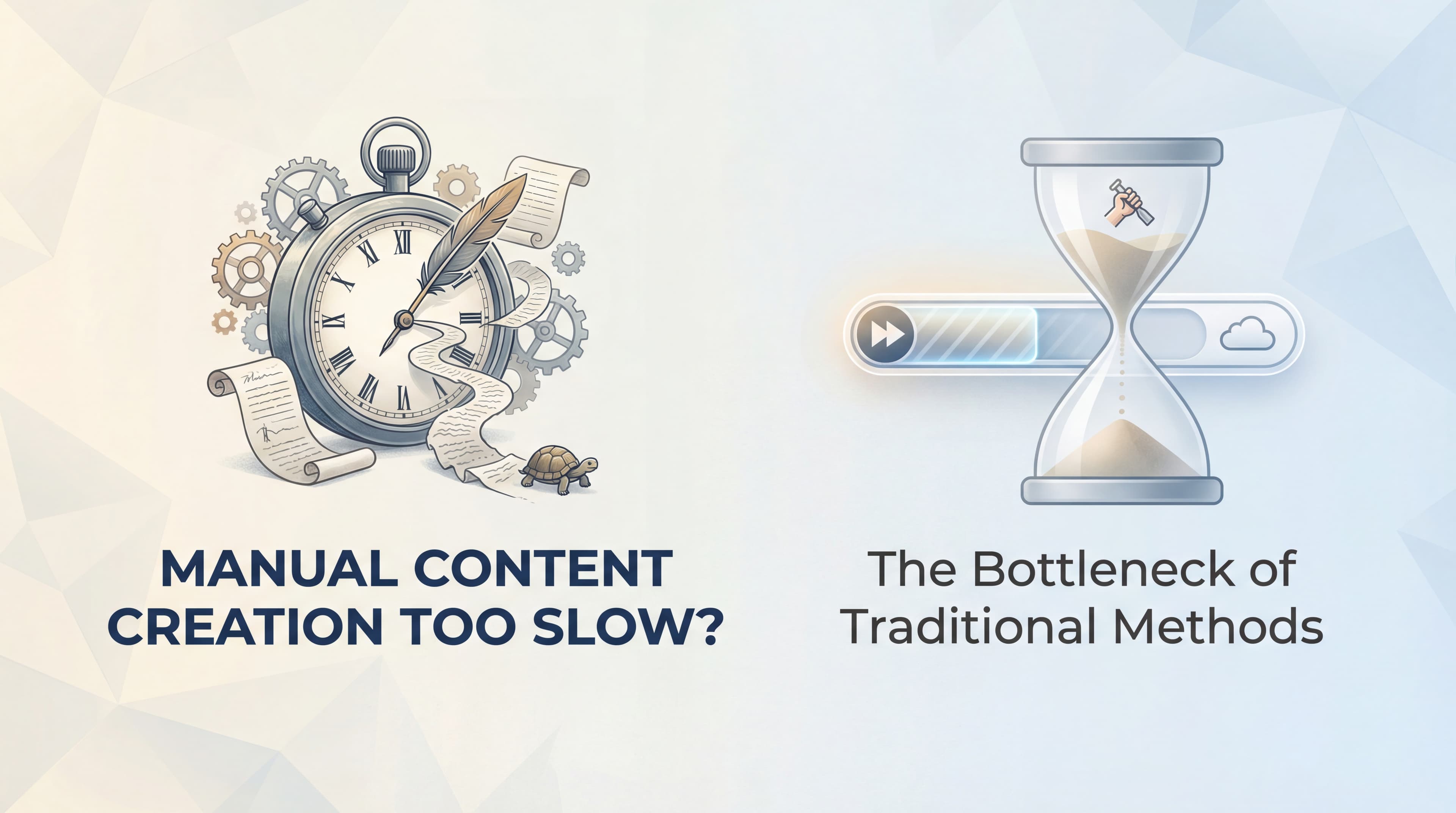
It's 4 PM on a Wednesday, and Sarah's staring at a blank Google Doc. She needs three blog posts by Friday. The cursor blinks mockingly. She's already spent two hours this morning "researching," which mostly meant falling down rabbit holes and bookmarking articles she'll probably never read again. The outline she started at lunch sits abandoned in another tab. Meanwhile, her Slack is lighting up with questions about next week's content calendar.
Sound familiar?
If you've ever felt like content creation is slowly consuming your life—or worse, that you're falling further behind despite working harder—you're not experiencing a personal failure. You're experiencing a systems problem that affects marketing teams everywhere. The frustration isn't about lacking creativity or writing skill. It's about the brutal math of manual content creation colliding with the demands of modern SEO and audience expectations.
This article isn't here to tell you that human creativity is obsolete or that you should hand everything over to robots. Instead, we're going to diagnose exactly where your time disappears in the content creation process, identify the bottlenecks that compound into major delays, and present practical solutions that let you work smarter without sacrificing quality. Whether you optimize your current process or explore AI-assisted workflows, the goal is the same: sustainable content production that doesn't burn out your team.
The Hidden Time Drains in Your Content Workflow
Let's break down what actually happens when you create a single blog post manually. Most marketers dramatically underestimate the true time investment because they only count the "writing" part.
Research typically consumes 2-4 hours per article. You're not just reading sources—you're evaluating credibility, cross-referencing claims, hunting for statistics that support your angle, and trying to find that one perfect case study you vaguely remember seeing last month. Each Google search spawns five new tabs. Each new tab introduces another potential tangent.
Outlining takes another 30-60 minutes if you're disciplined about it. But here's the thing: most writers skip this step or do it half-heartedly, which means they're essentially outlining while drafting. That's like trying to build a house while simultaneously drawing the blueprints.
The actual writing phase? Budget 3-5 hours for a comprehensive 1,500-2,000 word article. That's assuming you don't get interrupted, don't second-guess your approach halfway through, and don't spend twenty minutes trying to find the perfect transition sentence between sections.
Editing adds another 1-2 hours. You're checking for clarity, tightening sentences, fixing awkward phrasing, and hunting down typos that your brain somehow didn't register during the writing phase. Then comes formatting and publishing: adding images, optimizing meta descriptions, configuring SEO settings, and actually hitting publish. Another 30-60 minutes.
Add it all up, and you're looking at 8-12 hours per article. That's a full workday or more for a single piece of content.
But the real time drains aren't just the tasks themselves—they're the transitions between them. Context switching is a productivity killer. Every time you shift from research mode to writing mode to editing mode, your brain needs time to recalibrate. You lose momentum. You forget the brilliant point you were about to make. You spend five minutes just remembering where you left off.
Then there's the perfectionism paralysis. You rewrite the introduction four times because it doesn't feel quite right. You spend thirty minutes debating whether to use "leverage" or "utilize" (it's neither—just say "use"). You convince yourself that this article needs to be the definitive resource on the topic, so you keep adding sections until it's a 4,000-word monster that nobody will finish reading.
And let's not forget approval loops. If your content needs to pass through multiple stakeholders—a subject matter expert, a legal review, a brand manager—you can add days or even weeks to the timeline. Each reviewer has their own schedule, their own priorities, and their own opinions about whether that joke in paragraph three is "on brand."
These micro-delays compound across your content calendar. What seems manageable for one article becomes completely unsustainable when you need to produce consistently.
Why Traditional Content Processes Break at Scale
Let's do some uncomfortable math. If one article takes 8-12 hours to produce manually, and you need to publish weekly content to maintain SEO momentum, you're looking at 32-48 hours per month dedicated solely to content creation. That's an entire full-time job just for writing blog posts—and we haven't even talked about social media content, email newsletters, case studies, or video scripts.
For lean marketing teams, this creates an impossible choice: quality or quantity. You can spend those 40+ hours producing four meticulously crafted, comprehensive articles that truly serve your audience. Or you can churn out shorter, less polished pieces to maintain publishing frequency. Most teams end up sacrificing one for the other, and neither option feels good.
The quality-focused approach sounds noble, but it has real consequences. Search algorithms increasingly favor consistent publishing schedules. When you go weeks without new content, you signal to search engines that your site isn't actively maintained. Your domain authority suffers. Your existing content gradually loses ranking momentum as competitors publish more frequently.
The quantity-focused approach isn't much better. Rushing through content to hit publishing deadlines means surface-level research, generic insights, and articles that don't meaningfully differentiate your brand. Your audience can tell when you're phoning it in. Engagement drops. Bounce rates increase. You're creating content that technically exists but doesn't actually accomplish anything strategic.
This tension intensifies as your content needs grow. Early-stage companies might get away with one solid article per week. But as you expand into new product areas, target new audience segments, or compete in more crowded markets, that weekly cadence becomes inadequate. You need pillar content, supporting articles, comparison guides, how-to tutorials, and thought leadership pieces. The content demands multiply faster than your team's capacity.
Many marketing leaders respond by hiring more writers or outsourcing to freelancers. That can work, but it introduces new challenges: onboarding time, maintaining brand voice consistency, managing multiple contributors, and ensuring quality control across a distributed team. You trade the bottleneck of limited writing capacity for the bottleneck of editorial oversight.
The fundamental problem isn't about working harder or hiring more people. It's about the inherent inefficiency of manual content creation processes that were designed for a different era—when publishing one article per week was ambitious and search algorithms rewarded depth over consistency.
Process Fixes That Reclaim Hours Without New Tools
Before exploring technology solutions, let's look at process optimizations that can dramatically reduce your content creation time. These strategies work regardless of your current tools or team size.
Batching eliminates context switching costs. Instead of taking an article from research to publication in one marathon session, separate the phases across different days or time blocks. Dedicate Monday mornings to research for the entire week's content. Tuesday becomes outline day. Wednesday and Thursday are pure writing time. Friday handles editing and publishing.
This approach lets your brain stay in one mode longer, which significantly improves efficiency. When you're in research mode, you can evaluate multiple sources simultaneously, identify patterns across topics, and build a comprehensive resource library. When you shift to writing mode, all that research is already synthesized and ready to use. You're not constantly switching between "find information" and "explain information" mindsets.
Template systems eliminate structural decisions. Create detailed templates for your most common content types: how-to guides, listicles, comparison articles, explainer posts. These templates should specify not just the general structure but the specific sections, the typical word count for each section, and even the types of examples or data points to include.
When you sit down to write a how-to guide, you shouldn't be figuring out whether to start with the problem or the solution, whether to include prerequisites, or how to structure the steps. Those decisions are already made. You're just filling in the specifics for this particular topic. This reduces decision fatigue and speeds up both outlining and drafting.
The "good enough" framework prevents over-polishing. Define clear quality standards for different content types before you start creating. A comprehensive pillar page deserves meticulous attention to detail, multiple rounds of editing, and careful fact-checking. A timely news commentary or quick how-to guide doesn't need the same level of polish.
Create a simple rubric: Does this article answer the core question completely? Is it free of factual errors? Does it match our brand voice reasonably well? If yes to all three, it's ready to publish. You can always update and improve content after it's live, but perfectionism that keeps articles in draft status for weeks serves nobody.
Strategic repurposing multiplies content value. Stop thinking of each article as a standalone project. When you research a comprehensive topic, you're gathering enough material for multiple pieces. That 3,000-word ultimate guide can be broken into five focused articles. That case study can become a blog post, a social media series, and an email newsletter feature.
This doesn't mean literally copying and pasting sections. It means recognizing that thorough research creates reusable intellectual assets. You're not starting from scratch for each new piece—you're remixing and recontextualizing existing knowledge for different formats and audience needs.
Where AI Assistance Actually Makes Sense
Process optimization only goes so far. At some point, you hit the ceiling of human efficiency. This is where AI assistance becomes genuinely valuable—not as a replacement for human creativity, but as a tool that handles the mechanical aspects so you can focus on strategic thinking.
AI excels at research synthesis. Instead of spending hours reading through dozens of sources to extract key points, AI can process large volumes of information quickly and identify relevant patterns, statistics, and insights. You still need to verify the accuracy and evaluate the relevance, but the initial heavy lifting is done. What used to take three hours now takes thirty minutes.
Outline generation is another natural fit. Once you've defined your topic and target keyword, AI can structure a logical flow of sections based on search intent and common content patterns in your industry. You're not locked into that structure—you'll likely adjust it based on your strategic angle—but starting with a solid framework beats staring at a blank page.
First-draft frameworks save enormous amounts of time. This isn't about having AI write your final content word-for-word. It's about using AI to generate a rough draft that covers the key points, follows your outline, and incorporates your research. Think of it as a sophisticated first pass that a human editor will refine, personalize, and polish.
The draft might be generic in places. The transitions might be clunky. The voice might not perfectly match your brand. That's fine. You're not publishing it as-is. You're starting with 70% of the work already done, which means you can spend your time on the 30% that actually requires human judgment: strategic positioning, unique insights, brand voice refinement, and creative storytelling.
SEO optimization is another area where AI assistance shines. Instead of manually researching related keywords, analyzing competitor content, and optimizing meta descriptions, AI can suggest semantic variations, identify content gaps, and ensure your article covers the topic comprehensively from a search perspective. You still make the final decisions about what to include, but the analysis is automated. Exploring automated SEO content writing tools can help you understand what's available in this space.
Here's what still needs human oversight: brand voice refinement, fact verification, strategic angle selection, and editorial judgment about what resonates with your specific audience. AI can mimic a general professional tone, but it can't capture the subtle personality quirks that make your brand distinctive. It can summarize sources, but it can't evaluate credibility with the same skepticism a human editor brings. It can suggest content angles, but it can't understand your competitive positioning or strategic priorities.
The most effective approach is a hybrid model where AI handles approximately 60% of the mechanical work—research gathering, structural organization, initial drafting—so humans can focus on the 40% that's genuinely creative and strategic. This isn't about replacing writers. It's about letting writers spend their time on the parts of content creation that actually require human intelligence, creativity, and judgment. Understanding the nuances of AI content tools vs human writers helps you find the right balance for your team.
Building a Sustainable Content Engine
Whether you optimize your manual process or integrate AI assistance, the ultimate goal is creating a content system that's sustainable long-term. That starts with honest capacity planning.
Calculate your true content capacity based on available hours and realistic per-piece timelines. If your marketing team has 20 hours per week to dedicate to content creation, and each article takes 8 hours after process optimization, you can sustainably produce 2-3 articles weekly. Trying to publish five articles per week with that capacity means burnout, quality decline, or both.
Once you know your realistic capacity, you can make strategic decisions about content mix. Maybe you produce two comprehensive articles per week plus several shorter updates or repurposed pieces. Maybe you focus on one exceptional pillar article every two weeks instead of churning out mediocre weekly posts. The key is aligning your publishing schedule with what your team can actually deliver consistently.
Create content systems that maintain quality at your target volume. This means documented workflows, clear quality checklists, standardized templates, and defined approval processes. When content creation is a repeatable system rather than a custom project each time, you reduce variability and improve efficiency. Implementing content creation automation can help standardize these workflows significantly.
Your system should include feedback loops. After publishing an article, track not just traffic and engagement metrics but also the time investment required. If a particular content type consistently takes longer than expected, either adjust your timeline estimates or find ways to streamline that format. If certain topics generate strong engagement with less effort, consider producing more content in that category.
Track metrics that matter beyond just traffic numbers. Time-to-publish is crucial—how long does an article sit in draft or review status? Revision cycles reveal bottlenecks in your approval process. Writer satisfaction matters too, because burned-out team members produce worse content and eventually leave.
As your content engine matures, you'll identify opportunities for continuous improvement. Maybe you discover that batching research is incredibly effective, but batching writing doesn't work for your team's creative process. Maybe AI-generated outlines save time, but AI-generated first drafts require so much revision that manual drafting is faster. These insights let you optimize specifically for your team's strengths and constraints.
The brands that win in content marketing aren't necessarily the ones with the biggest budgets or the most writers. They're the ones who've built sustainable systems that consistently produce quality content without exhausting their teams. They've figured out the right balance between manual craft and automated efficiency. They've aligned their content ambitions with their actual capacity. For teams looking to expand output, exploring bulk content creation for blogs offers practical strategies for scaling without sacrificing quality.
Moving Forward: From Bottleneck to Breakthrough
If manual content creation is taking too long, you're not failing at marketing. You're experiencing the natural limits of traditional content processes in an environment that demands more volume, more consistency, and more sophistication than ever before.
The diagnostic questions to ask yourself: Where does your time actually go in the content creation process? Which tasks require genuine human creativity versus mechanical execution? What's your realistic content capacity given your current team and timeline? Are you optimizing for the right metrics, or are you measuring activity instead of impact?
The solutions exist on a spectrum. Process optimization—batching, templates, clear quality standards—can reclaim significant time without requiring new tools or technology. AI assistance can handle research synthesis, outline generation, and first-draft frameworks, freeing humans to focus on strategic refinement and brand voice. The most effective approach combines both: optimized processes enhanced by intelligent automation. Reviewing the best AI tools for content creation can help you identify which solutions fit your specific workflow needs.
What matters most is building a content system that's sustainable for your team. That might mean publishing less frequently but with higher quality. It might mean embracing AI assistance for the mechanical aspects while preserving human oversight for strategy and creativity. It might mean being more selective about content topics so you can go deeper on fewer subjects.
The goal isn't to work harder. It's to work smarter—creating content that serves your audience, supports your SEO strategy, and positions your brand effectively without burning out your team in the process.
If you're ready to move beyond manual bottlenecks and build a more efficient content engine, consider how AI-powered tools can fit into your workflow. Platforms like Sight AI combine content generation capabilities with AI visibility tracking, helping you not only create optimized articles faster but also monitor how AI models like ChatGPT and Claude reference your brand across their responses. Start tracking your AI visibility today and see exactly where your brand appears across top AI platforms—because creating great content is only half the equation. Making sure it gets discovered and cited by AI search is what drives sustainable organic growth in the modern landscape.