AI visibility optimization is the practice of tracking and improving how often ChatGPT, Claude, Perplexity, Gemini and Google AI Overviews mention, cite and recommend your brand. The leading tools for it in 2026 are Sight AI (tracking plus content and indexing), Profound (enterprise analytics), Peec.ai (recommendation tracking), AI SEO Tracker (affordable citation-source data) and PromptWatch (prompt testing). Content tools such as Frase and Writesonic help produce citable pages but do not measure visibility. The best setup is a tracker that samples a fixed prompt set over time, paired with a way to act on the gaps it finds.
Traditional analytics tools weren't built for this. They can't tell you when ChatGPT recommends your competitor instead of you, when Claude cites outdated information about your product, or what your share of voice is across AI platforms. Brands that ignore this risk becoming invisible to high-intent users at the exact moment those users are choosing a solution.
We evaluated each tool on four criteria: its ability to track AI visibility over time, the quality of its optimization insights, how well it integrates with existing marketing stacks, and how directly it supports measurable ROI. Some tools focus purely on tracking AI mentions and citations, others combine traditional SEO with AI-specific metrics, and a few cover both measurement and execution.
AI Visibility Optimization Tools Compared at a Glance
Not every tool on this list does the same job. Some measure how AI models talk about your brand; others help you produce content that earns citations. Use this table to shortlist before reading the detailed reviews.
| Tool | Primary focus | Tracks AI visibility over time | Best for |
|---|---|---|---|
| Sight AI | AI visibility tracking + content generation + indexing | Yes, across 6+ AI platforms | Teams that want tracking and execution in one platform |
| PromptWatch | Prompt testing and response analysis | Yes, with historical response archives | Content strategists running optimization experiments |
| Profound | AI brand monitoring and analytics | Yes, with real-time alerts | Enterprise analytics teams |
| Writesonic | AI writing with citation-friendly formatting | No (content creation) | High-volume content teams |
| AI SEO Tracker | Prompt tracking and citation-source analysis | Yes, with visibility trends | Startups, agencies and lean teams |
| Frase.io | Question-led content research and optimization | No (content optimization) | Teams building pillar content |
| AirOps | Workflow automation | Via connected tools | Marketing ops at scale |
| Peec.ai | AI recommendation tracking | Yes | E-commerce, SaaS and service brands |
| Scrunch | Creator and influencer impact on AI visibility | Yes | Consumer brands with influencer programs |
1. Sight AI
Best for: Comprehensive AI visibility tracking across ChatGPT, Claude, Perplexity, and other AI platforms with actionable optimization recommendations.
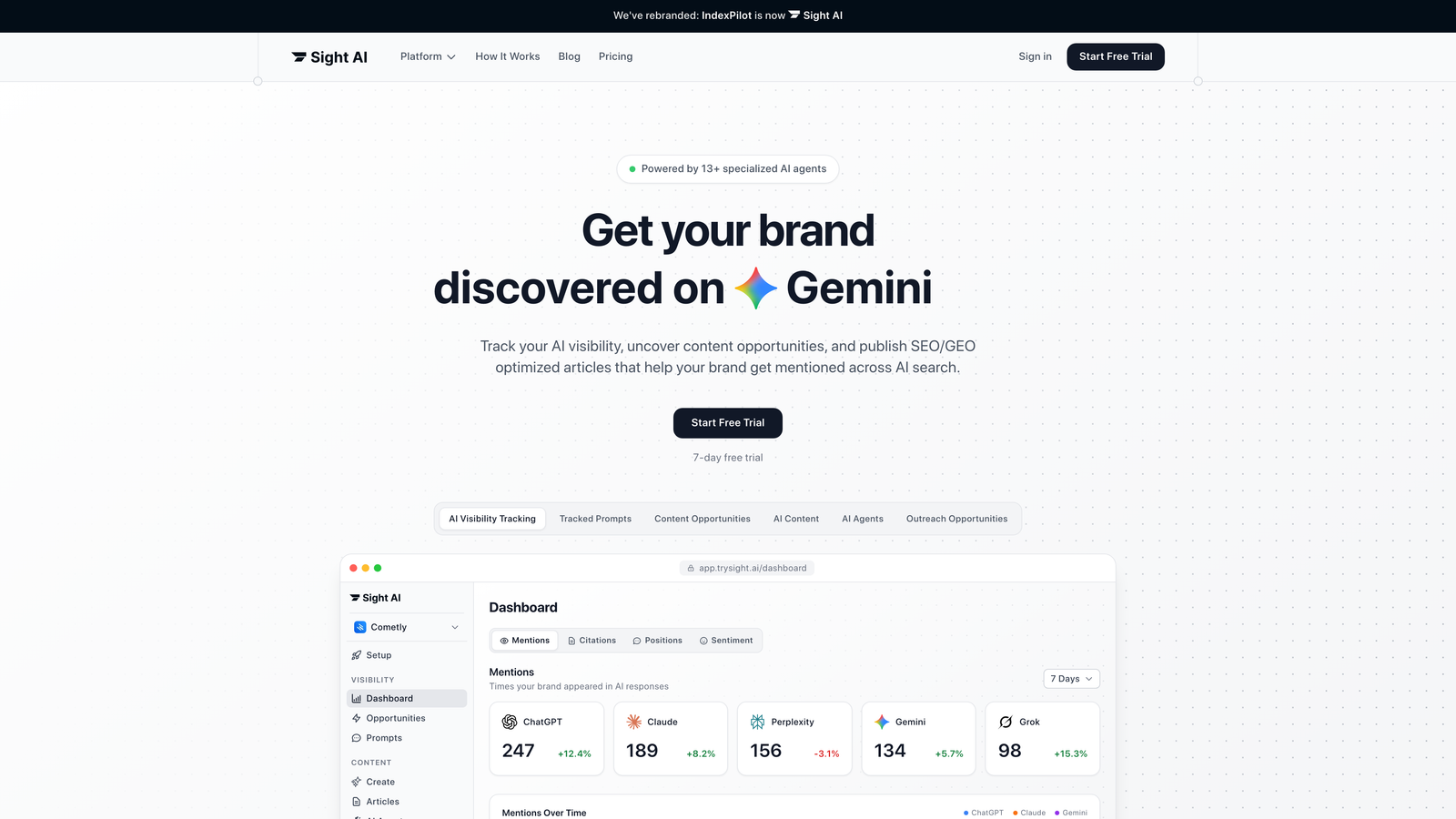
Sight AI pioneered the AI visibility optimization category, building the first platform specifically designed to track and improve how brands appear in AI-generated responses.
Where This Tool Shines
Sight AI excels at answering the question most marketing tools can't: "How visible is my brand in AI conversations?" The platform monitors your mentions across major AI platforms in real-time, tracking not just frequency but context, sentiment, and competitive positioning.
Unlike traditional SEO tools retrofitted for AI, Sight AI was purpose-built for ai visibility optimization challenges. It identifies the specific queries where competitors appear instead of you, analyzes why AI models favor certain brands, and provides concrete optimization strategies. The platform's strength lies in its actionable intelligence—it doesn't just report problems, it tells you exactly how to fix them.
It also closes the loop between insight and execution. Specialized AI content agents generate SEO/GEO-optimized articles, guides, and listicles aimed at the prompts where you're missing, and IndexNow integration pushes new pages to search engines and AI crawlers without waiting for organic recrawls. Few tools on this list cover tracking, content creation, and indexing in a single workflow.
Key Features & Capabilities
✅ Real-time tracking: Monitor brand mentions across ChatGPT, Claude, Perplexity, Gemini, and other AI platforms as they happen.
✅ AI Visibility Score: A single trackable metric across 6+ AI platforms, combined with sentiment and prompt-level detail, so you can measure progress week over week.
✅ Competitive analysis: See your share of voice versus competitors in AI responses with detailed positioning data.
✅ Query-level insights: Discover which specific searches trigger competitor mentions instead of yours.
✅ Content optimization recommendations: Get actionable guidance based on how AI models evaluate and cite sources.
✅ 13+ AI content agents and Autopilot mode: Generate format-specific, GEO-optimized content and automate publishing to keep closing visibility gaps.
✅ IndexNow and sitemap automation: Submit new and updated content automatically for faster discovery.
✅ Citation tracking: Monitor which of your pages AI platforms reference most frequently and why.
✅ Sentiment analysis: Understand how AI models describe your brand versus competitors in their responses.
✅ Integration capabilities: Connect with existing analytics platforms to correlate AI visibility with business outcomes.
✅ Custom alerts: Receive notifications when your AI visibility changes significantly or competitors gain ground.
Best For / Ideal Users
Sight AI is ideal for marketing teams at B2B SaaS companies, e-commerce brands, and professional services firms where AI-powered search significantly influences buyer decisions. It's particularly valuable for brands in competitive categories where AI recommendations directly impact customer acquisition.
Companies with existing content marketing programs gain the most value, as the platform helps optimize existing assets for AI visibility rather than requiring entirely new content creation. Agencies and founders who want to scale content production without adding headcount also benefit from the built-in content agents. A free trial is available.
2. PromptWatch
Best for: Teams focused on monitoring and analyzing how AI models respond to specific prompts and queries related to their brand.
PromptWatch provides specialized monitoring capabilities for tracking brand mentions and positioning across AI conversational platforms. The tool focuses on understanding the nuances of how different AI models interpret and respond to various prompt formulations.
Where This Tool Shines
PromptWatch excels at systematic prompt testing and response analysis. The platform allows you to create libraries of relevant queries and track how different AI models respond over time. This approach helps identify patterns in when and how your brand appears in AI-generated content.
The tool's comparative analysis features enable you to see how slight variations in query phrasing affect brand visibility. This granular insight helps content teams understand the linguistic triggers that improve AI citation rates.
Key Features & Capabilities
✅ Prompt library management: Create and organize collections of brand-relevant queries to monitor consistently.
✅ Cross-platform testing: Compare how different AI models respond to identical prompts.
✅ Response tracking: Monitor changes in AI-generated responses over time to identify trends.
✅ Competitor comparison: Track competitive brand mentions within AI responses to similar queries.
✅ Historical data: Access archives of previous responses to understand visibility trends.
Best For / Ideal Users
PromptWatch works well for content strategists and brand managers who need to understand the specific language patterns that drive AI visibility. It's particularly useful for teams conducting ongoing content optimization experiments.
3. Profound
Best for: Enterprise teams seeking deep analytics on AI-powered search behavior and brand perception analysis.
Profound positions itself as an analytics platform that bridges traditional digital metrics with emerging AI visibility data. The platform emphasizes understanding user intent and behavior across both conventional search engines and AI-powered discovery platforms.
Where This Tool Shines
Profound's strength lies in its analytical depth and data visualization capabilities. The platform aggregates signals from multiple sources to provide a comprehensive view of brand visibility across the evolving search landscape.
The tool's reporting features allow marketing teams to correlate AI visibility metrics with business outcomes, making it easier to justify investment in AI optimization initiatives to leadership. Real-time alerting and prompt analysis also make it a fit for reputation-sensitive brands that need to react quickly when the way language models describe them shifts.
Key Features & Capabilities
✅ Multi-channel visibility tracking: Monitor brand presence across traditional search, AI platforms, and voice assistants.
✅ Intent analysis: Understand the user intent behind queries where your brand appears or is absent.
✅ Prompt and context analysis: See the actual prompts that trigger mentions and the surrounding context, not just isolated references.
✅ Perception scoring: Quantify sentiment and recommendation strength over time.
✅ Custom dashboards: Build visualizations that connect AI visibility to downstream conversion metrics.
✅ Automated reporting: Schedule regular reports for stakeholders showing AI visibility trends.
✅ Integration options: Connect with business intelligence tools and marketing platforms.
Best For / Ideal Users
Profound is designed for enterprise marketing teams with dedicated analytics resources. It's most valuable for organizations that need to report AI visibility metrics alongside traditional marketing KPIs in unified dashboards.
4. Writesonic
Best for: Content creation teams that want AI-assisted writing with built-in optimization for AI discoverability.
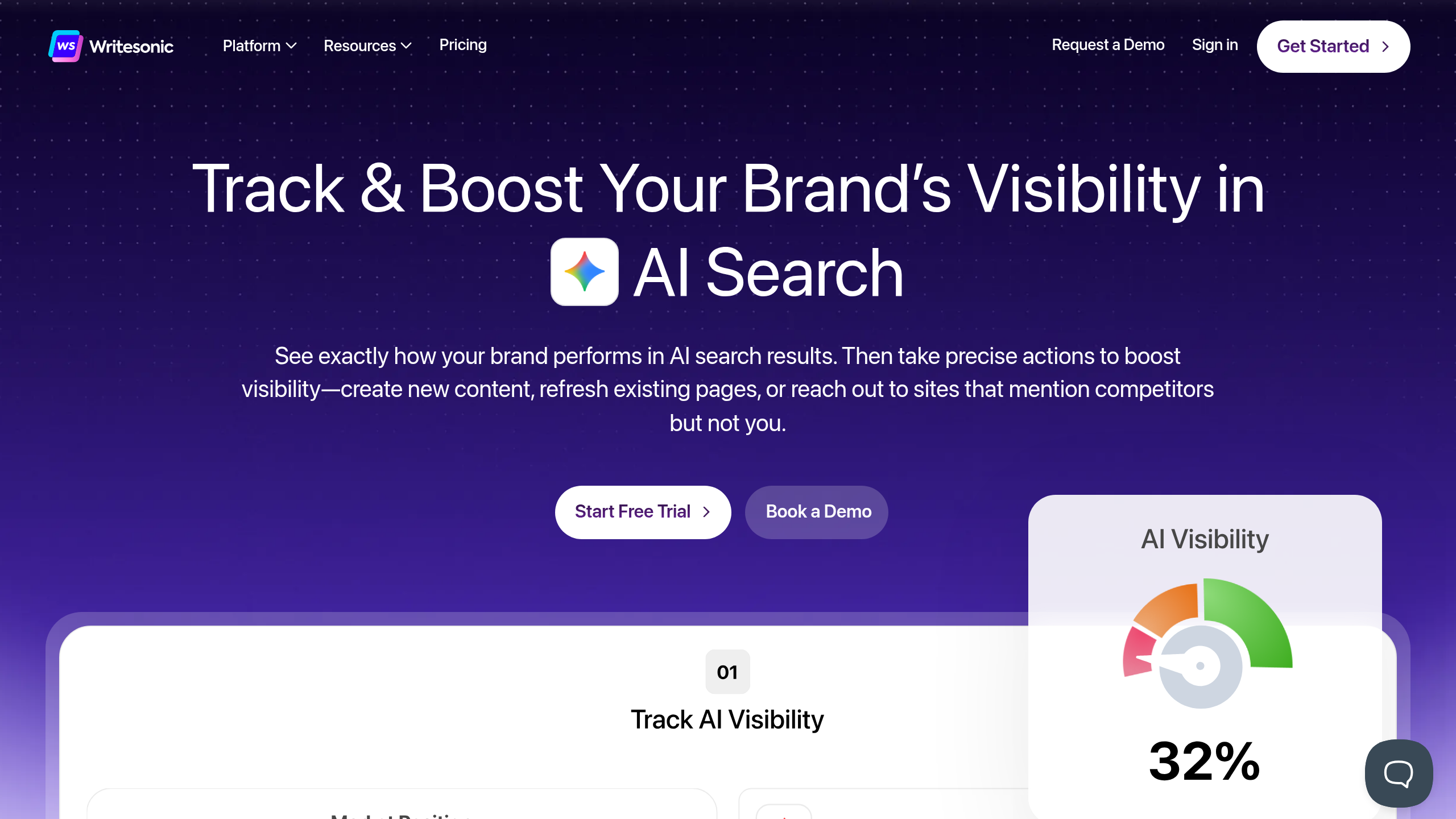
Writesonic primarily functions as an AI writing assistant but includes features designed to help content rank well in both traditional search engines and AI-powered platforms. The platform emphasizes creating content that AI models are more likely to cite and reference.
Where This Tool Shines
Writesonic excels at helping teams produce large volumes of content optimized for AI visibility. The platform's AI writing capabilities understand the structural and informational qualities that AI models favor when selecting sources to cite.
Content teams can use Writesonic to quickly generate drafts that incorporate the comprehensiveness, accuracy signals, and formatting characteristics that improve citation likelihood across AI platforms.
Key Features & Capabilities
✅ AI content generation: Create articles, product descriptions, and landing pages optimized for AI discovery.
✅ Citation-friendly formatting: Built-in templates that structure content in ways AI models prefer to reference.
✅ Fact-checking integration: Tools to verify claims and add credibility signals AI models value.
✅ Bulk content creation: Generate multiple pieces optimized for different query variations.
✅ SEO optimization: Combine traditional SEO best practices with AI-specific optimization.
Best For / Ideal Users
Writesonic is ideal for content marketing teams that need to produce high volumes of content efficiently while maintaining optimization for AI visibility. It's particularly useful for e-commerce brands creating product content and B2B companies building thought leadership libraries.
5. AI SEO Tracker
Best for: Teams that want straightforward, affordable AI visibility tracking across ChatGPT, Claude, Perplexity, Gemini, and Google AI Overviews without enterprise complexity.
AI SEO Tracker focuses on making AI visibility monitoring accessible to teams of any size. The platform tracks how often your brand appears in AI-generated answers for the prompts your customers actually ask, then shows you which sources those AI engines cite so you know exactly where to earn placements.
Where This Tool Shines
AI SEO Tracker excels at connecting visibility data to concrete next steps. Instead of only reporting mention counts, it surfaces the specific pages and publications that AI models pull from when answering your target prompts. This citation-source intelligence turns tracking into a practical roadmap: get featured in the sources AI engines already trust, and your recommendation rate follows.
The platform is also notably simple to set up. You add your brand, competitors, and a list of target prompts, and the tool starts monitoring responses across multiple AI engines. This low-friction approach makes it a strong fit for teams that want answers in days, not after a lengthy enterprise onboarding.
Key Features & Capabilities
✅ Multi-engine prompt tracking: Monitor brand mentions across ChatGPT, Claude, Perplexity, Gemini, and Google AI Overviews for your target prompts.
✅ Citation source analysis: See which websites and pages AI models cite when answering your queries, so you know where to build presence.
✅ Competitor benchmarking: Compare your share of AI mentions against competitors for the same prompt set.
✅ Visibility trends over time: Track how your AI presence improves as you publish content and earn citations.
✅ Sentiment and positioning insights: Understand how AI engines describe your brand versus alternatives.
✅ Simple, fast setup: Start tracking prompts within minutes without complex configuration or sales calls.
Best For / Ideal Users
AI SEO Tracker is ideal for SaaS startups, SEO agencies, and lean marketing teams that need actionable AI visibility data without enterprise pricing. It works especially well for teams running active content and digital PR programs, since the citation-source data tells them exactly which placements will move the needle on AI recommendations.
6. Frase.io
Best for: Content optimization focused on answering specific questions comprehensively—a key factor in AI citation.
Frase.io combines content research, optimization, and creation capabilities with a focus on building comprehensive, authoritative content. The platform analyzes top-performing content for target topics and identifies the questions, subtopics, and depth required to become a definitive resource.

Where This Tool Shines
Frase excels at content gap analysis and comprehensive topic coverage. The platform identifies what top-ranking content includes and what your content lacks, making it easier to build resources that AI models consider authoritative enough to cite.
The tool's question-focused approach aligns well with how users interact with AI platforms. By ensuring your content thoroughly answers related questions, you increase the likelihood of AI citations across various query formulations.
Key Features & Capabilities
✅ Content briefs: Generate detailed outlines based on analysis of top-performing content for your topics.
✅ Question research: Identify related questions users ask that your content should address.
✅ Topic modeling: Ensure comprehensive coverage of subtopics that establish topical authority.
✅ AI writing assistant: Draft content sections that address identified gaps.
✅ Optimization scoring: Track how well your content covers essential elements compared to competitors.
✅ SERP analysis: Understand what makes content successful in both traditional and AI-powered search.
Best For / Ideal Users
Frase.io is ideal for content teams focused on building comprehensive, authoritative resources rather than quick blog posts. It works particularly well for B2B companies creating pillar content and educational resources that serve as go-to references in their industries.
7. AirOps
Best for: Marketing operations teams building scalable workflows that incorporate AI visibility optimization into existing processes.
AirOps functions as a workflow automation platform that helps marketing teams integrate AI capabilities—including visibility optimization—into their existing operations. The platform emphasizes building repeatable processes for content optimization and monitoring.
Where This Tool Shines
AirOps excels at operationalizing AI visibility efforts. Rather than providing standalone monitoring, it helps teams build automated workflows that incorporate visibility tracking, content optimization, and reporting into their regular marketing operations.
The platform's workflow approach makes it easier to scale AI optimization efforts across large content libraries or multiple brands without requiring manual intervention for each piece of content.
Key Features & Capabilities
✅ Workflow automation: Build repeatable processes for content optimization and visibility tracking.
✅ Bulk operations: Apply optimization strategies across large content libraries efficiently.
✅ Integration hub: Connect various AI tools and marketing platforms into unified workflows.
✅ Custom rules: Create automated actions triggered by visibility changes or content performance.
✅ Team collaboration: Assign optimization tasks based on workflow triggers and track completion.
Best For / Ideal Users
AirOps is best suited for marketing operations teams at mid-to-large companies with substantial content libraries. It's particularly valuable for organizations that have already identified optimization strategies and need to apply them consistently at scale.
8. Peec.ai
Best for: Brands focused on understanding and optimizing their presence in AI-powered recommendation systems.
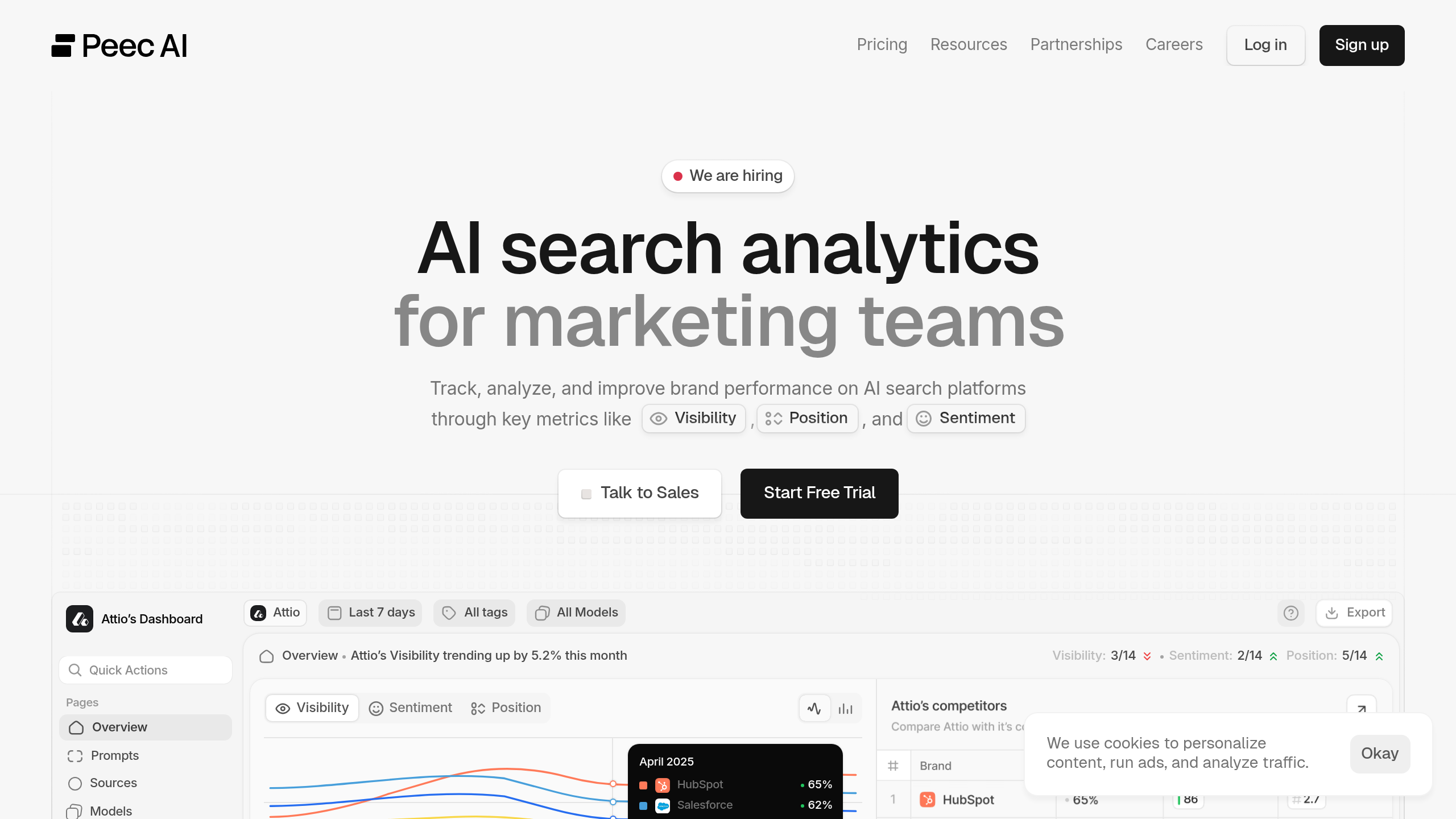
Peec.ai specializes in tracking how brands appear in AI-generated recommendations and suggestions. The platform focuses specifically on the recommendation use case—when users ask AI platforms for product suggestions, service providers, or solution recommendations.
Where This Tool Shines
Peec.ai excels at monitoring recommendation contexts where purchase intent is highest. When users ask AI platforms "What's the best [product category]?" or "Which [service] should I use?", this tool tracks whether your brand appears in those high-value responses.
The platform provides insights into the factors that influence AI recommendation decisions, helping brands understand why they're included or excluded from these critical moments. For retailers and DTC brands, its focus on shopping-intent prompts and category-level share of voice in AI shopping assistants makes the data directly tied to revenue.
Key Features & Capabilities
✅ Recommendation tracking: Monitor brand inclusion in AI-generated product and service recommendations.
✅ Positioning analysis: See where you rank within AI recommendation lists versus competitors.
✅ Context monitoring: Understand the specific use cases and scenarios where AI platforms recommend your brand.
✅ Competitive benchmarking: Track which competitors appear most frequently in recommendation contexts.
✅ Optimization suggestions: Receive guidance on improving recommendation likelihood.
Best For / Ideal Users
Peec.ai is particularly valuable for brands in competitive categories where AI recommendations directly influence purchase decisions. E-commerce brands, SaaS companies, and service providers benefit most from understanding their recommendation visibility. Product-led brands comparing shopping-focused options can also review our roundup of AI tools for optimizing product visibility.
9. Scrunch
Best for: Influencer marketing teams tracking how brand mentions by creators affect AI visibility and brand positioning.
Scrunch approaches AI visibility from an influencer marketing angle. The platform tracks how influencer content and creator mentions influence brand visibility across AI platforms, recognizing that AI models often reference popular creator content when forming brand recommendations.
Where This Tool Shines
Scrunch excels at connecting influencer marketing efforts to AI visibility outcomes. The platform helps brands understand how creator partnerships and influencer mentions contribute to or detract from brand positioning in AI-generated responses.
This approach recognizes that AI platforms don't only reference official brand content—they also synthesize information from creator reviews, social media discussions, and influencer recommendations when forming brand opinions.
Key Features & Capabilities
✅ Influencer impact tracking: Monitor how creator content affects brand visibility in AI platforms.
✅ Creator discovery: Identify influencers whose content AI platforms frequently reference.
✅ Sentiment analysis: Understand how influencer mentions shape AI-generated brand descriptions.
✅ Content performance: Track which creator content types drive the most AI visibility impact.
✅ Campaign measurement: Assess influencer marketing ROI including AI visibility effects.
Best For / Ideal Users
Scrunch is ideal for consumer brands with active influencer marketing programs. It's particularly valuable for companies in beauty, fashion, technology, and lifestyle categories where creator opinions significantly influence both consumer decisions and AI model knowledge about brands.
Other AI Visibility Platforms Worth Evaluating
Several adjacent platforms didn't make the main list but solve specific problems well. Consider them if your situation matches.
Otterly.AI
Otterly.AI treats AI visibility strictly as a search problem. It tracks your position in AI-generated answers across ChatGPT, Perplexity, and Google AI Overviews, reports which keywords and questions trigger mentions, and delivers automated weekly reports with competitive benchmarking. It suits SEO teams that want rank-tracking-style data for generative search without broader monitoring.
Knowatoa
Knowatoa focuses on inconsistency between models. Its side-by-side view shows how ChatGPT, Claude, and other systems describe your brand differently, scores portrayal consistency, and flags perception gaps where a model has conflicting or incomplete information. API access makes it useful for technical teams building custom dashboards.
Semrush AI Visibility Toolkit
For teams already working in Semrush, the AI Visibility Toolkit adds generative search monitoring as an add-on module. AI visibility metrics sit alongside traditional position tracking and competitive data in combined reports, so there's no new platform to learn. The trade-off is less AI-specific depth than purpose-built tools.
Brandwatch
Brandwatch is an enterprise social listening platform that has extended into AI conversation tracking. Its value is a unified view of brand perception across social, news, forums, and AI responses, with long-range historical trend analysis, crisis detection, and enterprise security controls. It fits large brands with existing social listening programs and custom enterprise budgets.
What Separates Leading AI Visibility Platforms
When evaluating AI visibility platforms, many marketers make the mistake of treating them like traditional analytics tools—measuring what already exists rather than uncovering what could be. The most valuable platforms don't just report on your current AI presence; they reveal the strategic opportunities hiding in the gaps between what AI platforms recommend and what they should recommend.
The difference between reactive tracking and proactive optimization fundamentally changes your ROI. A tool that simply tells you "your brand was mentioned 47 times this month" provides minimal actionable value. But a platform that identifies "AI platforms recommend your competitors for these 12 high-intent queries where your content is actually more comprehensive" gives you a roadmap for growth.
Beyond Basic Mention Tracking
First-generation AI visibility tools focused primarily on monitoring—counting mentions, tracking sentiment, and alerting you to changes. These capabilities remain important, but they represent only the foundation of what modern platforms should deliver.
The next evolution centers on opportunity identification. Advanced platforms analyze not just where you appear, but where you're conspicuously absent—particularly in contexts where your expertise, content, or solutions are highly relevant. They identify the queries where AI platforms consistently recommend competitors despite your superior or comparable offerings.
This shift from monitoring to opportunity discovery changes how marketing teams use these tools. Instead of passive observation, teams can actively pursue specific, high-value visibility gains based on concrete data about gaps in AI knowledge or recommendation patterns.
Content Gap Analysis That Drives Action
The most sophisticated AI visibility platforms connect the dots between your absence in AI recommendations and specific content deficiencies you can address. When AI platforms ignore your brand for relevant queries, there's usually a reason—and identifying that reason is where real optimization begins.
Effective platforms examine why AI models overlook your content. Common reasons include insufficient topic coverage, lack of authoritative signals, outdated information, or formatting that makes content difficult for AI systems to parse and extract. The best tools don't just identify these issues—they prioritize them based on potential impact.
For example, you might discover that AI platforms consistently recommend competitors when users ask about a specific use case your product handles well. Investigation reveals you have no dedicated content addressing that use case directly. This represents a clear content opportunity: create comprehensive resources specifically addressing that scenario, and you'll likely capture those AI recommendations.
Query-Level Visibility Intelligence
Generic visibility metrics provide limited strategic value. Knowing your "overall AI visibility score" doesn't tell you where to focus optimization efforts. The platforms that drive real results operate at the query level, showing you exactly which questions, searches, and prompts trigger competitor mentions instead of yours.
This granular approach reveals patterns you can act on. You might find that AI platforms readily recommend your brand for basic informational queries but consistently favor competitors for comparison or evaluation queries. This insight suggests specific content types to develop—detailed comparison guides, use case analyses, or implementation resources that address the evaluation mindset.
Query-level data also helps content teams understand the language patterns and phrasings that improve citation likelihood. When you see which variations of similar questions trigger your mentions versus competitor mentions, you gain insights into the semantic signals AI platforms prioritize.
Competitive Intelligence That Reveals Strategy
Understanding your own visibility means little without competitive context. The most valuable platforms provide detailed analysis of how competitors achieve their AI presence, revealing strategies you can adapt or opportunities they've overlooked.
This goes beyond simple share-of-voice comparisons. Advanced platforms identify the specific content assets, structural approaches, and topical coverage that make competitor content citation-worthy. They reveal which competitors dominate which query categories and why—information that informs both your content strategy and positioning decisions.
Competitive analysis becomes particularly powerful when it reveals asymmetric opportunities. Perhaps competitors dominate product comparison queries but rarely appear in how-to content. Or they're strongly associated with one use case but absent from adjacent applications. These gaps represent opportunities to establish visibility in underserved areas.
Integration With Content Operations
AI visibility optimization can't exist in isolation from your broader content operations. The most practical platforms integrate with the tools content teams already use—content management systems, SEO platforms, analytics tools, and project management software.
This integration enables teams to incorporate AI optimization into existing workflows rather than treating it as a separate initiative requiring dedicated processes. When your AI visibility platform can push optimization recommendations directly into your content management system or assign content gap tasks through your project management tool, execution becomes dramatically more efficient.
Integration also allows you to correlate AI visibility with downstream outcomes. Connecting AI mention data with web analytics, CRM systems, and conversion tracking helps demonstrate the business impact of improved AI visibility—critical for securing continued investment in optimization efforts.
Actionable Recommendations, Not Just Data
The gap between insight and action determines whether teams actually improve their AI visibility. Platforms that simply present data about your current state leave the strategic work entirely to you. More sophisticated tools translate visibility gaps into specific, prioritized recommendations.
Look for platforms that suggest concrete content improvements, structural changes, or topical additions that address identified gaps. The best recommendations connect directly to missed opportunities—telling you not just "create more content about X" but "create comprehensive content about X because AI platforms recommend competitors 87% of the time for these related queries despite your relevant expertise."
Prioritization matters as much as identification. With limited resources, teams need guidance on which opportunities offer the highest potential return. Platforms that estimate the visibility impact of addressing specific content gaps help teams make informed decisions about where to focus optimization efforts.
What This Means for Your Selection Process
When evaluating AI visibility platforms, shift your assessment criteria from "what can this tool measure?" to "what opportunities can this tool uncover?" The platforms that drive meaningful results help you discover and prioritize the specific content developments that will improve your AI presence.
Ask potential vendors to demonstrate not just their tracking capabilities, but their opportunity identification features. Request examples of how the platform identifies content gaps, analyzes competitive positioning, and translates visibility data into actionable content recommendations. The quality of these strategic capabilities matters far more than the sophistication of the tracking dashboard.
The brands winning in AI search aren't those with the most comprehensive monitoring—they're the ones that most effectively identify and fill the content gaps that prevent AI platforms from recommending them. Choose tools that illuminate those gaps and provide clear paths to filling them.
How to Track AI Visibility and Answer Engine Optimization Performance Over Time
AI responses are non-deterministic, so a single check tells you little. Measuring answer engine optimization (AEO) progress requires a consistent methodology. Whichever tool you choose, make sure it supports the following:
- A fixed prompt set: Track the same commercial, comparison, and informational prompts on every run so changes reflect your work, not a shifting sample.
- A regular cadence: Daily or weekly sampling smooths out response variance and reveals real trends.
- Model-by-model breakdowns: ChatGPT, Claude, Perplexity, Gemini, and Google AI Overviews often describe the same brand differently; aggregate scores hide these gaps.
- Core metrics: Mention rate, share of voice versus named competitors, position within recommendation lists, sentiment, and which of your URLs get cited.
- Citation-source history: Knowing which third-party pages AI engines rely on, and how that list changes, tells you where PR and content efforts are landing.
Among the tools above, Sight AI (AI Visibility Score and prompt-level tracking across AI models), PromptWatch (historical response archives), AI SEO Tracker (visibility trends and citation sources), Profound (perception scoring and alerts), and Otterly.AI (weekly automated reports) are built for longitudinal tracking. Content tools like Writesonic and Frase don't measure AI visibility themselves, so pair them with one of these trackers to confirm that new content actually moves your numbers.
Complementary SEO Tools in an AI Visibility Stack
No single tool covers every layer of brand visibility. AI models still lean heavily on pages that are indexed, authoritative, and well-structured, so traditional SEO tools remain part of the stack:
- Google Search Console: Free, first-party data on clicks, impressions, indexing status, and Core Web Vitals. Pages that aren't indexed can't be retrieved by AI search features either, making it the baseline for any team.
- Semrush and Ahrefs: Keyword, backlink, and competitive data. Ahrefs' backlink index and Content Explorer are especially useful for finding unlinked brand mentions and authority-building opportunities.
- Surfer SEO, Clearscope, and Frase: On-page content optimization using NLP-based term and topic coverage, which supports the comprehensiveness AI models favor when choosing sources.
- Moz Pro: Domain Authority benchmarks and Moz Local for consistent NAP data, relevant for multi-location brands.
- Mention or Brandwatch: Web and social mention monitoring. Mention offers an affordable entry point for small teams; Brandwatch serves enterprise reputation management.
Making the Right Choice
The right AI visibility tool depends on where you are in your optimization journey and what infrastructure you already have in place.
You can also compare these options against a wider field in our comprehensive guide to AI visibility software tools, which evaluates additional platforms across pricing tiers and use cases.
For teams starting from scratch or those who need dedicated AI visibility tracking, Sight AI offers the most comprehensive purpose-built solution. If you're already invested in enterprise SEO platforms, BrightEdge or Conductor provide seamless integration with existing workflows. Mid-market teams using Semrush or Ahrefs can add AI visibility features without switching platforms, while smaller businesses benefit from Moz Pro's accessible approach and educational resources.
Content-focused teams should consider MarketMuse or Clearscope for page-level optimization that improves both traditional search performance and AI citation likelihood. These tools excel at ensuring your content meets the comprehensiveness standards AI platforms demand.
A practical way to assemble a stack by team size:
- Solo founders and early-stage teams: Google Search Console plus one dedicated AI visibility tracker such as Sight AI or AI SEO Tracker. Add Mention if web mention monitoring matters.
- Growing marketing teams: An AI visibility platform with content capabilities, paired with Semrush or Ahrefs for keyword and competitive data, plus Surfer SEO, Clearscope, or Frase once content volume justifies it.
- Agencies and enterprises: An AI visibility platform with competitive and query-level data, an SEO suite, Brandwatch or Profound for perception monitoring, and AirOps if you need to operationalize optimization across large libraries or multiple brands.
Before committing, answer three questions: Do you need data to inform manual content decisions, or automation that acts on visibility insights? Which AI platforms does your audience actually use? Does the data need to flow into existing analytics and CRM tools, or can you work from a standalone dashboard?
Frequently asked questions
What is AI visibility optimization?
AI visibility optimization is the practice of measuring and improving how often, how accurately, and how favorably AI systems such as ChatGPT, Claude, Perplexity, Gemini, and Google AI Overviews mention, cite, and recommend your brand. It combines prompt-level tracking with content, technical SEO, and PR work aimed at the sources AI models rely on.
Which is the best AI visibility optimization tool?
It depends on the job. For combined tracking and content execution, Sight AI is the most complete purpose-built option. AI SEO Tracker suits lean teams that want affordable citation-source data, Profound suits enterprise analytics, Peec.ai suits recommendation-driven e-commerce, and Semrush's toolkit suits teams consolidating inside an existing SEO platform.
Which tools track AI search visibility and answer engine optimization performance over time?
Sight AI, PromptWatch, AI SEO Tracker, Profound, Peec.ai and Otterly.AI all store historical results for a fixed prompt set, so you see trends rather than one-off snapshots. Content tools such as Writesonic and Frase do not measure visibility. See the tracking methodology section above for the metrics and sampling cadence to require before you buy.
Can traditional SEO tools track AI visibility?
Partly. Semrush offers an AI Visibility Toolkit add-on, but most traditional suites measure rankings and backlinks rather than how AI models describe or recommend you. Dedicated platforms provide prompt-level, model-by-model data, citation sources and sentiment that SEO tools don't. Keep Search Console and your SEO suite for indexing and authority, and add a dedicated tracker for generative answers.
How long does it take to improve AI visibility?
Expect to measure in weeks to months. Retrieval-based engines like Perplexity and Google AI Overviews can reflect newly indexed content relatively quickly, which is why fast indexing matters, while changes in how models describe your brand from training data take longer. Consistent tracking over a fixed prompt set is the only reliable way to confirm progress.
The brands gaining ground in AI search aren't waiting for perfect tools or complete strategies—they're starting now with the intelligence platforms that match their current capabilities and scaling from there. Start tracking your AI visibility today and discover where your brand appears in the conversations that matter most to your audience.