Search is no longer what it used to be. While marketers obsess over keyword rankings and backlink profiles, a quiet revolution is reshaping how content gets discovered. AI assistants like ChatGPT, Claude, and Perplexity are becoming primary information sources for millions of users—and they're selecting content based on entirely different criteria than traditional search engines.
Here's the challenge: your content might rank beautifully on Google, but if AI models aren't citing or recommending it, you're missing a growing segment of organic traffic. Traditional SEO tactics that worked for years are yielding diminishing returns, while marketers who understand AI-powered discovery are seeing exponential growth.
This isn't about abandoning traditional SEO. It's about expanding your approach to capture traffic from both traditional search engines and AI-powered discovery channels. The brands winning in 2026 are those treating AI visibility as seriously as they treat Google rankings—because in the new organic traffic equation, both matter equally.
This guide breaks down the practical steps for leveraging AI across your entire organic growth funnel. From content creation and optimization to technical indexing and measurement, you'll learn how to position your brand for discovery in an AI-first search landscape.
The New Organic Traffic Equation: Why AI Changes Everything
Traditional SEO taught us a simple formula: target the right keywords, earn quality backlinks, optimize technical elements, and traffic follows. That formula still works—but it's no longer complete.
Today's organic traffic comes from two distinct discovery channels. The first is familiar: traditional search engines where users type queries and click through to websites. The second is newer and rapidly growing: AI assistants that synthesize information from multiple sources and present direct answers, often with citations to original content.
Think of it like this: when someone asks ChatGPT "What's the best marketing automation platform for small businesses?", the AI doesn't just regurgitate a list of keywords. It analyzes content from across the web, evaluates authority signals, considers freshness, and constructs a nuanced response—potentially mentioning your brand or your competitor's.
This creates what we call the dual discovery paradigm. Your content must satisfy two different sets of criteria: traditional search algorithms that prioritize keywords, backlinks, and user engagement signals, AND AI models that evaluate how easily your content can be parsed, understood, and cited.
The difference is fundamental. Google's algorithm looks at your site's authority, technical optimization, and how users interact with your pages. AI models look at how clearly you explain concepts, how well-structured your information is, and whether your content provides citeable facts and insights.
Where traditional SEO rewards comprehensive keyword coverage, AI discovery rewards clarity and conversational structure. Where traditional SEO values backlink quantity and quality, AI models value how quotable and authoritative your specific statements are.
This shift explains why some brands with modest traditional SEO metrics are getting mentioned frequently by AI assistants, while others with strong domain authority are rarely cited. The rules of discovery have expanded, and brands that master both channels will capture the lion's share of organic traffic growth.
The practical implication? You can no longer optimize for just one discovery channel. Your content strategy must address both traditional search visibility and AI recommendation likelihood—or you're leaving half your potential organic traffic on the table.
AI-Powered Content Creation That Scales
Content velocity has always mattered for organic growth, but AI has fundamentally changed what's possible. The old constraint was simple: quality content takes time, and human writers can only produce so much. That bottleneck is dissolving.
Multi-agent AI systems represent a leap beyond simple content generation tools. Instead of one AI model trying to handle every aspect of content creation, specialized agents coordinate on different tasks. One agent researches the topic and identifies key points. Another structures the outline. A third writes the content. A fourth optimizes for SEO. A fifth ensures GEO optimization for AI discovery.
This division of labor mirrors how editorial teams work, but operates at machine speed. The result is content that maintains quality and brand voice while scaling to volumes previously impossible for human teams alone.
Here's where it gets interesting: these systems can operate in autopilot mode. You set content parameters—topics, keywords, brand voice guidelines, target audience—and the system continuously produces optimized articles. No manual intervention required for each piece.
But scaling content creation is only valuable if the content actually drives traffic. This is where dual optimization becomes critical. Every piece must be optimized for both traditional SEO metrics (keyword placement, semantic relevance, internal linking) and GEO factors (conversational structure, citeable facts, clear explanations).
Content freshness signals play an increasingly important role in both channels. Search engines have always valued fresh content, but AI models show even stronger preferences for recently published information. When an AI assistant answers a question about current best practices or emerging trends, it gravitates toward content published in recent months over older articles—even if those older articles have stronger traditional authority signals.
This creates an advantage for brands that can maintain high content velocity. Publishing multiple optimized articles weekly keeps your brand top-of-mind for AI models evaluating current information sources. It's not just about quantity—it's about maintaining a continuous presence in the information landscape AI models scan.
The quality question inevitably arises: can automated systems really maintain the authority and expertise that builds trust? The answer lies in how you deploy them. AI content systems work best as force multipliers for human expertise, not replacements. Subject matter experts provide strategic direction, review key pieces, and inject proprietary insights that AI can't generate independently.
Think of it as shifting human effort from mechanical writing tasks to higher-value strategic and editorial work. Your team focuses on what humans do best—strategic thinking, unique perspectives, relationship-building—while AI handles the scalable production work.
Optimizing for AI Discovery and Citations
Getting your content in front of AI models is one challenge. Getting them to actually cite and recommend it is another entirely.
AI models don't just randomly select sources. They evaluate content based on specific characteristics that make information easy to parse, verify, and present to users. Understanding these characteristics is the foundation of GEO—Generative Engine Optimization.
Start with content structure. AI models prefer content organized in clear, logical hierarchies. When information flows from broad concepts to specific details, with clear section breaks and descriptive headings, AI can more easily extract relevant information for specific queries.
Compare two articles on the same topic. The first uses vague headings like "Getting Started" and "Next Steps." The second uses specific headings like "Prerequisites and Required Tools" and "Step-by-Step Implementation Process." When an AI model searches for implementation guidance, the second article's structure makes it trivially easy to locate and cite the relevant section.
Conversational optimization matters more than most marketers realize. AI assistants engage in dialogue, not keyword matching. Content written in conversational, question-answering formats aligns naturally with how AI models construct responses.
This doesn't mean dumbing down your content. It means structuring information the way you'd explain it to a smart colleague. Use natural language. Address common questions directly. Provide clear, citeable statements rather than vague generalizations.
Consider how you present facts and insights. AI models look for statements they can confidently cite. Compare "Many businesses see improvements" versus "Companies implementing this approach typically experience faster time-to-value and reduced operational complexity." The second provides specific, citeable information without fabricated statistics.
Authority signals work differently in AI discovery than traditional SEO. While backlinks matter for traditional search, AI models evaluate authority based on how your content demonstrates expertise. Do you provide nuanced analysis? Do you acknowledge complexity and trade-offs? Do you cite other authoritative sources appropriately?
Brand mentions across AI platforms create a feedback loop. When AI models consistently mention your brand in relevant contexts, it reinforces your authority in that topic area. This is why tracking AI visibility matters—you need to understand how AI models currently perceive and discuss your brand.
Sentiment analysis reveals whether AI mentions are positive, neutral, or negative. If an AI assistant mentions your brand but frames it negatively or with caveats, that signals content optimization opportunities. You need to publish content that shifts the narrative and provides AI models with better source material.
Prompt tracking shows which user queries trigger mentions of your brand. This intelligence is gold for content strategy. If you're getting mentioned for queries about basic features but not advanced use cases, you know where to focus content development efforts.
The competitive intelligence angle is equally valuable. Understanding how AI models discuss your competitors reveals gaps and opportunities. If competitors are getting cited for topics where you have equal or superior expertise, it signals optimization opportunities in your content.
Technical Foundations: Indexing and Content Velocity
Publishing great content means nothing if search engines and AI models don't discover it quickly. Indexing speed has become a critical competitive advantage in organic traffic growth.
Traditional indexing relied on search engine crawlers discovering new content on their own schedule. You published an article and waited—sometimes days or weeks—for search engines to find, crawl, and index it. During that lag time, your content generated zero organic traffic.
IndexNow protocol changes this equation completely. Instead of waiting for crawlers, your site proactively notifies search engines the moment new content publishes. Supported by Microsoft Bing, Yandex, and other search engines, IndexNow enables near-instant indexing of new and updated content.
Think about the impact: publish an article optimized for a trending topic, and it can start appearing in search results within minutes instead of days. For time-sensitive content, news-related topics, or competitive keywords, this speed advantage is substantial.
Automated sitemap updates work in parallel with IndexNow. Your sitemap should update automatically every time content publishes or changes, ensuring search engines always have current information about your site structure and content freshness.
This technical foundation enables true content velocity. When you can publish multiple optimized articles weekly and know they'll be indexed immediately, you can maintain the consistent content freshness that both search engines and AI models favor.
CMS integration eliminates the other major bottleneck in content operations: manual publishing. When your content generation system can publish directly to your CMS, you remove the human delay between content creation and publication.
This doesn't mean abandoning editorial oversight. Smart workflows include review queues where human editors approve content before publication. But for certain content types—data-driven articles, routine updates, topic coverage—autopilot publishing makes sense.
The compound effect of these technical foundations is significant. Faster indexing means faster traffic. Higher content velocity means more opportunities for rankings and AI citations. Automated publishing means your content operations can scale without proportional increases in manual effort.
Site speed and technical SEO fundamentals still matter, of course. Fast-loading pages, mobile optimization, clean HTML structure—these basics remain important for both traditional search and AI discovery. But in 2026, indexing speed has emerged as the differentiator between brands that grow organic traffic quickly and those that struggle. Understanding why content isn't indexed quickly can help you identify and fix the technical barriers costing you traffic.
Measuring What Matters: AI Visibility Metrics
Traditional analytics tell you how much traffic you're getting from search engines. They don't tell you anything about how AI models are discussing your brand—and that blind spot is increasingly costly.
AI visibility tracking represents a new category of marketing intelligence. It answers questions traditional analytics can't: How often do AI assistants mention your brand? In what contexts? With what sentiment? For which user queries?
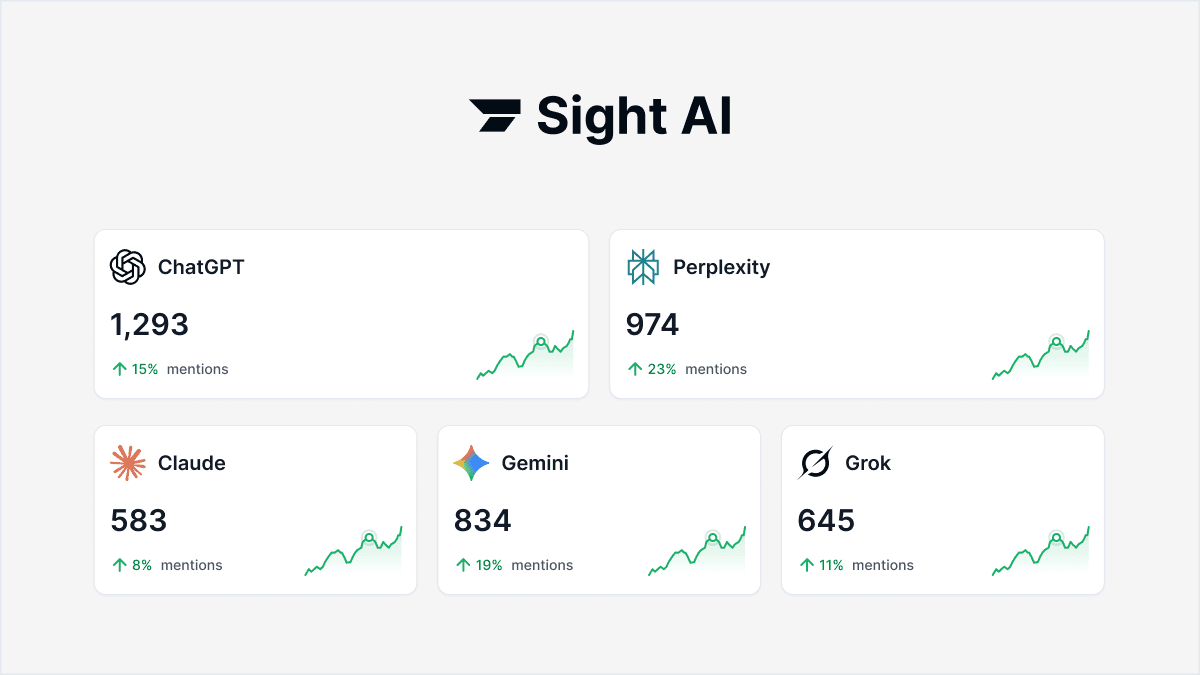
Tracking brand mentions across ChatGPT, Claude, and Perplexity reveals your share of voice in AI-assisted search. If users are asking these platforms about your industry or product category, are you being mentioned? Are competitors being recommended instead?
This visibility data creates actionable intelligence. Low mention frequency signals that your content isn't optimized for AI discovery. High mention frequency with negative sentiment signals narrative problems you need to address through strategic content.
Sentiment analysis goes beyond simple positive/negative classification. It reveals how AI models frame your brand. Are you mentioned as an industry leader or a budget option? Are you cited for innovation or reliability? These nuances shape user perception and purchase decisions.
Consider two brands in the same category. Brand A gets mentioned frequently but primarily in contexts about "affordable alternatives" and "basic features." Brand B gets mentioned less frequently but in contexts about "advanced capabilities" and "enterprise solutions." Which brand is better positioned? The answer depends on their target market and positioning goals—but both need that intelligence to optimize effectively.
Prompt tracking reveals the specific user queries that trigger brand mentions. This data directly informs content strategy. If you're getting mentioned for "getting started" queries but not "advanced implementation" queries, you know where to focus content development.
Competitive intelligence through AI visibility tracking provides strategic advantages. You can monitor how frequently competitors are mentioned, in what contexts, and with what sentiment. When a competitor starts getting increased mentions, you can investigate what content or positioning changes drove that shift.
This intelligence also reveals white space opportunities. If neither you nor competitors are being mentioned for certain relevant queries, it signals an opportunity to create authoritative content that fills that gap.
The measurement framework for AI-driven organic growth combines traditional metrics with AI visibility data. Track both your traditional search rankings and your AI mention frequency. Monitor both traditional organic traffic and the sentiment of AI discussions about your brand. Measure both keyword positions and prompt coverage.
This comprehensive view reveals the full picture of your organic presence. You might have strong traditional SEO metrics but weak AI visibility—or vice versa. Understanding both dimensions enables strategic resource allocation and optimization priorities.
Building Your AI-Driven Organic Growth Stack
Understanding AI-powered organic growth is one thing. Implementing it systematically is another. The brands seeing results have built integrated technology stacks around three core pillars.
The first pillar is AI content generation. This includes multi-agent systems capable of producing SEO and GEO optimized long-form content at scale. Look for solutions that offer autopilot modes, CMS integration, and customizable brand voice parameters. The goal is content velocity without sacrificing quality. Exploring AI content writer with autopilot capabilities can help you understand what's possible with modern systems.
The second pillar is AI visibility tracking. You need tools that monitor how ChatGPT, Claude, Perplexity, and other AI platforms mention and discuss your brand. Sentiment analysis and prompt tracking capabilities are essential for actionable intelligence.
The third pillar is automated indexing. IndexNow integration and always-updated sitemaps ensure your content gets discovered immediately after publication. This technical foundation makes content velocity valuable—there's no point publishing frequently if that content sits unindexed for days. Learning how to increase Google crawl rate is essential for maximizing your indexing speed.
These three pillars work synergistically. AI content generation creates the volume. Automated indexing ensures rapid discovery. AI visibility tracking measures impact and informs optimization. Together, they create a flywheel effect where each component amplifies the others.
Your implementation roadmap depends on your current baseline. If you're starting from scratch with limited organic traffic, begin with content generation and indexing. Build a foundation of optimized content that gets discovered quickly. Once you have consistent content velocity, add AI visibility tracking to measure impact and guide optimization.
If you already have strong traditional SEO but limited AI visibility, start with tracking to understand your current AI presence. Use that intelligence to optimize existing content for AI discovery and guide new content development. Add content generation capabilities to scale your optimized content production.
If you have high content velocity but slow traffic growth, your bottleneck is likely indexing speed or optimization quality. Implement IndexNow integration first, then audit content for both SEO and GEO optimization. Use AI visibility tracking to identify specific optimization opportunities.
Common pitfalls to avoid: Don't treat AI content generation as a replacement for strategy. Automation scales execution, but humans still need to provide strategic direction, topic selection, and editorial oversight. Don't ignore traditional SEO fundamentals while chasing AI optimization. Both matter. Don't publish content without tracking its impact on both traditional search rankings and AI visibility.
Integration is key. Your content generation system should publish directly to your CMS. Your indexing should trigger automatically on publication. Your visibility tracking should monitor both traditional and AI channels. When these systems work together seamlessly, you achieve true autopilot organic growth.
The resource allocation question is practical: how much should you invest in each pillar? A balanced approach allocates roughly equal attention to all three. Overinvesting in content generation without visibility tracking means you're flying blind. Strong tracking without content generation means you see opportunities but can't execute at scale. Great content without fast indexing means delayed results.
Putting It All Together
Increasing organic traffic with AI isn't about choosing between traditional SEO and AI optimization—it's about mastering both. The brands winning in 2026 understand that organic discovery now happens across two parallel channels, each with distinct requirements and opportunities.
The strategic framework is clear: create optimized content at scale using multi-agent AI systems, ensure rapid indexing through IndexNow and automated sitemaps, optimize for both traditional search and AI discovery, and measure impact through comprehensive visibility tracking across both channels.
This approach requires integrated technology, but more importantly, it requires a mindset shift. Stop thinking about organic traffic as purely a function of keyword rankings and backlinks. Start thinking about it as a function of visibility across all discovery channels—traditional search engines and AI assistants alike.
The first-mover advantage is real and temporary. As more brands recognize the importance of AI visibility and optimize accordingly, competition will intensify. The brands acting now are establishing authority signals and content footprints that will compound over time. Those waiting are ceding ground to competitors who understand the new rules of organic discovery.
Implementation doesn't require a complete overhaul of your existing content marketing operations. Start with one pillar—whether that's content generation, indexing optimization, or visibility tracking—and build from there. The key is starting systematically rather than trying to do everything at once.
The measurement framework is straightforward: track traditional organic traffic alongside AI mention frequency and sentiment. Monitor keyword rankings alongside prompt coverage. Measure content velocity alongside indexing speed. This comprehensive view reveals where you're strong, where you're weak, and where to focus optimization efforts.
The opportunity is substantial. While many brands still focus exclusively on traditional SEO, AI-assisted search is growing rapidly. Users are increasingly turning to AI assistants for information, recommendations, and decision support. Brands that appear in those AI responses are capturing organic traffic from AI search that competitors don't even know exists.
Stop guessing how AI models like ChatGPT and Claude talk about your brand—get visibility into every mention, track content opportunities, and automate your path to organic traffic growth. Start tracking your AI visibility today and see exactly where your brand appears across top AI platforms.