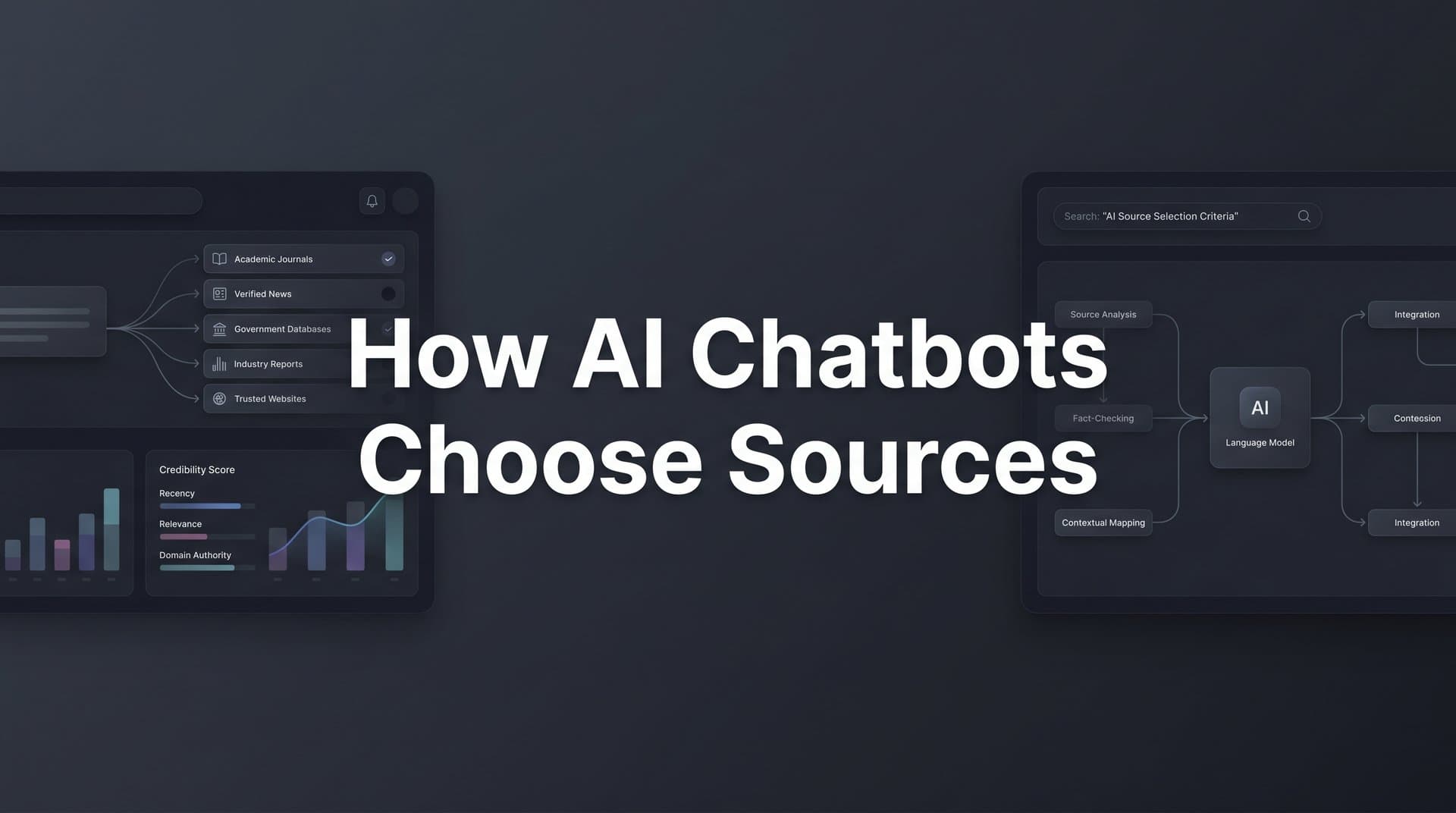
AI chatbots choose sources in two layers. First, a model's training data decides which brands and sites it already "knows". Second, for live answers, a retrieval system (RAG) searches an index, ranks pages by semantic relevance, authority, freshness and how easy they are to parse, then passes the top passages to the model to synthesize and cite. ChatGPT, Claude and Perplexity weight these layers differently, so the same question can produce different brands and citations.
Ask ChatGPT about project management software and it may recommend Asana, Monday.com and ClickUp. Claude may add Notion and Trello, and Perplexity may cite a different set of pages. For marketers and founders, that difference decides who gets visibility in AI search. The selection is not random. It follows patterns you can identify, and this guide explains them layer by layer.
The Foundation Layer: How Training Data Shapes AI Knowledge
Before an AI model ever answers your question, it has already formed opinions about which sources matter. These opinions crystallize during the training process, when models ingest massive datasets scraped from across the internet.
Think of it like this: if you spent years reading only certain publications, those sources would naturally dominate your mental reference library. AI models work the same way. During training, they process billions of web pages, licensed content from publishers, books, research papers, and curated datasets. The content that appears most frequently, most prominently, and most authoritatively in this training data becomes the model's baseline knowledge.
This creates a fundamental advantage for established brands. If your company was mentioned consistently across high-quality sources during the model's training window, you're already in the AI's reference library. A startup that launched after the training cutoff date? It's essentially invisible to the base model, no matter how innovative the product. Understanding how AI chooses brands to mention starts with recognizing this training data foundation.
But frequency alone doesn't guarantee visibility. AI training processes weight sources based on authority signals embedded in the data itself. Content from domains with strong backlink profiles, consistent technical structure, and clear topical expertise gets weighted more heavily than random blog posts. The model learns to recognize patterns that correlate with reliability.
Content recency during training windows matters enormously. Most large language models have training cutoffs—specific dates beyond which they have no native knowledge. GPT-4's training data, for instance, extends through specific periods, creating a knowledge boundary. Content published after that cutoff doesn't exist in the model's base knowledge, fundamentally limiting its ability to cite newer sources without additional mechanisms.
The depth of topical coverage also influences training data selection. AI models don't just absorb individual facts—they build conceptual networks. When multiple authoritative sources discuss a brand in connection with specific use cases, features, or industry categories, the model develops stronger associations. A brand mentioned superficially across scattered sources has weaker representation than one discussed in depth across focused, authoritative content.
This training foundation explains why certain brands dominate AI responses even when newer, potentially better alternatives exist. The model's base knowledge reflects the internet as it existed during training, creating momentum for brands that invested in content and authority building early.
Real-Time Intelligence: How RAG Systems Select Current Sources
Training data creates the foundation, but it doesn't explain how AI models cite sources from last week or discuss brands that didn't exist during training. Enter Retrieval-Augmented Generation, the technology that allows AI models to fetch and incorporate real-time information.
RAG systems work like an intelligent research assistant sitting between you and the AI model. When you ask a question, the RAG system first searches external sources—web indexes, proprietary databases, curated knowledge bases—to find relevant, current information. It then feeds this retrieved content to the language model, which synthesizes it into a coherent response.
The critical moment happens during retrieval and ranking. The RAG system doesn't just grab random sources—it evaluates and ranks them based on multiple factors. Semantic relevance comes first: how closely does the content match the user's actual query intent? This goes beyond simple keyword matching to understand conceptual alignment. Learning how AI models select sources reveals the complexity behind these ranking decisions.
Domain authority plays a massive role in RAG ranking. Systems often incorporate signals similar to traditional SEO: domain age, backlink profiles, technical site quality, and historical reliability. A source from an established, authoritative domain ranks higher than identical content from an unknown site. This creates a compounding advantage for brands that have invested in domain authority over time.
Content freshness receives special weight in RAG systems, particularly for queries where recency matters. When someone asks about current events, product releases, or trending topics, the system prioritizes recently published or updated content. This creates opportunities for newer brands—if you can publish authoritative, timely content, you can bypass the training data disadvantage.
Structured data and clear content organization significantly improve RAG selection likelihood. Content with proper schema markup, clear headings, well-formatted lists, and logical information architecture is easier for retrieval systems to parse and understand. The AI can quickly extract relevant facts, making these sources more valuable for citation.
Different AI platforms implement RAG differently, creating varying citation behaviors. Perplexity AI selects sources with transparent citation, showing users exactly which sources informed each part of the response. ChatGPT's browsing mode uses RAG but often synthesizes without explicit attribution. Claude can access current information through integrations but handles citations differently than Perplexity.
This variation matters for marketers. Understanding which AI platforms use which retrieval methods helps you target optimization efforts. Content optimized for Perplexity's citation-heavy approach needs different characteristics than content targeting ChatGPT's synthesis-focused responses.
The 7 signals at a glance
| Signal | Layer | What it means in practice |
|---|---|---|
| Training-data presence | Model | Consistent mentions in quality sources before the cutoff |
| Semantic relevance | Retrieval | A passage answers the exact question, not just the keyword |
| Domain authority | Retrieval | Backlinks, site history and technical quality |
| Freshness | Retrieval | Recent publication or update for time-sensitive queries |
| Parseability | Retrieval | Clear headings, lists, tables and schema markup |
| Corroboration | Both | Independent sources agree on the same facts or brand |
| Quotability | Generation | Specific, verifiable statements and original data |
Recognition Patterns: Authority Signals AI Models Trust
AI models don't evaluate sources in isolation. They recognize patterns of authority that emerge across the broader information ecosystem. Understanding these recognition patterns reveals why some brands consistently get cited while others remain invisible.
Entity recognition sits at the core of AI authority assessment. Large language models build entity graphs during training—networks of relationships between brands, people, concepts, and topics. When a brand appears consistently across multiple high-quality sources, the model develops strong entity recognition. It "knows" that brand as a legitimate player in its category.
This creates a network effect for brand mentions. A company mentioned once in a single article has weak entity recognition. A company mentioned across dozens of authoritative sources, discussed in various contexts, and linked to specific use cases develops strong entity recognition. The AI model treats these entities as more authoritative sources by default. This explains how AI chatbots mention brands with varying levels of confidence.
Topical clustering amplifies authority signals. When your brand appears consistently in content about specific topics, the AI associates you with expertise in those areas. A marketing automation platform mentioned repeatedly in content about email campaigns, lead nurturing, and customer journeys builds stronger topical authority than a platform mentioned sporadically across unrelated topics.
Cross-referencing between sources serves as a trust signal. When multiple independent, authoritative sources reference the same brand or cite similar information, AI models interpret this as validation. It's the digital equivalent of corroboration—if multiple trusted sources agree, the information gains credibility.
Clear expertise signals within content itself influence authority recognition. Content that demonstrates deep knowledge through specific examples, technical accuracy, unique insights, and comprehensive coverage signals expertise to AI systems. Surface-level content that rehashes common knowledge without adding value gets lower authority weight.
Consistent brand presentation across sources matters more than many marketers realize. When your brand name, category positioning, and key differentiators appear consistently across multiple sources, AI models develop clearer, more confident representations. Inconsistent messaging across sources creates confusion, potentially reducing citation likelihood.
The distinction between primary and secondary sources affects authority assessment. Content that presents original research, unique data, or firsthand expertise signals primary source status. Content that summarizes or aggregates information from other sources gets tagged as derivative. AI models generally prefer citing primary sources when available.
Building Systematic Authority
Authority isn't built through individual pieces of content—it emerges from systematic patterns across your entire content ecosystem. Brands that consistently publish expert-level content, earn mentions in authoritative publications, and maintain clear topical focus build the kind of authority signals AI models recognize and reward.
Content DNA: What Makes Information AI-Quotable
Not all content is equally quotable. AI models gravitate toward specific content characteristics that make information easier to extract, verify, and cite. Understanding these characteristics helps you create content that AI systems naturally want to reference.
Definitive statements carry more citation weight than hedged language. When content makes clear, specific claims backed by evidence, AI models can extract quotable facts. Compare "Some experts believe email marketing might be effective" to "Email marketing generates an average ROI of $42 for every dollar spent, according to the Data & Marketing Association." The second statement is concrete, specific, and citable.
Unique data and original research create citation magnets. When you publish information that doesn't exist elsewhere—proprietary research, original surveys, unique case studies with named companies and verifiable results—you become the primary source. Understanding how AI models cite sources reveals why original data earns more references than aggregated content.
Clear, logical explanations improve quotability dramatically. Content that breaks down complex concepts into understandable components, uses analogies effectively, and progresses logically from introduction to conclusion is easier for AI to process and synthesize. Dense, jargon-heavy content that assumes extensive prior knowledge creates friction.
Formatting patterns significantly impact AI citation likelihood. Content with clear hierarchical structure, descriptive headings, concise paragraphs, and well-formatted lists is easier for both RAG systems and language models to parse. The AI can quickly identify relevant sections and extract specific information.
Specificity beats generalization in AI citations. Content that provides specific examples, names actual tools or companies, includes concrete numbers, and describes particular use cases gives AI models quotable material. Generic advice that could apply to anything rarely gets cited because it doesn't add unique value.
The distinction between opinion and fact matters to AI systems. Factual content with clear evidence gets weighted differently than opinion pieces. While AI models can cite both, they treat verifiable facts as more authoritative for most queries. This doesn't mean opinion content lacks value—it means understanding the difference helps you position content appropriately.
Comprehensive coverage within focused topics improves citation likelihood. Content that thoroughly explores a specific subject, addressing common questions, covering edge cases, and providing actionable details, becomes a reference resource. Surface-level content that touches on many topics without depth rarely earns citations.
Current, updated content receives preference for time-sensitive queries. Maintaining content freshness through regular updates, adding new examples, incorporating recent developments, and updating statistics keeps content relevant for AI citation. Stale content from years ago might still exist in training data but won't get prioritized by RAG systems.
Visibility Intelligence: Tracking and Optimizing AI Citations
Understanding how AI models choose sources is only valuable if you can measure your own visibility and systematically improve it. Building an effective AI visibility strategy requires both monitoring and optimization.
Tracking AI mentions starts with systematic testing across multiple platforms. Query each major AI model with questions relevant to your category, use cases, and competitive landscape. Document which brands get mentioned, in what contexts, and with what framing. This baseline reveals your current AI visibility position. Learning how to track your brand in AI chatbots provides the foundation for any optimization strategy.
Prompt variation uncovers different citation patterns. The same basic question phrased differently can trigger different source selections. Test multiple query formulations: direct questions, comparison requests, use-case-specific queries, and problem-solution framings. Each variation reveals different aspects of AI visibility. Running these prompts by hand gets unmanageable quickly; automated prompt tracking across AI models records which brands and sources appear for each prompt over time.
Sentiment analysis within AI responses matters as much as raw mentions. Getting cited negatively or in limiting contexts doesn't help your brand. Track not just whether you're mentioned, but how you're positioned relative to competitors and what attributes or use cases the AI associates with your brand.
Content gap analysis identifies optimization opportunities. When AI models cite competitors for topics where you have expertise, you've found a content gap. These gaps represent specific opportunities to create the kind of authoritative, quotable content that earns AI citations.
Systematic content optimization based on AI citation patterns creates compounding returns. Analyze which of your existing content pieces earn citations and which get overlooked. Identify the characteristics that differentiate cited content—topic focus, formatting, depth, data inclusion, clarity—and apply those patterns to new content creation.
Building topical authority requires sustained focus. Rather than creating scattered content across dozens of topics, concentrate on establishing deep expertise in specific areas. Comprehensive topic coverage across multiple related pieces builds the kind of topical clustering that AI models recognize as authoritative.
Entity building happens through consistent brand presence across the web. Earn mentions in industry publications, contribute expert commentary to relevant articles, publish guest content on authoritative sites, and maintain active participation in your industry ecosystem. Each authoritative mention strengthens your entity recognition. If your brand isn't showing up in AI searches, systematic entity building is often the solution.
Structured data implementation improves both RAG discoverability and content parsing. Proper schema markup helps AI systems understand your content structure, identify key facts, and extract quotable information. This technical foundation makes your content more accessible to retrieval systems.
Building a Sustainable AI Visibility Strategy
AI visibility isn't a one-time optimization—it's an ongoing process of monitoring, learning, and adapting. Brands that treat AI citations as a core marketing metric, systematically track their visibility, and continuously optimize based on performance data will build sustainable competitive advantages as conversational search grows. For a comparison of monitoring platforms, see our roundup of AI visibility software tools.
The Competitive Landscape of AI Citations
AI source selection follows identifiable patterns, but those patterns aren't static. They evolve as models improve, as new content enters training data, and as RAG systems refine their ranking algorithms. The brands winning AI visibility today are those treating it as a strategic priority rather than an afterthought.
The shift from traditional search to conversational AI interfaces is accelerating. Users increasingly ask questions of ChatGPT, Claude, and Perplexity instead of typing keywords into Google. This behavioral shift makes AI citations progressively more valuable. Getting mentioned by an AI model isn't just about visibility—it's about being the answer when potential customers ask questions.
Early movers in AI visibility optimization gain compounding advantages. As you build entity recognition, earn citations, and establish topical authority, each success makes future citations more likely. The brand that AI models already recognize as authoritative has a lower bar for future citations than unknown competitors.
The integration of AI citations into traditional search results amplifies their impact. Google's AI Overviews, Bing's AI integration, and other search engines incorporating AI-generated responses mean AI visibility increasingly drives traditional search visibility too. Optimizing for AI citations creates benefits across multiple channels.
Content strategies built for AI visibility align naturally with user value. The characteristics that make content AI-quotable—clarity, specificity, unique data, comprehensive coverage, authoritative expertise—are the same characteristics that make content valuable to human readers. You're not optimizing for algorithms at the expense of users; you're creating genuinely better content.
The technical infrastructure supporting AI visibility continues evolving. New retrieval methods, improved ranking algorithms, and enhanced entity recognition capabilities emerge regularly. Staying informed about these developments and adapting your strategy accordingly separates leaders from followers in AI visibility.
Measurement and attribution for AI-driven traffic require new approaches. Traditional analytics might not capture when someone discovers your brand through an AI conversation and later visits directly. Building systems to track and attribute AI-influenced conversions helps demonstrate ROI and justify continued investment in AI visibility.
Frequently asked questions
How does ChatGPT choose its sources?
Without browsing, ChatGPT answers from patterns learned in its training data and cites nothing live. With search enabled, it sends your question (often rewritten into several sub-queries) to a web index, retrieves candidate pages, and favors those that match the intent closely, come from trusted domains and state facts clearly. It then synthesizes an answer and attaches links to the pages it drew on most. See the RAG section above for the ranking factors.
What signals make AI models trust a source enough to cite it?
The strongest signals are semantic relevance to the question, domain authority, freshness for time-sensitive topics, clean structure that is easy to extract, corroboration by independent sources, and specific, verifiable claims or original data. The table of seven signals above summarizes them by layer.
What is the difference between a source-grounded AI and a regular chatbot?
A regular chatbot answers mainly from its training data, so it can be outdated and rarely shows where a claim came from. A source-grounded system retrieves documents at query time and ties its answer to them, often with paragraph-level citations. That traceability lets you verify each statement and see which pages shaped the answer, which is why tools like Perplexity are easier to audit than ungrounded responses.
Why do AI systems cite certain sources about my brand and not others?
They cite the pages that best match the prompt and look most authoritative and current, which are often review sites, comparison articles or forums rather than your own site. If those third-party pages describe you inaccurately or omit you, the AI repeats that. Track which sources appear for your key prompts, then improve your own pages and earn mentions on the sources models already rely on.
The brands that will dominate AI citations five years from now are the ones investing in systematic visibility tracking and GEO-optimized content creation today. Start tracking your AI visibility today and build the foundation for sustainable competitive advantage in the age of conversational search. The question isn't whether AI citations will matter to your business—it's whether you'll be among the brands AI models choose to mention.