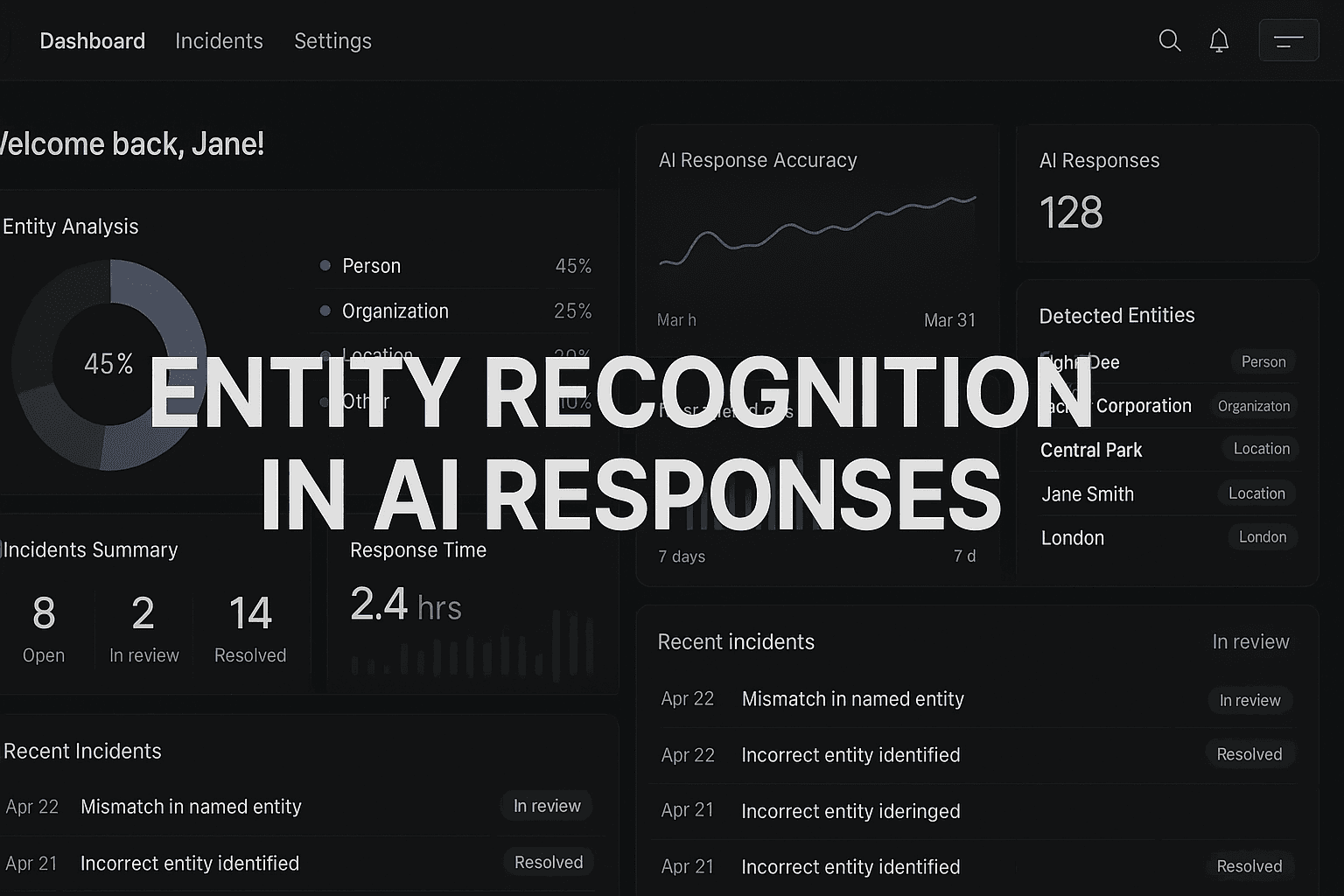
You're staring at your analytics dashboard at 11 PM on a Tuesday, and something doesn't add up. Your product is objectively better than your competitors'. Your pricing is competitive. Your customer reviews are stellar. Yet when you test ChatGPT, Claude, or Perplexity with queries like "What's the best project management software?" or "Who are the leading experts in marketing automation?", your brand is nowhere to be found.
Meanwhile, three of your competitors appear consistently in every AI-generated recommendation list.
This isn't bad luck. It's not algorithm bias. It's entity recognition—and most marketers don't even know it exists.
Here's what's actually happening: AI models are making split-second decisions about which brands to mention based on how well they "recognize" and understand your company as a distinct entity. Think of it like AI's internal contact database. If your brand isn't properly stored in that database with the right context and associations, you're invisible—no matter how good your product is or how much you've invested in traditional SEO.
The stakes are higher than you might think. As more consumers and businesses turn to AI for research and recommendations, entity recognition is becoming the new battleground for market visibility. Early data suggests that AI-influenced purchase decisions are growing exponentially, and brands that master entity recognition now will capture disproportionate market share as this shift accelerates.
But here's the surprising part: unlike traditional search algorithms that feel opaque and unchangeable, entity recognition is something you can actually influence. Once you understand how AI models identify, categorize, and remember brands, you can systematically improve your visibility in AI responses.
This isn't about gaming the system or finding shortcuts. It's about helping AI models accurately understand who you are, what you do, and why you're relevant to specific queries. When done right, entity recognition optimization ensures that your brand appears in the right conversations, positioned correctly, and recommended to the right audiences.
In this guide, we'll break down exactly what entity recognition is, why it matters more than most marketers realize, and how AI models actually process and remember brands. You'll learn the specific factors that influence entity recognition success, the critical mistakes that undermine your efforts, and a practical action plan for improving your AI visibility starting today.
By the end, you'll understand why some brands dominate AI recommendations while others remain invisible—and more importantly, how to ensure your brand is in the first category.
Decoding Entity Recognition in AI Responses
Entity recognition is AI's ability to identify and understand real-world objects, people, places, and brands within text—then use that understanding to make informed recommendations. It's the difference between an AI model seeing "Asana" as a random word versus recognizing it as a project management software company with specific features, use cases, and competitive positioning.
This goes far beyond simple keyword matching. When someone asks ChatGPT or Claude about project management tools, the AI doesn't just scan for the words "project" and "management." It identifies which entities in its knowledge base are relevant project management solutions, evaluates their authority and context, then decides which ones to mention based on the specific query.
For marketers, this creates a fundamental shift in how visibility works. Traditional SEO focused on ranking for keywords. Entity recognition focuses on whether AI models understand your brand exists, what you do, and why you're relevant to specific conversations. If the AI doesn't have a clear entity profile for your company, you're invisible—regardless of your actual market position.
Why Context Beats Keywords
Modern AI uses contextual understanding rather than text matching, making traditional keyword optimization insufficient for AI visibility. The word "Apple" perfectly illustrates this challenge. It could refer to the fruit, the technology company, or Apple Records. Entity recognition uses surrounding context—phrases like "iPhone," "MacBook," or "Tim Cook"—to determine which meaning applies.
This contextual processing means generic keyword stuffing actually hurts your entity recognition. AI models look for semantic authority: consistent associations with relevant industry terms, demonstrated expertise in specific domains, and clear positioning within your market category.
When your content repeatedly appears alongside terms like "marketing automation," "lead generation," and "conversion optimization," AI models build stronger associations between your brand and those concepts. This semantic clustering determines whether you appear when users ask about those topics.
The Competitive Intelligence Factor
Entity recognition creates measurable competitive advantages by determining which brands AI models consider authoritative in specific domains. In the CRM space, for example, certain brands consistently appear in AI recommendations while others remain invisible—directly impacting lead generation and market perception.
This isn't random. Brands with strong entity recognition have built comprehensive digital footprints that help AI models understand their expertise, authority, and relevance. They've created content that demonstrates deep knowledge, earned mentions in authoritative sources, and established clear semantic relationships with their industry.
The gap between recognized and unrecognized brands continues to widen. As AI models process more data and refine their understanding, they reinforce existing authority patterns. Brands that establish strong entity recognition early gain compounding advantages, while those that delay face increasingly difficult recovery paths.
Understanding entity recognition as a competitive factor rather than a technical curiosity changes how you approach content strategy, digital presence, and brand positioning. It's not about optimizing for algorithms—it's about ensuring AI models accurately understand who you are and why you matter.
Decoding Entity Recognition in AI Responses
Let's cut through the jargon and get to what actually matters for your business.
Entity recognition is AI's ability to identify and understand real-world objects, people, places, and brands within text—then use that understanding to make informed recommendations. Think of it as the difference between AI seeing your brand name as random letters versus recognizing it as a legitimate business with specific expertise, market position, and relevance to user queries.
This goes far beyond simple keyword matching. When someone asks ChatGPT or Claude about project management software, the AI doesn't just scan for the words "project management" and return whatever text contains those terms. Instead, it identifies which entities in its knowledge base are actually project management companies, understands their relationships to relevant concepts like team collaboration and workflow optimization, and then decides which brands are most relevant to mention based on the specific context of the query.
Here's why this matters for marketers: entity recognition directly controls whether your brand appears in AI-generated recommendations and how you're positioned when you do appear. It's the foundational layer that determines AI visibility—without strong entity recognition, all your other marketing efforts become invisible to AI systems.
Why Context Beats Keywords Every Time
Modern AI models use contextual understanding rather than simple text matching, which fundamentally changes how brands need to approach visibility optimization.
Traditional SEO taught us to focus on keywords—get the right terms on your page, build some backlinks, and you'd rank. Entity recognition operates differently. AI models analyze the surrounding text, user intent, and semantic relationships to understand what entities mean in specific contexts.
Consider the word "Apple." Depending on context, it could refer to the fruit, Apple Inc. the technology company, or Apple Records the music label. Entity recognition uses contextual clues—surrounding words, sentence structure, topic domain—to determine which meaning applies and respond appropriately.
For your brand, this means generic keyword stuffing actually hurts your entity recognition accuracy. If your company name appears in random, unrelated contexts or surrounded by generic marketing fluff, AI models struggle to understand what you actually do and when you're relevant to mention.
The brands that dominate AI recommendations have built semantic authority—consistent, contextually rich associations between their brand and specific expertise areas. When AI models encounter these brands, they understand not just what the company is called, but what problems they solve, who they serve, and why they're authoritative in their domain.
The Competitive Intelligence Factor
Entity recognition creates measurable competitive advantages by determining which brands AI models consider authoritative in specific domains.
This isn't theoretical—it's happening right now in your market. Some brands consistently appear in AI recommendations while others remain invisible, directly impacting lead generation, market perception, and revenue growth. The gap between recognized and unrecognized brands continues to widen as more consumers rely on AI for research and vendor selection.
In competitive industries like CRM software, marketing automation, or cybersecurity, entity recognition often determines which brands make the shortlist. When a potential customer asks an AI assistant to recommend solutions, the brands with strong entity recognition appear by default. Those without strong recognition don't even get considered—regardless of product quality, pricing, or traditional SEO performance.
The competitive intelligence opportunity here is significant. By understanding how AI models recognize and categorize entities in your industry, you can identify
Why Context Beats Keywords
Here's where entity recognition fundamentally diverges from everything you learned about traditional SEO. While keyword optimization focuses on matching specific terms, AI models operate on an entirely different principle: contextual understanding.
Think about how you recognize people in conversation. When someone mentions "Jordan," you don't just match the word—you use context clues to determine whether they're talking about Michael Jordan, the country, or your colleague from accounting. AI models do exactly the same thing with brands.
This contextual processing explains why keyword stuffing not only fails with AI systems but actively undermines your entity recognition. When AI models encounter your brand name surrounded by generic marketing jargon and keyword-heavy content, they struggle to build a clear understanding of what you actually do and why you matter.
Consider the word "Apple" as a perfect example. Depending on context, it could reference the fruit, Apple Inc., Apple Records, or even the Big Apple nickname for New York City. AI models analyze surrounding text, user intent, and semantic relationships to determine which meaning applies. They look at co-occurring terms, sentence structure, and broader topic clusters to make accurate distinctions.
The same principle applies to your brand. When AI encounters your company name, it's simultaneously processing dozens of contextual signals: What industry terms appear nearby? What problems are being discussed? What relationships exist with other entities? What expertise is being demonstrated?
This is why a brand mentioned in a detailed technical discussion about cybersecurity challenges will develop stronger entity recognition in that domain than one mentioned a hundred times in generic business content. Quality of context trumps quantity of mentions every single time.
Modern AI models use transformer architectures that excel at understanding semantic relationships and contextual nuances. They don't just count keywords—they map the entire semantic landscape around your brand. They identify patterns in how your brand relates to specific problems, solutions, industries, and use cases.
For marketers, this creates both a challenge and an opportunity. The challenge is that traditional keyword optimization strategies provide minimal value for entity recognition. The opportunity is that building genuine expertise and authority in your content creates compound benefits that keyword stuffing never could.
When you consistently demonstrate deep knowledge in specific domains, AI models begin associating your brand with those expertise areas. This association strengthens over time as the model encounters your brand in increasingly sophisticated contexts. Eventually, your brand becomes the model's go-to reference for specific topics—but only if the contextual signals support that authority.
This means your content strategy must shift from keyword targeting to semantic authority building. Instead of asking "What keywords should we include?", the better question becomes "What contextual signals demonstrate our expertise?" Instead of optimizing for search volume, optimize for contextual relevance and depth of insight.
The practical implication is clear: success with entity recognition requires building semantic authority around your core expertise areas, not just optimizing for isolated keywords. Your content needs to demonstrate genuine understanding, use industry-specific terminology naturally, and establish clear relationships between your brand and the problems you solve.
This contextual approach also explains why some brands with modest traditional SEO performance achieve strong AI visibility while others with excellent keyword rankings remain invisible to AI systems. The brands that win in AI responses are those that have built rich, contextually relevant content ecosystems that help AI models understand exactly what they do and why they matter.
The Competitive Intelligence Factor
Entity recognition isn't just a technical concept—it's creating a new competitive battlefield where some brands dominate AI recommendations while others remain completely invisible. The difference between these two groups isn't product quality or market share. It's how well AI models recognize and understand your brand as an authoritative entity in your domain.
Think about what happens when a potential customer asks ChatGPT or Claude for software recommendations in your industry. The AI doesn't conduct a comprehensive market analysis or review every available option. Instead, it draws from its entity knowledge base—the brands it recognizes as relevant and authoritative for that specific query context.
If your brand has strong entity recognition, you appear in these recommendations consistently. If not, you're invisible, regardless of your actual market position.
This creates a measurable competitive advantage that compounds over time. Brands that appear frequently in AI recommendations benefit from increased visibility, higher perceived authority, and more inbound leads—all without traditional advertising spend. Meanwhile, competitors with weak entity recognition watch potential customers discover and choose alternatives they've never heard of.
The gap between recognized and unrecognized brands is widening rapidly. As AI adoption accelerates, early movers in entity recognition optimization are capturing disproportionate market share. They're becoming the default recommendations, the go-to experts, the brands that AI models trust to mention.
Consider the CRM space as a concrete example. When users ask AI tools about customer relationship management software, certain brands appear consistently across different AI models and query variations. These brands benefit from what amounts to free, highly targeted exposure to prospects actively researching solutions. Other CRM companies—some with excellent products and strong traditional SEO—remain absent from these conversations entirely.
The impact extends beyond direct recommendations. Strong entity recognition influences how AI models position your brand in comparative analyses, whether they include you in category discussions, and how they describe your capabilities and differentiators. Weak recognition means not just invisibility, but potential misrepresentation when you are mentioned.
This competitive dynamic is fundamentally different from traditional SEO. In search, you could target specific keywords and gradually improve rankings through optimization. With entity recognition, the stakes are binary—you're either recognized as a relevant authority or you're not. There's no page two of AI recommendations where you can slowly climb the rankings.
The strategic implication is clear: entity recognition optimization is becoming as critical as traditional SEO for competitive positioning. Brands that treat it as a nice-to-have rather than a must-have risk losing market visibility as consumer behavior shifts toward AI-assisted research and recommendations.
The good news? Unlike some competitive advantages that require massive resources or market dominance, entity recognition can be systematically improved through strategic content and digital presence optimization. Understanding how AI models process and remember entities gives you the roadmap for building recognition strength—regardless of your current market position.
The Hidden Impact of Entity Recognition on Your Marketing ROI
While most marketers obsess over traditional SEO metrics and social media engagement, a seismic shift is happening right under their noses. Consumers and business buyers are increasingly bypassing Google entirely, turning instead to AI assistants for product research, vendor comparisons, and purchase recommendations. If your brand isn't recognized by these AI systems, you're losing opportunities before prospects even know you exist.
This isn't a future trend—it's happening now. The question isn't whether AI will influence your revenue, but how much you're already losing to competitors who've figured out entity recognition.
The AI Recommendation Economy
Think about how your own behavior has changed in the past year. When you need a software recommendation, do you still spend 20 minutes clicking through Google results? Or do you ask ChatGPT, "What's the best CRM for a 50-person sales team?" and trust its curated response?
Your prospects are doing the same thing. They're asking AI assistants for vendor shortlists, comparing solutions through conversational queries, and arriving at purchase decisions without ever visiting your carefully optimized website. If AI models don't recognize your brand as relevant to these queries, you're simply not in the conversation.
The competitive advantage here is brutal and compounding. Brands that appear consistently in AI recommendations build familiarity and trust with prospects before any human interaction occurs. Meanwhile, invisible brands are fighting an uphill battle—trying to convince prospects they're credible alternatives to the AI-recommended options that already feel like safe choices.
This creates a winner-take-most dynamic. Early adopters of entity recognition optimization capture disproportionate attention as AI adoption accelerates. The gap between recognized and unrecognized brands widens with every query processed.
Building Unshakeable Brand Authority
Here's where entity recognition becomes truly powerful: it doesn't just generate individual leads—it fundamentally reshapes how your market perceives your authority.
When AI consistently positions your brand as the expert solution for specific problems, something remarkable happens. Prospects arrive at your website already convinced of your credibility. They're not comparison shopping anymore—they're validating a decision they've essentially already made based on AI recommendations.
This authority compounds over time. Strong entity recognition creates a feedback loop where increased AI visibility leads to more brand mentions, which strengthens entity recognition further, which drives even more visibility. You're not just winning individual opportunities—you're building a moat that becomes harder for competitors to cross.
The conversion impact is substantial. When prospects reach your sales team after AI recommendations, they're asking "how" questions instead of "why" questions. They want to know how to get started, not why they should choose you. That's the power of pre-established authority through entity recognition.
The Cost of AI Invisibility
Now flip the scenario. What happens when your competitors master entity recognition while you remain invisible to AI systems?
Every day, potential customers are asking AI assistants for recommendations in your category. Every day, your competitors are being mentioned while you're not. Every day, prospects are forming opinions about market leaders without ever considering your brand. The opportunity cost isn't just about lost leads—it's about losing your position in the market conversation entirely.
This invisibility creates a vicious cycle
Putting It All Together
Entity recognition isn't just another technical SEO concept to add to your checklist—it's the foundation of how AI models decide whether your brand exists in their recommendations. While your competitors might be dominating AI responses today, you now understand exactly why that's happening and what you can do about it.
The path forward starts with three critical actions: audit your current AI visibility across multiple platforms to understand where you stand, standardize your brand identity and messaging across all digital touchpoints to eliminate confusion, and build systematic content that demonstrates deep expertise in your domain with consistent industry terminology and semantic associations.
Remember that entity recognition optimization is a long-term investment, not a quick fix. AI models learn from patterns over time, which means the content and authority signals you build today will compound in value as these systems continue to evolve. The brands that start optimizing now will have insurmountable advantages over those that wait until AI-driven research becomes the dominant consumer behavior.
The competitive landscape is shifting faster than most marketers realize. Every day you're invisible in AI responses is a day your competitors are capturing market share, building authority, and establishing themselves as the default recommendations in your industry.
Start tracking your AI visibility today and take control of how AI models understand and recommend your brand. The question isn't whether entity recognition will matter to your business—it's whether you'll optimize for it before or after your competitors do.