You've just published what might be your best article yet. The research is solid, the writing is sharp, and you're confident it'll resonate with your audience. You hit publish, share it on social media, and wait for the organic traffic to start flowing. Days pass. Nothing. A week later, you check Google Search Console and discover the harsh truth: your content isn't even indexed yet. Search engines haven't found it. As far as Google is concerned, your article doesn't exist.
This isn't a rare occurrence. It's the default experience for countless publishers who assume that hitting publish means immediate visibility. The reality is far more complex. Between the moment you publish and the moment search engines actually discover and index your content, there's a gap—sometimes spanning days or weeks—where your work sits in digital limbo, invisible to the very audience you created it for.
Content indexing automation services exist to close this gap. They're the bridge between creation and discovery, ensuring that search engines know about your new pages the moment they go live. For marketers and founders operating at modern content velocity, waiting for passive crawling isn't just inefficient—it's a competitive disadvantage. This guide breaks down how indexing automation works, when it delivers the biggest impact, and how to implement it without disrupting your existing workflow.
The Crawl Budget Reality: Why Your Content Waits in Line
Search engines don't monitor the entire web in real-time. They allocate crawl budget—a finite amount of resources—to each website based on factors like domain authority, update frequency, and server performance. Think of it like a delivery route: established, high-traffic sites get frequent visits, while newer or smaller sites might only see the crawl bot once every few weeks.
When you publish new content, it enters a discovery queue. For sites with healthy crawl budgets, this queue moves quickly. But for everyone else, new pages wait. Search engines eventually find them through sitemap checks or by following links from other pages, but there's no guarantee of when that happens. During this waiting period, your content exists in a strange state: live on your site, but invisible to search.
The business impact of this delay is more significant than most realize. If you're covering a trending topic, waiting three days for indexing means competitors who got indexed faster already claimed the top positions. If you're launching a product and coordinating PR around it, delayed indexing means your carefully timed content push happens without the foundation of indexed pages to support it. Every hour your content remains unindexed is an hour you're not building authority, not capturing search traffic, and not converting visitors.
Here's what many publishers miss: indexing and ranking are separate processes. Getting indexed means your page is in the search engine's database—it's eligible to appear in results. Ranking is where your page actually shows up for relevant queries. You can't rank if you're not indexed first. Indexing is the prerequisite, and delays at this stage cascade into every downstream SEO metric you care about. Understanding how to improve content indexing speed becomes essential for maintaining competitive advantage.
Proactive Notification: How Automation Accelerates Discovery
Content indexing automation flips the traditional model. Instead of waiting for search engines to discover your content through periodic crawls, automation services proactively notify them the moment you publish. This happens through a combination of protocols and APIs that create a direct communication channel between your site and search engines.
The IndexNow protocol is the foundation for many automation services. Developed collaboratively by Microsoft and Yandex, IndexNow allows publishers to submit URLs directly to participating search engines via a simple API call. When you publish or update a page, your automation service sends an instant notification containing the URL and a timestamp. Search engines receive this signal and prioritize crawling that specific page, often within minutes instead of days.
Automated sitemap generation works in parallel. Traditional sitemaps are static XML files that list all your URLs. Implementing sitemap automation for content sites generates dynamic sitemaps that update in real-time as you publish, edit, or delete content. When search engines check your sitemap—which they do regularly for established sites—they immediately see the new URLs and their priority levels. This creates a second discovery pathway that reinforces the direct API notifications.
The workflow is designed to be invisible to content creators. You publish through your CMS exactly as you always have. Behind the scenes, the automation service detects the new content, generates the necessary API calls, updates your sitemap, and logs the submission for monitoring. There's no manual step where someone needs to remember to ping search engines or submit URLs through Google Search Console. It happens automatically, every time, without exception.
For sites using headless CMS architectures or custom publishing platforms, webhooks trigger the indexing automation. When your CMS fires a "content published" event, the automation service listens for that webhook, extracts the new URL, and initiates the notification sequence. Proper CMS integration for content automation means indexing automation can work with virtually any modern publishing stack, regardless of how custom or complex your setup might be.
The result is a dramatic reduction in time-to-index. Pages that might have taken 48-72 hours to appear in search results through passive crawling can be indexed within 15-30 minutes when automation handles the notification. For high-velocity publishers, this compression of the indexing timeline translates directly to faster traffic acquisition and earlier ranking opportunities.
What Separates Professional-Grade Solutions from Basic Tools
Not all indexing automation services deliver the same results. The difference between effective solutions and basic tools comes down to three core capabilities: multi-platform support, integration depth, and verification mechanisms.
Multi-Search-Engine Coverage: Basic tools often focus exclusively on Google, leaving Bing, Yandex, and other search engines to discover content through traditional crawling. Professional services support IndexNow for instant notification to Bing and Yandex, while also leveraging Google's Indexing API where applicable and maintaining traditional sitemap protocols as a fallback. This multi-platform approach ensures your content gets discovered across the entire search ecosystem, not just the dominant player.
Native CMS Integration: The best automation services connect directly to your content management system at the database or API level. For WordPress, this means plugins that hook into the publishing workflow without requiring custom code. For Webflow, it means native integrations that trigger on content changes through Webflow content automation solutions. For headless CMS platforms like Contentful or Sanity, it means webhook listeners that respond to publication events. Surface-level integrations that rely on RSS feeds or manual triggers introduce delays and failure points that undermine the entire purpose of automation.
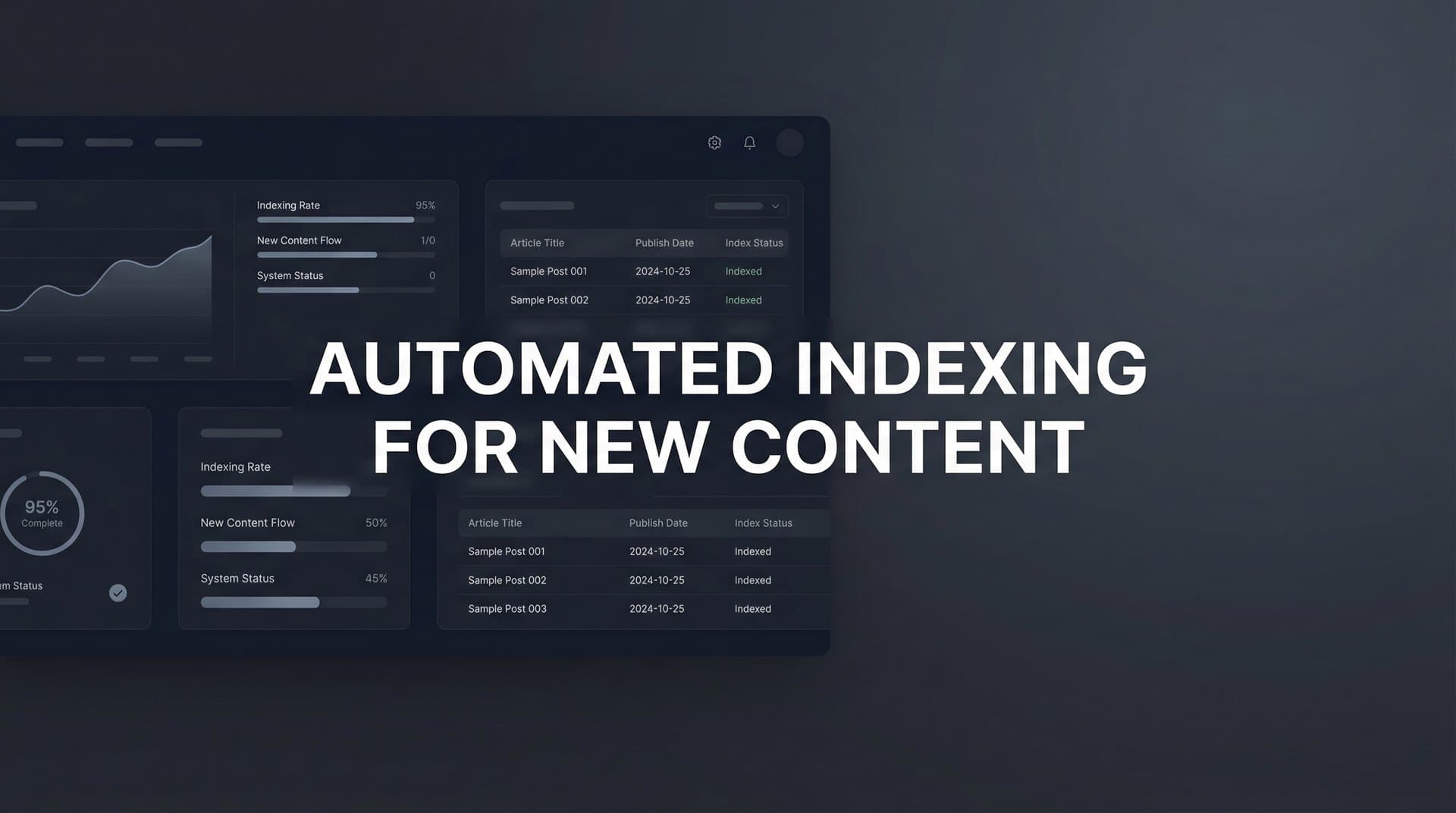
Monitoring and Confirmation: Sending indexing requests is only half the equation. Professional services track whether those requests actually resulted in indexing. They monitor Google Search Console data, check indexing status through search engine APIs, and alert you when pages fail to index despite successful notification. This visibility transforms indexing from a black box into a measurable process where you can identify and resolve issues before they impact traffic.
Reporting capabilities matter more than most publishers realize. When you're managing multiple sites or publishing dozens of articles per week, you need centralized dashboards that show indexing status across all properties. You need historical data showing time-to-index trends, so you can spot degradation in crawl budget allocation. You need alerts when indexing failures cluster around specific content types or publication times, indicating systematic issues rather than random failures.
Scalability is the final differentiator. Basic tools work fine for individual blogs publishing a few times per week. But agencies managing 50+ client sites or media companies publishing 100+ articles daily need infrastructure that handles volume without degradation. Exploring content indexing automation tools helps identify services that offer API rate limits appropriate to your publishing velocity and that won't throttle or queue indexing requests during high-volume periods.
High-Impact Scenarios Where Automation Delivers Maximum Value
Content indexing automation provides value for any publisher, but certain scenarios amplify its impact dramatically. Understanding where automation delivers the biggest return helps prioritize implementation and justify investment.
High-Volume Publishing Operations: News organizations, content marketing agencies, and SaaS companies running multiple blogs share a common challenge: content velocity that outpaces traditional crawling. When you're publishing 20-50 articles per day across multiple sites, manual indexing verification becomes impossible. Automation ensures every piece of content gets equal treatment, regardless of when or where it's published. For agencies managing client portfolios, an agency content automation solution means you're not relying on individual clients to remember manual submission steps.
Time-Sensitive Content: Product launches, event coverage, and trending topic responses have narrow windows of opportunity. If you're announcing a new feature and your announcement post takes three days to index, you've missed the moment when interest peaks. Competitors who got indexed faster captured the early search traffic and established ranking positions that are harder to displace later. Implementing instant content indexing solutions compresses this timeline, ensuring your content is discoverable when the topic is most relevant.
Technical SEO Recovery: Site migrations, platform changes, and major redesigns often result in indexing chaos. Hundreds or thousands of URLs change simultaneously, and search engines need to discover and re-index the new structure. Automation accelerates this recovery process by proactively notifying search engines about every changed URL. What might take weeks through passive crawling can happen in days with proper automation, minimizing traffic loss during the transition period.
Large-scale content updates benefit similarly. If you're refreshing 200 older articles with new information and updated publish dates, you want search engines to re-crawl and re-index those pages quickly. Leveraging bulk content publishing automation triggers re-indexing requests for updated content, ensuring your improvements get recognized without waiting for the next scheduled crawl.
Setting Up Automation Without Breaking Your Workflow
Implementation starts with connecting your automation service to your CMS. For WordPress sites, this typically means installing a plugin that integrates with your publishing workflow. Look for plugins that trigger indexing requests on post publication, not on save-as-draft or preview actions. You want automation tied to the actual go-live moment.
For Webflow and similar platforms, integration often happens through Zapier or native API connections. Configure webhooks in your CMS to fire when content is published or updated. Point those webhooks to your indexing automation service, which listens for the events and initiates notification sequences. Test this flow thoroughly before going live—publish a test page, verify the webhook fires, confirm the indexing request reaches search engines.
API key configuration is where many implementations stumble. IndexNow requires a shared API key that proves you own the domain you're submitting URLs for. Generate this key through your automation service, then place it in your site's root directory as a text file. Search engines verify ownership by checking for this file before accepting indexing requests. Missing or incorrectly placed API keys result in silent failures where requests are sent but ignored.
Common Configuration Mistakes: Triggering indexing requests for draft content or preview pages floods search engines with URLs that don't resolve to published content. This degrades trust and can result in your domain being throttled or ignored. Only trigger automation for live, publicly accessible URLs. Similarly, avoid submitting URLs with session parameters, tracking codes, or other dynamic elements that create duplicate URL variations. Clean, canonical URLs should be the only ones submitted.
Verification requires checking multiple sources. Start with your automation service's dashboard—confirm that requests are being sent successfully. Then check Google Search Console and Bing Webmaster Tools to verify that submitted URLs are actually being indexed. Look for patterns in failures: if certain content types consistently fail to index, you may have robots.txt rules or meta tags blocking crawlers despite successful notification.
Troubleshooting indexing failures often reveals underlying technical issues. If pages aren't indexing despite successful notification, check for noindex meta tags, robots.txt blocks, or canonical tags pointing to different URLs. Verify your server responds quickly to crawler requests—slow response times can cause crawlers to abandon indexing attempts even after receiving notifications. Use Google's URL Inspection Tool to see exactly how Googlebot views your pages and identify any crawling or rendering issues.
Tracking Performance Beyond Binary Indexed Status
Measuring indexing automation success requires metrics that go deeper than simple indexed/not-indexed status. Time-to-index is the foundational metric: how long does it elapse between publication and confirmed indexing? Track this across all your content to establish baselines and identify degradation. If your average time-to-index increases from 30 minutes to 6 hours, something has changed—crawl budget allocation, technical issues, or automation configuration problems.
Segment time-to-index by content type and publication time. Do blog posts index faster than product pages? Does content published on weekday mornings index faster than weekend publications? These patterns reveal how search engines prioritize different content types and can inform your publishing calendar. If you discover that content published between 9am-11am EST indexes 3x faster than content published at other times, you've found a tactical advantage.
Connecting Indexing Speed to SEO Outcomes: Faster indexing should correlate with faster traffic acquisition. Track the time between publication and first organic session. Compare this metric before and after implementing automation. For competitive keywords, measure how quickly your new content appears in top 100 rankings. Pages that index within an hour have more opportunity to accumulate early engagement signals—clicks, time on page, return visits—that influence ranking algorithms.
Use indexing data to inform content strategy decisions. If you notice that certain topic clusters index faster and generate traffic more quickly, that's a signal to prioritize similar content. If specific content formats—long-form guides vs. short news updates—show different indexing patterns, adjust your content mix accordingly. Indexing speed becomes a leading indicator of content-market fit.
Monitor indexing coverage ratios: what percentage of your published content is actually indexed? For healthy sites, this should approach 100%. If you're seeing 70-80% coverage, you have a discoverability problem that automation can help solve, but you may also have quality issues causing search engines to deliberately exclude certain pages. Investigate the unindexed URLs to understand whether the problem is technical or content-related. Reviewing content indexing automation benefits helps quantify the full impact on your SEO performance.
Removing Friction Between Creation and Discovery
Content indexing automation isn't about manipulating search engines or finding shortcuts around their guidelines. It's about removing unnecessary friction in a process that should be straightforward: when you publish content, search engines should know about it immediately. The traditional model of passive crawling made sense when the web was smaller and publishing velocity was lower. Today's content landscape demands more responsive discovery mechanisms.
The competitive advantage of faster indexing compounds over time. Every piece of content that indexes hours or days faster than competitors' content has more opportunity to accumulate ranking signals. Over dozens or hundreds of articles, this advantage translates to measurably faster organic growth. For organizations where content marketing drives customer acquisition, indexing automation is infrastructure—not optional tooling.
Evaluate your current workflow honestly. How long does your content typically take to index? Are you manually submitting URLs through Search Console, or hoping passive crawling eventually finds everything? If you're publishing more than a few times per week, manual processes don't scale. If you're competing for time-sensitive keywords, delays in indexing directly cost you traffic and revenue.
Modern automation services integrate seamlessly with existing publishing stacks. Implementation doesn't require rebuilding your CMS or retraining your content team. It's a layer that sits between your publishing workflow and search engines, handling the notification and verification steps that previously required manual intervention or simply didn't happen at all.
Stop guessing how AI models like ChatGPT and Claude talk about your brand—get visibility into every mention, track content opportunities, and automate your path to organic traffic growth. Start tracking your AI visibility today and see exactly where your brand appears across top AI platforms.